
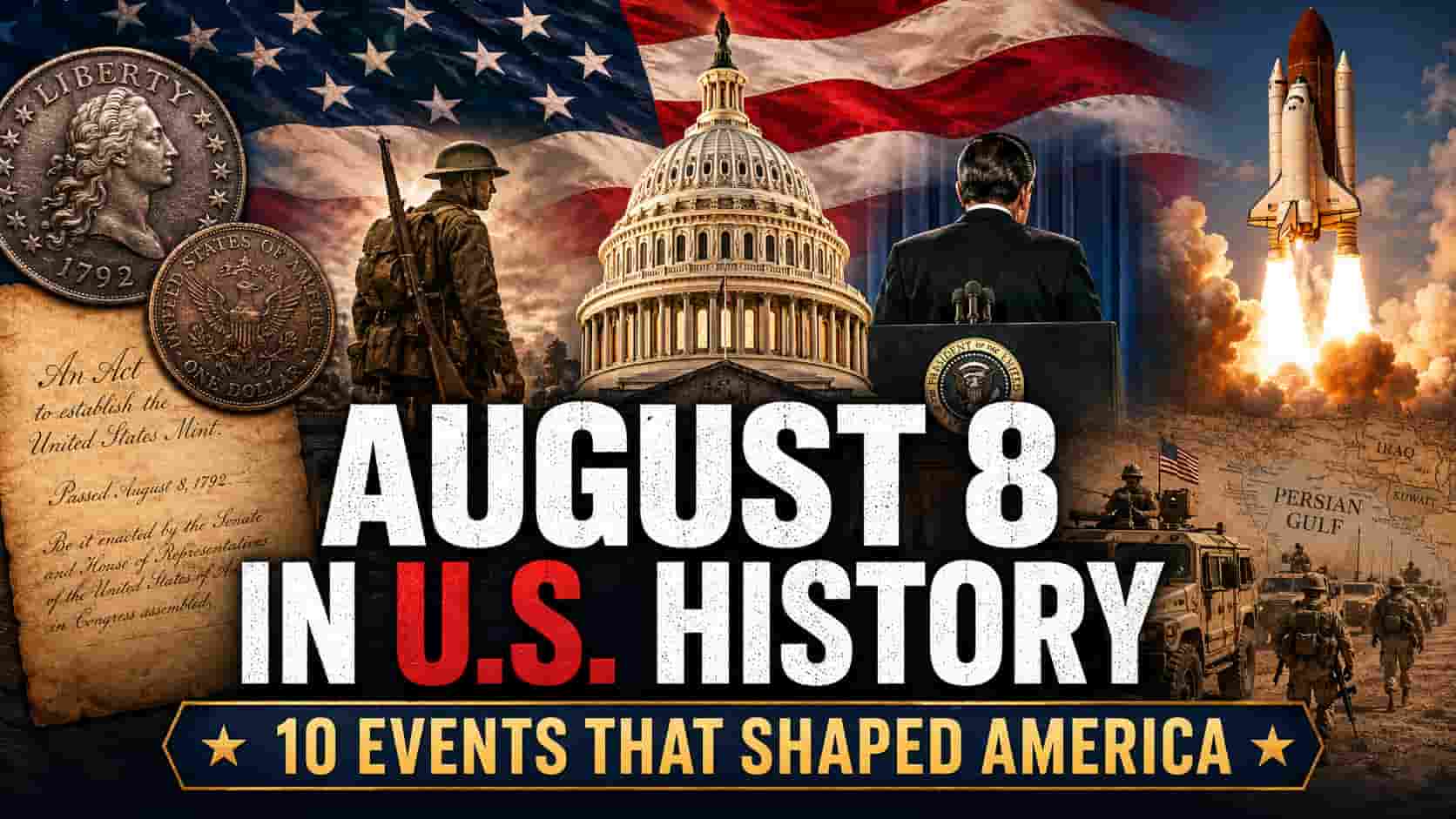
From the foundations of America’s monetary system and the slavery debate to Watergate, World War II, energy policy and the Space Shuttle era, August 8 has repeatedly marked important turning points in U.S. history.
American history is filled with dates that connect seemingly unrelated chapters of the nation’s development. August 8 is one of them.
Across more than two centuries, events connected to this date have touched the U.S. monetary system, the expansion of slavery, two world wars, presidential power, federal employment policy, national security, energy policy and space exploration.
Midtown Tribune reviewed official records from the Library of Congress, U.S. Congress, National Archives, FBI, Department of Defense, presidential archives and NASA to identify ten notable events associated with August 8.
1. 1786 — Congress Helps Build America’s Monetary System
On August 8, 1786, the Continental Congress adopted important resolutions concerning the coinage system of the young United States.
The country was still operating under the Articles of Confederation, years before the Constitution created the present federal government.
Congress established specifications for gold, silver and copper coins and continued the development of a national monetary structure based on the dollar.
An important distinction is that Congress had already adopted the dollar as the basic American monetary unit in 1785. August 8, 1786, therefore should not be described as the “birthday of the dollar.”
Instead, the date represents an important step toward the standardized American coinage system that would later be developed under the Constitution.
2. 1846 — The Wilmot Proviso Ignites a National Debate Over Slavery
On August 8, 1846, Pennsylvania Congressman David Wilmot introduced what became known as the Wilmot Proviso.
The proposal sought to prohibit slavery in territory the United States might acquire from Mexico as a result of the Mexican-American War.
The measure ultimately did not become law, but its political impact was enormous.
It forced Congress and the country to confront a question that was becoming increasingly difficult to avoid: Would slavery be allowed to expand westward as the United States acquired new territory?
The controversy exposed the growing divide between North and South.
Although the Civil War was still fifteen years away, the debate surrounding the Wilmot Proviso became one of the important political conflicts leading toward the national crisis of the 1850s.
3. 1918 — The Battle of Amiens Opens a Decisive Phase of World War I
On August 8, 1918, Allied forces launched a massive offensive near Amiens, France.
The attack became one of the most important turning points of the final months of World War I.
British, French and other Allied forces broke through German positions and inflicted heavy losses. German military leader Erich Ludendorff later described August 8 as a “black day” for the German army.
American forces were also engaged in the broader Allied offensives of this final phase of the war.
The U.S. Army identifies the period beginning August 8 and continuing through the Armistice of November 11, 1918, as part of the final Allied offensive campaigns in which American units participated.
The German military never fully recovered the strategic initiative.
Three months later, the fighting on the Western Front ended.
4. 1942 — Six Nazi Saboteurs Are Executed in Washington
On August 8, 1942, six German agents sent to the United States by Nazi Germany were executed in Washington, D.C.
Their mission, known as Operation Pastorius, was one of the most remarkable domestic security cases of World War II.
Eight German agents had secretly entered the United States in June 1942.
One group landed from a German submarine near Amagansett on Long Island, New York. A second group landed in Florida.
They carried money, explosives and instructions to attack American industrial and transportation targets.
The FBI arrested all eight men.
A military commission sentenced them to death, but President Franklin D. Roosevelt commuted the sentences of George Dasch and Ernest Burger after their cooperation with American authorities.
The other six were executed on August 8.
The case remains one of the best-known examples of an enemy sabotage operation reaching American soil during World War II.
5. 1945 — President Truman Signs the U.S. Ratification of the United Nations Charter
On August 8, 1945, President Harry S. Truman signed the United States instrument of ratification for the Charter of the United Nations.
The Charter itself had been signed by representatives of participating nations in San Francisco on June 26, 1945.
The U.S. Senate subsequently approved ratification, allowing Truman to complete the American constitutional process.
The timing was extraordinary.
The Second World War was reaching its final days, and the United States was helping design the international system that would follow it.
American participation in the United Nations represented a major change from the isolationist pressures that had influenced U.S. foreign policy after World War I.
The United Nations Charter entered into force on October 24, 1945.
The United States became one of the five permanent members of the U.N. Security Council.
6. 1969 — Nixon Orders Equal Employment Opportunity Across the Federal Government
On August 8, 1969, President Richard Nixon signed Executive Order 11478, titled “Equal Employment Opportunity in the Federal Government.”
The order established a federal policy of equal opportunity in employment throughout the executive branch.
Federal departments and agencies were directed to maintain programs designed to prevent discrimination and ensure equal treatment of employees and job applicants.
The order became an important part of the legal and administrative framework governing federal employment.
It was later amended and expanded by subsequent presidents.
More than half a century later, Executive Order 11478 remains an important historical milestone in the development of federal Equal Employment Opportunity policy.
7. 1974 — Richard Nixon Announces His Resignation
The most famous August 8 event in modern American political history occurred in 1974.
On the evening of August 8, President Richard Nixon addressed the nation on television and radio and announced that he would resign the presidency.
The Watergate scandal had pushed his administration to the brink of collapse.
The crisis began with the 1972 break-in at Democratic National Committee headquarters in the Watergate complex, but ultimately expanded into investigations of obstruction, abuse of presidential power and attempts to conceal what had happened.
By August 1974, Nixon faced the likelihood of impeachment in the House and possible removal by the Senate.
He chose to resign.
The distinction between the two dates is important: Nixon announced his resignation on August 8, 1974. His resignation officially took effect at noon on August 9.
Vice President Gerald Ford then became the 38th president of the United States.
Nixon remains the only U.S. president to resign from office.
8. 1990 — The Persian Gulf Crisis Escalates as U.S. Forces Deploy
August 1990 marked the beginning of one of the largest American overseas military deployments since the Vietnam War.
Iraqi forces under Saddam Hussein invaded Kuwait on August 2.
The George H. W. Bush administration responded by organizing an international coalition and deploying American forces to protect Saudi Arabia and prepare for the possibility of military action.
Operation Desert Shield rapidly transformed the Persian Gulf.
By August 8, American aviation and reconnaissance units were moving into operational positions in the region, supporting U.S. Central Command and coalition planning.
Over the following months, more than half a million American service members would deploy to the region.
When diplomacy failed to force Iraq out of Kuwait, the U.S.-led coalition began Operation Desert Storm in January 1991.
The campaign ultimately expelled Iraqi forces from Kuwait.
9. 2005 — President George W. Bush Signs the Energy Policy Act
On August 8, 2005, President George W. Bush signed the Energy Policy Act of 2005 into law.
The legislation represented one of the most significant federal energy measures of its era.
It addressed domestic energy production, electricity infrastructure, energy efficiency, alternative fuels, renewable energy and nuclear power.
The law also included incentives and standards intended to improve the efficiency of buildings and consumer products.
The Bush administration presented the legislation as part of a long-term effort to strengthen U.S. energy security and reduce dependence on foreign sources of energy.
The law remains an important reference point for understanding the evolution of American energy policy in the early 21st century.
10. 2007 — Space Shuttle Endeavour Launches Toward the International Space Station
On August 8, 2007, Space Shuttle Endeavour lifted off from Kennedy Space Center in Florida on mission STS-118.
The shuttle launched at 6:36 p.m. Eastern Time with a crew of seven astronauts.
Among them was Barbara Morgan, a former schoolteacher who became a NASA astronaut.
The mission continued the construction and expansion of the International Space Station.
Endeavour carried equipment and structural components to the orbiting laboratory.
STS-118 was the 22nd Space Shuttle mission to the International Space Station.
The flight demonstrated the central role of NASA’s Shuttle program in constructing what became the largest international space project ever assembled in orbit.
From America’s First Coins to the Space Age
Taken together, the events associated with August 8 provide a remarkable snapshot of American history.
In the 18th century, the young republic was developing its own monetary system.
In the 19th century, the United States was confronting the political consequences of slavery and territorial expansion.
During the 20th century, Americans fought global wars, confronted enemy sabotage at home, helped construct the postwar international order and witnessed the resignation of a president.
By the beginning of the 21st century, the national agenda included energy security and construction of the International Space Station.
The events are very different, but together they demonstrate how the United States evolved — politically, militarily, economically and technologically — over more than two centuries.
The dates and principal historical facts in this article were reviewed against official records and materials published by U.S. government agencies, congressional institutions, federal archives and NASA.
Official U.S. Government Sources
The historical dates and facts in this article were checked against primary sources and official records of the United States government.
- Library of Congress — Resolution of August 8, 1786 — U.S. monetary and coinage system
- Library of Congress — Ordinance for the Establishment of the Mint
- U.S. House of Representatives — History, Art & Archives — The 29th Congress and the Wilmot Proviso
- U.S. Senate — The Mexican-American War and Congressional Debate
- U.S. Government Publishing Office — GovInfo — Congressional Historical Record — Wilmot Proviso
- U.S. Army Center of Military History — Supporting Allied Offensives, August 8–November 11, 1918
- Federal Bureau of Investigation (FBI) — Nazi Saboteurs and George Dasch
- Harry S. Truman Presidential Library — President Truman Signs the United Nations Charter Ratification Document
- National Archives — United Nations Charter
- National Archives — Executive Order 11478 — Equal Employment Opportunity in the Federal Government
- National Archives — Richard Nixon Announces His Resignation — August 8, 1974
- U.S. Department of Defense — Operation Desert Shield and Desert Storm
- U.S. Air Force — 55th Wing History — Persian Gulf Deployment
- U.S. Government Publishing Office — GovInfo — Energy Policy Act of 2005 — Public Law 109-58
- George W. Bush White House Archives — President Signs Energy Policy Act — August 8, 2005
- NASA — Space Shuttle Endeavour — STS-118 Mission
- NASA — Endeavour Lifts Off — August 8, 2007
Sources accessed through official U.S. government, congressional, military, presidential archive and NASA websites.
Ask Midtown Tribune about this story
Answers are grounded first in this article. Search all Midtown Tribune reporting from the main AI Search page.
AI-generated summary. Verify important details in the linked original articles.