
Benny Johnson Missed the Biggest Problem With Mamdani’s $70 Million Grocery Stores
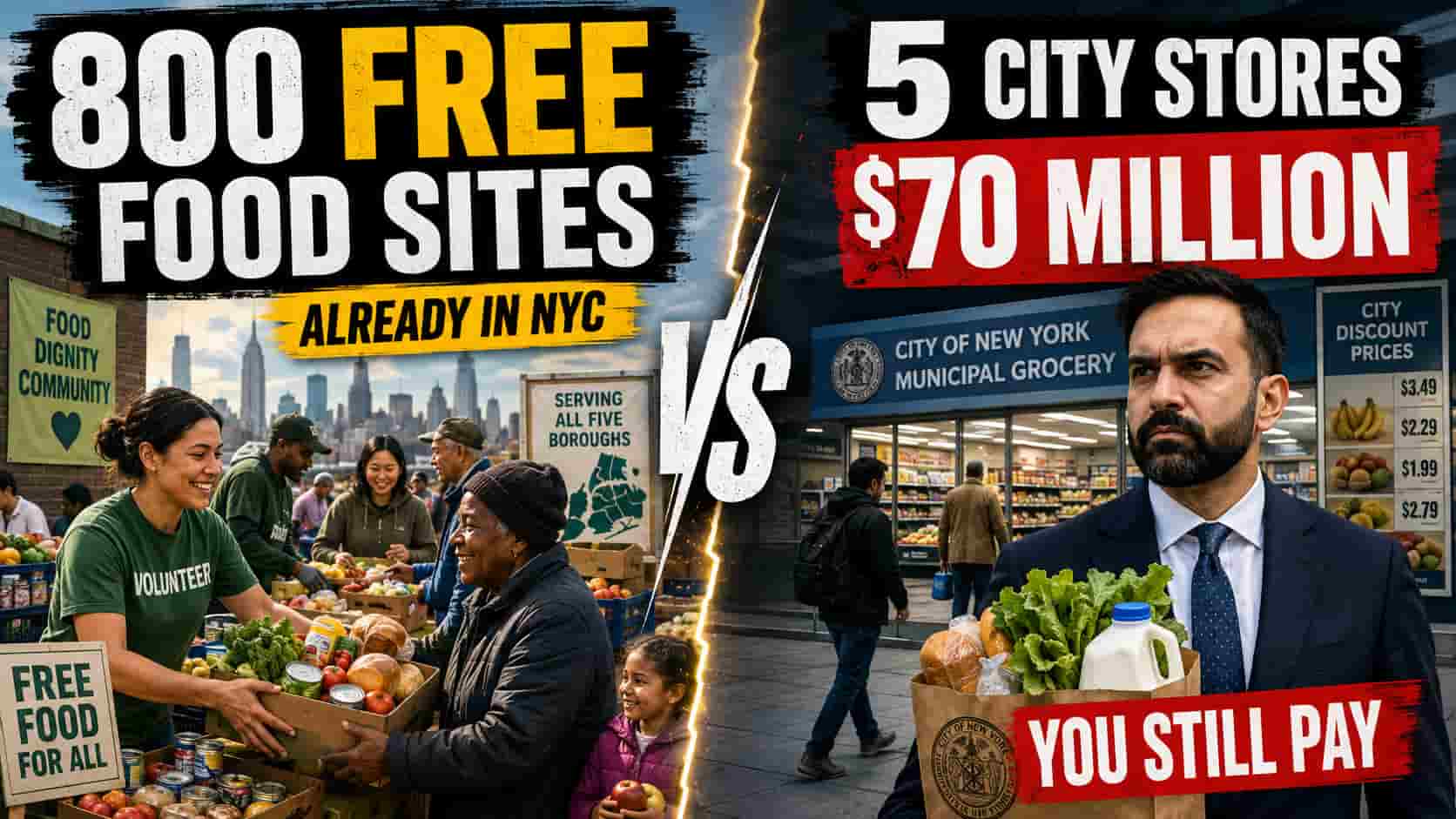
New York already has nearly 800 community food sites providing groceries and meals for free. Mayor Zohran Mamdani wants to spend $70 million creating five stores where customers will still have to pay.
Conservative commentator Benny Johnson found an irresistible target in Mayor Zohran Mamdani’s proposed municipal grocery stores.
In a viral video titled “Mamdani’s Government Grocery Store BACKFIRES After He Demands ID to Buy Food: ‘That’s RACIST!’”, Johnson mocked the possibility that shoppers might need some form of identification or customer card to access publicly subsidized grocery discounts.
The political joke practically wrote itself: New York progressives regularly criticize voter-ID laws, yet Mamdani’s administration appeared to be considering a system for identifying people buying discounted bananas.
Johnson spent much of the video attacking that apparent contradiction, warning about resale, abuse, government control, and competition with private bodegas. He repeatedly compared a possible grocery-card system with New York’s voting rules.
It was an effective viral argument.
But Johnson became so fascinated by the ID issue that he missed the most obvious absurdity of the entire proposal:
New York City already has a vast network of nearly 800 food pantries, soup kitchens, and mobile distribution sites where New Yorkers in need can receive food for free.
Mamdani now wants taxpayers to spend $70 million creating five new stores where customers will still have to pay.
That is the comparison the video should have led with.
Five Stores, $70 Million and Food That Is Not Free
Mamdani’s administration says five new municipal grocery stores will offer a selected basket of essential products at prices approximately 30% below the regular market level.
The discounted categories are expected to include fresh produce, meat, seafood, dairy products, refrigerated foods, and pantry staples.
City Hall has allocated $70 million to the five-store initiative. The administration estimates that the program could save an average participating household about $90 per month.
But a 30% discount is not free food.
Customers would still pay approximately 70% of the ordinary price for the covered items.
That would be a meaningful discount for some households. But it becomes much less revolutionary when compared with the food-assistance system that New York already has.
The Nearly 800-Site Network Mamdani Did Not Invent
Food Bank For New York City says its network includes nearly 800 food pantries, soup kitchens, and mobile pantries operating throughout the five boroughs.
Its public directory helps residents locate free groceries, hot meals, and SNAP assistance near their homes. Food Bank says the network reaches every borough and nearly every New York City neighborhood.
The city’s own Human Resources Administration separately reports that its Community Food Connection program provides funding to more than 700 community kitchens and food pantries citywide.
At food pantries, residents can receive groceries to prepare at home. Community kitchens provide prepared meals.
These numbers substantially overlap. They should not be added together to claim that New York has 1,500 different locations.
Many food pantries participate simultaneously in the Food Bank, HRA, City Harvest, and other assistance networks.
But the central fact remains:
New York already has a large, functioning infrastructure of almost 800 locations offering food assistance without charging recipients at the register.
NYC 311 states the policy even more plainly: free food is available to New Yorkers in need through emergency food sites.
The “Capitalist” Network Gives Food Away for Free
There is an irony here that Johnson’s video almost completely overlooked.
Long before Mamdani’s new “socialist” grocery experiment, New York’s supposedly capitalist society had already created an enormous charitable food-distribution system.
It is supported through a mixture of:
- private donations;
- religious congregations;
- nonprofit organizations;
- volunteers;
- rescued food from businesses;
- corporate contributions;
- philanthropic foundations;
- and existing city programs.
City Harvest, for example, rescues usable food from farms, restaurants, wholesalers, supermarkets, and other businesses. It delivers food to more than 400 pantries, soup kitchens, and community food programs across the five boroughs. Its food map identifies locations distributing food free of charge.
This network is not purely private. Taxpayer-funded programs already support many participating organizations.
It is therefore more accurate to describe it as a community-based public-private system—not a purely “capitalist” one.
But unlike Mamdani’s five proposed stores, these organizations already possess warehouses, trucks, refrigerators, volunteers, neighborhood relationships, and decades of experience getting food to people who need it.
Most importantly, they provide the food for $0.
The Real Comparison
The central policy comparison is not difficult:
Existing system
- Nearly 800 pantries, kitchens, and mobile sites;
- locations throughout all five boroughs;
- established nonprofit and community operators;
- groceries and meals provided free to people in need;
- existing transportation, storage, volunteer, and distribution infrastructure.
Mamdani’s proposal
- Five stores;
- $70 million in initial public spending;
- substantial construction and equipment costs;
- private companies selected to operate the stores;
- selected products offered approximately 30% below market prices;
- customers still required to pay;
- potential need for continuing subsidies to maintain the discounts.
Presented this way, the obvious question is not whether Mamdani will demand an ID for bananas.
The obvious question is:
Why is New York spending $70 million building five new subsidized retail stores instead of examining whether that money could deliver more food through the nearly 800 locations that already provide it for free?
What Could $70 Million Do for the Existing Network?
The available evidence does not establish that the city chose the new-store model because of corruption.
Without an audit, procurement evidence, financial records, or an official investigation, corruption should not be presented as a proven explanation.
But the absence of proven corruption does not make the policy economically sensible.
City Hall should be required to publish a serious cost-benefit comparison between the two alternatives.
Could $70 million help existing organizations:
- purchase and distribute more groceries;
- extend pantry operating hours;
- provide additional refrigerated storage;
- add trucks and mobile distribution sites;
- increase home delivery for seniors and disabled residents;
- reduce lines and product shortages;
- serve more neighborhoods;
- rescue more surplus food before it is discarded?
The existing HRA-funded network already distributes tens of millions of pounds of food annually. A 2026 city job posting describing the Community Food Connection program listed annual funding of approximately $47 million and distribution of more than 31 million pounds per year.
Against that benchmark, a new $70 million capital initiative deserves far more scrutiny than it has received.
The city should explain why constructing five retail locations is a better hunger-relief investment than reinforcing a network hundreds of times larger.
But Aren’t the Two Programs Different?
Mamdani’s supporters have a legitimate response.
Food pantries are intended primarily for people experiencing food insecurity. The proposed municipal stores would theoretically be open to the broader public and would allow customers to shop in a conventional retail environment without undergoing an income test.
That is a meaningful difference.
Some families may be reluctant to use emergency food programs. Others may earn too much to qualify for certain benefits while still struggling with New York’s high cost of living. A public store could offer them lower prices without requiring them to demonstrate hardship.
But this distinction does not end the debate.
It merely changes the question:
Is spending $70 million on five stores the most efficient way to provide a 30% discount to shoppers who are not using the existing free-food network?
That question requires actual financial modeling—not slogans about affordability, socialism, capitalism, or grocery-store democracy.
Johnson’s ID Argument Was Catchy—but Incomplete
The ID controversy started when officials were asked how the stores would prevent customers from buying large quantities of discounted products for resale.
During the discussion, an official referred to the possibility of something resembling a library-card system. Johnson interpreted that as proof that identification would be required to access the subsidized food program.
The comment created a perfect political opening.
If identification is necessary to prevent abuse of grocery subsidies, critics asked, why do the same politicians resist universal photo-ID requirements at polling locations?
The contrast is rhetorically powerful, but it distracted from the economic substance of the plan.
Whether the city ultimately uses a library card, loyalty account, purchase limit, address check, or no identification at all, it must still answer several practical questions:
- Who may receive the discount?
- Can residents of New Jersey or Connecticut shop there?
- Can tourists use the subsidized prices?
- How will bulk purchases and resale be prevented?
- How much personal purchasing data will be collected?
- Who will manage that data?
- How much will the annual subsidies cost?
- What will happen to nearby bodegas and independent supermarkets?
Those are valid issues.
But none is as striking as the contrast between five stores that charge money and almost 800 sites that already distribute food free of charge.
Will the Municipal Stores Hurt Bodegas?
Johnson also predicts that government-supported stores will drive private grocery stores and bodegas out of business.
Five locations are unlikely to destroy New York’s entire private grocery industry.
But the risk of localized unfair competition is real.
A private bodega must pay rent, property-related costs, insurance, wages, security expenses, utilities, and the full wholesale price of its inventory.
A city-backed operator may receive publicly financed construction, below-market occupancy costs, government promotion, and direct or indirect assistance intended to hold prices below the market.
A small independent store located near one of the municipal outlets may reasonably ask how it is expected to compete with a retailer whose financial structure is supported by taxpayers.
This is especially relevant because the Mamdani administration simultaneously claims to support small businesses while creating a publicly subsidized competitor in one of the city’s most difficult low-margin industries.
The Kansas City Warning
Johnson’s video also refers to the failure of the Sun Fresh grocery operation in Kansas City.
The comparison is not exact. New York’s proposed model has different operators, locations, rules, and financial arrangements.
But the broader lesson is relevant: public investment does not automatically make a grocery store operationally sustainable.
Grocery retail typically operates on narrow margins. Spoilage, theft, staffing, refrigeration, security, transportation, and inventory management can quickly consume the difference between politically promised prices and financial reality.
If the five stores cannot survive while maintaining the promised discounts, taxpayers may face a choice:
- provide additional subsidies;
- reduce the discounts;
- cut product selection;
- replace the operator;
- or close the stores.
The $70 million allocation may therefore be only the beginning of the public cost, not the final price.
The Biggest Absurdity Was Hiding in Plain Sight
Benny Johnson correctly identified weaknesses in Mamdani’s proposal.
He raised legitimate concerns about government subsidies, resale, enforcement, identification, private competition, and the possibility of an expensive municipal failure.
But he became so absorbed in the voter-ID comparison that he missed the strongest argument available to him.
The deepest absurdity is not that New Yorkers might need a card to obtain discounted groceries.
It is that New York already has a nearly 800-location community network giving food away for free—yet the administration wants to spend $70 million creating five new stores where shoppers will still pay approximately 70% of the market price.
The “capitalist” network, built over decades through charities, businesses, religious groups, volunteers, donors, food-rescue organizations, and existing public programs, already provides food for nothing.
The new “socialist” stores will require major construction spending, private operators, government supervision, customer-management systems, and potentially continuing subsidies—and will still collect money at the checkout counter.
Johnson found the meme.
He missed the math.
Bottom Line
The ID controversy makes an excellent viral clip, but it is not the most important part of Mamdani’s grocery proposal.
The real issue is whether New York needs to construct five expensive government-backed stores when an enormous food-assistance network already operates across the city.
Before the first $70 million is spent, City Hall should publish a transparent comparison showing:
- how many households the five stores are expected to help;
- how much each household’s savings will cost taxpayers;
- how much ongoing public subsidy will be required;
- how the stores will affect nearby private businesses;
- and how many additional meals or grocery packages the same investment could provide through the existing free-food network.
Until those numbers are available, the project looks less like a revolution in food affordability and more like an expensive political attempt to reinvent a system New York already has—on a much larger scale, in far more neighborhoods, and at a lower price to the person receiving the food:
free.
Official Sources and Supporting Documents
Official New York City, NYCEDC, NYC Comptroller and nonprofit source pages supporting the facts about the proposed municipal grocery stores and New York City’s existing free-food distribution network.
N.Y.C. Groceries: Five Stores, Discounts and Public Funding
-
NYC Mayor’s Office — Mamdani Announces 30% Grocery Discount
Official announcement confirming plans for five municipal grocery stores and a core basket of essential products priced approximately 30% below ordinary market prices. -
NYC Mayor’s Office — Full Grocery Plan Press Conference Transcript
Primary-source transcript covering purchase limits, possible resale, customer management and the official’s reference to a system resembling a library card. -
NYCEDC — Official N.Y.C. Groceries Program Page
Official overview of the five-store plan, confirmed locations, affordability requirements and selection of private grocery operators. -
NYCEDC — Grocery Vision and Private Operator RFP Announcement
Confirms that experienced private companies will be selected through a competitive procurement process to operate the city-supported stores. -
NYCEDC — N.Y.C. Groceries Operator Request for Proposals
Official procurement page containing the requirements and submission process for companies seeking to manage one or more stores. -
NYC Comptroller — FY 2027 Preliminary Budget Review
Independent city fiscal review identifying a new $70 million allocation for the mayor’s city-run grocery-store initiative. -
NYCEDC — La Marqueta Identified as the First Store Site
Official information about the planned East Harlem location and the implementation of the public grocery-store initiative. -
NYCEDC — The Peninsula in the Bronx Identified as the Second Site
Official announcement concerning the proposed Hunts Point location and plans to identify additional sites in the other boroughs.
Existing Free-Food Network in New York City
-
Food Bank For New York City — Find Free Food
The organization’s official directory says New Yorkers can find free groceries, hot meals and assistance through nearly 800 food pantries, soup kitchens and mobile pantries across the five boroughs. -
Food Bank For New York City — Food Distribution Network
Official description of a network of almost 800 pantries, soup kitchens and mobile sites serving every borough and nearly every neighborhood. -
NYC Human Resources Administration — Community Food Connection
Official NYC page stating that Community Food Connection funds more than 700 community kitchens and food pantries citywide. -
ACCESS NYC — Free Food From Pantries and Community Kitchens
Official city benefits page explicitly stating that residents can get free food from a food pantry or community kitchen. -
NYC 311 — Food Pantries and Soup Kitchens
Official NYC 311 guidance confirming that people can receive free food from food pantries and prepared meals from soup kitchens. -
Food Help NYC — Official Free-Food Location Map
City-operated search tool for locating food pantries and soup kitchens providing free food throughout New York City. -
City Harvest — Food Distribution
Official description of City Harvest’s work with more than 400 food pantries, soup kitchens and community programs distributing free, nutritious food. -
City Harvest — More Than 400 Partner Programs
Confirms daily deliveries through a fleet of trucks to more than 400 food pantries, soup kitchens and community food programs across all five boroughs. -
City Harvest — Free Food Map and Mobile Markets
Searchable map of pantries, soup kitchens, community refrigerators, distributions and City Harvest Mobile Markets offering food free of charge.
Editorial note: The Food Bank, HRA and City Harvest figures describe overlapping networks. They should not be added together as separate locations. The sources nevertheless confirm that New York already has a citywide infrastructure of hundreds of sites providing free groceries and prepared meals.
Ask Midtown Tribune about this story
Answers are grounded first in this article. Search all Midtown Tribune reporting from the main AI Search page.
AI-generated summary. Verify important details in the linked original articles.