
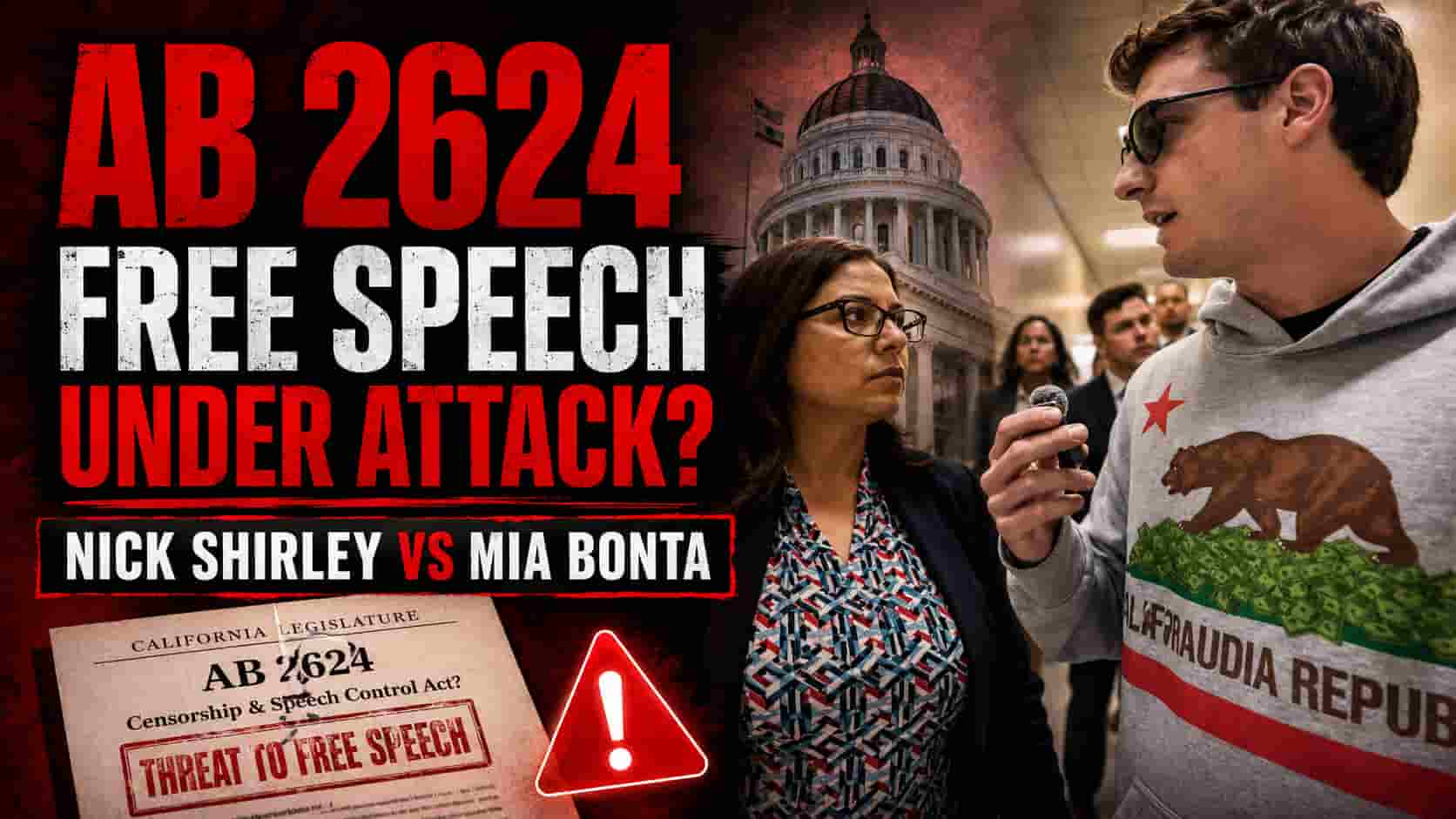
California says AB 2624 protects immigration-service workers from doxxing and threats. Midtown Tribune sees a much more dangerous precedent: a state law reaching into the publication of names, photographs, videos and employment information — while allowing government and courts to examine the publisher’s “intent.” Independent journalist Nick Shirley, who has investigated alleged taxpayer fraud and testified before the U.S. Senate, is now confronting the law’s author directly.
California is moving toward a dangerous constitutional experiment.
Can the state regulate publication of someone’s name, face, workplace or video — and then decide whether the journalist had an acceptable “intent” when publishing it?
That is the First Amendment question surrounding AB 2624, legislation authored by California Assemblymember Mia Bonta.
Bonta says the bill is about protecting immigration-support workers from doxxing, threats and violence.
Midtown Tribune’s view is different:
A government that gives special legal protection against publication of names, images and employment information — and makes liability depend on the publisher’s supposed intent — is stepping directly into the territory of protected speech and investigative journalism.
And one independent journalist has become central to that fight:
Nick Shirley.
Video: Nick Shirley Confronts Mia Bonta
A viral video shows Shirley confronting Bonta directly over AB 2624 and its possible effect on investigations of fraud and taxpayer-funded organizations.
Shirley’s objection is straightforward.
He investigates organizations by going to physical locations, asking questions, filming people, identifying businesses and publishing what he finds.
That is precisely the kind of aggressive, modern investigative journalism that can collide with a law regulating publication of names, images, video and employment information.
Bonta rejects the accusation that her bill targets journalists.
Her office says AB 2624 “doesn’t stop journalism or fraud investigations” and argues that penalties require proven intent to threaten or incite violence.
That sounds reassuring.
But the constitutional problem is not eliminated simply by inserting the word “intent.”
What Does “Specific Intent” Really Mean?
Intent exists inside a person’s mind.
A prosecutor cannot photograph it.
A plaintiff cannot subpoena it directly.
It has to be inferred.
That means authorities may look at:
- what the journalist wrote;
- how aggressive the headline was;
- whether the journalist repeatedly criticized the subject;
- whether a face or workplace was shown;
- what the journalist said before publication;
- what followers did afterward;
- whether the reporter intended embarrassment, exposure, pressure or intimidation.
That is exactly why this language should concern anyone who cares about press freedom.
The state is no longer merely asking:
“Did you threaten someone?”
It can instead become:
“Why did you publish this person’s name and face?”
That is a very different constitutional question.
Any Serious Investigation Can Produce Anger
Investigative journalism is often uncomfortable.
A reporter investigating suspected fraud may publish:
- a business name;
- a worker’s name;
- photographs;
- video from outside a facility;
- employment relationships;
- public records;
- confrontational interviews.
Readers may become angry.
People may post harsh comments.
Some may even make threats.
But that does not automatically mean the journalist intended violence.
The danger appears when the government gains the power to investigate whether the journalist’s tone, presentation or repeated criticism demonstrates prohibited intent.
A free press should not have to prove to the government that its motives were sufficiently pure before publishing truthful information.
AB 2624 Goes Beyond Protecting Home Addresses
If this bill were limited to hiding a threatened worker’s private residential address, the constitutional issue would be considerably narrower.
But the statutory framework deals with far more.
Bonta’s own official explanation says AB 2624 extends California’s Safe at Home protections to immigration-support providers, employees and volunteers who document threats, harassment or violence. Her office also acknowledges that the bill contains civil and criminal enforcement mechanisms tied to publication and harmful intent.
The legislation’s protected categories can include information and images that are routinely central to journalism.
That is where the line between legitimate anti-doxxing legislation and government interference with publication becomes dangerously thin.
Nick Shirley Is Not a Hypothetical Example
This is why Shirley’s role matters.
He is not a law-school hypothetical.
He has spent months conducting field investigations into alleged fraud, government spending and providers receiving taxpayer-funded reimbursements.
On July 15, 2026, Shirley appeared as a witness before the U.S. Senate Homeland Security and Governmental Affairs Committee during a hearing focused on fraud in America.
In his written testimony, Shirley argued that fraud involving taxpayer money is widespread and said independent citizens and journalists are doing investigative work that government and major media organizations have failed to perform.
Committee Chairman Rand Paul specifically highlighted Shirley’s investigations in his opening statement.
Paul described Shirley visiting daycare centers in Minnesota that had collected large taxpayer payments, as well as health-care and hospice businesses in California. According to Paul, some locations displayed warning signs that deserved scrutiny and verification.
That does not prove every allegation Shirley has made.
But it establishes something important:
Shirley is now part of an official federal inquiry into fraud involving public money.
And he is simultaneously confronting a California lawmaker over legislation he believes could make this kind of investigation harder.
That makes the First Amendment controversy impossible to dismiss as merely a social-media stunt.
Bonta Says Journalism Is Protected
Bonta has been unusually direct in responding to critics.
Her office says critics are spreading misinformation and insists that ordinary investigative journalism — including visiting locations, filming in public and publishing reports — does not meet the bill’s harmful-intent standard.
She has also said:
“Doxxing isn’t journalism.”
That proposition by itself is unobjectionable.
Publishing someone’s home address for the purpose of directing violent attackers toward that person is not legitimate reporting.
The harder question is this:
Who decides when aggressive reporting becomes “doxxing”?
And what happens to the journalist while that question is being litigated?
The Chilling Effect Happens Before Conviction
A government does not need to imprison hundreds of reporters to damage press freedom.
It only needs to create enough uncertainty that reporters begin censoring themselves.
Imagine an independent journalist investigating a nonprofit receiving taxpayer money.
The reporter has:
- names;
- photographs;
- video;
- employee information;
- addresses of public-facing offices;
- allegations from whistleblowers.
Before publication, the reporter now has to ask:
Could this organization claim that I intended to intimidate its employees?
Could my headline be cited as evidence?
Could my criticism be characterized as encouraging others?
Could I face an injunction?
Could I be forced to hire lawyers merely to prove that my investigation was protected journalism?
For an independent reporter, a legal battle can itself become punishment.
That is the chilling effect.
California Even Created a Journalist Exception — Which Proves the Problem Exists
Bonta’s office points to California Evidence Code §1070, the state journalist shield statute, as evidence that journalism remains protected under portions of AB 2624.
But this raises another issue.
Why should Sacramento need to decide who qualifies for a special journalist exception at all?
Today’s press includes:
- newspapers;
- television networks;
- independent digital publications;
- bloggers;
- YouTubers;
- podcasters;
- documentary filmmakers;
- citizen investigators.
The First Amendment does not say freedom of the press belongs only to organizations that government recognizes as traditional media.
A law that makes a distinction between a protected “journalist” and an unprotected independent investigator can itself become dangerous in a media environment where some of the biggest stories originate outside legacy newsrooms.
This Is Also a Taxpayer-Accountability Question
AB 2624 deals specifically with immigration-support services.
Bonta’s office says workers in that sector have been followed, threatened and harassed and deserve the same Safe at Home protections available to other threatened groups.
No serious argument for press freedom requires tolerating threats of violence.
But immigration organizations are not exempt from public scrutiny simply because their work is politically sensitive.
If an organization receives public money, journalists should be free to investigate:
- who works there;
- who receives funding;
- whether services are actually being provided;
- whether public records match physical operations;
- whether billing is legitimate;
- whether the people named in official documents actually exist and perform the claimed work.
That principle must apply equally to every political constituency.
The First Amendment Is Supposed to Protect Uncomfortable Journalism
The First Amendment was not written to protect only polite speech.
It protects criticism precisely because governments and institutions frequently dislike being criticized.
A reporter does not need the subject’s permission to investigate.
A public-interest investigation does not lose constitutional protection simply because it causes embarrassment, anger or political pressure.
California may punish actual threats.
It may punish stalking.
It may prosecute violence.
It may protect residential addresses in appropriate circumstances.
But when it begins regulating the publication of identities, images and employment information and then asks courts to determine the journalist’s underlying intent, the government is moving much closer to the editorial process itself.
That is why Midtown Tribune considers AB 2624 an open threat to free speech and freedom of the press.
Where Are the Press-Freedom Organizations?
There is another remarkable aspect of this controversy.
Midtown Tribune searched the publicly available websites of major organizations known for defending free speech and journalists.
As of August 20, we found no AB 2624-specific public campaign or statement in searches of:
- the American Civil Liberties Union;
- the Committee to Protect Journalists;
- Reporters Without Borders;
- Freedom of the Press Foundation;
- the First Amendment Coalition.
Our searches do not prove that none of these organizations has discussed the legislation privately or in material not indexed publicly.
But the absence of a visible response is striking.
These organizations routinely warn about laws elsewhere that can intimidate journalists or cause self-censorship.
Why is a California bill regulating publication of identifying information and images not generating similar urgency?
And Where Is the “World Press”?
American and European media routinely condemn governments abroad for:
- intimidating journalists;
- criminalizing controversial expression;
- weaponizing vaguely defined speech laws;
- pressuring independent media;
- forcing reporters to self-censor.
Those concerns are justified.
But credibility requires consistency.
Freedom of the press cannot mean:
“We oppose government pressure when the government is politically unfriendly to us.”
It has to mean opposition to government restrictions even when the protected constituency is politically fashionable.
Otherwise press freedom becomes not a principle, but a partisan instrument.
Could Federal Courts Stop AB 2624?
Yes.
If AB 2624 becomes law, its constitutionality can be challenged in federal court.
A journalist, publisher or other person facing a credible threat of enforcement does not necessarily have to wait to be prosecuted.
First Amendment plaintiffs can bring a pre-enforcement challenge and ask a federal judge for a preliminary injunction preventing enforcement while the constitutional case proceeds.
Potential arguments could include:
- First Amendment infringement;
- unconstitutional restriction on protected publication;
- overbreadth;
- vagueness;
- unconstitutional chilling of speech;
- impermissible injunctions or prior restraints in particular applications.
A case would ordinarily begin in a federal district court.
From there it could reach the U.S. Court of Appeals for the Ninth Circuit.
Ultimately, the U.S. Supreme Court could review the case.
A federal court can strike down unconstitutional provisions or prevent California officials from enforcing them.
Can the President Simply Cancel the Law?
No.
The president cannot erase a California statute by executive order.
But the federal government is not powerless.
The U.S. Department of Justice can, in appropriate circumstances, participate in litigation involving constitutional rights or conflicts between state and federal law.
Ultimately, however, the clearest constitutional battlefield would likely be the federal judiciary.
The central argument would be simple:
California may prosecute true threats and violence. It may not use those legitimate goals as a vehicle for suppressing constitutionally protected investigative publication.
The Supreme Court Could Become the Final Arbiter
If AB 2624 produces litigation, the Supreme Court could eventually be asked to decide how far California may go in regulating publication of truthful identifying information.
The Court would have to balance genuine personal-safety concerns against some of the oldest First Amendment principles in American law.
Among the questions could be:
Can a state punish publication based on an inferred intent?
Can it impose special protections around photographs and employment information of a politically defined group of workers?
Does the law burden substantially more protected speech than necessary?
Does the threat of lawsuits or injunctions improperly chill journalism?
Those questions go far beyond Nick Shirley.
They concern every independent journalist in America.
Bonta’s Defense Does Not End the Debate
Bonta says AB 2624 is simply an extension of an existing confidentiality system.
She argues that people working with immigrant communities have been subjected to serious threats and that critics are intentionally distorting the bill.
That is her position, and it deserves to be stated accurately.
But lawmakers do not get the final word on whether their own legislation violates the Constitution.
Courts do.
The First Amendment was designed precisely for situations in which government says:
“Trust us. We will only use this against bad actors.”
Constitutional protections exist because government cannot be asked to police itself.
The Most Dangerous Question: “What Did the Journalist Mean?”
This may ultimately be the heart of the controversy.
A free press should generally be judged by what it actually publishes and whether that publication falls within clearly established unlawful categories.
AB 2624 introduces another question:
What did the publisher intend?
Once prosecutors and courts begin examining the motives behind aggressive investigative reporting, journalists inevitably begin thinking about how those motives might later be portrayed.
That can affect:
- which names they publish;
- which photographs they show;
- which employees they confront;
- how strongly they write;
- whether they publish at all.
For Midtown Tribune, that is not a theoretical concern.
That is a direct threat to the independence of the press.
What Is Confirmed
Official and primary sources confirm:
- Mia Bonta authored AB 2624 and describes it as an expansion of California’s Safe at Home protections for immigration-support workers;
- Bonta publicly denies that the bill criminalizes investigative journalism;
- her office specifically relies on an intent requirement and the California journalist shield statute in defending the bill;
- Nick Shirley publicly opposes the legislation;
- Shirley testified before the U.S. Senate Homeland Security and Governmental Affairs Committee on July 15, 2026 regarding alleged fraud involving taxpayer funds;
- Chairman Rand Paul specifically discussed Shirley’s investigations in the committee’s official hearing materials.
Midtown Tribune Editorial Position
Protecting people from genuine threats is legitimate.
Giving government new authority over publication of names, photographs, video and employment information is something entirely different.
California cannot claim to defend democracy while creating laws that cause journalists to wonder whether an aggressive investigation could later be reinterpreted as evidence of prohibited “intent.”
Nick Shirley’s confrontation with Mia Bonta puts a human face on that danger.
He investigates.
He films.
He identifies people and organizations.
He asks where taxpayer money went.
He has now carried those concerns before the United States Senate.
Whether readers agree with every one of Shirley’s investigations is beside the point.
The First Amendment does not protect only journalists whose conclusions government approves.
And press-freedom organizations should not suddenly become silent because the government applying pressure is California and the protected organizations operate in immigration services.
The principle is simple:
No politician — Republican or Democrat — should have the power to make journalists fear prosecution or litigation merely for exposing the people, money and institutions they are investigating.
If AB 2624 crosses that constitutional line, the federal courts — and ultimately the Supreme Court of the United States — have both the authority and the duty to stop it.
Primary Sources
- California Assemblymember Mia Bonta — Setting the Record Straight on AB 2624
- California Assemblymember Mia Bonta — Response to AB 2624 Critics
- California Assemblymember Mia Bonta — AB 2624 Legislative Description
- U.S. Senate Homeland Security and Governmental Affairs Committee — Nick Shirley Written Testimony, July 15, 2026
- U.S. Senate HSGAC — Chairman Rand Paul Opening Statement, July 15, 2026
Midtown Tribune Editorial Note: This article is editorial analysis. The characterization of AB 2624 as an attack on free speech and press freedom represents Midtown Tribune’s editorial assessment. Mia Bonta’s contrary position is included and linked to her official statements. References to Nick Shirley’s fraud investigations do not independently establish that every entity he investigated committed fraud; his U.S. Senate testimony and the committee chairman’s statements are cited as primary records of the allegations and federal inquiry.
Ask Midtown Tribune about this story
Answers are grounded first in this article. Search all Midtown Tribune reporting from the main AI Search page.
AI-generated summary. Verify important details in the linked original articles.