
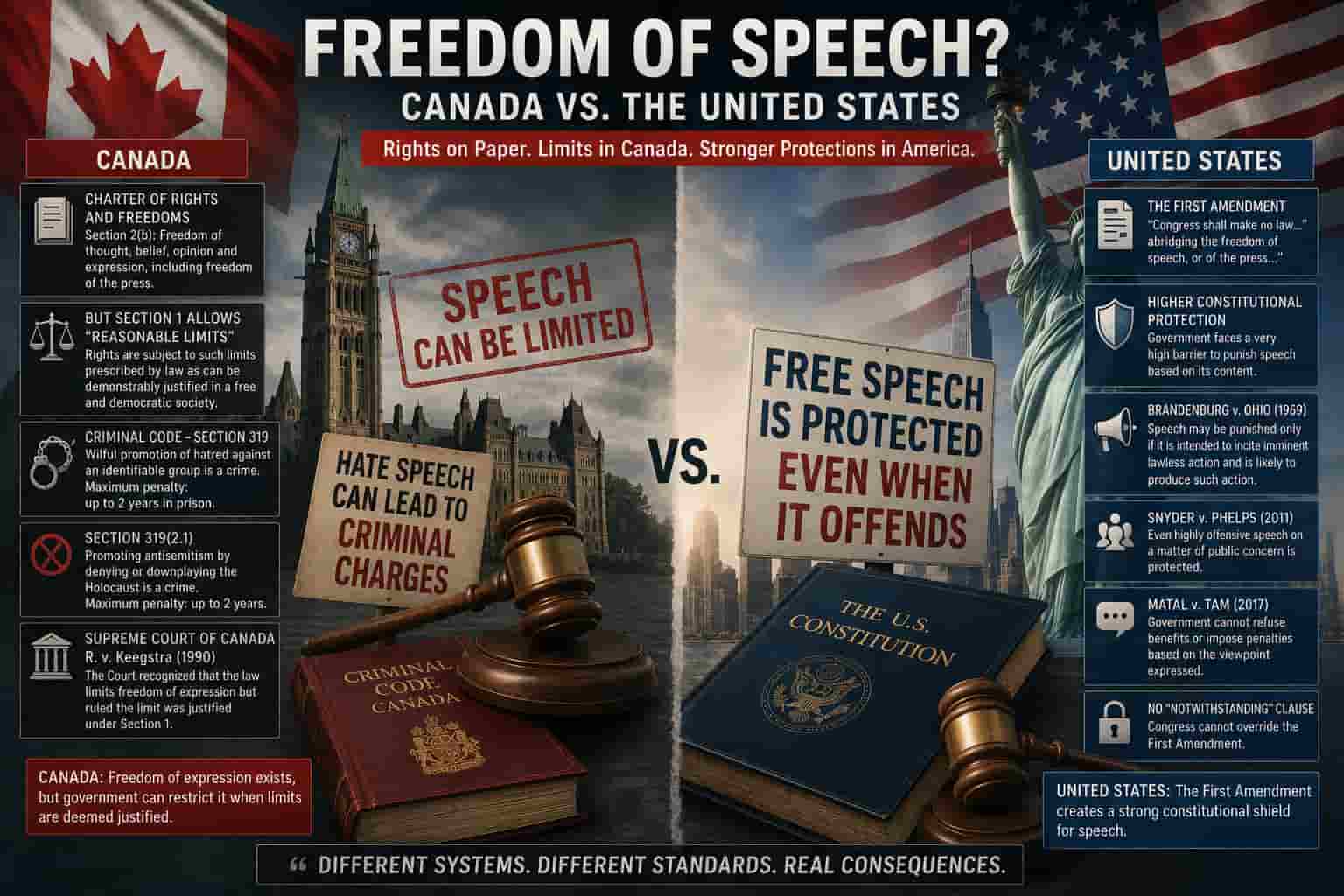
Canada calls freedom of expression a fundamental right. But Canadian law does not protect speech the way the First Amendment does in the United States. The difference is not merely political rhetoric: it is written directly into the two countries’ constitutional systems.
In Canada, government may restrict constitutionally protected expression when courts conclude that those restrictions are legally justified. Canadian criminal law also makes certain categories of speech punishable by imprisonment.
In the United States, by contrast, the government faces a far higher constitutional barrier when it attempts to punish people because of the ideas or viewpoints they express.
The most accurate conclusion is therefore not that Canada has “no freedom of speech whatsoever.”
It is this:
Canada does not have American-style freedom of speech.
And the distinction can be demonstrated using the governments’ own laws and their highest courts.
1. The Difference Is Written Into the Constitution
Canada’s Charter of Rights and Freedoms expressly protects freedom of expression.
Section 2(b) guarantees:
“freedom of thought, belief, opinion and expression, including freedom of the press and other media of communication.”
But before reaching Section 2, the Charter establishes an important limitation.
Section 1
Section 1 states that Charter rights are subject to:
“such reasonable limits prescribed by law as can be demonstrably justified in a free and democratic society.”
In other words, Canada constitutionally recognizes freedom of expression and simultaneously provides a mechanism for government restrictions on that freedom.
Official Canadian Charter of Rights and Freedoms — Government of Canada
The American First Amendment begins from a dramatically different premise:
“Congress shall make no law … abridging the freedom of speech, or of the press…”
The United States also recognizes limited categories of unprotected speech, but the constitutional structure begins with a prohibition directed at government.
That difference is fundamental.
Canada: freedom of expression exists, subject to constitutionally permissible “reasonable limits.”
United States: government is presumptively prohibited from restricting speech because of its content or viewpoint.
2. Canada Can Criminally Prosecute a Person for Promoting Hatred
One of the clearest examples appears in the Criminal Code of Canada, Section 319.
Section 319(1): Public Incitement of Hatred
A person commits an offense by publicly inciting hatred against an identifiable group when the incitement is likely to lead to a breach of the peace.
For an indictable offense, the maximum punishment is two years in prison.
Section 319(2): Wilful Promotion of Hatred
Canadian law goes further.
It provides that a person who, outside a private conversation, wilfully promotes hatred against an identifiable group may also be prosecuted.
The maximum penalty on indictment is again two years’ imprisonment.
Criminal Code of Canada — Section 319, official Government of Canada text
This is an important distinction from American constitutional doctrine.
Canadian law is not limited solely to punishing direct threats or orders to commit an immediate act of violence. It expressly creates a criminal offense centered on the communication of hatred when all elements of the statute are satisfied.
3. Which Groups Are Covered?
Canada’s Criminal Code defines an “identifiable group” broadly.
Section 318(4) includes groups distinguished by:
- color;
- race;
- religion;
- national or ethnic origin;
- age;
- sex;
- sexual orientation;
- gender identity or expression;
- mental disability;
- physical disability.
That definition is part of the federal Criminal Code’s hate-propaganda framework.
This means Canadian criminal law expressly regulates certain speech according to what is communicated about legally identified groups.
4. Canada Has a Specific Criminal Provision Concerning Holocaust Denial
Section 319(2.1) creates another speech-related offense.
The provision applies when a person, outside private conversation, wilfully promotes antisemitism by condoning, denying or downplaying the Holocaust.
The maximum penalty on indictment is two years in prison.
This is an important example because it illustrates the fundamental philosophical difference between Canada and the United States.
The question is not whether Holocaust denial is false or morally repugnant. It is.
The constitutional question is different:
Should government have the power to criminally punish a person merely for expressing such an idea?
Canada answers that question differently from the American First Amendment tradition.
5. Canada Provides Defenses — but the Speaker Can Still Face Criminal Proceedings
Canadian law does contain important protections.
Section 319(3), for example, establishes defenses to wilful promotion of hatred.
They include circumstances in which:
- the accused establishes that the statements were true;
- an opinion concerning a religious subject was expressed in good faith;
- statements concerned a matter of public interest, their discussion was for the public benefit, and the speaker had reasonable grounds for believing them true;
- the speaker was acting in good faith to identify matters producing hatred in order to have them removed.
Canadian law also requires the consent of the Attorney General before proceedings under Sections 319(2) and 319(2.1) may be instituted.
These protections matter.
But they also expose the central difference between the systems.
In Canada, a speaker may need to rely upon a statutory defense in a criminal proceeding arising from the content of his speech.
In the United States, the First Amendment often prevents government from criminalizing the speech in the first place.
6. The Supreme Court of Canada Has Already Confronted This Question
The landmark case is R. v. Keegstra, decided by the Supreme Court of Canada in 1990.
James Keegstra was a teacher who taught his students grotesque antisemitic conspiracy theories. He was prosecuted under the provision prohibiting wilful promotion of hatred.
The constitutional issue was critical.
The Supreme Court accepted that the prohibition infringed the freedom of expression protected by Section 2(b).
But that did not end the case.
The Court concluded that the restriction could nevertheless survive because it was justified under Section 1 of the Charter.
That is the Canadian constitutional system in action:
The speech can be constitutionally protected expression.
The law can restrict that expression.
And the restriction can still be constitutional.
R. v. Keegstra — official Supreme Court of Canada decision
That result would be much harder to reproduce under modern American First Amendment doctrine.
7. The American Rule: Even Advocacy of Illegal Conduct Can Be Protected
One of the most important American cases is Brandenburg v. Ohio (1969).
The Supreme Court established a very demanding test before government may criminalize advocacy of unlawful conduct.
The First Amendment generally prevents government from punishing advocacy of force or violation of law unless the advocacy is:
- directed to inciting or producing imminent lawless action, and
- likely to incite or produce such action.
That word imminent is crucial.
Brandenburg doctrine — official Constitution Annotated, Congress.gov
A person can therefore advocate an offensive, radical or even dangerous political ideology in America without automatically committing a crime.
The government ordinarily needs much more than:
“This opinion spreads hatred.”
The constitutional threshold is significantly higher.
8. America Generally Does Not Recognize a General “Hate Speech” Exception to the First Amendment
This point is often misunderstood.
The United States can punish conduct associated with speech — such as true threats, criminal solicitation or constitutionally defined incitement.
But there is no general First Amendment rule saying:
“Speech loses constitutional protection simply because government considers its viewpoint hateful.”
American constitutional doctrine is particularly hostile to viewpoint discrimination.
Congress.gov’s official Constitution Annotated explains that laws regulating speech according to the particular idea, opinion or perspective expressed are viewpoint-based and are unconstitutional in most contexts.
This is one of the strongest differences between Canada and the United States.
9. Matal v. Tam: Government Cannot Decide Which Opinions Are Too Offensive
The Supreme Court reinforced this principle in Matal v. Tam (2017).
The case concerned the federal government’s refusal to register trademarks considered disparaging.
The constitutional problem was that government was deciding which ideas or expressions were offensive enough to receive unfavorable treatment.
The Court rejected that approach.
The official Congressional Constitution Annotated explains that laws allowing government to determine whether speech is disparaging or offensive raise serious viewpoint discrimination concerns.
That principle reaches far beyond trademarks.
It reflects a central idea of the First Amendment:
Government is not supposed to be the official judge of which viewpoints deserve respect.
10. Snyder v. Phelps: Even Outrageously Offensive Speech Can Be Protected
Another extraordinary example is Snyder v. Phelps (2011).
Members of the Westboro Baptist Church picketed near the funeral of a U.S. serviceman using messages that were deeply offensive to the serviceman’s family.
Nevertheless, the Supreme Court held that the First Amendment barred liability under the circumstances because the speech concerned matters of public concern and occurred in a public place.
The official Constitution Annotated summarizes the rule: government cannot punish speech on a matter of public concern simply because it is upsetting or arouses contempt.
This illustrates a central American principle:
Free speech is tested when the speech is offensive — not when everybody agrees with it.
11. Canada Has Something the United States Does Not: The Notwithstanding Clause
Perhaps the most extraordinary difference appears in Section 33 of the Canadian Charter.
It is known as the notwithstanding clause.
Section 33 permits Canada’s Parliament or a provincial legislature to expressly declare that a law will operate notwithstanding Section 2 or Sections 7 through 15 of the Charter.
Why does that matter for freedom of speech?
Because Section 2 contains freedom of expression.
A Section 33 declaration expires after five years unless renewed, but the legislature may enact another declaration.
Canadian Charter — Section 33, official Government of Canada text
There is no American constitutional equivalent.
Congress cannot pass a statute declaring:
“This law shall operate notwithstanding the First Amendment.”
If Congress violates the First Amendment and the courts invalidate the law, Congress cannot simply suspend the First Amendment for five years through an ordinary federal statute.
That structural difference alone demonstrates how different the two systems are.
12. But America’s Freedom of Speech Is Not Absolute Either
A fair comparison requires acknowledging this.
The First Amendment does not mean that every verbal or written communication is immune from law.
American law permits regulation of narrow categories such as:
- true threats;
- constitutionally defined incitement;
- certain defamatory statements;
- obscenity under applicable Supreme Court standards;
- speech integral to criminal conduct;
- certain restrictions involving time, place and manner.
The essential difference is that the U.S. government ordinarily cannot create a general category called “offensive ideas” or “hate speech” and remove First Amendment protection from it.
Even inside categories of speech government may regulate, viewpoint discrimination can remain constitutionally prohibited.
13. The Constitutional Philosophies Are Fundamentally Different
The difference can be stated simply.
Canadian model
The government recognizes freedom of expression but may restrict it when the restriction is prescribed by law and demonstrably justified in a free and democratic society.
That principle is written directly into Section 1 of the Charter.
American model
Government begins from the opposite command:
“Congress shall make no law … abridging the freedom of speech…”
Modern Supreme Court doctrine then places particularly severe constitutional obstacles in the way of content- and viewpoint-based restrictions.
This does not make American speech unlimited.
But it does make government censorship based on ideas considerably more difficult.
14. A Simple Hypothetical Shows the Difference
Imagine someone publishes a vicious and deeply offensive political statement about a particular religious or ethnic group.
Assume that the statement:
- contains no true threat;
- does not direct anyone to commit an immediate crime;
- is not likely to produce imminent lawless action;
- nevertheless deliberately promotes hatred against the group.
Under Canada’s Section 319 framework, such speech can potentially trigger criminal liability if prosecutors prove all the statutory elements.
Under American constitutional law, the fact that the speech is hateful by itself ordinarily would not be sufficient.
The government would need a constitutionally recognized basis for punishment — such as a true threat, solicitation, or incitement meeting the Brandenburg standard.
That is not a minor technical difference.
It is the difference between two conceptions of what freedom of speech means.
15. Rights “On Paper” — but Subject to Government Limits
It would be inaccurate to claim that Canadians possess no freedom of expression.
They clearly do.
Their Charter expressly guarantees it.
Canadian courts have repeatedly protected expression and have also struck down restrictions found to be excessively broad.
But Canadian freedom of expression is qualified by a constitutional limitation clause that has no direct American First Amendment equivalent.
Canadian criminal law also explicitly criminalizes some categories of expression.
And the Supreme Court of Canada has upheld certain such restrictions even after acknowledging that they infringe constitutionally protected expression.
For an American reader accustomed to the First Amendment, that distinction is enormous.
Conclusion: Canada Has Freedom of Expression — but Not the American First Amendment
The strongest argument does not require exaggeration.
Canada is a democratic country.
Canada has constitutional freedom of expression.
Canada has independent courts.
But Canada does not provide the same constitutional protection for speech that exists in the United States.
Its own law demonstrates why:
Section 1 expressly permits reasonable limits on Charter rights.
Section 319 makes certain hate-promoting expression a criminal offense carrying potential imprisonment.
R. v. Keegstra demonstrates that the Supreme Court can recognize an infringement of freedom of expression and nevertheless uphold the restriction under Section 1.
And Section 33 allows legislatures, under specified conditions, to enact legislation that operates notwithstanding Section 2 — the very section containing freedom of expression.
America follows a different constitutional philosophy.
The First Amendment is based on profound distrust of government’s ability to decide which ideas citizens should be allowed to hear.
That is why the most legally defensible headline is not:
“Canada has no freedom of speech.”
It is:
Canada officially does not have American-style freedom of speech.
The Canadian government guarantees expression — but it also reserves substantially greater constitutional authority to restrict it.
The American First Amendment puts the government itself under a much stronger prohibition.
Why This Is Bad for Canada
The problem with allowing government to define the limits of lawful expression is not only that offensive or hateful speech can be restricted. The deeper danger is that the same legal principle can gradually expand into broader political, religious, cultural, or social disputes. Once the state is accepted as the authority that decides which ideas cross the line from protected expression into punishable speech, citizens may begin to censor themselves even before a court becomes involved. That chilling effect can weaken journalism, political opposition, academic debate, religious discussion, and ordinary public disagreement. In the American First Amendment tradition, the presumption is that government should not be trusted to decide which viewpoints are acceptable. Canada’s model places more faith in legislatures and courts to balance speech against other social interests. The risk is that the definition of an acceptable “reasonable limit” can change with governments, political pressure, and prevailing social attitudes. For a democratic country, that can make public debate narrower precisely when unpopular, controversial, or dissenting speech most needs protection.
Official Sources
Government of Canada
Canadian Charter of Rights and Freedoms — Sections 1, 2 and 33
Criminal Code of Canada — Section 319
Criminal Code — Hate Propaganda provisions beginning at Section 318
R. v. Keegstra — Supreme Court of Canada
United States
First Amendment — Constitution Annotated, Congress.gov
Brandenburg and the Current Incitement Doctrine — Congress.gov
Viewpoint-Based Regulation of Speech — Congress.gov
Matal v. Tam and Viewpoint Discrimination — Congress.gov
Midtown Tribune Analysis | August 23, 2026
Ask Midtown Tribune about this story
Answers are grounded first in this article. Search all Midtown Tribune reporting from the main AI Search page.
AI-generated summary. Verify important details in the linked original articles.