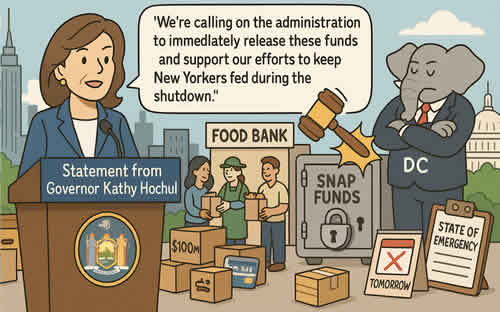
Gov. Kathy Hochul said court rulings confirm the Trump administration must release emergency nutrition assistance to protect roughly 3 million New Yorkers from losing SNAP benefits. The governor criticized Washington Republicans for inaction, noting New York sued to secure relief while preparing contingency measures, including fast-tracking more than $100 million for food banks and declaring a state of emergency. With the decisions in hand, Ms. Hochul said the federal government can fully fund SNAP and called for immediate disbursement to support the state’s efforts to keep residents fed during the shutdown.
Statement from Governor Kathy Hochul
“Today’s rulings confirm that the Trump administration must release emergency nutrition assistance for the 3 million New Yorkers set to lose their SNAP benefits tomorrow.
“No state should have to sue the federal government to ensure families can put food on the table. But when Washington Republicans refused to act, New York took them to court to mitigate this crisis.
“My administration remains prepared for the worst — fast-tracking over $100 million for food banks and pantries and declaring a state of emergency. With these rulings, it is clear the Trump administration can fully fund the SNAP program. We’re calling on the administration to immediately release these funds and support our efforts to keep New Yorkers fed during the shutdown.”
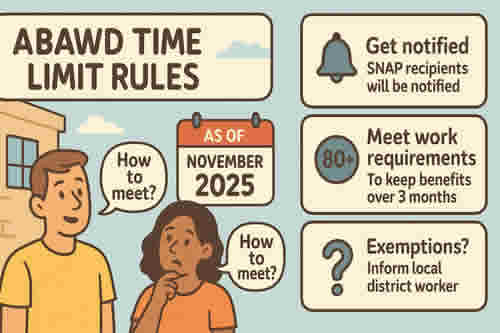
Supplemental Nutrition Assistance Program (SNAP). The Able-Bodied Adults Without Dependents (ABAWD) time limit rules for Supplemental Nutrition Assistance Program (SNAP) participants are in effect as of November 2025. Due to federal law changes, New York State’s waiver of work requirements for certain able-bodied adults without dependent children (ABAWD) will end as of November 2025. As a result of this federal action, as of November 2025, those subject to ABAWD time limit – including new groups of individuals subject to these rules – must comply with certain work requirements to keep SNAP benefits for more than 3 months. The information below explains who is subject to these work requirements and how they can meet the requirement to maintain SNAP benefits. SNAP recipients will be notified by their local social services district if they are subject to these requirements. If you believe you should be exempt from these requirements based on program rules or if you are meeting the work requirement, you should inform your local district worker.
Able-Bodied Adults Without Dependents (ABAWD) Work Rules
Who is an ABAWD?
An ABAWD is a person who is:
Aged 18 to 64,
Not living with a child under 14, and
Able to work.
Does everyone need to follow the ABAWD work rules?
No. You might not have to follow the ABAWD work rules, if:
You are younger than age 18, or age 65 or older,
Someone in your household is younger than age 14,
You receive disability benefits from a public or private source, such as Veterans Affairs or New York State disability benefits,
You are pregnant,
You are unable to work at least 80 hours per month because of a physical or mental health reason,
You are an Indian, Urban Indian, California Indian, or other Indian eligible for the Indian Health Services, or
You are excused from the General SNAP Work Rules because you are:
A 16 or 17-year-old who is not the head of the household or who is in school or in an employment program at least half-time,
Unable to work because of a mental or physical health reason,
Taking care of a child younger than age 6,
Taking care of an incapacitated person,
Meeting the work rules under the Temporary Assistance for Needy Families (TANF) program,
Receiving or applying for unemployment benefits,
Participating in a drug or alcohol addiction treatment program,
Enrolled in a school, training program, or college at least half-time (students may be subject to other eligibility rules),
Already working at least 30 hours per week,
Already earning $217.50 (30 times the federal minimum wage) or more per week, OR
An SSI applicant or recipient.
Call your Local District Contact Number as soon as possible if you think you or someone in your household should be excused from following the ABAWD rules.What is the ABAWD time limit?
If you are an ABAWD, you must meet the ABAWD work rules to continue receiving SNAP benefits for more than 3 months in a 3-year period. This is also known as the ABAWD time limit. Once you use up the 3 months and you are not meeting the ABAWD work rules, you will lose your SNAP benefits. In New York, the current 3-year period started on October 1, 2023, and will end on September 30, 2026.How can you meet the ABAWD work rules?
Paid or unpaid work for 20 hours per week (80 hours per month)Examples include:
Having a job where you work at least 20 hours per week or earn at least $217.50 per week, even if you work less than 20 hours per week.
Doing in-kind work by exchanging your services for something other than money for at least 80 hours per month (for example, doing building maintenance in exchange for a reduction in rent).
Learn job skills, approved by the social services district for 20 hours per week (80 hours per month), that can help you earn more money.Examples include:
Doing job searches, workshops on resumé writing, or other training approved by your local district. Some of these activities can be done online at websites like JobZone and Virtual Career Center.
Job skills training programs, English language instruction, or educational activities – including college courses, certifications, or credential programs – that help you prepare for work.
Community Service/Volunteer
The number of hours you would need to participate in community service or volunteer work is based on your SNAP benefit divided by the state minimum wage. For example, if you get $300 in SNAP and the state minimum wage in your area is $16.50, then you have to complete 18 hours of community service or volunteer work each month. ($300 ÷ $16.50 = 18 hours).
Volunteer or do a Work Experience Program assignment with local nonprofit or public service organizations (such as food pantries, parks, or libraries).
Keep Your SNAP Benefits Fact Sheet – This flyer helps SNAP recipients and organizations that work with them. It raises awareness and promotes compliance with ABAWD work rules.
ABAWD Medical Statement — This form will help SNAP recipients document that they are exempt from the ABAWD time limit because of a physical or mental health reason, pregnancy, or participation in substance use treatment
Monthly WIOA Job Search Activity Record — Print Ready — This form will help ABAWDs keep track of their job search activities under WIOA (Use this form if you are completing the record by hand.)
Call your Local District Contact Number as soon as possible if you are already doing one of these things. Also, if your work hours including paid and unpaid work drop below 80 hours per month, you must let the local district know within 10 days after the end of the month.
Remember: Tell your local district if you earn more than $217.50/week before taxes (even if it is less than 20 hours/week of work). If you do, you are exempt from the ABAWD work rules.What if you have a good reason for not following these ABAWD work rules?
You may receive SNAP benefits beyond the 3-month time limit if you have a good cause reason for not following the ABAWD work rules or you show that you should be excused from following the ABAWD work rules because you meet one or more of the conditions to be excused. Good cause reasons for not following the rules include issues that a person cannot control, such as getting sick or having a household emergency. These are some examples of good cause reasons but there are others, too. If you claim to have a good cause reason for not following the ABAWD work rules or believe you should be excused from following the rules, you must provide proof if the district asks you to do so. If you believe that you have a good cause reason for not meeting the ABAWD rules, you should call the Local District Contact Number to provide proof.If you lose your SNAP benefits, how can you get them back?
If you lose your SNAP benefits, because you did not meet the ABAWD work rules, you should call your Local District Contact Number. The district will explain what you need to do to start getting SNAP benefits again. The district must offer you help in meeting the ABAWD work rules to start receiving SNAP benefits again.
General Work Rules for SNAP Recipients
Some people getting SNAP age 16 to 59 must follow the general SNAP work rules. Some adults getting SNAP age 18 to age 64 must also meet the Able-Bodied Adults Without Dependents (ABAWD) rules. SNAP work rules and ABAWD rules can be met by participating in SNAP Employment & Training (SNAP E&T) work activities. Many people do not have to meet the SNAP work rules because they are excused. Below, you can learn if you are excused from the general SNAP work rules and the ABAWD rules or how to meet them if you are not excused.
General SNAP Work Rules
What do you need to do to follow the general SNAP work rules?
You must follow these general SNAP work rules to keep your SNAP benefits:
Accept any job offer you receive, unless there is a good reason you can’t.
If you have a job, don’t quit your job or choose to work less than 30 hours each week without having a good reason, such as getting sick, being discriminated against, or not getting paid.Note: You will not lose your SNAP benefits if your hours fall below 30 hours per week and you are still earning $217.50 per week (30 times the federal minimum wage).
Tell us about your job and how much you are working.
Participate in SNAP E&T work activities if assigned by the district.
Does everyone need to follow these General SNAP Work Rules?
No. You may not have to follow these rules if you are:
Younger than age 16, or age 60 years or older (Please read the important note below about people aged 60 to 64),
A 16 or 17-year-old who is not the head of the household or who is in school or in an employment program at least half-time,
Unable to work because of a mental or physical health reason,
Taking care of a child younger than age 6,
Taking care of an incapacitated person,
Meeting the work rules under the Temporary Assistance for Needy Families (TANF) program,
Receiving or applying for unemployment benefits,
Participating in a drug or alcohol addiction treatment program,
Enrolled in a school, training program, or college at least half-time (students may be subject to other eligibility rules),
Already working at least 30 hours per week,
Already earning $217.50 (30 times the federal minimum wage) or more per week, OR
An SSI applicant or recipient.
Important: If you are between 60 and 64, you don’t have to follow the general SNAP work rules. However, if none of the other conditions listed above apply to you, you may still have to follow the ABAWD rules. Find out if you are excused from the ABAWD rules.What if you think you should be excused from the general SNAP work rules?
Call your Local District Contact Number as soon as possible if you think you or someone in your household should be excused from following the work rules.What if you have a good cause reason for not following the general SNAP work rules?
Good cause reasons for not following the general SNAP work rules include things that you cannot control such as getting sick, facing a household emergency, or not having childcare. These are some examples of good cause reasons but there are others, too. You must provide proof of any good cause reason when asked by the local district. If you believe you should be excused from following the general SNAP work rules, you must also provide proof, if asked by the district. For example, the district might ask for a statement from your doctor or other documents showing you had a good cause reason for not following the rules or should be excused.
Call your Local District Contact Number as soon as possible if you think you or someone in your household has a good cause reason for not following the work rules.
SNAP Employment & Training (SNAP E&T) Assignments
What are SNAP E&T assignments?
The SNAP E&T program can help you and people in your household gain skills and find work. If you are assigned to SNAP E&T, you may be required to participate in supervised job search, job readiness activities, work experience, job skills training, vocational training, educational training, or other work activities. SNAP E&T participants receive case management services to help them reach their employment goals. If the district assigns you or someone in your household to participate in SNAP E&T, they cannot ask you to participate in work activities and/or employment to meet the SNAP work rules for more than 30 hours per week (no more than 120 hours per month). A person may choose to participate in work activities for more than 30 hours per week but cannot be required to do so.
Note: People who are also receiving Temporary Assistance (TA) benefits may be required to participate in work activities for up to 40 hours per week. The assigned work activity for these people is generally a combined TA and SNAP work assignment. A person who receives TA and SNAP and does not comply with assigned work activities willfully and without a good cause reason may be subject to a TA work sanction. However, if the person participates in the assigned work activities for at least 30 hours per week (120 hours per month), the household’s SNAP benefits will not be affected.What if you have costs from participating in the SNAP E&T program?
Your local district will pay costs for you or people in your household that are necessary and reasonable to participate in a SNAP E&T activity. These costs may include:
Transportation
Childcare
Personal safety items or equipment
Other reasonable required costs, such as tools, books, and uniforms
If the district cannot pay your costs to participate in a SNAP E&T assignment, you will be excused from participating. If the district tells you or someone in your household that you must participate in a SNAP E&T work activity, the person must participate. If you do not participate in the SNAP E&T assignment or you quit a job willfully and without a good cause reason, you may lose your SNAP benefits.What happens if you don’t follow these general SNAP work rules?
You may lose your SNAP benefits if you don’t follow these work rules and you don’t have a good cause reason. If you do not follow the general SNAP work rules or you do not participate in a SNAP E&T assignment, you will be sent a Conciliation Notification. You will be offered a meeting with the district to explain why you did not follow the rules.
If you receive a Conciliation Notification, you must contact the local district by the date on the Conciliation Notification to explain why you did not follow the work rules. If the district decides you had a good cause reason, your household’s SNAP benefits will stay the same. If you did not have a good cause reason, the district will offer you a chance to participate in the same activity you did not complete in order to not lose SNAP benefits. If the district decides that the same activity is not available or is no longer a good fit for you, you may be asked to complete another activity. If you do not complete the activity or prove they had a good cause reason, your household’s SNAP benefits may go down or stop.How long will you lose your SNAP benefits if you don’t follow these general SNAP work rules or do not complete a SNAP E&T assignment?
The first time you do not follow these rules, you can’t get SNAP benefits for one month.
The second time you do not follow these rules, you can’t get SNAP benefits for three months.
The third time, and any additional time after that, you do not follow these rules, you can’t get SNAP benefits for six months.
If you lose your SNAP benefits because you did not follow the general SNAP work rules or did not complete a SNAP E&T assignment, you must be allowed to start receiving SNAP benefits before the end of the time period noted above if you prove you should be excused from following the general SNAP work rules.Where can you find additional resources?
New York City recorded 2,192 overdose deaths in 2024, down 28% from 3,056 in 2023—the first substantial drop after nearly 10 years of increases, Mayor Eric Adams and DOHMH Acting Commissioner Dr. Michelle Morse said Tuesday. Declines were seen across all five boroughs, with Staten Island down about 49%. Black and Latino New Yorkers saw 29% reductions yet still died at roughly twice the rate of white residents, and the Bronx remains the hardest-hit borough. City, state, and federal investments—backed by nearly $190 million in opioid-settlement funds to date and projected to reach $550 million by 2041—have expanded prevention, treatment, and harm-reduction services, including Overdose Prevention Centers and wider access to methadone and buprenorphine. The city budgeted $41 million in FY2025 for overdose response. New Yorkers can call or text 988 for 24/7 support.
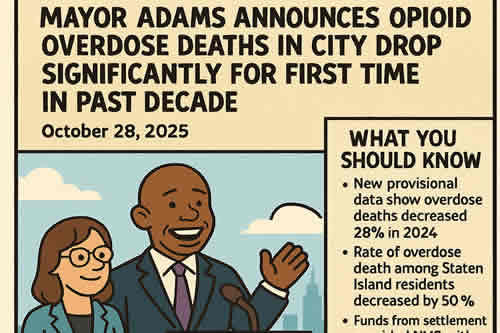
Mayor Adams Announces Opioid Overdose Deaths in City Drop Significantly for First Time in Past Decade
– New York City Mayor Eric Adams and New York City Department of Health and Mental Hygiene (DOHMH) Acting Commissioner Dr. Michelle Morse today announced new data released by DOHMH that shows a significant decrease in overdose deaths in New York City in 2024 — marking the first substantial decrease following a nearly 10-year period of increasing overdose deaths in the five boroughs. There were 2,192 deaths last year, down from 3,056 in 2023, mirroring national trends, and overdose deaths decreased almost universally across demographic groups and neighborhoods in 2024. Additionally, residents of all five boroughs saw decreases in overdose deaths and, for the first time since 2018, overdose deaths decreased among Black and Latino New Yorkers; however, significant racial and geographic inequities persist.
“The data we are releasing today represents a major shift in a decades-long overdose crises that has claimed the lives of so many New Yorkers and Americans across the nation. Progress on reducing opioid overdoses will never make up for the families that have been devastated and the communities torn apart by these drugs, but it gives us hope that brighter days are ahead,” said Mayor Adams. “I am proud of the work our administration has done to stay focused on this issue by pursuing litigation and using funds from opioid settlements proactively, strategically, and forcefully to support those who are struggling. We will continue to make the right investments in programs and treatments that help keep New Yorkers safe and healthy.”
“While we are finally seeing the needle move on fatal overdoses across the city, too many New Yorkers still continue to die from preventable deaths,” said DOHMH Acting Commissioner Dr. Morse. “As city leaders, we must be steadfast in our support of programs that save lives, while we continue to address historic disinvestment and other forms of structural racism. I am grateful for the tireless dedication of advocates, local providers, Health Department staff, and partners inside and outside government as we work to keep our communities and neighbors safe and connected to care.”
Despite seeing promising decreases, inequities in overdose deaths still persist in New York City. Black and Latino New Yorkers each saw a 29 percent reduction in overdose deaths but died at twice the rate of their white counterparts. While the rate of fatal overdose decreased 24 percent among Bronx residents, the borough continues to have the highest rate of overdose deaths — at more than double the rate of Manhattan, the borough with the second-highest rate. The rate of overdose deaths among Staten Island residents decreased by about 49 percent. Residents of Hunts Point-Mott Haven, Highbridge-Morrisania, Crotona-Tremont, East Harlem, and Fordham-Bronx Park continued to bear the greatest burden of overdose deaths in 2024.
To address the continued need for comprehensive services, the city continues to invest in evidence-based practices and partner with local providers to reach the communities most in need. In FY 2025 alone, the city allocated $41 million across DOHMH, NYC Health + Hospitals, and the Office of the New York City Chief Medical Examiner to support the expansion of services around the city and enhance the existing network of care.
Ongoing funds from opioid settlements through DOHMH have supported wraparound services for syringe service programs, including on-site medical care, connections to health care and social services, and support for basic needs. In FY 2025, syringe service programs that operate Overdose Prevention Centers provided approximately 39,000 harm reduction services to more than 8,000 participants, reducing the risk of overdose and infectious disease and providing referrals to treatment and other health and social services. In 2023, the Adams administration also allocated $3 million to eight providers on Staten Island through a request for proposal to directly support the expansion of buprenorphine treatment, outreach and engagement, and care navigation services in the borough. This past July, the city announced $4 million in annual funding for nine outpatient and opioid treatment programs citywide to increase access to methadone and buprenorphine. Contracting for the expansion of the number of hospitals participating in DOHMH’s emergency department-based nonfatal opioid overdose response program called Relay remains ongoing.
Since beginning to receive funding through opioid settlements, NYC Health + Hospitals has had over 9,700 patient engagements with expanded substance use services at Street Health Outreach and Wellness vans, nearly 83,000 encounters with patients in emergency departments with addiction services provided by the Emergency Department Leads program, and has successfully launched a cutting-edge addiction simulation training for emergency department prescribers. Additionally, NYC Health + Hospitals has provided comprehensive addiction consultations at over 24,700 inpatient admissions through the Consult for Addiction Treatment and Care in Hospitals program.
Further, the Office of the Chief Medical Examiner’s Drug Intelligence and Intervention Group program has offered support services to more than 4,000 individuals following the death of a loved one from an overdose.
All actions taken by Mayor Adams and the Adams administration to prevent overdose deaths also underscore the administration’s efforts to improve and extend the average lifespan of all New Yorkers through “HealthyNYC” to 83 years by 2030. HealthyNYC sets ambitious targets to address the greatest drivers of premature death, including chronic and diet-related diseases, screenable cancers, overdose, suicide, maternal mortality, violence, and COVID-19.
New Yorkers looking to access substance use services can call or text 988 for free, confidential support 24/7. Resources can also be found on the “NYC HealthMap” and on DOHMH’s website.
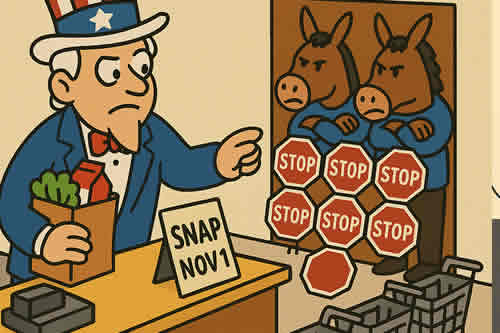
If the Democrats hadn’t blocked government funding 12 times over the course of 5 weeks, SNAP benefits would be paid on time. Period. End of story.
But thanks to the Left’s obstruction, approximately 42 MILLION Americans will not receive their SNAP benefits on November 1st.
Contingency funds can’t save this. Democrats REFUSED to pass a clean CR and fund regular monthly benefits for fiscal year 2026. Those contingency funds are legally available only to supplement appropriated benefits when they fall short—not to replace benefits Democrats voted down. The appropriation no longer exists.
Democrats would rather see American families go hungry than give up their radical illegal aliens first agenda. That’s the truth.
Nearly 3 Million New Yorkers Could Lose Their Food Assistance in November — Ahead of Thanksgiving — Due to GOP’s Federal Government Shutdown. As USDA Refuses To Unlock Federal Funds, Governor Fast-Tracks $30 Million To Support Over 16 Million Meals Statewide, In Addition to the $11 Million In Emergency Food Bank Funds Announced Last Week . 140,000 New Yorkers Will Face a 40% Hike in ACA Health Insurance Premiums Beginning November 1 . Heating Assistance for More than 1.5 Million New Yorkers Delayed Indefinitely As Winter Approaches.
Governor Hochul today rallied with New Yorkers impacted by Washington Republicans’ devastating cuts to health care, food assistance and other critical programs. With nearly three million New Yorkers at risk of losing the food assistance they receive from the Supplemental Nutrition Assistance Program (SNAP) starting November 1 due to the GOP’s federal government shutdown, the Governor also announced that she is fast-tracking $30 million in State funds to support over 16 million meals. This additional funding follows Governor Hochul’s announcement last week of more than $11 million to support local emergency food relief. The Governor’s funding announcements come as federal administrators at the USDA have refused to unlock the federal funding needed to ensure SNAP recipients receive their November food assistance. This would mark the first time in U.S. history that a federal administration has stopped food assistance during a government shutdown.
Additionally, Governor Hochul today launched a new website where everyday New Yorkers can share their personal stories about the devastating effects of Washington Republicans’ cuts to health care, food assistance and other critical programs. The new website — ny.gov/federalcuts — breaks down the impacts on regions across the state and includes relevant resources available to New Yorkers affected by these cuts.
“I am doing everything in my power to soften the blow of the destruction Republicans in Washington are inflicting on our state,” Governor Hochul said. “While I’ve said repeatedly that no state can backfill these devastating cuts, I am committed to ensuring New Yorkers do not go hungry this holiday season and am taking action to support the families suffering the consequences of Republicans’ cruelty. Republicans in Congress voted to rip health care and vital services from millions of New Yorkers and my administration and the people of New York will continue holding them accountable.”
After their Big Ugly Bill stripped nearly two million New Yorkers of their health coverage and is anticipated to result in more than 300,000 households losing SNAP food assistance, the White House is capitalizing on the uncertainty of the government shutdown to create even more chaos. Unless the Trump Administration and Washington Republicans act to end the government shutdown or backfill critical programs, beginning on November 1 New Yorkers face devastating cuts to food assistance, skyrocketing health care premiums, and a loss of other critical programs like heating assistance.
Nearly three million New Yorkers who rely on SNAP each month to feed themselves and their families may not receive their SNAP benefits in November — ahead of the Thanksgiving holiday
140,000 New Yorkers will see their health care premiums skyrocket by nearly 40 percent
Funds for for the Home Energy Assistance Program (HEAP) are delayed making it harder for more than 1.5 million New Yorkers to afford their utility bills and keep warm as temperatures begin to drop and winter approaches
Early education in jeopardy across the state with a lack of federal funding to support Head Start programs
Critical infrastructure projects and jobs will be put at risk with cuts to infrastructure and security funding
Senator Kirsten Gillibrand said, “Republicans in Congress have needlessly shut down the government, and now they’re refusing to work with Democrats to maintain the benefits that put food on the table for millions of New Yorkers. As families across New York face crushing health care costs driven by Trump administration policies that only benefit the wealthiest Americans, House Republicans have left Washington on a taxpayer-funded vacation. It’s time for them to get back to work and finally start partnering with Democrats to lower costs for working families.”
Representative Jerrold Nadler said, “Health care premiums are about to skyrocket and November SNAP benefits for over three million New Yorkers are at risk because of the Republican shutdown. Republicans are threatening to starve low-income Americans for their own political gain. I have called on the Trump Administration to use every tool available to keep food assistance flowing to hungry seniors, veterans, and families with children. The Administration has the authority to cover most November SNAP benefits through the contingency fund and can use its transfer authority to make up the rest. If they refuse to act, it’s a deliberate choice to take food off the tables of millions of Americans. Meanwhile, the House has been out for over a month now and it’s long past time for Republicans to get back to work to help families put food on the table and keep their affordable health care. The Governor’s new website will help New Yorkers across the state find the resources and assistance they need until Republicans come back to the negotiation table and open the government.”
Representative Nydia Velázquez said, “While Republicans in Congress play political games with people’s lives, millions of New Yorkers are being forced to choose between putting food on the table and keeping their health care. These cuts aren’t just numbers, they are families in our communities who will lose coverage, go hungry, or fall deeper into poverty. I applaud Governor Hochul for standing up for New Yorkers and giving them a platform to share their stories. The human cost of these GOP attacks must be seen and heard.”
Representative Gregory W. Meeks said, “Families across Queens and throughout the state are paying the price for GOP cuts to health care and food assistance. Governor Hochul is standing up for New Yorkers while Republicans in Washington put politics over people and enjoy vacation time. This new website is important because it encourages New Yorkers to share their experiences and highlight the damage these reckless Republican policies are doing to our communities. Democrats are fighting to protect food assistance for Americans and improve the cost of living nationwide.”
I am committed to ensuring New Yorkers do not go hungry this holiday season and am taking action to support the families suffering the consequences of Republicans’ cruelty.
Governor Kathy Hochul
Representative Paul Tonko said, “Over the past several months, congressional Republicans have inflicted real pain on families in every corner of our state — stripping away health care, gutting food and home heating assistance, and driving up costs for millions. With open enrollment beginning next month and families bracing for skyrocketing premiums and the loss of SNAP benefits, it’s never been more urgent to ensure that New Yorkers have the resources and information they need to survive. This new initiative gives families the tools to navigate these devastating cuts — and just as importantly, a place to share their stories so we can continue fighting for their priorities against this callous Republican regime.”
Representative Grace Meng said, “I have asked my constituents to share their stories about the impact of higher health care costs, and I’m pleased to see Governor Hochul launching a similar effort for all New Yorkers. I thank her for being such a staunch ally in our fight against GOP cuts that threaten to have devastating impacts on our state. I again repeat my call for Republican leaders to immediately reopen the government and address the healthcare crisis, and I will continue urging them to do so. From health care to food assistance and other crucial services, we must stop the harm impacting New York and communities across the nation.”
Representative Joseph Morelle said, “I’m grateful to Governor Hochul for giving more people the chance to share their stories. While she and our local partners fight to protect our communities, I’ll keep pushing in Washington to stop these cruel cuts and make sure government stands for the people it is supposed to serve.”
Representative Ritchie Torres said, “In the Bronx, SNAP is not an abstract policy. It is the difference between hunger and stability for over 150,000 families. When Republicans in Washington threaten to cut food assistance, they are threatening to take meals off the tables of children, seniors, and working parents in communities like mine. I am grateful to Governor Hochul for fighting to protect New Yorkers from the cruelty of these cuts and for standing with those who have the least.”
Representative Dan Goldman said, “Donald Trump and his New York Republican allies insist on tearing away health care and food assistance from millions of families to benefit their billionaire buddies. While Democrats in Congress stand ready to address the cost-of-living crisis and reopen the government, the Republican-led House hasn’t voted in over a month. I’m grateful Governor Hochul is stepping up to help New Yorkers tell their stories and get the help they need, and I’ll keep doing everything I can to hold Republicans accountable for this cruel and damaging agenda.”
Representative John W. Mannion said, “Withholding SNAP benefits from millions of American children, seniors, and veterans is the wrong choice by the Trump administration. As I’ve said before, Congress has already approved billions of dollars in contingency funds that could be used right now to protect people’s health and safety. I’m grateful to Governor Hochul for giving New Yorkers a voice to share how these cruel and unnecessary cuts are affecting their lives. I’ll keep fighting to make sure no one in our state goes without food, health care, or basic support.”
Representative Timothy Kennedy said, “As families in Western New York are struggling to make ends meet, Washington Republicans are pulling the rug out from under them — gutting their healthcare, taking food off their tables, and leaving working people to pay the cost of their chaos. I thank Governor Hochul for being a strong partner in protecting New Yorkers from these cruel and reckless cuts. While Congressional Republicans play politics with people’s lives, in New York we’re putting working families first and fighting to cancel these cuts.”
State Senator Gustavo Rivera said, “This new portal launched by Governor Hochul will give New Yorkers the opportunity to share their stories of the devastating impacts of Trump’s HR1 cuts. Millions of New Yorkers are about to see their healthcare and energy costs significantly increase. Families will lose SNAP benefits that they rely on to buy groceries. Our state will need to step up to lessen the impact of these egregious cuts and support constituents who have been betrayed by Washington Republicans.”
State Senator Roxanne J. Persaud said, “These reckless federal cuts are not just numbers on a budget, they represent real people who will struggle to put food on the table, afford their medication, or keep their homes warm this winter. The impacts will have a lasting effect, and we must stand united to protect New Yorkers from Washington’s political games to ensure that no family is left behind.”
Assemblymember Andrew Hevesi said, “These cuts to our health care, food assistance, and energy programs are not abstract numbers — they are intentional decisions to harm children, families, and people from every corner of our state. If we’ve learned anything from the collective demonstrations across the country, it’s that Americans won’t be fooled by this administration, its lies, or repeated failures to live up to its promises. I encourage every New Yorker to visit this new website and see how far-reaching these impacts truly are — and I thank Governor Hochul for her continued leadership, as well as Speaker Heastie for ensuring the Legislature stands united.”
New York Common Pantry Executive Director Stephen Grimaldi said, “As a boots-on-the-ground emergency food provider, we are seeing a surge in the number of people seeking our help. The loss of SNAP dollars will impact millions of New Yorkers. These SNAP figures aren’t just numbers on a page; they’re empty plates in our neighbors’ homes.”
Christine C. Quinn, President & CEO of Win said, “There is nothing ‘beautiful’ about the One Big Beautiful Bill—it’s a recipe for starvation and suffering. These cruel federal policies are colliding with an immediate crisis: SNAP benefits will run out in just days, leaving millions of children across the country—hundreds of thousands here in New York City—without food. At Win, we see this every day—thousands of homeless children and babies who depend on these benefits will go hungry if Washington doesn’t act. We applaud Governor Hochul for her leadership and for keeping this issue front and center, especially as we approach Thanksgiving—a time when no family should have to worry about whether their child will eat. The actions coming from out of Washington would push New York into fiscal and human crisis, forcing parents to make impossible choices between food and rent, medicine and shelter. We are sounding the alarm—City, State, and Federal leaders must act now, before this catastrophe becomes irreversible.”
If you are a New York State resident who uses SNAP, you will be notified by November 1 of any official updates regarding the status of your November benefits.
October 27, 2025
Albany, NY
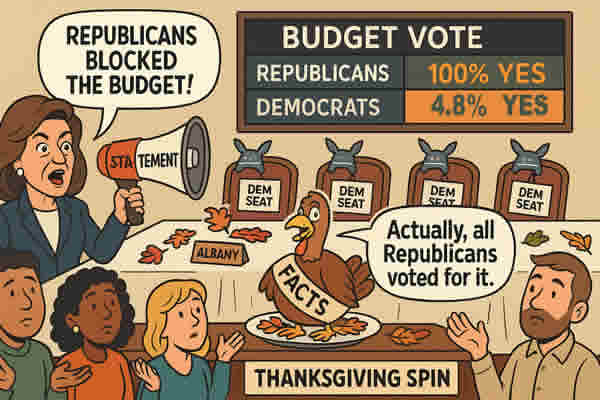
Midtown Tribune Ed.:This statement by Governor Hochul contradicts the facts: all Republicans voted for the budget, and eight additional Democratic votes were needed to reach the 60-vote threshold.
As of late October 2025, the tally in the United States Senate shows that a funding measure to avoid a shutdown (advanced via cloture) needs 60 votes to proceed, under the usual threshold for ending debate. Good Morning America+2crfb.org+2
The most recent vote on the Republican-backed continuing resolution recorded 52 yeas (including three Democrats/Independent-caucus votes) and 42 nays. The Guardian+2Good Morning America+2 Thus, to reach the 60-vote threshold, 8 more votes would have been needed (60 − 52 = 8).
So, in short: eight Democratic (or Democratic-caucus) votes were still missing for the measure at that point. #shutdown
Here are the numbers from that 52–42 cloture vote:
Democratic caucus (Democrats + King/Sanders): 3 “Yes” out of 44 who voted ⇒ 6.8% voted Yes.
Registered Democrats only: 2 “Yes” out of 42 who voted ⇒ 4.8% voted Yes.
Democrats not voting:3 (Booker, Heinrich, Rosen). U.S. Senate
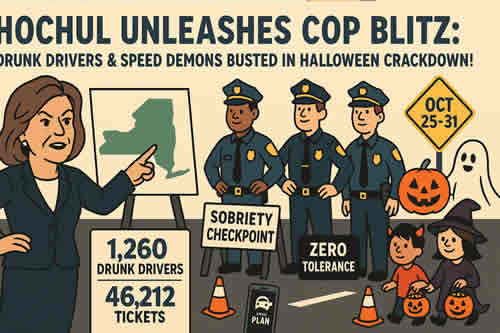
New York Governor Kathy Hochul has launched a statewide crackdown on impaired and reckless driving, deploying extra State Police and local law enforcement patrols from October 25 through Halloween night on October 31. Funded by the Governor’s Traffic Safety Committee, the initiative includes sobriety checkpoints, heightened DWI enforcement, and targets for speeding and distracted drivers amid heightened risks from trick-or-treaters and partygoers. Last year’s effort yielded over 46,000 tickets and 1,260 impaired-driving arrests; officials urge motorists to plan sober rides via the free “Have a Plan” app, citing federal data showing Halloween pedestrian deaths surge 43% and nearly one-third of fatal crashes involve drunk drivers.
Governor Hochul Announces Increased State Police and Local Law Enforcement Patrols to Combat Impaired and Reckless Driving Through Halloween
Governor Kathy Hochul today announced that State Police and local law enforcement will increase patrols through Halloween, targeting impaired and reckless drivers. The enforcement period, which is funded by the Governor’s Traffic Safety Committee, runs from Saturday, October 25 through Friday, October 31.
“Halloween should be fun and safe for everyone, regardless of how you choose to celebrate,” Governor Hochul said. “Unfortunately, poor choices behind the wheel can lead to deadly consequences. There is no excuse to drive impaired, drive distracted or speed. The New York State Police and our local law enforcement officers will be out and looking for anyone who makes the decision to jeopardize the safety of others this Halloween.”
New York State Department of Motor Vehicles Commissioner and Governor’s Traffic Safety Committee Chair Mark J.F. Schroeder said, “We want everyone to be safe and enjoy Halloween festivities. If your celebration includes consuming alcohol or drugs, plan to have a sober ride. Nothing will haunt you like a DWI. We all play a part in ensuring children and parents get home safely when they are out trick-or-treating. Look for pedestrians, lower your speed, put away the distractions and make sure everyone gets home safely.”
New York State Police Superintendent Steven G. James said, “Keeping our roadways safe is a shared responsibility, and that begins with making smart choices before you get behind the wheel. Our Troopers will be out in full force this Halloween to protect the public from impaired, distracted, and reckless drivers. We want everyone to enjoy the holiday, but safety must come first. Plan ahead, drive sober, and help us make sure every child and family makes it home safely.”
New York State Sheriffs’ Association President and Chautauqua County Sheriff James Quattrone said,“Law enforcement will be out to make sure everyone is safe this spooky time of year. As families are enjoying Halloween, and sometimes the days before and after, drivers need to be on the lookout for pedestrians. It is hard to see little ghouls and goblins if you are speeding or driving impaired. The Sheriffs of New York State want you to enjoy your tricks and treats safely, so obey the speed limit and drive sober.”
During last year’s initiative, law enforcement officers issued 46,212 citations, arrested 1,260 drivers for impaired driving and ticketed 9,029 drivers for speeding.
Motorists can expect several sobriety checkpoints and additional DWI patrols during the enforcement period. In addition to targeting impaired drivers, law enforcement officers will also be looking for drivers that are distracted or speeding.
The National Highway Traffic Safety Administration reports Halloween is a particularly deadly night due to the high number of impaired drivers on the roads and a significant increase in pedestrians. In 2023, 29 percent of fatal car crashes on Halloween involved impaired drivers. Studies also show that pedestrian deaths increase by 43% on Halloween compared to other nights. NHTSA data also shows that the impaired driving crisis killed more than 13,000 people for the second year in a row. Drunk driving deaths have increased 22 percent since 2019 with someone killed or injured in a drunk driving crash every 85 seconds.
For drivers who might find themselves in need of a way home after Halloween parties, the Governor’s Traffic Safety Committee and the New York State STOP-DWI Foundation’s “Have a Plan” mobile app is available for Apple and Android smartphones. The app enables New Yorkers to locate and call a taxi service and program a designated driver list. It also provides information on DWI laws and penalties, and a way to report a suspected impaired driver.
New York, it’s go time! Confirm your registration by tonight’s deadline, then make a plan to vote. Early voting starts today and runs through next weekend, so pick a day, find your polling site, and be heard. Learn more and get set: https://voterlookup.elections.ny.gov/
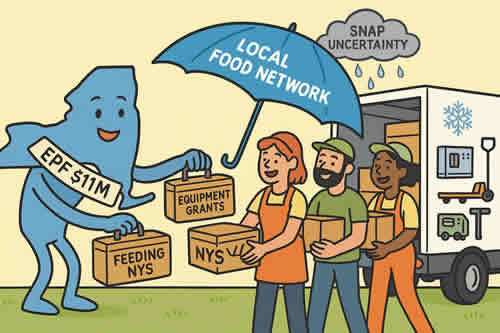
New York Gov. Kathy Hochul said the state will allocate more than $11 million to shore up food-relief operations, including over $5 million in equipment grants for 97 nonprofits and more than $6 million to support Feeding New York State and the 10 regional food banks. The funds—drawn from the Environmental Protection Fund—aim to expand storage and transportation capacity and sustain staffing as the state implements its food-donation and recycling law. Officials said the program, begun in 2018, has helped scale food recovery efforts, including 63 million pounds of edible food captured since 2022, as groups brace for uncertainty around federal SNAP benefits.
Governor Kathy Hochul Announces More Than $11 Million to Support Local Emergency Food Relief
Grant Funding Supports Food Emergency Relief Programs Operated by 97 Not-For-Profit Organizations Across the State. New York State Renews Partnership with Feeding New York State for Nation-Leading Food Donation and Collection Program
Governor Kathy Hochul today announced more than $11 million to support emergency food relief for New Yorkers in need. More than $5 million in Local Emergency Food Relief Equipment grants were awarded to nearly 100 not-for-profit organizations, including food pantries, soup kitchens, and other programs dedicated to assisting New Yorkers experiencing food insecurity across the state. In addition, more than $6 million will support a renewed partnership with Feeding New York State and the 10 regional food banks by funding critical staffing and essential operations at food banks and their local partners statewide. This action comes at a time when the Trump Administration refuses to ensure the nearly 3 million New Yorkers who rely on SNAP will have access to their benefits next month ( Editor: Democratic Party leadership refuses to accept the budget, and Trump has no authority).
“While the Trump administration continues to starve federal food assistance programs of funding, New York State is investing directly in local organizations that feed New Yorkers who are struggling with skyrocketing food prices,” Governor Hochul said. “With more than three million New Yorkers experiencing food insecurity, including more than 750,000 children under the age of 18, we are making investments in community-based food relief organizations to fight hunger and complement our wide-ranging affordability efforts.”
A total of 97 Local Emergency Food Relief Equipment grants, ranging from $1,200 to $100,000, will help organizations purchase emergency generators and equipment used for cooling and transporting donated food, and expand the quantity and type of food emergency food relief organizations can provide to New Yorkers in need. The grant program is administered by the Department of Environmental Conservation (DEC) as part of an ongoing commitment to properly manage wasted food, prevent food from needlessly being thrown away, reduce greenhouse gas emissions, feed hungry New Yorkers and engage with communities across the state.
With funding provided by the State’s Environmental Protection Fund (EPF), DEC has awarded millions to 145 emergency food relief organizations since the program was first created in 2018 to assist with the purchase of equipment used for the cooling and transportation of donated food to New Yorkers in need.
DEC is also renewing its nation-leading partnership with Feeding New York State and the 10 regional food banks as part of the ongoing implementation of the New York State Food Donation and Food Scraps Recycling Law. DEC is providing more than $6 million to Feeding New York State to support the ongoing deployment of staff to grocery stores, supercenters, restaurants and other food service and food retail businesses to enhance donation activities. Funding will also be used to purchase essential equipment and supplies that support food recovery efforts at food banks and their local partners and hire additional staff at food banks. It will also enhance the Venison Donation program that supports additional processing of high-quality venison. DEC has provided $10.8 million to Feeding New York State and the 10 regional food banks through the EPF since 2018.
New York State Department of Environmental Conservation Commissioner Amanda Lefton said, “New York State continues to make real progress in reducing wasted food and helping feed communities experiencing the ongoing erosion of social safety nets due to federal funding cuts. Governor Hochul’s latest $11 million to support emergency food relief organizations across the state and continuing nation-leading partnerships with Feeding New York State and regional food banks will be instrumental in providing healthy, quality food to hungry New Yorkers.”
Feeding New York State Interim Executive Director Kathleen Stress said, “Food programs are essential in the fight against hunger. Feeding New York State, in partnership with our food banks and their local programs, is expanding agency-enabled pick-ups from food generators like grocers and producers. Since launching this initiative in 2022, we’ve successfully recovered 63 million pounds of edible food for our charitable network. We’re proud to continue this impactful work with support from Governor Hochul and DEC.”
Highlights of the nearly 100 Local Emergency Food Relief Equipment grant-funded projects include:
Capital Region
Food Pantries for the Capital District, $100,000: support the lease of three box trucks to help increase organizational capacity for food distribution. This equipment will directly impact and improve the organization’s Food Express pick-up and delivery of food orders from the Regional Food Bank, and their food shuttle delivery program.
Higher Horizons Development Corporation, $93,754: support the purchase of a van/box truck, blast freezer, and generator that will allow Higher Horizons Food Pantry to increase the amount of food it can offer.
Sycamore Collaborative, $98,185: support the purchase of a box truck with a lift gate, refrigerator, and a straddle stacker to help increase the amount of food available for those in need through the organization’s food pantry.
Central New York
Seven Valleys Health Coalition, $56,000: und the purchase of a pickup truck, bed topper for the truck and three insulated food storage containers. This equipment will help to expand two of their program’s Seven Valleys Food Rescue and Produce Prescription.
Westcott Community Center $1,200: support the purchase of a freezer that will allow the center to increase storage capacity at their food pantry.
Finger Lakes
House Of Mercy Inc., $50,607: support the purchase of a cargo van and insulated containers that will allow them to increase the amount of food they can distribute to those in need at their emergency shelter.
Irondequoit Community Cupboard Inc., $22,960: fund the purchase of a back-up generator which will keep their refrigeration equipment operating and continue to serve their clients during the event of a power loss.
Long Island
Sid Jacobson Jewish Community Center, $63,755: support the purchase and installation of a walk-in freezer and generator. The equipment will help enhance the ability to collect, store, and distribute perishable foods.
People Loving People Inc., $56,800: support the purchase of a truck to transport more food from donors to their food pantry.
Mid-Hudson
Second Chance Foods Inc., $100,000: support the purchase of a cargo van, outdoor walk-in cooler, outdoor walk-in freezer, three reach-in refrigerators, and a reach-in freezer. These purchases will increase storage capacity for donated food set for distribution.
The Family Resource Center of Peekskill, $100,000: support the purchase of a hybrid truck, a car refrigerator, two commercial freezers, a refrigerator, and a backup, solar battery generator. The equipment will help expand outreach for their Harvest Time Food Pantry Program to serve more people.
Port Chester Carver Center, $100,000: support the purchase of a box truck with a lift gate and emergency generator to help increase their storage capacity and allow them to expand their Retail Recovery partnership.
Mohawk Valley
Feed Our Veterans, $100,000: support the purchase of a heavy-duty vehicle that will allow them to increase the amount of picked up donations. They will also purchase an emergency generator that will allow them to keep their freezers running in the event of a power outage.
Rescue Mission of Utica, $32,317: support the purchase of a walk-in cooler and walk-in freezer to help increase their capacity to store food.
New York City
Al-Madinah School Inc, $100,000: support the purchase of a refrigerated truck, a commercial walk-in cooler and commercial walk-in freezer. This equipment will enhance their emergency pantry’s ability to receive, store, and distribute fresh, perishable food to those in need.
The Connected Chef Foundation Inc., $100,000: support the purchase of two insulated walk-in refrigerated units, four refrigerators, and two freezers. The equipment purchased will help expand the Lifeline Groceries emergency food distribution program.
The Flatbush Community Fund, $100,000: support the purchase of a walk-in cooler, a walk-in freezer, an electric forklift, two coolers, a freezer, and an emergency generator. The equipment will help increase the amount of food their pantry can receive and distribute to those in need.
North Country
Essex Food Hub Inc., $81,000: support the purchase of a refrigerated van and cooler trailer to help support their Farm to Food Pantry program. The refrigerated van will allow transporting more food and the cooler trailer increases storage capacity to preserve donated food.
Joint Council for Economic Opportunity of Clinton and Franklin Counties Inc., $80,069: support the purchase of a walk-in cooler, two freezers and a box truck to help increase capacity at and transport to their Plattsburgh food pantry.
Southern Tier
Catholic Charities of Broome County, $46,496: support the purchase of a 2024 food transit cargo van and insulated food delivery cooler bags to expand the ability to deliver food to individuals, families, and unhoused individuals who are unable to visit their food pantry.
Corning Council for Assistance, $96,000: support the purchase of a backup generator, exterior walk-in refrigerator, and exterior walk-in freezer. The new equipment will increase the amount of food provided to individuals in need by improving their food pantry’s operations and expanding its storage capabilities.
Western New York
Rehoboth House of Prayer Inc., $99,262: support the purchase of a refrigerated box truck, electric pallet jack and charging station, walk-in freezer, walk-in cooler, and emergency generator. This equipment will increase capacity for food storage and distribution.
Cazenovia Recovery Systems Inc., $92,934: support the purchase of two walk-in cooler/freezer units for two of their locations, Sundram Manor and Unity House.
A full list of awardees is available on DEC’s website.
New York State Food Donation and Food Scraps Recycling Law
The New York State Food Donation and Food Scraps Recycling Law, which helps reduce waste and climate-altering emissions caused by landfilling, also demonstrates the State’s commitment to vulnerable New Yorkers impacted by devastating federal cuts to social programs that feed communities across the nation.
Governor Hochul recently announced a record 63 million pounds of food collected from the state’s largest food-related businesses to feed hungry New Yorkers. The milestone is a direct result of DEC funding to capture new food donations and help build stronger, healthier communities.Watch a video announcing the latest record food donation milestone held during Climate Week and Hunger Action Month: https://youtu.be/xlt4A8CNOGE
For information about how all New Yorkers can help compost and take other steps to reduce waste at homes and businesses, visit DEC’s website.
New York State Leads on Affordability, Hunger, and Food Diversion Under Governor Hochul’s leadership, New York State continues to bring more New York food to New York school children, with support from the Nourish New York program, the 30 Percent NYS Initiative for school meals, the Farm-to-School program, the FreshConnect Fresh2You initiative, the Food Access Expansion Grant Program, the Farmers’ Market Nutrition Programs, the Urban Farms and Community Gardens Grants Programs, and more. These investments build on the Governor’s commitment to boost demand for New York agricultural products, bolster New York’s food supply chain, and ensure all New Yorkers can access fresh, local foods. This includes the Governor’s Executive Order 32 directing State agencies to increase the percentage of food sourced from New York farmers and producers to 30 percent of their total purchases within five years. The Governor has also committed $25 million toward the New York State Grown & Certified Infrastructure, Technology, Research and Development Grant Program to assist food producers, processors, distributors, and others using New York ingredients to bring innovative NYS Grown & Certified products to market and recently announced $10 million available through Round 3 of New York’s Regional School Food Infrastructure Grant Program to bring more New York food to New York schools.
Governor Hochul also announced in June, $13.7 million in funding for 19 projects statewide through the Resilient Food Systems Infrastructure Grant Program to provide capital and technical assistance to farmers and food businesses operating at the middle of the supply chain, helping to enhance coordination throughout the food system and improve access to markets for farmers. This investment will help connect the dots between our state’s food producers and retail operations.
Additionally, in September, Governor Hochul announced New York State’s first-ever inflation refund checks up to $400 are being sent to 8.2 million households statewide as part of her ongoing commitment to put money back into the pockets of New Yorkers. Earlier this year, the Governor also secured and enacted initiatives to cut taxes for the middle class to their lowest levels in 70 years, expand New York’s Child Tax Credit to up to $1,000 per child for the youngest children, and ensure universal free school meals to save families around $1,600 per child. Governor Hochul also announced that 1.6 million low-income children received summer food assistance totaling $194 million as part of the 2025 Summer Electronic Benefits Transfer, Summer EBT, program. The program provides $120 per child to eligible families to help pay for healthy food during the summer months when children might not have access to free school meals.
State Senator Roxanne J. Persaud said, “Access to nutritious food is a basic human right, not a privilege. I commend Governor Hochul for directing these critical funds to support food pantries, soup kitchens, and food banks that are on the frontlines of fighting hunger in our communities. At a time when federal uncertainty threatens SNAP benefits for millions, New York is once again stepping up to ensure that no family goes hungry. These investments strengthen not only our emergency food network but also our shared commitment to compassion and dignity for every New Yorker.”
State Senator Pete Harckham said, “With food insecurity continuing to plague our communities, New York must do everything it can to fight hunger. These new investments in Local Emergency Food Relief Equipment grants and Feeding New York will assist food banks statewide in gaining the resources necessary to carry out their vital services to our residents. I appreciate Gov. Hochul and my State Legislature colleagues for staying focused on the need to address undernourishment in this ongoing food crisis.”
Assemblymember Andrew Hevesi said, “Our federal government, under Republican party control, has decided to cut SNAP benefits for 3 million New Yorkers. At this exact same moment I want to express my gratitude to Governor Hochul, Speaker Heastie, Assembly Environmental Conservation Committee Chair Deborah Glick and all of my colleagues for fighting annually to increase the New York State Environmental Protection Fund. That yearly fight pays off today for New Yorkers in need with this announcement of EPF funded emergency food relief for nearly 100 non-profit food pantries and soup kitchens as well as emergency food relief equipment grants.”
Assemblymember Steven Raga said, “Access to food should never be a luxury — it is a human right. As elected officials, it’s our responsibility to ensure that no New Yorker is left behind when it comes to access to food. Governor Hochul’s multi-million dollar investment to support emergency food relief reaffirms our state’s commitment to fighting hunger, strengthening local food networks, and uplifting the communities that need it most. Thanks to her leadership, we’re seeing that support right here in Assembly District 30, where funds are being dedicated to the Connected Chef Foundation to expand its emergency food distribution program. I look forward to continuing to work with my colleagues and the Governor to ensure every New Yorker has access to food.”
Brooklyn Borough President Antonio Reynoso said, “While Trump feeds his greed and ego, New York is stepping up to feed our state. New York won’t stand by while Trump threatens our healthcare and SNAP benefits with his lengthy government shutdown. I am deeply grateful to Governor Hochul for including Al-Madinah School Inc., and the Flatbush Community Fund in her emergency funding to ensure that Brooklyn can fight back against these starvation tactics.”
New York City Councilmember Shahana Hanif said, “In the face of White House’s attacks on working class New Yorkers, Governor Hochul is stepping up efforts to address food insecurity,” said Council Member Shahana Hanif. “I applaud the critical investments she is making, including supporting Al-Madinah School in my district with a refrigerated truck that will dramatically improve their emergency pantry’s operations.”
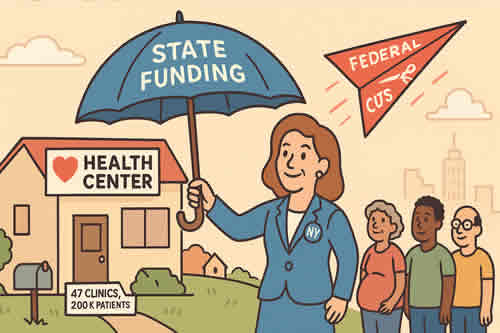
New York Gov. Kathy Hochul said the state will replace federal Medicaid reimbursements lost under H.R. 1, which bars organizations that provide abortions and received at least $800,000 in 2023 from federal Medicaid funding. Planned Parenthood’s five New York affiliates—operating 47 clinics that serve about 200,000 patients a year, including 100,000 Medicaid recipients—were designated “prohibited entities,” making them ineligible for federal funds across all services. State dollars will cover the gap to maintain access to contraception, abortion services, STI/HIV prevention, prenatal and menopausal care, mental health support, wellness visits and cancer screenings, with an emphasis on rural and medically underserved areas. The move follows broader state investments in reproductive health, including provider protections and $25 million annually through the New York State Abortion Access Program.
Governor Hochul Steps in to Protect Critical Health Care Provided by Planned Parenthood in Face of Federal Cuts
Republicans in Washington Stripped Funding for Planned Parenthood Clinics Across Nation
Governor Secures State Funding To Ensure New Yorkers Have Access to the Care They Need
Governor Kathy Hochul today announced that New York State will protect access to reproductive health care services despite Washington Republicans’ targeted attacks against Planned Parenthood health centers and the services they provide. Earlier this year, Congressional Republicans voted to end Medicaid patients’ ability to seek care at Planned Parenthood, threatening Planned Parenthood’s ability to operate in New York and compromising New Yorkers’ access to health care services, including contraception, abortion, STI and HIV prevention, prenatal and menopausal care, mental health services, and preventive care like wellness visits and cancer screenings.
”Washington Republicans have shown time and again that they’ll stop at nothing to undermine women’s health care and restrict access to reproductive rights,” Governor Hochul said. “In the face of Congressional Republicans voting to defund Planned Parenthood, I’ve directed the state to fund these vital services, protecting access to health care that thousands of New Yorkers rely on. I will always stand up for reproductive rights and the health care that New Yorkers deserve.”
Planned Parenthood is the leading provider of sexual and reproductive health services in New York State via five affiliate organizations, including Planned Parenthood of Greater New York, Planned Parenthood Hudson Peconic, Planned Parenthood of Central and Western New York, Planned Parenthood of the North Country New York, and Upper Hudson Planned Parenthood. This network of affiliates currently operates 47 health centers that serve over 200,000 patients each year. This includes 100,000 Medicaid patients, totaling over $35 million in annual Gross Medicaid revenue.
Over 60 percent of Planned Parenthood health centers are in rural or medically underserved areas, and these centers are often the only option available to New Yorkers living in these rural areas. They are a critical source of affordable health care to Medicaid and non-Medicaid recipients.
What Washington Republicans Voted To Do:
H.R. 1, enacted into law on July 4, includes a one-year prohibition on federal Medicaid funding for organizations that provide abortions and that received $800,000 or more in federal Medicaid funds in 2023.
H.R. 1 classified these organizations as “prohibited entities.” Planned Parenthood’s five affiliates in New York are the only providers in the state that meet the definition of a “prohibited entity.”
Prior to the passage of H.R. 1, Medicaid claims submitted by Planned Parenthood were reimbursed with a combination of federal and State dollars, though no federal dollars are used to reimburse abortion services.
Now that they are deemed a “prohibited entity” under H.R. 1, Planned Parenthood is no longer eligible to receive federal Medicaid funds for any of the services they provide.
Governor Hochul is protecting access to reproductive health care for all New Yorkers by allocating state funds to cover lost federal funding to Planned Parenthood affiliates in New York.
Governor Hochul continues to reaffirm her commitment to keeping reproductive resources safe and accessible in New York State. The Governor has made historic investments to expand reproductive freedom for New Yorkers, including increasing funding for abortion care providers, signing legislation to protect New York doctors and securing $25 million annually to fund abortion health care services through the New York State Abortion Access Program.
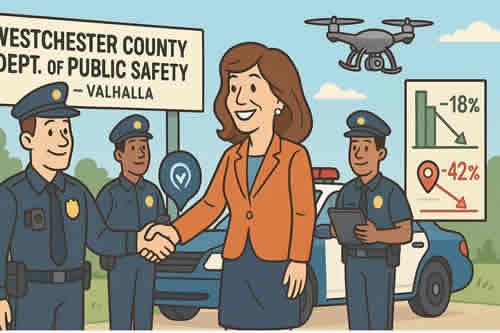
Governor Kathy Hochul today visited Westchester County to highlight the state’s investment of more than $11.4 million to modernize law enforcement technology and equipment across the county’s law enforcement agencies. The visit included a demonstration featuring state-of-the-art technology purchased by the county’s Department of Public Safety through the state’s Law Enforcement Technology grant program. These technology grants and sustained, record-level funding for other public safety initiatives – including the Gun Involved Violence Elimination (GIVE) initiative – are contributing to safer communities across the state. Westchester County has seen an 18 percent decrease in index crime since last year, and the two GIVE communities in the county have experienced a 42 percent decrease in shooting incidents with injury since Governor Hochul took office.
“Public safety is my number one priority, which is why I’ve invested $127 million in technology upgrades for local police departments across the state,“ Governor Hochul said. “I’m proud to support the men and women of law enforcement, and remain committed to enhancing the resources available to fight crime, protect our communities, and keep New Yorkers safe.”
This morning, Governor Hochul visited the Westchester County Department of Public Safety’s headquarters in the hamlet of Valhalla, located within the town of Mount Pleasant. In addition to the Department of Public Safety, the Mount Pleasant Police Department and 31 other police departments in Westchester County collectively received more than $11.4 million. Statewide, 378 police departments and sheriffs’ offices received $127 million through the Law Enforcement Tech Grant program.
The Department of Public Safety and Mount Pleasant Police Department together received approximately $1.3 million from the state, with which they purchased body-worn cameras, patrol vehicle tablets and other equipment to improve agency efficiency and accountability and community and officer safety. The Department of Public Safety also purchased GPS technology that reduces dangerous, high-speed vehicle pursuits by allowing officers to safely track and apprehend suspects, and the Mount Pleasant Police Department secured a drone for search and rescue operations. A list of police departments in Westchester County and other agencies across the state that received law enforcement technology grants is online.
Public safety is my number one priority, which is why I’ve invested $127 million in technology upgrades for local police departments across the state.
Governor Kathy Hochul
Police agencies in Westchester County reported an 18 percent decrease in overall crime during the first four months of 2025 compared to the same time last year, the most current, comprehensive data available. In addition, gun violence has decreased by double-digits in Mount Vernon and Yonkers, the two communities in Westchester County that participate in the GIVE initiative, since Governor Hochul took office. Shooting incidents with injury have declined 42 percent, the number of individuals shot has decreased 46 percent, and three fewer individuals (4 vs. 7) have been killed.
New York State Division of Criminal Justice Services Commissioner Rossana Rosado said, “As a proud Westchester County resident, I thank Governor Hochul for her record investment in law enforcement technology, which is making a real difference in communities here and across the state. By providing officers with the tools and training they need, we are strengthening local partnerships, improving public safety, and helping departments work smarter and more effectively. The results speak for themselves with fewer shootings, safer streets, and stronger collaboration across agencies.”
State Senate Majority Leader Andrea Stewart-Cousins said, “I thank Governor Hochul for her continued partnership in supporting law enforcement and helping keep our communities safe. This investment of more than $11 million in Westchester will strengthen 33 of our local police agencies as part of a $127 million statewide effort to give law enforcement the modern tools they need to prevent crime, protect officers, and build stronger community trust. These record-level investments are delivering results, crime is down and Westchester is safer because of our shared commitment to public safety.”
Westchester County Executive Ken Jenkins said, “Thank you to Governor Kathy Hochul for her leadership and understanding that fighting crime and keeping our streets safe requires both innovation and investment. I’m incredibly proud of the dedicated men and women in law enforcement who work tirelessly to protect the people of Westchester County. As the son of a New York City Police Officer, I know firsthand the toll this work can take — but I also know the immense pride that comes with achieving results like these. An 18 percent decrease in index crime is no small feat — it’s a testament to your hard work, commitment, and collaboration.”
The FY26 Enacted Budget maintained $347 million in unprecedented funding secured by Governor Hochul for gun violence prevention programs, including GIVE, and supports additional initiatives to improve public safety, expand support for victims and survivors of crime and strengthen communities.
The Division of Criminal Justice Services provides critical support to all facets of the state’s criminal justice system, including, but not limited to: training law enforcement and other criminal justice professionals; overseeing a law enforcement accreditation program; ensuring Breathalyzer and speed enforcement equipment used by local law enforcement operate correctly; managing criminal justice grant funding; analyzing statewide crime and program data; providing research support; overseeing county probation departments and alternatives to incarceration programs; and coordinating youth justice policy. Follow DCJS on Facebook, Instagram, LinkedIn and X (formerly Twitter).