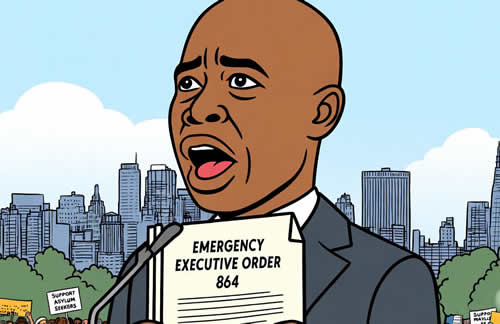
New York City Mayor Eric Adams on Sept. 25, 2025, signed Emergency Executive Order 864, extending Section 2 of EEO 862 for five days to manage an ongoing surge of asylum seekers and the resulting pressure on the Department of Homeless Services shelter system. The move continues the city’s state of emergency first declared in EEO 224 on Oct. 7, 2022, and cites authority under New York State law, the City Charter and the Administrative Code. The order takes effect immediately and can be modified or ended earlier, preserving operational flexibility as arrivals from the Southern border strain housing and services. Keywords: New York City, Eric Adams, Emergency Executive Order 864, EEO 862, EEO 224, asylum seekers, migrant crisis, DHS shelter system, September 25, 2025.
Emergency Executive Order 864
WHEREAS, over the past several months, thousands of asylum seekers have been arriving in New York City, from the Southern border, without having any immediate plans for shelter; and
WHEREAS, the City now faces an unprecedented humanitarian crisis that requires it to take extraordinary measures to meet the immediate needs of the asylum seekers while continuing to serve the tens of thousands of people who are currently using the DHS Shelter System; and
WHEREAS, additional reasons for requiring the measures continued in this Order are set forth in Emergency Executive Order No. 224, dated October 7, 2022; and
WHEREAS, the state of emergency based on the arrival of thousands of individuals and families seeking asylum, first declared in Emergency Executive Order No. 224, dated October 7, 2022, and extended by subsequent orders, remains in effect;
NOW, THEREFORE, pursuant to the powers vested in me by the laws of the State of New York and the City of New York, including but not limited to the New York Executive Law, the New York City Charter and the Administrative Code of the City of New York, and the common law authority to protect the public in the event of an emergency:
Section 1. I hereby order that section 2 of Emergency Executive Order No. 862, dated September 20, 2025, is extended for five (5) days.
§ 2. This Emergency Executive Order shall take effect immediately and shall remain in effect for five (5) days unless it is terminated or modified at an earlier date.
– New York Attorney General Letitia James’ Office of Special Investigation (OSI) today released its report on the death of Gary Worthy, who died on November 19, 2024 following an encounter with members of the New York City Police Department (NYPD) in Queens. After a thorough investigation, which included review of footage from body-worn cameras and security cameras, interviews with involved officers and witnesses, and comprehensive legal analysis, OSI concluded that a prosecutor would not be able to disprove beyond a reasonable doubt at trial that the officer’s actions were justified under New York law.
Shortly before 6:30 p.m. on November 19, NYPD officers responded to multiple 911 calls reporting a robbery with a gun at a smoke shop on Guy R. Brewer Boulevard in Queens. When officers arrived near the scene at 160th Street and Jamaica Avenue, one of the 911 callers approached the officers’ police car, pointed toward Mr. Worthy, and identified him as the alleged robber. One officer got out of the car in an attempt to pursue Mr. Worthy on foot, and Mr. Worthy started to run down the sidewalk along Jamaica Avenue. As they ran, Mr. Worthy turned and fired a gun, striking the chasing officer in the leg. The bullet went through the officer’s leg and struck a bystander in the leg. The chasing officer discharged his firearm in response, striking Mr. Worthy. Mr. Worthy was taken to a local hospital, where he was pronounced dead. The officer and the bystander were treated for their injuries. Officers recovered a gun at the scene.
Under New York’s justification law, a police officer may use deadly physical force when the officer reasonably believes it to be necessary to defend against the use of deadly physical force by another. In this case, as officers attempted to apprehend Mr. Worthy, he fired a gun, striking one officer and a bystander. Under these circumstances, given the law and the evidence, a prosecutor would not be able to disprove beyond a reasonable doubt at trial that the officer’s use of deadly physical force against Mr. Worthy was justified, and therefore OSI determined that criminal charges would not be pursued in this matter.
In this case, officers did not render aid to Mr. Worthy during the five minutes he lay on the ground waiting for the ambulance to arrive. While OSI acknowledges that medical attention outside of a hospital setting would not have saved Mr. Worthy’s life, OSI recommends that NYPD – and all police agencies – emphasize in training that officers must aid any person injured by police use of force, even if the person who needs aid has injured a police officer. Currently, NYPD’s training and policies require that when an officer uses force, officers must “obtain medical attention for any person injured as soon as reasonably possible,” and officers must “render reasonable aid to injured person(s) and/or request an ambulance or doctor to the location as necessary.”
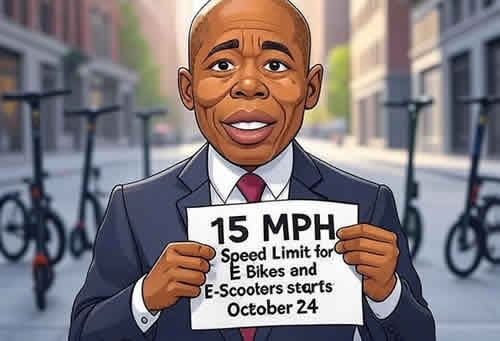
New York City Mayor Eric Adams has announced the implementation of a citywide 15 mph speed limit for e-bikes, e-scooters, and pedal-assist commercial bicycles, effective October 24, 2025, following the publication of the final rule in the City Record. The measure aligns with international best practices and is aimed at enhancing public safety amid record cycling growth and rising use of micromobility devices. The initiative builds on the Adams administration’s broader transportation safety agenda, which includes over 87 miles of new protected bike lanes, upgraded infrastructure, and the recent launch of the Department of Sustainable Delivery—a regulatory body tasked with overseeing delivery app operations and promoting safer streets. The administration continues to urge the City Council to adopt comprehensive legislation to hold app-based delivery companies accountable for incentivizing unsafe riding behaviors.
Mayor Adams Announces Citywide Speed Limit for E-Bikes to Go Into Effect on October 24
– New York City Mayor Eric Adams today delivered on a commitment made earlier this summer by announcing a citywide 15 mile-per-hour (mph) speed limit for electric bikes on city streets, effective October 24, 2025, following today’s publication of the final rule in the City Record. Once implemented, the 15 mph speed limit for e-bikes, e-scooters, and pedal-assist commercial bicycles will match the same speed limit that currently applies to stand-up e-scooters. The new rule mirrors best practices for e-bike speeds in many other areas of the world, including the European Union, which has implemented speed restrictions for e-bikes of 25 kilometers-per-hour (approximately 15 mph) in bike lanes.
“This new 15 miles-per-hour speed limit for e-bikes is about keeping New Yorkers safe while continuing to keep our city moving,” said Mayor Adams. “As more New Yorkers turn to e-bikes and e-scooters to get around our city, New Yorkers have asked us to set clear, consistent rules to address this issue and protect everyone. Starting October 24, whether you’re riding, walking, or driving, we know that everyone will be safe and protected on our streets. We’re proud of the work we’ve done to expand biking across the five boroughs while setting clear rules of the road that will improve public safety and New Yorkers’ quality of life.”
“With record bike ridership and a historic expansion of our protected bike lane network, we’re making it safer and easier than ever for the record number of New Yorkers choosing cycling by building infrastructure and providing education to meet the moment,” said New York City Department of Transportation (DOT) Commissioner Ydanis Rodriguez. “We are using every tool and studying worldwide best practices, to ensure every New Yorker is traveling at safe speeds on our streets.”
Today’s announcement is the latest step Mayor Adams has taken to enhance public safety for all New Yorkers on city streets. Other safety measures have included implementing targeted traffic enforcement against reckless driving, and the creation of the Department of Sustainable Delivery within the DOT. The Adams administration has also built a record 87.5 miles of new protected bike lanes, upgraded more than with sturdier barriers, and has begun building wider bike lanes along the city’s busiest routes to meet record demand for bike infrastructure throughout New York City.
Department of Sustainable Delivery Recently, Mayor Adams announced the Department of Sustainable Delivery. Fulfilling a promise from his 2024 State of the City Address, the Department of Sustainable Delivery will consist of a team of data analysts, policy analysts, and peace officers who will focus on methods to improve traffic and vehicle safety and work to hold delivery app companies accountable for public safety. Funded as part of Fiscal Year 2026 Adopted Budget, which builds on Mayor Adams’ “Best Budget Ever,” the Department of Sustainable Delivery will bring order to New York City streets as the number of app-based deliveries and delivery workers have soared with little accountability in place for app-based companies. The Adams administration continues to call on the New York City Council to take up the administration’s comprehensive legislation to crack down on the root cause of reckless e-bike riding by regulating the app companies that incentivize dangerous behavior.
The Adams administration continues to call on the New York City Council to take up the administration’s comprehensive legislation to crack down on the root cause of reckless e-bike riding by regulating the app companies that incentivize dangerous behavior.
“I’m sending a copy of this letter to the Secretary General, and I demand an immediate investigation. No wonder the United Nations hasn’t been able to do the job that they were put in existence to do…” – President Donald J. Trump
Donald J. Trump @realDonaldTrump
A REAL DISGRACE took place at the United Nations yesterday — Not one, not two, but three very sinister events! First, the escalator going up to the Main Speaking Floor came to a screeching halt. It stopped on a dime. It’s amazing that Melania and I didn’t fall forward onto the sharp edges of these steel steps, face first. It was only that we were each holding the handrail tightly or, it would have been a disaster. This was absolutely sabotage, as noted by a day’s earlier “post” in The London Times that said UN workers “joked about turning off an escalator.” The people that did it should be arrested! Then, as I stood before a Television crowd of millions of people all over the World, and important Leaders in the Hall, my teleprompter didn’t work. It was stone cold dark. I immediately thought to myself, “Wow, first the escalator event, and now a bad teleprompter. What kind of a place is this?” I then proceeded to make a Speech without a teleprompter, which kicked in about 15 minutes later. The good news is the Speech has gotten fantastic reviews. Maybe they appreciated the fact that very few people could have done what I did. And third, after making the Speech, I was told that the sound was completely off in the Auditorium where the Speech was made, that World Leaders, unless they used the interpreters’ earpieces, couldn’t hear a thing. The first person I saw at the conclusion of the Speech was Melania, who was sitting right up front. I said, “How did I do?” And she said, “I couldn’t hear a word you said.” This wasn’t a coincidence, this was triple sabotage at the UN. They ought to be ashamed of themselves. I’m sending a copy of this letter to the Secretary General, and I demand an immediate investigation. No wonder the United Nations hasn’t been able to do the job that they were put in existence to do. All security tapes at the escalator should be saved, especially the emergency stop button. The Secret Service is involved. Thank you for your attention to this matter!
AG James Secures First Criminal Conviction Under Home Equity Theft Protection Act
– New York Attorney General Letitia James today secured the guilty plea of former Rockland County real estate agent Oscar Dais for forging the signature of a homeowner to steal her property without her knowledge. In August 2021, Dais forged the signature of Monique Hill on a deed to take ownership of a Rockland County home while the home was in foreclosure. Dais pleaded guilty today in Rockland County Court to forgery and violation of the Home Equity Theft Protection Act (HETPA). This is the first conviction of a crime under HETPA, which helps protect New Yorkers from being taken advantage of when selling their home in foreclosure. Attorney General James worked to expand HETPA in 2023 as part of her ongoing efforts to prevent deed theft and protect New York homeowners.
“Oscar Dais took advantage of a homeowner who was dealing with a foreclosure and stole her property without her knowledge,” said Attorney General James. “No New Yorker should have to fear that the home they own will be stolen from them. I will continue to use every tool at my disposal to fight deed theft throughout our state and bring scammers like Oscar Dais to justice.”
In 2016, Hill’s mortgage lender began foreclosure proceedings after she and her husband defaulted on their mortgage. In August 2021, Dais created a copy of Hill’s deed with a signature line for “Monique Clark” – Hill’s former married name which she did not use. Dais then forged Hill’s signature on the deed and had it falsely notarized. Dais filed the forged deed with the Rockland County Clerk’s Office, transferring ownership of the property to a company he controlled. At the time that this deed was forged, notarized, and filed, Hill was in the Dominican Republic and had no knowledge of the forged deed.
In October 2021, Hill reported the fraudulent deed to the Office of the Attorney General (OAG). She then filed a civil suit against Dais, which is still pending. As a result of his conviction, Dais will pay restitution to Hill and the fraudulent deed will be voided, restoring Hill’s ownership of her share of the property.
The HETPA is a New York state law that protects homeowners selling a home in foreclosure or default to a buyer who wants to purchase the home as an investment. The HETPA requires complete contracts that sellers have a right to cancel, and the law prevents buyers from deceiving or misleading sellers. In 2023, Attorney General James advanced legislation to expand HETPA to also protect homeowners with active utility liens on their homes.
New Yorkers who believe they are a victim of deed theft are encouraged to contact OAG by calling 1(800) 771-7755, emailing deedtheft@ag.ny.gov, or filing a confidential complaint.
The OAG thanks the New York State Police for the criminal referral and its assistance with this investigation and prosecution. The OAG also thanks the City of Pooler, Georgia Police Department and the Harford County, Maryland Sheriff’s Office for their assistance in this investigation.
The case was investigated by Detective Sal Ventola under the direction of Supervising Detective Walter Lynch, and all under the supervision of Deputy Chief Juanita Bright. The Investigations Bureau is led by Chief Oliver Pu-Folkes. The audit function was undertaken by Principal Auditor Investigator Dmitry Temis under the supervision of Deputy Chief Auditor Sandy Bizzarro. The audit team is led by Chief Auditor Kristen Fabbri.
This case was prosecuted by Assistant Attorney General Lauren Sass, with initial investigation and assistance by Assistant Attorney General Nazy Modiri, under the supervision of the Real Estate Enforcement Unit Section Chief Nicholas John Batsidis, Public Integrity Bureau Chief Gerard Murphy and Deputy Chief Kiran Heer, with assistance from Legal Support Analyst Meredith Youngblood. Both the Investigations Bureau and the Public Integrity Bureau are part of the Division for Criminal Justice. The Division for Criminal Justice is led by Chief Deputy Attorney General José Maldonado and overseen by First Deputy Attorney General Jennifer Levy.
During a live interview on WBAI’s What’s Going On!, Mayor Eric Adams discussed New York City’s progress in reducing gun violence, citing historic lows in shootings during the first seven months of 2025. Adams emphasized a dual strategy of enforcement and prevention, including the removal of nearly 24,000 illegal guns and the expansion of youth-focused programs—such as 100,000+ summer jobs, 11,000 paid internships, and targeted support for foster care and NYCHA youth. He also highlighted national efforts by the African American Mayors Association to address root causes of violence in underserved communities. Responding to concerns about school absenteeism, Adams stressed the city’s renewed focus on re-engaging chronically absent students and called for greater federal support to address long-term impacts of the migrant crisis and systemic disparities.
Mayor Adams Calls In for Live Interview on WBAI’s “What’s Going On!”
Isaac Ferguson: Good morning, Mayor Adams. Welcome to WBAI.
Mayor Eric Adams: Hey, how’s it going? Great to be on with you.
Ferguson: It’s been some time since we’ve talked, mayor. It’s my pleasure.
Mayor Adams: Thank you for allowing me to come on and chat with you.
Ferguson: Mayor Adams, you go straight to the point. I know you’re having a crazy busy morning. I know you’re part of a national organization of Black mayors. I believe you still are very much involved in that.
Mayor Adams: Yes, it’s called AAMA, African American Mayors Association.
Ferguson: Yes, and I believe that one of the main objectives of that organization is to deal with the matter of gun violence in Black and brown communities. Am I right?
Mayor Adams: Yes, it is.
Ferguson: Can you tell us some of the developments, what’s going on with that organization, what’s their current platforms, and have they been able to make any progress?
Mayor Adams: Yes, they have. When you look at the major cities across the country, you are seeing these Black mayors really bringing down shootings and homicides. Right here in New York, in the first seven months of this year, we saw the lowest number of shootings and people who are victims of shootings drop to the lowest number in recorded history.
But not only that, our upstream solutions, when you look at these different cities, it’s not just about law enforcement, but it’s also about how you do upstream. Instead of waiting for a young person to fall into the river of violence and pull them out downstream, we went upstream.
What we’re doing with paid internships, 11,000 in the DOE, our Summer Youth Employment [Program], over 100,000. And what we’re doing with formerly justice-involved young people through our CRED program, teaching them trades and skills. So, the goal is not only to grab a young person when they commit a crime, but how do you prevent the crime from taking place in the first place. And that’s that proactive and reactive approach that you’re seeing across the country with these Black mayors.
Ferguson: Yes, mayor. But I’m here talking with young people, and gun violence has become a serious problem of the young, and especially young males. And what we’re seeing is that before the pandemic, our chronic school absenteeism stood at around 15 percent across the country. Now, it’s up over 30 percent. So, the young people are not returning to school. We told them to stay out of school because of the crisis of the pandemic, and probably people took it for granted that after the pandemic was over, they’ll return.
Now, many, many of those young males are in the streets. They’re not in school. And they’re getting into gangs. They’re forming their own families based on, call it machoism, to use an old term, and teen violence. What is being done to get these young people back into schools or get them into some situation where they can be influenced away from gangs and gang violence?
Mayor Adams: And that is so true, as you talked about it. The chronically absent children after COVID, this is the byproduct of COVID. As you indicated, many young people did not come to school because we told them during COVID to stay home. And that continued.
And in the Department of Education, we are focusing on those chronically absent young people, communicating with their family members and loved ones, finding out those who are not returning to school, coaching them to come back into school. And you’re really seeing a problem in the area of those children who are unhoused, at the shelter, or living with a family member because of a housing issue. That is the long-term impact that we are facing when it comes down to some of the violence we’re seeing.
You know, it goes back to what I shared with many New Yorkers, the impact of the $7.2 billion we lost during the migrant and asylum seeker [crisis]. Those dollars, I should say, those dollars could have gone to things like targeting our chronically absent children. We could have easily spent that half a billion dollars on just focusing on that. And when I talk about the impact of the money we lost because the federal government did not pick up the price tag, these are the things that I’m talking about.
But we are focusing on those chronically absent children to get them back into school because if you don’t educate, you will incarcerate. And that is what we’re seeing across this entire country.
Ferguson: Mayor Adams, we have many, many callers on the line. I know we can only take a few. And it’s so vital to hear from our listeners. So, we’re going to try to get one caller right now. Many people want to ask you questions and talk to you. And callers, please, stick to the matter of gun violence. I want to get the mayor’s opinion on this out to the public. And I want you to address his concerns and the activities he’s involved in with that.
First caller. Caller, you’re on the line. This is WBAI. You’re on the line with Mayor Adams, with Isaac Ferguson, and with Terri Wisdom. What’s your name, where you’re calling from, and what you got for us?
[Crosstalk.]
Ferguson: Let’s go on. Terri, you had some questions for the mayor concerning the claims that gun violence is down across New York City.
Terri Wisdom: Yes. Thank you. And good morning, Mayor Eric Adams. Welcome. We’re honored to have you here. Thank you. Extremely important to hear from you and your voice—
[Crosstalk.]
Wisdom: So, Mayor Adams, one of the things that we are hearing continually is gun violence is down. Gun violence is down across the city. And as we’re hearing that every day, we’re hearing about somebody being shot in the street, whether it’s a grandmother on a walker. And it’s mainly in our Black and brown communities. We know that there are disparities.
So, the question is, what are we doing about this systemic problem? How are we addressing it? And if, in fact, this is true, it’s overall down across the city. But in our areas, it appears to be down some. But down, you know, down less than, let’s say, in Staten Island, you know, it’s down a lot. But in Harlem or in Manhattan, it’s not.
So, what are we really doing? What are you doing to just address this matter? Because when people hear gun violence, the numbers are down, but they’re hearing about people getting shot, you know, what are we doing? And you’ve addressed some of it, but specifically, if you could address what is being done.
Mayor Adams: First, I think it’s important to know what’s the history of the overproliferation of guns. They have historically been in underserved communities, as we’ve stated. Black and brown communities, for the most part. This has been the history.
When you look at violence in Brownsville, Harlem, South Bronx, many of our young people pick up these guns because they were not receiving the real services to ensure they could not deal with gang violence and gun violence. When you think about gun violence, almost 50 percent is dealing with some form of association or attachment to gangs.
This has been a history, long, not in the last three years to four years, but even when I was a child. And so, we knew we had to zero in on what are the feeders to this violence. What causes a young person to get involved in this violence? And who are they? And that was my focus when I came into office.
A lot of them are foster care children. And we were watching our foster care children age out at 18, six to 700 a year were aging out and slipping through the cracks. So, what do we do? We’re paying their college tuition and giving them life coaches after they’re 21 years old and giving them a stipend so that they could go on with their lives and get the support that they need as any child would do.
And we knew that violence like gun violence happens after the school hours. So, what are we doing? We’re doing universal after school programs so our young people can have a place to go and participate in some form of development of their full personhood. And we also knew that many of our young people are dealing with financial restraints. And so that’s why we have paid internships, 11,000 to be exact.
And then we looked at places like NYCHA. Our public housing has always been a location where violence occurs at a large number, particularly gun violence. And for the first time, you’re seeing a substantial decrease in crime in NYCHA. And we targeted our NYCHA young people with our Summer Youth Employment [Program]. We had jobs that were allocated just for them so we could bring them into employment and give them the support they need.
And during summer months, as you saw historically, gun violence goes up over the summer months. And what we did for so many years, they were called by advocates to have a larger number of summer jobs. We, for the first time, had over 100,000 summer jobs and had our young people in school all year round. Over 110,000 young people were able to be in school all year round where they were able to get the support they needed during the summer months.
And as I stated, we also were proactive, I would say reactive, in that we removed 23,000 illegal guns off our streets, close to 24,000 actually. And we targeted those areas where we knew there was gun proliferation for the many years that we were conscious of.
And yes, it is down. And so, when you hear a high-profile shooting, it strikes your conscience and you begin to believe that these shootings are out of control. But in fact, the numbers don’t lie. We have the lowest number of shootings and victims of shootings in the recorded history of the city. The lowest number. And because we targeted those hot spots where the gangs were located.
Ferguson: Mayor, I believe we may be able to grab one caller. Caller, you’re on the line. What do you have for the mayor? People have been trying to get to you.
Question: Hi, Mayor Adams. My name is Gwen. I live in East Harlem. We met a long time ago. I wanted to put the spotlight on another part of this equation. And I think that this is, you know, this is not just a problem for New York City. This is a national problem. And one of the things we never discuss is the correlation between the legal drugs that we give children in school and gun violence.
And there are several studies, one of them Dr. Peter Breggin had spoken about, in the correlation between children that have been taking these drugs and gun violence. And actually, every single one of the kids that was involved in the mass shootings were children that had been taking legal drugs in school. They were taking Ritalin. They were taking Prozac. And now, if you read the bottles of these medicines, it tells you right there, at least on Prozac it does, that there’s a homicidal effect.
Now, it seems to me that we’ve done more to guard these, you know, drug companies than we have our own children. And I know you know this. I ran for City Council in New York City, that there are children, for example, like my neighbors, that weren’t allowed to go to school unless the parents would capitulate to be giving their drugs, like Ritalin, to their children. And this was just made easier for teachers so they didn’t have to deal with children—
Ferguson: Let Mayor Adams respond, because I believe he has to leave shortly. Can you quickly give us a response before you go, mayor, on that?
Mayor Adams: Yes. I don’t have any evidence, or I don’t know the review on this topic. I would love if there’s any reports—
Question: Dr. Peter Breggin. You can look at his work. But there’s several studies, and they’re well hidden there. I mean, it’s not something that’s right out there in the public. They don’t want you to know nationally that this could be a correlation. But, you know, you’re a smart man. And I think it would be really, really advantageous for you to look at the other sources of why this is going on.
I know how old you are. You’re around the same age as me. And when you and I went to school, we did not have mass shootings. We’ve had violence in Harlem, East Harlem, and other poor communities for different reasons.
Ferguson: Yes, ma’am. Your point is well taken. Thank you. I know the mayor has to leave at 7:45 [am]. He has informed me he has another engagement. Mayor Adams, I would love to have you back at some time to continue this discussion. It is such an important matter. And I’m asking you to continue to work for a total federal assault weapons ban and for more effective regulation of firearms. Thank you very much, mayor, for coming.
Mayor Adams: Thank you and have a good day. Take care.
Wisdom: Thank you, Mayor Adams. And I look forward to your plans to deal with gun violence if reelected. That’s what I’m looking forward to.
Governor Kathy Hochul has confirmed that MTA Metro-North Railroad will launch its new super-express service on the Hudson Line ahead of schedule, beginning October 6, 2025. Originally slated for 2026, the accelerated implementation will reduce travel times between Poughkeepsie and Grand Central Terminal to 90 minutes, and to under 75 minutes from Beacon—delivering a significant efficiency boost for Hudson Valley commuters. Supported by $26 million in capital investments, the initiative includes infrastructure upgrades, advanced train control systems, and new diesel-electric locomotives. The service enhancement aligns with the Governor’s broader transportation strategy to improve reliability, reduce congestion, and increase public transit adoption statewide.
New York. Governor Hochul Announces MTA Metro-North Railroad ‘Super-Express’ Trips Between Poughkeepsie and New York City to Launch Ahead of Schedule on Oct. 6
Governor Hochul: “These super-express trains will take you from Poughkeepsie to Grand Central in 90 minutes, and from Beacon to Grand Central in less than one hour and 15 minutes… When there is a need and when our commuters need something — they ask for improvement, enhancements, more reliability, faster speeds — we are committed to getting it done. That is my undying commitment to what is known as the lifeblood of this region.”
Hochul: “Golf’s biggest event is just about to tee off at Bethpage… It’s revered around the world for the accommodations and what we offer people, and we’re expecting another 20,000 people to literally be taking the train out to Farmingdale, which is going to put a strain on the system as they watch the U.S. take on the golf teams from Europe during the Ryder Cup. I want to make sure they all have a good experience — our locals and our visitors. And so today through Friday, we’re running eight more eastbound trains every day. And on Saturday, we’ll be adding nine more trains.”
Earlier today, Governor Kathy Hochul announced the launch of faster super-express trains on the Hudson Line between Poughkeepsie and New York City with the upcoming MTA Metro-North Railroad schedule effective Sunday, Oct. 5. The first super-express trains will run on Monday, Oct. 6. These new trips were announced in the Governor’s 2025 State of the State address and will cut travel times between Poughkeepsie and Grand Central Terminal to less than 90 minutes each way. Initially projected to launch in 2026, work was completed ahead of schedule, allowing for faster service to begin in October.
A rush transcript of the Governor’s remarks is available below:
First, I want to acknowledge some of the individuals you’ll be hearing from momentarily. Justin Vonashek, our President of Metro-North Rail — we’re going to have some announcements about Metro-North. Robert Free, the President of the Long Island Rail Road. I want to thank both of them for their tireless advocacy on behalf of not just the railroads, but, more importantly, our commuters. We also are joined by Mayor Kyriacou, the City of Beacon Mayor — he’s got some important announcements to make as well. And Anthony Simon, the union representing SMART, the thousands of Long Island Rail Road employees.
So let’s talk about Metro-North. Metro-North is more than just a train route. It is an incredible gateway between two worlds — and one is between the bustling streets of this great city, but also the charming hamlets up along the beautiful Hudson River. So you can have your morning run along the Hudson Line and then also end up at lunch time walking the streets of Manhattan and back home in a place like Beacon for dinner. So that’s the beauty of this connectivity, this extraordinary rail line, as well as its connectivity to other lines as well.
But — what I know as a New Yorker and as a mom — there’s nothing more precious in our lives than time. You know, how we get time back in our lives. And in my State of the State address, I address specifically the people who live along these rail lines, and said, “I want to give you some time back in your lives, and let’s be bold and ambitious about how we do that.” So we secured over $26 million in our State Budget for critical rail improvements along the Hudson Line.
First of all, we outfitted trains with state-of-the-art GPS and train simulation software. We also had to make significant investments in our signaling infrastructure to boost the train speeds — that was important — and adding brand new diesel-electric locomotives that are also faster and greener. And this was all supposed to happen in 2026. I said, “No. It’s going to happen in 2025.” Well, it’s 2025 and we are literally two weeks away from the start. We accelerated our timeline. We got the work done ahead of schedule. So two weeks from now, we’re going to have the super-express service along the Hudson Line begin.
So, listen to this: Starting October 6, these super-express trains will take you from Poughkeepsie to Grand Central in 90 minutes, and from Beacon to Grand Central in less than one hour and 15 minutes. How does that sound, Mayor? Pretty good for your residents of Beacon? For our daily commuters, we’re saving 14 minutes off your trip, 70 minutes a week. It’s a game changer for people. And so, if you really want to add it up, I did — four and a half hours extra a month back in your lives, and we’re just getting started.
But this is what I really love and cherish about infrastructure and transit. It’s not just about — as I said — the rails, and the bridges, the stations, it’s about connecting people in their lives and getting them home in time for their kids’ sporting event, or to help with the homework or to just kiss the little ones goodnight before they go to bed.
And this is part of fulfilling a promise I made when we finally launched congestion pricing. We said, “If we want more people to take our trains, we have to make it faster and more efficient for them to make that decision.” And so, we want to make it easier to get into Manhattan without a car, so this is part of that. If you give them reliable alternatives, this is the idea that they will embrace. And we’ve seen that incredibly, if you look at all the data associated with congestion pricing and how train ridership is up, traffic is down in the city. And so, all the results that we had hoped for are actually happening. So people told us they’d like to take the train, but they want it faster, they want it more efficient, and we delivered on that.
So these super-express trains are the latest in a long line of mass transit wins. As you know, we figured out a path, although it seemed insurmountable about a year ago, that we could fully fund the MTA capital plan — $68.4 billion. And we advanced long-stalled generational projects like the Second Avenue Subway and the Interborough Express. Again, those are my favorite ones — the ones that say “long-stalled.” Nobody could get it done. Not enough ambition or interest. And I say, “Bring those ones to me.”
And we also finished up our beautiful upgrades to Grand Central Madison in the Long Island Third Track. So we’ve proven over and over we can get it done. And these investments, not just in the systems, but also in our “Cops, Cameras, and Care” initiative we launched a couple of years ago.
Again, you’ve heard me say this, but it’s still holding. We just came off the safest summer in 10 years, the safest two month period — July and August — in recorded history. The crime rates are down. And just last week alone — last week compared to the same week a year ago — crime was down 66 percent. So, we’re making progress. I’ll say it for the 100th time: We are not declaring mission accomplished or victorious efforts here. We’re not done. But, those are numbers that cannot be challenged and they’re extraordinary, particularly considering the trajectory that we were once on.
But before we go, I have one more transit-related announcement about our sports fans, particularly our golf aficionados. Golf’s biggest event is just about to tee off at Bethpage. I was just out there last week. It’s an extraordinary, extraordinary part of our State Park system. It’s revered around the world for the accommodations and what we offer people, and we’re expecting another 20,000 people to literally be taking the train out to Farmingdale, which is going to put a strain on the system as they watch the U.S. take on the golf teams from Europe during the Ryder Cup.
So, I want to make sure they all have a good experience — our locals and our visitors. And so today through Friday, we’re running eight more eastbound trains every day. And on Saturday, we’ll be adding nine more trains. So make sure that our golf fans can get out to Bethpage without any difficulty.
So let me just say this: Today’s announcements in the scheme of all the complicating factors that are going on in the world may not seem significant to those who are not riders. But if you’re a rider, and you’ve been waiting for this, talking about it and it just never got done; people have been saying we can go faster someday, somehow — my friends, we got it done. It’s a commitment of all of our friends at the MTA, the Metro-North as well as the Long Island Rail Road.
When there is a need and when our commuters need something — they ask for improvement, enhancements, more reliability, faster speeds — we are committed to getting it done. That is my undying commitment to what is known as the lifeblood of this region. We do not function at all as the city we are without it, the region we are. And so I just want to say that we listen to the riders, and again, those are the most important voices out there in this entire system.
I know they’re going to be excited to start living the experience of having more time back in their lives. So let me talk about someone who’s very involved in this. Our next speaker, Metro-North President Justin Vonashek. And I want to thank him for finding the path to shave off a tremendous amount of time that would otherwise not have been happening until next year — we’re getting it done in 2025.
In a series of legal filings timed with Climate Week NYC, New York City is once again positioning itself at the forefront of national climate advocacy, opposing federal efforts to roll back the EPA’s 2009 Endangerment Finding. While city officials frame the move as essential to protecting public health and the environment, the broader debate over climate policy remains far from settled. Critics note that some of the planet’s highest recorded temperatures occurred in the early 20th century, before widespread industrialization, and argue that decades of massive public and private investment have yielded minimal observable changes in global climate patterns. As the cost of climate initiatives continues to climb into the trillions, questions persist about whether the current approach—centered on aggressive regulation and top-down mandates—is delivering measurable results or simply reinforcing political orthodoxy at the expense of economic flexibility and scientific debate.
City of New York Takes Multiple Actions Supporting Challenges to Federal Government’s Efforts to Roll Back Climate Science, Harm Public Health, Threaten Local Economies
The City of New York today announced that — as part of a coalition of dozens of cities, counties, and states from across the nation — it has filed three comment letters opposing the U.S. Environmental Protection Agency’s (EPA) proposed reversal of its 2009 “Endangerment Finding.” The landmark 2009 finding holds that greenhouse gas emissions — including those from motor vehicles — drive climate change and endanger public health and welfare. The new proposal — issued on August 1, 2025 — would deny the EPA’s authority to regulate harmful air pollution that contributes to climate change, harms public health, and would eliminate all existing EPA vehicle emission standards.
Additionally, earlier this month, the City of New York and a coalition of 19 attorneys general filed an amicus brief in the U.S. District Court for the District of Massachusetts in Environmental Defense Fund v. Wright, supporting the plaintiffs in a case challenging the authority of the Climate Working Group, convened by the U.S. Department of Energy in violation of Federal Advisory Committee Act requirements, to prepare a report that purports to undermine the scientific consensus on climate change.
This announcement builds on the work the Adams administration has done to address climate change and comes at the start of “Climate Week NYC,” the world’s biggest climate event of its kind. In 2024, Mayor Adams introduced the city’s first-ever climate budgeting publication through the city’s Fiscal Year 2025 Executive Budget. Climate budgeting is a process that incorporates science-based climate considerations into the city’s budget decision-making process by evaluating how actions and spending today contribute to meeting longer-term climate targets and needs. New York City is the first big city in the United States to adopt climate budgeting, joining other global cities, such as London, Oslo, and Mumbai, to utilize the process.
“New York City is no stranger to the devastating effects of natural disasters. With more extreme weather events hitting the five boroughs more often, for our safety and to protect our economy, we must be prepared for the effects of climate change, including by putting in place stronger federal regulations of greenhouse gases,” said Mayor Adams. “Attempts to undermine this scientific consensus should not be the basis for undoing important regulations that mitigate future environmental damage that threatens lives, brings harm to our communities, and hampers our economies. We are proud to stand with our partners from across the nation in taking multiple actions supporting long-held scientific findings that protect against environmental disasters in our communities.”
“More than a decade ago, the EPA formally determined that greenhouse gases threaten the public health and welfare of the American people, and that emissions from motor vehicles and engines contribute to the greenhouse gas pollution that threatens public health and welfare,” said New York City Corporation Counsel Muriel Goode-Trufant. “Now, over the span of a few months, the U.S. Department of Energy and the EPA have sought to manufacture a basis to reject this overwhelming scientific consensus, endangering all Americans and all New Yorkers.”
The 2009 Endangerment Finding was the direct result of the landmark 2007 U.S. Supreme Court opinion in Massachusetts v. EPA, which confirmed the EPA’s authority under the Clean Air Act to regulate greenhouse gas emissions that threaten public health and welfare. In direct response to that opinion, and after more than two years of scientific review, the EPA determined, in 2009, that greenhouse gas emissions from motor vehicles contribute to air pollution that harm public health and welfare.
2009 Endangerment Finding Comment Letter
In their letter submitted to the EPA today, the coalition argues that rescinding the 2009 Endangerment Finding would violate settled law, Supreme Court precedent, and scientific consensus, endangering the lives of hundreds of millions of Americans, particularly those in communities disproportionately impacted by environmental harms.
Scientific research has proven that every region of the country is experiencing harms of climate change and motor vehicle pollution, including changes in temperature, precipitation, and sea level rise. Extreme summer heat — driven by climate change — is leading to increased rates of heat-related illnesses and deaths, particularly among vulnerable populations like children, the elderly, low-income individuals, and workers. Increasing rates of natural disasters — like wildfires, hurricanes, flooding, and droughts — not only have a devastating effect on public health and safety, but on state and local economies as well.
Climate change poses existential risks to New Yorkers’ health and safety. Sea level rise in New York City is putting communities and infrastructure at risk of regular flooding. Extreme weather events — such as Superstorm Sandy in 2012 and Hurricane Ida in 2021 — can result in injury and loss of life due to exposure, interrupted utility service, or lack of access to emergency services. Additionally, warming temperatures exacerbate or introduce health problems. On average, more than 500 New Yorkers die prematurely because of extreme heat in New York City each year.
Not only does the EPA’s proposed reversal ignore those facts, but it also violates the EPA’s legal obligations under the federal Clean Air Act to regulate greenhouse gas emissions to address climate change.
The coalition argues, in today’s letter, that the EPA’s new legal interpretations are inconsistent with the Clean Air Act and binding Supreme Court precedent, and that the proposal would mark a drastic reversal of its own longstanding findings without any explanation grounded in science. To make matters worse, the Climate Working Group report on which the EPA relies is substantively flawed, yet the EPA blindly accepts its findings and disregards the scientific consensus, which was just reaffirmed by the National Academies of Sciences, Engineering, and Medicine last week.
In filing this comment letter, the coalition urges the EPA to abandon its proposal to rescind the 2009 Endangerment Finding.
Motor Vehicles Comment Letter
In withdrawing the 2009 Endangerment Finding, the EPA also proposes to repeal all existing federal greenhouse gas emissions standards for all motor vehicle classes and all years. In a second letter submitted to the EPA today, the coalition explains that this unprecedented disruption to the regulatory norms of the last 15 years will harm states and local governments’ residents, industries, natural resources, and public investments.
Regulatory enforcement for greenhouse gas emissions is also crucial to vehicle affordability, consumer choice, and to the success of the American automotive industry. The greenhouse gas program for vehicles incentivizes automakers to innovate and create better cars, saving drivers hundreds of billions of dollars in fuel and maintenance costs, and helps support domestic manufacturing and jobs. Repealing that program, as the EPA now proposes, will shutter factories, kill jobs, and wipe out billions of dollars in investments by Congress, states, and local governments to keep the American auto industry thriving and globally competitive.
Climate Working Group Comment Letter
Earlier this month, on September 2, the City of New York joined another coalition of 27 localities from around the nation in filing a comment letter opposing the Climate Working Group report that EPA relied on in its proposed recission of the 2009 Endangerment Finding.
In that comment letter, the coalition identified several legal flaws in the Climate Working Group report. In creating the Climate Working Group, the U.S. Department of Energy selected five widely known climate change skeptics, ignored well-established scientific integrity standards, and failed to comply with the Federal Advisory Committee Act’s procedures, which require the disclosure of all committee-related records and that committee meetings be open to the public.
The report — written in less than two months and filled with inaccuracies, factual omissions, and mischaracterizations of climate science research — attempts to critique decades of peer-reviewed scientific research establishing that the emission of greenhouse gases cause climate change and endanger public health and welfare.
In filing the comment letter, the coalition urged the Department of Energy to withdraw the unlawful and misguided Climate Working Group report.
Joining the City of New York in filing all three comment letters were the attorneys general of Arizona, California, Connecticut, Colorado, Delaware, the District of Columbia, Hawaii, Illinois, Maine, Maryland, Massachusetts, Michigan, Minnesota, New Jersey, New Mexico, New York, North Carolina, Oregon, Rhode Island, Vermont, Washington, Wisconsin, and the chief legal officers of the city and county of Denver, Colorado, Chicago, Illinois, and Martin Luther King Jr. County, Washington.
Climate Working Group Amicus Brief
On August 29, the City of New York and 19 attorneys general from around the nation filed an amicus brief in the U.S. District Court for the District of Massachusetts in Environmental Defense Fund v. Wright, supporting the plaintiffs in their effort to declare the Climate Working Group’s report unlawful.
In their brief, the coalition argued that the Department of Energy violated the Federal Advisory Committee Act by establishing and utilizing the Climate Working Group, and that this violation will harm state and local governments’ strong interest in ensuring that the federal government rely on the best available science to guide its climate policy decisions. In New York City, the New York City Panel on Climate Change uses federal climate data to develop its own reports and mapping tools, which inform many city policies, including the Climate Resilience Design Guidelines and zoning rules related to current and future flood conditions.
On September 17, the district court held that the federal government is not exempt from the Federal Advisory Committee Act.
Joining the City of New York in filing this amicus brief were the attorneys general of California, Colorado, Connecticut, Delaware, the District of Columbia, Hawaii, Illinois, Maine, Maryland, Massachusetts, Michigan, Minnesota, New Jersey, New Mexico, New York, Oregon, Vermont, Washington, and Wisconsin.
In addition to the actions described above, Elijah Hutchinson, Executive Director of the New York City Mayor’s Office of Climate and Environmental Justice, testified before EPA on August 21 to oppose its proposed recission of the 2009 Endangerment Finding and motor vehicle greenhouse gas standards.
These four actions build on the numerous actions the Adams administration has taken to protect New Yorkers from the effects of climate change. Just last week, Mayor Adams broke ground on a $218 million public safety project to protect Red Hook from coastal flooding and save hundreds of millions of dollars for residents in lost property costs. And, as announced in the Mayor’s Management Report last week, in Fiscal Year 2025, the city saw major environmental gains and savings, largely due to composting and recycling. Overall recycling tonnage increased 4 percent, and the diversion rate of recyclables rose for a third consecutive year to 21.8 percent, the highest since Fiscal Year 2011. Tons of refuse disposed to landfills decreased to the lowest level in at least 15 years, largely due to the tons of organic waste that were diverted, which increased nearly 29 percent. In 2023, Mayor Adams celebrated the passage of the “City of Yes for Carbon Neutrality” proposal, a historic set of citywide zoning changes that will facilitate climate action, clean energy, and resiliency.
During a live interview Eric Adams and First Deputy Mayor Randy Mastro addressed key issues facing the city, including preparations for UN General Assembly security, casino licensing developments, and the future of the horse carriage industry. Mayor Adams reiterated his commitment to re-election and emphasized continued support from working-class and Jewish communities, despite persistent media speculation about his political future. Deputy Mayor Mastro highlighted the administration’s focus on job creation and revenue generation through casino expansion, while both leaders stressed public safety and economic revitalization as top priorities. The mayor also clarified his position regarding national political figures and reaffirmed his dedication to leading New York City.
Mayor Adams Calls In for Live Interview on 77 WABCs “Sid & Friends in the Morning”
Sid Rosenberg: Now we get two guys on the phone, two great guys, one being the mayor himself, Eric Adams, and his first deputy mayor, a friend of mine as well, Randy Mastro. So, Mr. Mayor, Mr. First Deputy Mayor, good Monday morning. How are you guys?
Mayor Eric Adams: Hey, how’s it going, Sid? It’s great to be on with you.
First Deputy Mayor Randy Mastro: Always great to be with you, Sid.
Rosenberg: Thank you, guys. Thank you both. Well, let’s get to the first question. I guess you both can answer this and that is what I just talked about. Busy week here in New York. The UN General Assembly really starts later on today. But Trump will be here tomorrow. Zelensky Wednesday. Putin speaks on Thursday. Bibi speaks on Friday.
And on top of that, the Jewish New Year starts tonight. I know Jessica Tisch is hard at work, guys, as we speak. So let’s get to it, Mr. Mayor and Randy. What about this very busy week in terms of security here in New York City?
First Deputy Mayor Mastro: We are a city, Sid, that welcomes the world here. We will welcome all of these dignitaries, the president, Netanyahu. And we will have a safe city. We’ve got the greatest Police Department in the world. We know how to make the city safe for big events like this. There will be traffic issues. People are encouraged to use public transportation.
And we also have this important Jewish holiday. It’s a great time. And we intend to make the city safe for all those who are practicing their faith. So it’s a special time in the city. We live in the greatest international city in the world. And we have the greatest Police Department to make it safe.
Rosenberg: Eric, I do want to get to the Jewish part of this discussion. Randy just mentioned that it will be safe and we put our trust and faith in you. But I did read something in the New York Post this weekend that said that you are very confident that you still got a shot in this race, if not going to win this race, because of specifically the Jewish vote. So as we get set to usher in Rosh Hashanah tonight, I read that in the New York Post, so it’s got to be true. You are confident that the Jewish people will vote for you, yes?
Mayor Adams: As I indicated during the interview, my secret weapon is working class people, the Jewish community, all of these various communities. As you see the attacks and assaults, and even on part of the Indian community of some of the comments that are made, arresting Modi, arresting Netanyahu, what the Democratic primary winner has bestated. Working class people and the various communities over the city, I believe there’s a real silent majority in this city, and I’m looking forward to that.
Rosenberg: Before we get back to some of the campaign stuff with you, Mr. Mayor, there are a couple of business things we’ll discuss here quickly. Let me tell you, okay, guys? I’m not one of these old-fashioned idiots who thinks casinos are bad for the neighborhood. Trust me when I tell you, they’re just wrong.
It gets jobs. It brings in revenue. I don’t understand why people would not want a casino. Look what it’s done to Atlantic City. It’s still a dump outside the casino park, but at least that part is nice. All these other great cities that have casinos, we need it here. So I know the Freedom Plaza casino plan is about to get voted on, but you guys, you tell me. What is the likelihood that’ll get done with that one? If not them, then who?
First Deputy Mayor Mastro: Well, Sid, once again, you’re speaking common sense. I mean, it’s thousands of jobs. It’s billions in revenue for the local economy. And, you know, what happened last week with the projects in Times Square and on the far west side, you know, that just denied New York City the opportunity to compete for a limited number of casino franchises.
Now, what’s going to happen on the east side? Again, our administration supports each of these New York City plans going forward so they can compete in the final round for a limited number of casino licenses. But, unfortunately, the way the system was established at the state legislative level, the mayor, you know, has a representative, but there are also, you know, local electeds who have representatives, and each of their votes counts equally.
That’s why you had what happened on the west side happen, shouldn’t have happened. We are confident that several of the city’s casino plans will go through, but each vote, you know, is weighted heavily in favor of local elected officials, unfortunately.
Rosenberg: Yeah, I don’t like that either. So, is it fair to assume then, Randy, I mean, we’re going to get, what, three? I know Stevie Cohen’s got a chance out there in Queens. I thought the Coney Island one in Brooklyn was dead, but I guess not. But we’re going to get three. Is that right?
First Deputy Mayor Mastro: Well, you’ve got Bally’s in the Bronx, which the City Council tried to kill, and the mayor saved it, and they couldn’t override his veto. You’ve got Steve Cohen’s proposal in Queens. You’ve also got the resort’s proposal in Queens. These are strong proposals.
And, of course, you have Coney Island, which is an intriguing proposal, right? And today, fingers crossed, local electeds will join the mayor and do the right thing. But, you know, we’re going to have some strong proposals, think that we’ll go through to the final round, and hopefully we’ll get the benefit. Billions of dollars and thousands of jobs for the local economy.
Mayor Adams: And, Sid, an indicator of how successful the community and the corporate partnership could be is just go look at in Queens, Aqueduct. You know, thousands of jobs, new development, hotels, it becomes an anchor for the entire community and tourism. You know, tourists come in, they come for the entertainment, and it’s just a real win. And so it’s unfortunate that this sort of NIMBYism gets in the way of how these great projects can benefit the entire city.
Rosenberg: Couldn’t agree more gentleman. When I go to Florida, I stay at the Seminole Hard Rock Hotel and Casino. My God, Jimmy Allen, I love that place. The hotel, to be exact.
You know, Randy and Eric, you both just mentioned the City Council. I know, Mr. Mayor, you’re going back and forth with them on these horse carriages. Now, I know some horse took off last weekend. That’s scary when one of these horses actually is running through the street.
So there is a safety factor here, too, besides the fact that it’s always been the contention of animal lovers that over the years the horses aren’t treated well. I know, Mr. Mayor, you’d like to see the end of the horse carriages. Where are we with that?
Mayor Adams: The City Council. It’s up to them. It’s up to them to do the right thing. The legislation is there. It’s pending. They need to take it up and put it to a vote. When you look at the bill that was put through by Bob Holden, he has, I think, over 20 council persons who are ready to make a vote on it. It’s time to put it to a vote.
We did the right thing, and you’re right. It is a public safety issue. You cannot have a horse running through our streets. What are we waiting for? For some child or some elderly person to be harmed. It’s time to really evolve away from the horse carriage industry inside Central Park.
Rosenberg: All right. Let’s get, Mr. Mayor, to your weekend. Randy, I love you. I know you’re there. Don’t worry. You’ve been great. Let me get to you. You hear the news. Oh, you know, Cuomo was in churches praying at mosques. An odd picture, I’ve got to be honest, but okay, fine. Curtis was out at San Gennaro. You had, you know, Mamdani, wherever he was, I guess, Harlem. And they go, where’s Eric? Where’s Eric?
And, you know, this is the conversation, Mr. Mayor, that takes place every day. There’s a large group of people in this city, from business people to people who live here, to politicians, to media, that say, it’s just a matter of time, Eric. He’s dropping out. This is it. This is Monday morning, Eric’s gone. And you get on TV and you go, “I’m not going anywhere.”
So can we just put this? Can we just put this to rest one way or another right here, right now, Mr. Mayor? Are you dropping out of this race at any time?
Mayor Adams: As I said, I’ve made it clear, and it doesn’t matter what I say. People are writing stories anyway. What I’m going to say is go back to what I said seven weeks ago, when they were saying tomorrow he’s leaving, tomorrow he’s leaving. I’m focused on this race, and I’m focused on running the city.
You mentioned several people. You know what’s unique about them? They don’t have day jobs. I have a day job. I have to run the most complex city in the entire country, if not the globe. And I have to stay focused on doing that. And that’s what I’m doing. I am straight ahead in the campaign. I’m going to continue to run the city and run for re-election.
Now, what has happened, Sid, is that, really, I have another candidate in the race, and that’s the media. What they have done has undermined my ability to raise funds, to continue to secure my voters. When you’re hearing every day that tomorrow Eric is leaving, tomorrow’s Eric is leaving six weeks out, it impacts your fundraising ability. It impacts securing your endorsements. And, you know, many of those who are with me are saying, Eric, we’re just getting all of these mixed messages every day.
And so I’m not saying woe is me, I’m saying why not me? Why not me because I’ve done a great job for the city and we’re going to continue to do that.
Rosenberg: So you’re not taking a job with Trump? Trump has not offered you a job? He has offered you a job, you said no? What’s the Trump job situation?
Mayor Adams: And, you know, and I love that because when the question was asked I said no. They wrote it anyway. When the question was asked of am I going to Saudi Arabia. I said no. They wrote it anyway. They say you are going to the Yankee game to meet with the president? I said, no, they wrote it anyway. Think about that for a moment. So, truth no longer matters. You know, sensationalism matters.
Rosenberg: You’re right. You’re right. So, last thing on Trump, look, we know, you know, he helped you out with your situation. That’s fine. But you’re not looking for an endorsement. I mean, it seems to some of us, and I don’t want to say something that’s not true, because you just ruled off a whole bunch of untruths, Eric.
It seems to me like you guys were getting kind of close when he won the inauguration and then the whole case deal and now it seems like he’s kind of said “No, this guy doesn’t have a chance. No thanks.” What’s the real deal between you and Trump?
Mayor Adams: Well there was never a time when I was offered a job and he was always focused on what he must do but in the country, and I’m focused on running the city and what he did was he helped out with justice you know that’s what he did.
I should have never been charged. This was lawfare. I was fighting for our city when we were dealing with the migrants and asylum seeker crisis. The Justice Department looked at it and saw it was improper. This was the right thing to do. And so what I’m going to continue to do is do the right thing for New Yorkers.
And so, I respect the president doing his job. I got to do my job, and continue to move the city forward. And we’ve done amazing things in the city and I’m really proud of the record of this city.
First Deputy Mayor Mastro: Can I just say–
Rosenberg: Yes, jump in. Yeah.
First Deputy Mayor Mastro: Thank you, Sid. I just wanted to say one thing, you know, about re-election, and I’m not involved in the campaign, but I know how hard this guy works every day for New York, okay? Crime down by record proportions, jobs up to record levels, affordable housing produced at an unprecedented rate. He’s working his butt off, and to me, he’s producing incredible results for New Yorkers.
That’s a guy who not only should stay in office, [but] who wants to stay in office. I’m just really proud of what we’re doing in City Hall and what he’s doing out there every day. He’s doing his job while the other ones are running around in circles.
Rosenberg: That’s fair, but there’s no chance— I get asked this too all the time, Mr. Mayor, so I’m just telling you what I get asked. There’s no chance that you’ll sit in a room with Andrew Cuomo and Curtis Sliwa, the three of you, and try to figure out a way to maybe come together or do something to make sure that Mamdani doesn’t win. That’s not happening, right? All four of you gentlemen are out to win, right?
Mayor Adams: Yes, we are out to win. And keep in mind, we all agree that Zohran is the number one threat to our city. There’s no getting around that. Zohran and his socialist comrades, they’re the number one threat to our city, and we’re all clear on that. You know, we disagree on several things, Curtis and Andrew and I, but we are all in agreement that Zohran is the number one threat to our city, he and his socialist comrades.
Rosenberg: Final 30 seconds, Eric, another interview coming up. What is your big Rosh Hashanah message to the big Jewish audience that’s listening to me right now?
Mayor Adams: You know, enjoy this important New Year, let it be a sweet New Year. Let me do the job of keeping you safe while you are enjoying this, the festivities with your families. No one does it better with the NYPD. We know the New Year is here, and we want to be here to ensure that there’s a very safe New Year. And we look forward to visiting some of my friends of the Jewish community as I celebrate Rosh Hashanah with them.
Rosenberg: Mr. Mayor, that’s a terrific job and First Deputy Mayor Randy Mastro, you’re great too. Thank you gentlemen so much for hopping on this morning. Stay safe. I know you got a big week ahead and we’ll talk again very, very soon. Thank you guys so much.
New York City and state leaders, including Mayor Eric Adams and Governor Kathy Hochul, announced the approval of an ambitious $3.5 billion plan to revitalize the Brooklyn Marine Terminal. The project envisions a 60-acre, all-electric maritime port alongside 6,000 new homes—40 percent of which will be permanently affordable—plus nearly 30 acres of new public open space and expanded industrial and commercial facilities. Expected to generate $18 billion in economic impact and create thousands of jobs, the plan aims to restore the terminal as a vital economic engine while advancing the city’s commitment to sustainability, climate resilience, and equitable development along the waterfront. The initiative follows extensive community engagement and marks a key step in Mayor Adams’ vision to transform New York’s waterways into a “Harbor of the Future.”
Mayor Adams, Governor Hochul, Representative Goldman, Senator Gounardes Announce Passage of Historic $3.5 Billion Vision Plan to Transform Brooklyn Marine Terminal Into Modern Maritime Port, Create New, Vibrant Mixed-Use Community Along Waterfront
– New York City Mayor Eric Adams, New York Governor Kathy Hochul, New York City Economic Development Corporation (NYCEDC) President and CEO Andrew Kimball, U.S. Representative Dan Goldman, and New York State Senator Andrew Gounardes today announced that the Brooklyn Marine Terminal (BMT) Task Force has passed a historic vision plan to turn BMT into a modern, maritime port and create a vibrant, mixed-use community along the Brooklyn waterfront. The proposal — which is backed by $418 million in city, state, and federal investments — will transform the dilapidated marine terminal into a 60-acre, all-electric maritime port that can, once again, serve as a key economic driver for the community and city. In addition to a revitalized port, the plan passed today will also create 6,000 new homes — including over 2,400 permanently-affordable units — as well as at least 28 acres of public space, 275,000 square feet of commercial space, 250,000 square feet of community facility space, and 275,000 square feet of light-industrial and industrial space at discounted rents. The plan, which covers a total of 122 acres, will also deliver vital resiliency and infrastructure upgrades for the area while generating an estimated $18 billion in economic impact, 37,000 temporary construction jobs, and 2,000 permanent jobs. The Vision Plan adopted by the BMT Task Force serves as the foundation for all future investments and redevelopment at BMT. After assuming control of BMT in May 2024, the Adams administration convened a BMT Task Force to lead an extensive community engagement process and develop a shared vision for the site. Following a year of engagement with over 4,200 community members, today’s landmark vote continues Mayor Adams’ vision to turn New York City’s waterfront into a “Harbor of the Future;” establish New York City as the global destination for green technology, innovation, and opportunity; and create approximately 53,000 temporary and permanent jobs and $95 billion in economic impact.
“Today, our city took a massive step towards the future. By approving this $3.5 billion vision plan, we will turn a crumbling marine terminal into a modern maritime port while creating thousands of affordable homes and tens of thousands of good-paying jobs. We’ll deliver the open space our city needs and keep New York at the front of the green economy,” said Mayor Adams. “For years, naysayers have told us that the days of big ideas and bold initiatives were over, but New York City is proving them wrong. We’re turning our waterfront into a ‘Harbor of the Future’ and unlocking opportunity for generations to come. When I came into office, I promised to ‘Get Stuff Done,’ and, today, we are doing it in a big way. Thank you to all the members of the BMT Task Force who took their responsibility seriously and to all the community members and experts who weighed in along the way.”
“This bold, $3.5 billion vision will transform the Brooklyn Marine Terminal into a modern, all-electric maritime hub and a thriving new neighborhood — delivering good-paying jobs, affordable homes, and public amenities for generations to come,” said Governor Hochul. “New York state is proud to stand with the city to make this once-in-a-generation investment in our waterfront, our economy, and our communities. Together, we’re proving that growth, resiliency, and equity can go hand in hand.”
“Today is a historic day for New York City. The Brooklyn Marine Terminal Task Force, which is comprised of city, state, and federal elected officials, and representatives ranging from local neighborhoods to regional agencies, voted to advance the $3.5 billion vision-plan to create a modern, all-electric 60-acre port and mixed-use community with 6,000 units of housing in the heart of the ‘Harbor of the Future,’” said Deputy Mayor for Housing, Economic Development, and Workforce Adolfo Carrion, Jr. “I appreciate and thank all BMT Task Force members for their hard work on the planning process over the past year and look forward to the first ribbon cutting on the BMT site in just a few short years.”
“The passing of the Brooklyn Marine Terminal Vision Plan is a historic, transformative investment in New York City’s economic future — unlocking thousands of jobs, modernizing critical infrastructure, and creating a resilient, mixed-use waterfront that drives inclusive growth,” said NYCEDC President and CEO Kimball. “This plan positions the city as a national leader in maritime innovation with a critical node in the city’s Blue Highways network that will get trucks off our streets, while delivering lasting benefits to the Red Hook community and beyond. I would like to extend my deepest gratitude to the entire task force for their steadfast commitment to working with NYCEDC to create this monumental vision.”
“For the first time in two generations, the Brooklyn Marine Terminal is on track to once again become a vital and vibrant economic, maritime, environmental, and community asset,” said U.S. Representative Goldman. “For decades, the port and surrounding area was allowed to fall into disrepair, and every attempt to revitalize it failed. Today, we have taken a truly historic step forward in finally realizing a plan that will save, modernize and expand the port, create an industrial and commercial hub for the future, address climate change and spearhead the blue highway, connect our neighborhoods to the waterfront, and build thousands of affordable homes to tackle the housing crisis. I am grateful for the time, energy and effort spent by all Task Force members, regardless of how they voted, and I am grateful that this community-centered project was able to achieve so much for so many. I look forward to continuing to work with my colleagues, the city, state and EDC to build a brighter future for the Brooklyn waterfront.”
“For decades, the Brooklyn Marine Terminal has been allowed to decay and become a barrier between our communities and the waterfront,” said StateSenator Gounardes. “Now, we have a unique chance to transform the terminal into something that actually meets our needs: a mixed-use neighborhood with a modernized port, new parks, industrial and community space, and thousands of new affordable homes. This is a complex project with a lot of different stakeholders, and this vision plan reflects the many good ideas and difficult decisions generated by the Task Force process. If we’re serious about creating a city that works for all of us, we need to actually get things done. This plan is an important step in doing just that.”
The BMT Vision Plan will transform a crumbling marine terminal into a modern, all-electric port while creating thousands of homes and tens of thousands of new jobs.
The BMT Task Force — which is chaired by U.S. Representative Dan Goldman and co-chaired by New York State Senator Andrew Gounardes and New York City Councilmember Alexa Avilés — is comprised of wide range of experts, including federal, state, and local elected officials, the local community board, local resident organizations, maritime and industrial stakeholders, unions, planning and environmental justice organizations, and representatives of the local business community. The BMT Task Force voted in favor of a Vision Plan that creates a high-level framework in nine distinct areas:
Port: Under the plan, the BMT will be transformed into a 60-acre modern and sustainable all-electric port with a new marginal pier to promote water-to-water freight, remove trucks from local streets and New York City roadways, and serve as a key node in the Adams administration’s Blue Highways initiative to move more goods along the city’s waterways.
Affordable Housing: The plan will deliver 6,000 housing units on the site, with 40 percent, or 2,400 units, permanently affordable at an average of 60 percent of the Area Medium Income. A total of 200 affordable units will be reserved on-site for New York City Housing Authority (NYCHA) Red Hook Houses East and West residents, and 50 affordable units will be reserved for NYCHA Wyckoff and Gowanus Houses residents. Additionally, a $75 million fund to preserve or create affordable units off-site in Community Board 6 will be created, and $200 million will be allocated to NYCHA Red Hook Houses East and West.
Atlantic Basin: The Brooklyn Cruise Terminal will also be redeveloped with new public open space, industrial and commercial space, and up to a 400-key hotel, transforming the area around Pier 11 and Pier 12 into an attractive waterfront destination district open to the community.
Industrial: The plan will create over 275,000 square feet of industrial space available at discounted rents, more than 275,000 square feet of commercial space across the site to enliven and support community retail corridors, and a $10 million development fund to support the industrial sector within the broader Red Hook neighborhood.
Education and Workforce: The plan promotes a comprehensive workforce strategy, including a Project Labor Agreement; targeted community hiring; a dedicated world-class experiential learning center at Pier 11; and funding to establish an economic mobility network in Red Hook and a maritime career readiness program for residents of NYCHA Red Hook Houses East and Red Hook Houses West. Over 250,000 square feet of community facilities and cultural space, including space for a new public school at BMT North will also be included.
Open Space: The vision plan includes at least 28 acres of public open space and approximately one mile of new public waterfront access and greenway.
Resiliency: The plan calls for a comprehensive resiliency strategy, including a raised site to protect against future sea level rise, a floodwall designed to withstand a 2,100, 100-year storm, and on-site stormwater management.
Connectivity and Transit: The plan puts pedestrians and public transit first, prioritizing pedestrian mobility while also improving bus speeds to rider destinations and reducing truck traffic. It will include pedestrianized streets, no parking minimums, district-wide garages, micromobility and freight hubs, bus priority lanes, increased ferry services, and a $50 million commitment for electric shuttle service as a bridge towards the Metropolitan Transportation Authority evaluating the restoration of historic bus service such as the B71, or establishing enhanced and/or new bus service for improved intra and inter-neighborhood mobility.
Governance and Implementation: The plan will create a new legal entity — the Brooklyn Marine Terminal Development Corporation (BMTDC) — to realize the vision plan, ensure development is financially viable and self-sustaining, and implement a phased redevelopment delivering community benefits in partnership with the mixed-use development. The board of the BMTDC will include appointees of the mayor, governor, and local elected officials, as well as representation from the local community, such as NYCHA Red Hook East and West, as well as maritime and industrial expertise.
In the coming weeks, NYCEDC will form a Brooklyn Marine Terminal Advisory Task Force to guide the project through environmental review and development of a General Project Plan. NYCEDC will continue engaging with this new task force to refine the specifics of the site plan, ultimately leading up to NYCEDC’s release of a draft Environmental Impact Statement and Empire State Development’s adoption of a draft General Project Plan in 2026.
NYCEDC will also launch a Request for Expressions of Interest (RFEI) in the coming weeks to solicit proposals from port operators, developers, and maritime industry experts on how to optimize maritime operations at BMT. As part of this RFEI, NYCEDC will seek input on optimal size, layout, and economically viable uses of the commercial port, including Blue Highways connections to Hunts Point. NYCEDC is aiming to release the first request for proposal for a long-term port operator by the end of 2026.
The plan passed today represents a wide range of community and stakeholder input. Over the past year, NYCEDC has engaged over 4,260 community members, received 915 survey responses, and held 47 public engagements, including 27 workshops, 15 feedback and info sessions, three town halls, and two surveys. Additionally, NYCEDC conducted 11 site tours with 198 members of the public, NYCHA residents, elected officials, and city agencies; 23 advisory group meetings; 32 task force meetings, office hours, and small group discussions; 13 stakeholder focus groups and project briefings with small businesses, community associations, and organizations; nine NYCHA Red Hook Houses East and West tabling events, focus groups, and feedback sessions; and five canvassing efforts in Red Hook with Green City Force. This vision plan incorporates feedback heard across each of these sessions and delivers commitments addressing key themes heard from the community, such as a need for a modern and sustainable port and container operations, expanded waterfront open space, creation of workforce training and career pipelines, increased public transit, and resiliency protections from climate change.
The Adams administration is already delivering on its commitment to modernize and electrify the port. In March, NYCEDC announced an $18 million investment and the execution of three contracts to upgrade the port, including the removal of four out-of-service cranes across Piers 9A and 10, the purchase of a new electric ship to shore crane to serve the Red Hook Container Terminal at Pier 10, and crucial fender repairs to Pier 10 to protect the pier from future vessel damage. To date, NYCEDC has secured nearly $418 million in public capital to rebuild and modernize the port; this includes an early $80 million city capital commitment, $65 million in state funding, a $164 million grant from the U.S. Department of Transportation — the largest ever received by NYCEDC — and a corresponding $109 million city capital match.
Today’s announcement also marks major progress toward realizing NYCEDC’s “Blueprint for Blue Highways” released earlier this month, which provides a strategy to create up to 8,000 new jobs by moving freight by waterways instead of roadways, for a total of 117,000 jobs across Blue Highways sectors by 2035. The Adams administration’s Blue Highways initiative works to reduce truck traffic and increase freight capacity across the five boroughs by shifting the movement of more goods onto the city’s waterways. More progress has been made on Blue Highways in the last two years than in the 20 previous, including prior announcements of a new Hunts Point Marine Terminal and a micro-freight facility at Downtown Skyport.