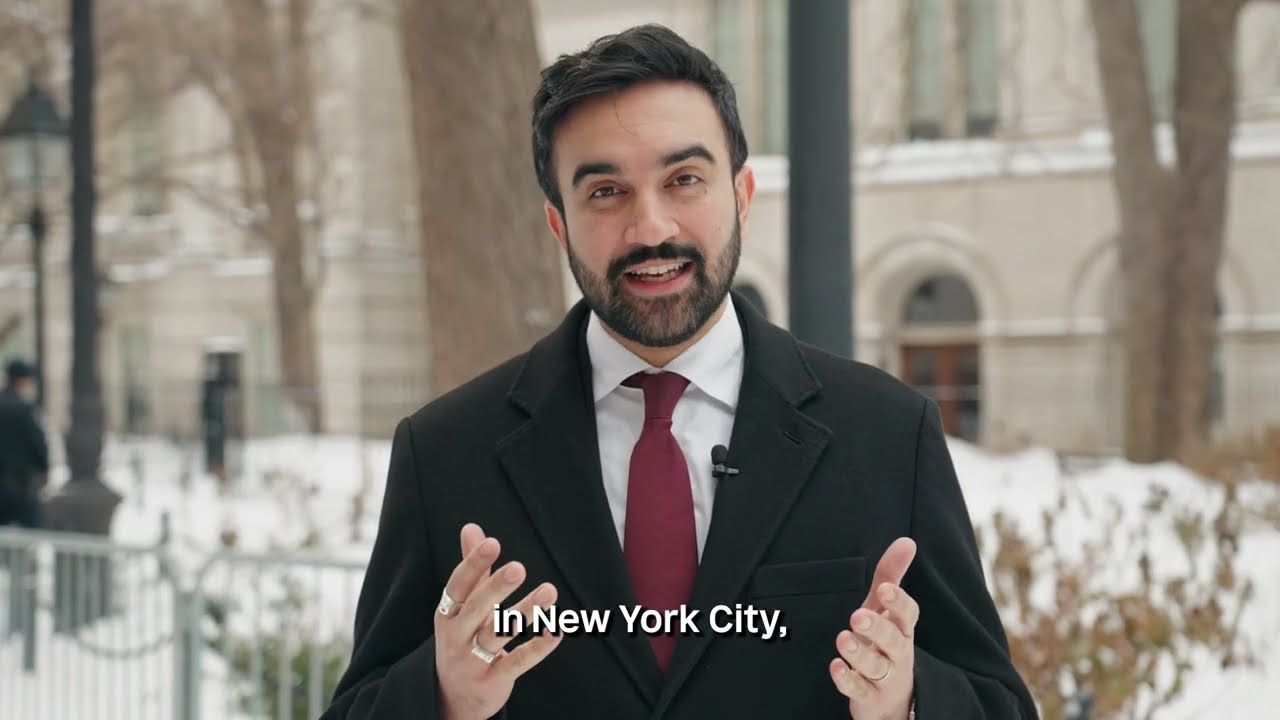

The video “Anti-ICE Protestors Issue Me a Chilling Warning” by intrepid (and apparently frostbite-resistant) independent journalist Nate Friedman is a hilarious, teeth-chattering dispatch straight from the frozen tundra of a New York City anti-ICE rally—conveniently timed one year after Trump’s big comeback. Nate rolls up early, hands turning into popsicles while he quips about yanking off his gloves, and right away drops the million-dollar question that’s clearly kept every virtue-signaling hipster up at night: “Why are we shivering outside a library like sad penguins when we could be blocking traffic at Trump Tower literally every single day?”
Cue the greatest hits of performative outrage. A private chef brandishes a “Murderer” sign aimed at the big bad orange man, confidently brands Tom Homan (ICE’s deportation champ) a full-on Nazi… until Nate casually mentions Obama slapped a shiny medal on Homan in 2015 for crushing deportation records. Plot twist! Her enlightened response: “Uh… Trump probably got to him somehow.” Because nothing says “deep thinker” like retroactively canceling your own side’s heroes.
Then there’s the visionary who wants open borders drenched in “empathy” (because empathy fixes logistics, apparently), and the absolute galaxy-brain suggestion to abolish ICE and replace it with… the immigrants themselves. Yes, folks: let the people who just crossed the border moonlight as border guards. What could possibly go wrong? Efficiency, accountability, national security—pfft, details. A Maoist Communist Union duo earnestly pitches their “pre-party organization,” lecturing on mass line theory and brushing off Mao-era famines and purges as mere “bourgeois smears.” But relax—they assure us coffee will survive the revolution. “The workers harvested the beans, comrade.”
The vibe gets extra spicy with masked coordinators slinking around like low-budget spies, hissing “Don’t talk to that Zionist” to anyone who makes eye contact with Nate. When he innocently inquires, “Hey, when’s the Free Iran rally scheduled?” the response is pure gold: “Talk to the People’s Forum.” Classic deflection—because nothing screams “principled solidarity” like selective outrage.
All the while, the crowd chants “F*** ICE” on loop, waves trans flags alongside Ukrainian ones (priorities!), hawks $20 “revolutionary” T-shirts, and engages in profound philosophical debates about whether storming a Minneapolis church mid-service to heckle an ICE-linked parishioner is “a bit much” or “totally fine if the pastor’s chill.” Spoiler: opinions are split, but the nuance is razor-thin.
Nate, bless his chilled soul, endures the nonstop rejection, the “drop dead, fascist” love notes, and actual tailing by what he suspects are paid pros trying to dox his address—all while asking the one question nobody wants to answer: “Okay, abolish ICE… then what?” The answers range from vague “empathy reforms” to letting immigrants self-police the border to straight-up “shut down the whole system.” Passion? Overflowing. Concrete plans? Crickets. It’s a masterclass in feelings-over-facts theater.
His raw, no-makeup style—freezing in the snow, shrugging off insults, and politely pressing for actual solutions—peels back the curtain on this glorious circus: endless rage, zero roadmap, and a burning desire to dismantle government, borders, and common sense itself in the Trump era. All masterfully orchestrated, we can only assume, by the usual shadowy hand behind the curtain (you know the one—rhymes with “People’s Forum funding streams”).
The White House said President Donald J. Trump welcomed the formation of the National Committee for the Administration of Gaza (NCAG) as a key step in Phase Two of his 20-point “Comprehensive Plan to End the Gaza Conflict,” with NCAG leader Dr. Ali Sha’ath tasked with restoring public services, rebuilding civil institutions, stabilizing daily life, and laying the groundwork for self-sustaining governance. The statement claims the framework aligns with U.N. Security Council Resolution 2803 (2025) and is overseen by a “Board of Peace” chaired by Trump, supported by a founding Executive Board—named as Secretary Marco Rubio, Steve Witkoff, Jared Kushner, Sir Tony Blair, Marc Rowan, Ajay Banga, and Robert Gabriel—plus senior advisors Aryeh Lightstone and Josh Gruenbaum for day-to-day execution. It also names Nickolay Mladenov as High Representative for Gaza to coordinate between the Board and NCAG, appoints Major General Jasper Jeffers to command an International Stabilization Force to support security, demilitarization, and aid delivery, and establishes a Gaza Executive Board (including Witkoff, Kushner, Turkey’s Minister Hakan Fidan, Sir Tony Blair, Marc Rowan, Minister Reem Al-Hashimy, Sigrid Kaag, and others) to assist governance and service delivery, with additional members to be announced in the coming weeks.
Statement on President Trump’s Comprehensive Plan to End the Gaza Conflict
Yesterday, President Donald J. Trump congratulated the formation of the National Committee for the Administration of Gaza (NCAG), a vital step forward in implementing Phase Two of his Comprehensive Plan to End the Gaza Conflict—a 20-point roadmap for lasting peace, stability, reconstruction, and prosperity in the region.
The NCAG will be led by Dr. Ali Sha’ath, a widely respected technocratic leader who will oversee the restoration of core public services, the rebuilding of civil institutions, and the stabilization of daily life in Gaza, while laying the foundation for long-term, self-sustaining governance. Dr. Sha’ath brings deep experience in public administration, economic development, and international engagement, and is widely respected for his pragmatic, technocratic leadership and understanding of Gaza’s institutional realities.
This milestone perfectly aligns with United Nations Security Council Resolution 2803 (2025), which endorsed President Trump’s Comprehensive Plan and welcomed the establishment of the Board of Peace. The Board of Peace will play an essential role in fulfilling all 20 points of the President’s plan, providing strategic oversight, mobilizing international resources, and ensuring accountability as Gaza transitions from conflict to peace and development.
To operationalize the Board of Peace’s vision—under the chairmanship of President Donald J. Trump—a founding Executive Board has been formed, composed of leaders with experience across diplomacy, development, infrastructure, and economic strategy. The appointed members are:
Secretary Marco Rubio
Steve Witkoff
Jared Kushner
Sir Tony Blair
Marc Rowan
Ajay Banga
Robert Gabriel
Each Executive Board member will oversee a defined portfolio critical to Gaza’s stabilization and long-term success, including, but not limited to, governance capacity-building, regional relations, reconstruction, investment attraction, large-scale funding, and capital mobilization.
In support of this operating model, the Chairman has appointed Aryeh Lightstone and Josh Gruenbaum as senior advisors to the Board of Peace, charged with leading day-to-day strategy and operations, and translating the Board’s mandate and diplomatic priorities into disciplined execution.
H.E. Nickolay Mladenov, an Executive Board member, will serve as the High Representative for Gaza. In this capacity, he will act as the on-the-ground link between the Board of Peace and the NCAG. He will support the Board’s oversight of all aspects of Gaza’s governance, reconstruction, and development, while ensuring coordination across civilian and security pillars.
To establish security, preserve peace, and establish a durable terror-free environment, Major General Jasper Jeffers has been appointed Commander of the International Stabilization Force (ISF), where he will lead security operations, support comprehensive demilitarization, and enable the safe delivery of humanitarian aid and reconstruction materials.
In support of the Office of the High Representative and the NCAG, a Gaza Executive Board is being established. The Board will help support effective governance and the delivery of best-in-class services that advance peace, stability, and prosperity for the people of Gaza. The appointed members are:
Steve Witkoff
Jared Kushner
Minister Hakan Fidan
Ali Al-Thawadi
General Hassan Rashad
Sir Tony Blair
Marc Rowan
Minister Reem Al-Hashimy
Nickolay Mladenov
Yakir Gabay
Sigrid Kaag
The United States remains fully committed to supporting this transitional framework, working in close partnership with Israel, key Arab nations, and the international community to achieve the objectives of the Comprehensive Plan. The President calls on all parties to cooperate fully with the NCAG, the Board of Peace, and the International Stabilization Force to ensure the swift and successful implementation of the Comprehensive Plan.
Additional Executive Board and Gaza Executive Board members will be announced over the coming weeks.
In remarks delivered from the White House for a national Zoom webinar, Melania Trump urged students to treat AI as a creative tool, not a substitute for judgment.
WASHINGTON—First Lady Melania Trump used a virtual address to thousands of classrooms Friday to pitch artificial intelligence as a once-in-a-generation accelerator of learning and creativity—while cautioning students not to let the technology do their thinking for them. (The White House)
Speaking in opening remarks for “Zoom Ahead: AI for Tomorrow’s Leaders,” a national learning event hosted by Zoom, Mrs. Trump described an “Age of Imagination” in which curiosity can be satisfied “almost magically, in seconds,” and argued that the decisive skill in the AI era is not memorization but asking better questions. (The White House)
The event—scheduled for Jan. 16 at 9:00 a.m. Pacific via Zoom Webinar—was positioned by the company and the White House as part of a broader push to build AI literacy for K–12 students and educators, with a particular emphasis on responsible use. (Zoom)
“Age of Imagination,” “intellectual freedom”
Mrs. Trump’s prepared remarks read like a motivational address aimed at demystifying AI for young audiences: a student who wants to design fashion, write music, or create an animated superhero series can now use AI tools from home to draft concepts, characters and scripts. (The White House)
But the core of the speech was less about software than mindset. “In the new AI era, the most powerful skill is knowing what to ask, why it matters, and how to think beyond the first answer,” she said, urging students to be “stubbornly curious” and to “question everything.” (The White House)
Her closing message, however, drew a bright line between generation and meaning. AI can create “images and information,” she said, but “only humans can generate meaning and purpose.” She urged students to “never surrender your thinking to AI,” warning against treating the technology as a shortcut. (The White House)
A corporate partnership with a classroom pitch
The White House said the initiative is intended to “improve America’s children’s understanding” of AI and to “empower the next generation” to use it in education and later careers, with Zoom as a partner reaching “thousands of schools nationwide.” (The White House)
Zoom, for its part, framed the webinar as part of a wider AI literacy program and emphasized confidence and ethics in adoption. The company’s release said its event is designed to help students understand how AI can be used “responsibly, creatively, and confidently,” and noted that Mrs. Trump would deliver opening remarks live from the White House. (Zoom)
Eric Yuan, Zoom’s chief executive and founder, echoed the responsible-use theme, arguing that the spread of AI in learning and work makes literacy and ethical norms essential for students and educators. (The White House)
The politics of AI education
Mrs. Trump has increasingly made technology and youth-focused education a signature lane, using the language of national competitiveness alongside personal development. The Zoom release quoted her as saying students and educators have a “unique chance to get ahead” by learning AI early, positioning literacy as a workforce advantage and a way for communities to shape, not simply absorb, technological change. (Zoom)
The White House statement also tied Friday’s remarks to a broader agenda, noting that Mrs. Trump had called on the international community at the 2025 United Nations General Assembly to join her efforts and that she plans to host an inaugural meeting of a related initiative, “Fostering the Future Together,” at the White House this spring. (The White House)
A simple message for a complicated technology
For all the talk of “imagination,” the subtext of the address reflected a debate that has moved quickly from Silicon Valley to school districts: how to harness AI’s ability to draft, summarize and generate media without weakening core skills like reasoning, writing and judgment.
Mrs. Trump offered a practical rule of thumb: use AI to widen the field of ideas—but keep ownership of conclusions. “Be intellectually honest with yourself,” she said. “Use AI as a tool—but do not let it replace your personal intelligence.” (The White House)
In an era when students can produce a passable essay or a polished slide deck in minutes, the First Lady’s prescription was old-fashioned: do the hard part yourself. The technology may be new; the standard she set was not.
President Donald J. Trump has scored another remarkable foreign policy triumph: the bold capture and extradition of Nicolas Maduro, the indicted narcoterrorist and socialist dictator who plunged Venezuela into chaos, starved its people, and menaced American security, now detained on U.S. soil to face long-overdue justice.
Democrats spent years howling that Maduro was a ruthless tyrant who had to be delegitimized, pressured, and removed. But the instant President Trump succeeds where they failed, they erupt in furious hypocrisy — prioritizing their unhinged hatred of President Trump over American interests and national security.
Here are just a few of the many hypocritical Democrats then vs. now:
Sen. Chuck Schumer
THEN: “And the President brags about his Venezuela policy. Give us a break. He hasn’t brought an end to the Maduro regime. The Maduro regime is more powerful today and more entrenched today than it was when the President began.” (2/5/20)
NOW: “This is reckless. And the American people are just, this morning, in fear of what’s going to happen here.” (1/4/26)
Sen. Dick Durbin
THEN: “The people of Venezuela deserve better than this. We can’t allow this President’s short attention span to stop us from delivering on our promise to help the Venezuelan people rebuild their country… Though President Trump may seem ready to throw in the towel, I stand committed to aiding the people of Venezuela.” (6/20/19)
NOW: “I disagree with President Trump’s use of U.S. military forces without Congressional approval & worry deeply about this Admin’s follow through on foreign policy interventions.” (1/3/26)
Sen. Chris Van Hollen
THEN: “[T]he United States is now going to use its levers and influence to push for a negotiation to have a transition to the truly elected leader… Obviously, we know Maduro and his cronies do not want to go quietly into the night, but the United States needs to work with its partners and allies in the region to ratchet up the pressure…” (8/2/24)
NOW: “It is an illegal act of war to replace Maduro.” (1/3/26)
Sen. Chris Murphy
THEN: “If Trump cared about consistency, he would make the realist case for intervention in Venezuela (getting rid of Maduro is good for the United States) rather than trying to pretend his Administration all of the sudden cares about toppling anti-democratic regimes.” (1/23/19)
NOW: “The invasion of Venezuela has nothing to do with American security. Venezuela is not a security threat to the U.S.” (1/4/26)
Sen. Tim Kaine
THEN: “This is a deeply concerning development for Venezuelans and for the entire region, since instability abroad impacts us here at home, too.” (9/2/24)
NOW: “President Trump’s unauthorized military attack on Venezuela to arrest Maduro… is a sickening return to a day when the United States asserted the right to dominate the internal political affairs of all nations in the Western Hemisphere.” (1/3/26)
Sen. Amy Klobuchar
THEN: “I have of course supported bringing in the new president and delegitimizing the Maduro government. You always leave things on the table.” (5/2/19)
NOW: “I have strongly opposed sending American forces into harm’s way in Venezuela without authorization from Congress. We should not put Americans at risk in this way without careful deliberation among the people’s elected representatives. Wars for regime change can lead to unintended consequences.”(1/3/26)
Sen. Elizabeth Warren
THEN: “Maduro is a dictator and a crook who has wrecked his country’s economy, dismantled its democratic institutions, and profited while his people suffer. The United States should lead the international community in addressing Venezuela’s humanitarian crisis and supporting regional efforts to negotiate a political transition.” (7/30/2019)
NOW: “What does it mean that the U.S. will ‘run’ Venezuela, and what will Trump do next around the world? The American people voted for lower costs, not for Trump’s dangerous military adventurism overseas that won’t make the American people safer.” (1/3/26)
Rep. Jamie Raskin
THEN: “The democratic world must stand up for the rule of law in Venezuela and oppose Maduro’s assault on the electoral process and free speech. The right-wing attack on democratic institutions anywhere is a threat to freedom everywhere.” (8/2/24)
NOW: “Trump is not only violating our Constitution, but he is shredding the rules-based international order created after World War II, whose essential building block is the political sovereignty and territorial integrity of each nation.” (1/4/26)
Rep. Darren Soto
THEN: “Honored to speak with @cdvorlando yesterday about Venezuelan TPS, raising the reward for Maduro’s capture to $100M, and bringing democracy back to Venezuela. #VenezuelaLibre” (10/6/24)
NOW: “Trump’s trading one dictator for another just to get oil? This will do NOTHING to help my constituents’ family members who just lost their TPS and still can’t return home.” (1/5/26)
DVANCING ARTIFICIAL INTELLIGENCE EDUCATION FOR AMERICAN YOUTH
By the authority vested in me as President by the Constitution and the laws of the United States of America, it is hereby ordered:
Section 1. Background. Artificial intelligence (AI) is rapidly transforming the modern world, driving innovation across industries, enhancing productivity, and reshaping the way we live and work. To ensure the United States remains a global leader in this technological revolution, we must provide our Nation’s youth with opportunities to cultivate the skills and understanding necessary to use and create the next generation of AI technology. By fostering AI competency, we will equip our students with the foundational knowledge and skills necessary to adapt to and thrive in an increasingly digital society. Early learning and exposure to AI concepts not only demystifies this powerful technology but also sparks curiosity and creativity, preparing students to become active and responsible participants in the workforce of the future and nurturing the next generation of American AI innovators to propel our Nation to new heights of scientific and economic achievement. To achieve this vision, we must also invest in our educators and equip them with the tools and knowledge to not only train students about AI, but also to utilize AI in their classrooms to improve educational outcomes. Professional development programs focused on AI education will empower educators to confidently guide students through this complex and evolving field. Educators, industry leaders, and employers who rely on an AI-skilled workforce should partner to create educational programs that equip students with essential AI skills and competencies across all learning pathways. While AI education in kindergarten through twelfth grade (K-12) is critical, our Nation must also make resources available for lifelong learners to develop new skills for a changing workforce. By establishing a strong framework that integrates early student exposure with comprehensive teacher training and other resources for workforce development, we can ensure that every American has the opportunity to learn about AI from the earliest stages of their educational journey through postsecondary education, fostering a culture of innovation and critical thinking that will solidify our Nation’s leadership in the AI-driven future.
Sec. 2. Policy. It is the policy of the United States to promote AI literacy and proficiency among Americans by promoting the appropriate integration of AI into education, providing comprehensive AI training for educators, and fostering early exposure to AI concepts and technology to develop an AI-ready workforce and the next generation of American AI innovators.
Sec. 3. Definition. For the purposes of this order, “artificial intelligence” or “AI” has the meaning set forth in 15 U.S.C. 9401(3).
Sec. 4. Establishing an Artificial Intelligence Education Task Force. (a) There is hereby established the White House Task Force on Artificial Intelligence Education (Task Force). (b) The Director of the Office of Science and Technology Policy shall be the Chair of the Task Force. (c) The Task Force membership shall consist of the following members: (i) the Secretary of Agriculture; (ii) the Secretary of Labor; (iii) the Secretary of Energy; (iv) the Secretary of Education; (v) the Director of the National Science Foundation (NSF); (vi) the Assistant to the President for Domestic Policy; (vii) the Special Advisor for AI & Crypto; (viii) the Assistant to the President for Policy; and (ix) the heads of other such executive departments and agencies (agencies) and offices that the Chair may designate or invite to participate. (d) The Task Force shall be responsible for implementing the policy stated in section 2 of this order and coordinating Federal efforts related to AI education, including the actions outlined in this order.
Sec. 5. Establishing the Presidential Artificial Intelligence Challenge. (a) Within 90 days of the date of this order, the Task Force shall establish plans for a Presidential Artificial Intelligence Challenge (Challenge), and the agencies represented on the Task Force shall, as appropriate and consistent with applicable law, implement the plans by holding the Challenge no later than 12 months from the submission of the plan. The Challenge shall encourage and highlight student and educator achievements in AI, promote wide geographic adoption of technological advancement, and foster collaboration between government, academia, philanthropy, and industry to address national challenges with AI solutions. (b) The Challenge shall feature multiple age categories, distinct geographic regions for competition, and a variety of topical themes of competition to reflect the breadth of AI applications, encouraging interdisciplinary exploration. (c) The Task Force and, as appropriate, agencies represented on the Task Force shall collaborate with relevant agencies and private sector entities to provide technical expertise, resources, and promotional support for implementing the Challenge, including through existing funding vehicles.
Sec. 6. Improving Education Through Artificial Intelligence. (a) To provide resources for K-12 AI education, agencies represented on the Task Force shall seek to establish public-private partnerships with leading AI industry organizations, academic institutions, nonprofit entities, and other organizations with expertise in AI and computer science education to collaboratively develop online resources focused on teaching K-12 students foundational AI literacy and critical thinking skills. The Task Force shall promptly announce such public-private partnerships on a rolling basis as they are formed. (i) The Task Force shall seek to utilize industry commitments and identify any Federal funding mechanisms, including discretionary grants, that can be used to provide resources for K-12 AI education. To the extent practicable and as consistent with applicable law, agencies shall prioritize funding for such purposes when it would further the aims of the program for which funding is available. (ii) The Task Force shall work to ensure the resources funded as described in subsection (i) of this section are ready for use in K-12 instruction within 180 days following the Task Force’s formal announcement of the first slate of public-private partnerships. (b) Within 90 days of the date of this order, the Task Force shall identify existing Federal AI resources on which agencies may rely, such as the NSF- and Department of Agriculture-sponsored National AI Research Institutes, to support partnerships with State and local educational agencies to improve AI education. (c) Within 90 days of the date of this order, the Secretary of Education shall issue guidance regarding the use of formula and discretionary grant funds to improve education outcomes using AI, including but not limited to AI-based high-quality instructional resources; high-impact tutoring; and college and career pathway exploration, advising, and navigation. (d) Within 90 days of the date of this order, the Secretary of Education shall identify and implement ways to utilize existing research programs to assist State and local efforts to use AI for improved student achievement, attainment, and mobility.
Sec. 7. Enhancing Training for Educators on Artificial Intelligence. (a) Within 120 days of the date of this order, the Secretary of Education shall take steps to prioritize the use of AI in discretionary grant programs for teacher training authorized by the Elementary and Secondary Education Act of 1965 (Public Law 89-10), as amended, and Title II of the Higher Education Act of 1965 (Public Law 89-329), as amended, including for: (i) reducing time-intensive administrative tasks; (ii) improving teacher training and evaluation; (iii) providing professional development for all educators, so they can integrate the fundamentals of AI into all subject areas; and (iv) providing professional development in foundational computer science and AI, preparing educators to effectively teach AI in stand-alone computer science and other relevant courses. (b) Within 120 days of the date of this order, the Director of the NSF shall take steps to prioritize research on the use of AI in education. The Director of the NSF shall also utilize existing programs to create teacher training opportunities that help educators effectively integrate AI-based tools and modalities in classrooms. (c) Within 120 days of the date of this order, the Secretary of Agriculture shall take steps to prioritize research, extension, and education on the use of AI in formal and non-formal education through 4-H and the Cooperative Extension System. The Secretary of Agriculture shall also utilize existing programs to create teacher and educator training opportunities that help effectively integrate AI-based tools and modalities into classrooms and curriculum.
Sec. 8. Promoting Registered Apprenticeships. (a) Within 120 days of the date of this order, the Secretary of Labor shall seek to increase participation in AI-related Registered Apprenticeships, including by: (i) Prioritizing the development and growth of Registered Apprenticeships in AI-related occupations. The Secretary of Labor shall establish specific goals for growing Registered Apprenticeships in AI-related occupations across industries; and (ii) Using apprenticeship intermediary contracts and allocating existing discretionary funds, as appropriate and consistent with applicable law, to engage industry organizations and employers and facilitate the development of Registered Apprenticeship programs in AI-related occupations. In doing so, the Secretary of Labor shall support the creation of industry-developed program standards to be registered on a nationwide basis, enabling individual employers to adopt the standards without requiring individual registry. (b) Within 120 days of the date of this order, the Secretary of Labor shall encourage States and grantees to use funding provided under the Workforce Innovation and Opportunity Act (WIOA) (Public Law 113-128), as amended, to develop AI skills and support work-based learning opportunities within occupations utilizing AI by: (i) issuing guidance to State and local workforce development boards encouraging the use of WIOA youth formula funds to help youth develop AI skills; (ii) clarifying that States can use Governor set-asides to integrate AI learning opportunities into youth programs across the State; and (iii) consistent with applicable law, establishing AI skills training and work-based learning as a grant priority in all Employment and Training Administration youth-focused discretionary grant programs. (c) Within 120 days of the date of this order, the Secretary of Labor, through the Assistant Secretary of Labor for Employment and Training, and in collaboration with the Director of the NSF, shall engage with relevant State and local workforce development boards, industry organizations, education and training providers, and employers to identify and promote high-quality AI skills education coursework and certifications across the country. Through such engagement, the Secretary of Labor shall: (i) identify applicable funding opportunities to expand access to high-quality AI coursework and certifications; (ii) set performance targets for youth participation through any grants awarded for this purpose; and (iii) utilize industry and philanthropic partnerships to the extent practicable. (d) Within 120 days of the date of this order, and in consultation with the Secretary of Education and the Director of the NSF, the Secretary of Labor shall support the creation of opportunities for high school students to take AI courses and certification programs by giving priority consideration in awarding grants as appropriate and consistent with applicable law to providers that commit to use funds to develop or expand AI courses and certification programs. The Secretary of Labor and the Secretary of Education shall encourage recipients to build partnerships with States and local school districts to encourage those entities to consider offering high school students dual enrollment opportunities to take courses to earn postsecondary credentials and industry-recognized AI credentials concurrent with high school education. (e) Within 120 days of the date of this order, all agencies that provide educational grants shall, as appropriate and consistent with applicable law, consider AI as a priority area within existing Federal fellowship and scholarship for service programs.
Sec. 9. General Provisions. (a) Nothing in this order shall be construed to impair or otherwise affect: (i) the authority granted by law to an executive department or agency, or the head thereof; or (ii) the functions of the Director of the Office of Management and Budget relating to budgetary, administrative, or legislative proposals. (b) This order shall be implemented consistent with applicable law and subject to the availability of appropriations. (c) This order is not intended to, and does not, create any right or benefit, substantive or procedural, enforceable at law or in equity by any party against the United States, its departments, agencies, or entities, its officers, employees, or agents, or any other person.
The U.S. Department of Justice has sued Illinois Governor J.B. Pritzker and Attorney General Kwame Raoul in federal court, arguing that a pair of Illinois immigration-related laws unlawfully interfere with federal authority and operations—an example of the administration’s broader pushback against state measures it views as obstructing federal immigration enforcement. The challenged package includes the “Illinois Bivens Act,” which creates a state-law cause of action tied to alleged constitutional violations committed during “civil immigration enforcement,” and the “Court Access, Safety, and Participation Act,” which bars civil immigration arrests at (and, as described in reporting and advocacy materials, within a buffer zone around) Illinois courthouses; supporters frame the laws as due-process and courthouse-access protections, while DOJ frames them as unconstitutional constraints and liability exposure designed to chill federal enforcement.
Justice Department Sues J.B. Pritzker, Kwame Raoul Over the Illinois Bivens Act
Today, the Department of Justice filed a lawsuit against Illinois Governor J.B. Pritzker and Attorney General Kwame Raoul, challenging their unconstitutional attempt to regulate federal law enforcement officers through the so-called “Illinois Bivens Act” and “Court Access, Safety, and Participation Act.”
Not only are the laws illegal attempts to regulate and discriminate against the federal government through novel causes of action, but, as alleged in the complaint, the laws threaten the safety of federal officers who have faced an unprecedented wave of harassment, doxxing, and even violence. Threatening officers with ruinous liability and even punitive damages for executing federal law and for simply protecting their identities and their families also chills the enforcement of federal law and compromises sensitive law enforcement operations. The danger is acute.
“The Department of Justice will steadfastly protect law enforcement from unconstitutional state laws like Illinois’ that threaten massive punitive liability and compromise the safety of our officers,” said Assistant Attorney General Brett A. Shumate of the Justice Department’s Civil Division.
“Unfortunately, Illinois politicians prefer to attack law enforcement with lawsuits and punitive damages rather than support ICE’s Criminal Alien Program, which prioritizes the safe removal of dangerous criminal aliens like murderers, child rapists, and other serious offenders,” said U.S. Attorney Steven D. Weinhoeft for the Southern District of Illinois. “Courthouse arrests are only necessary in the first place because Illinois refuses to honor federal detainers at the jails and prisons, instead preferring to release criminals back into our communities.”
On her first day in office, Attorney General Bondi instructed the Department’s Civil Division to identify state and local laws, policies, and practices that facilitate violations of federal laws or impede lawful federal operations. Today’s lawsuit is the latest in a series of lawsuits brought by the Civil Division targeting illegal policies designed to thwart federal law enforcement across the country, including in New York, New Jersey, and Los Angeles, California.
December 22, 2025 Office of Public Affairs U.S. Department of Justice 950 Pennsylvania Avenue, NW Washington DC 20530 Press Release Number: 25-1235
On Thursday, December 18, 2025, the President signed into law:
S. 1071, the “National Defense Authorization Act for Fiscal Year 2026,” which authorizes fiscal year 2026 appropriations principally for Department of War programs and military construction, Department of Energy national security programs, Intelligence programs, and Department of State programs; supports a military basic pay increase and other authorities relating to the United States Armed Forces; and provides authorities related to and makes other modifications to national security, foreign affairs, homeland, commerce, judiciary, and other related programs.
I extend my warmest greetings to the Jewish community in the United States and all around the world as they begin their celebration of Hanukkah—the Festival of Lights and a joyous season of reflection and hope.
More than 2,000 years ago, the Jewish people rose up against the forces of tyranny and restored their freedom to worship and live according to their faith, fighting for the inalienable rights endowed by our Creator. Following their tremendous victory, they sought to rededicate their Holy Temple. As tradition tells us, although they only had enough oil to light the lamp in the Temple for one night, in a glorious sign of the Almighty’s divine providence, it remained aflame for 8 days. In remembrance of this great miracle, over the next 8 days, families and loved ones will gather to light the menorah, which serves as an enduring symbol of light’s victory over darkness and the eternal triumph of good over evil. Hanukkah is a thanksgiving for these miracles.
To this day, the menorah stands as an enduring symbol of liberty, of the idea that each citizen, in the words that George Washington wrote to the Hebrew Congregation in Newport, “shall sit in safety under his own vine and fig tree and there shall be none to make him afraid.”
This holiday season, my Administration continues to stand firmly with the Jewish people and defend the right of every believer to worship freely and without fear of persecution. The flames of Hanukkah stand as a reminder of the strength and resilience of the Jewish people and of the spirit that continues to guide our Nation toward a brighter future.
Just as the grace of the Almighty brought the Maccabees to victory, it has sustained the miracle of America—a shining light to the entire world—for nearly 250 years. As we continue to usher in the Golden Age, may the blessings of this season bring renewed peace, joy, and warmth to all those who celebrate. Happy Hanukkah!
New York State is putting more than $300 million into hospital upgrades aimed at making care safer and more connected, Governor Kathy Hochul announced. The funding will support 22 projects statewide to improve health information technology, expand electronic medical records, strengthen cybersecurity to protect patient data, and grow telehealth services. State officials say the goal is to help hospitals—especially financially strained providers—modernize critical systems, reduce cyber risk, and make it easier for New Yorkers to access care remotely. The awards are part of New York’s broader push to improve hospital infrastructure and resilience across the state.
Governor Hochul Announces More Than $300 Million to Advance Health Information Technology and Cybersecurity in Hospitals Across New York State
Governor Kathy Hochul today announced more than $300 million in new state funding to support health care transformation projects across New York. The awards, made through the Statewide Health Care Facility Transformation Program IV and V, will support 22 projects aimed at improving health information technology by expanding patient electronic medical records, strengthening cybersecurity and patient information security, and expanding telehealth services.
“By modernizing our hospitals’ IT infrastructure and protecting patients’ information, we’re strengthening the foundation of health care in New York State,” Governor Hochul said. “These investments will help ensure that hospitals have the tools they need to safeguard patient data, expand telehealth services and deliver a healthier future for all New Yorkers.”
New York State Department of Health Commissioner Dr. James McDonald said, “With these investments, we are focused on developing safe, reliable and connected patient-centered care. By expanding data capabilities and improving cybersecurity defenses, we’re enhancing clinical decision making across the state’s health care network.”
This funding prioritizes projects that:
Support financially distressed providers;
Modernize critical health information technology infrastructure;
Strengthen cybersecurity and patient information security; and
Expand telehealth services.
Awardees include hospitals in every region of the State.
This investment builds on Governor Hochul’s continued efforts to strengthen New York’s health care delivery system. The Statewide Health Care Facility Transformation Program has awarded more than $1.75 billion to providers working to improve access, equity, and quality of care across New York. These awards are part of a broader, long-term commitment that has directed more than $4.7 billion in health care capital funding statewide since 2016.
Under Governor Hochul’s leadership, New York State enacted nation-leading cybersecurity regulations for hospitals, establishing a robust blueprint to protect critical systems and enhance the resilience of the state’s health care network against cyber threats.
New York Governor Kathy Hochul and Queens County District Attorney Melinda Katz announced the successful disruption of a Queens-based organized retail theft ring responsible for stealing over $2.2 million in merchandise from 128 Home Depot locations across nine states. A 780-count indictment charges 13 individuals with first-degree grand larceny, criminal possession of stolen property, and conspiracy, leveraging new provisions in the FY 2025 Enacted Budget—secured by Governor Hochul—that permit aggregation of stolen goods values across incidents and enhance penalties for fencing operations. The case, developed through a joint investigation by the Queens DA’s Office and the New York State Police Organized Retail Theft Task Force (funded with more than $40 million in state resources), marks a significant enforcement milestone: 11 defendants have been arraigned, with maximum penalties of up to 25 years for theft crew members and 15 years for fences. The operation’s takedown contributes to broader statewide results, including 1,261 arrests, recovery of $2.6 million in stolen goods, and a 14% year-over-year decline in retail theft in New York City as of December 2025.
Governor Hochul and Queens District Attorney Katz Announce Indictment Charges in $2.2 Million Organized Retail Theft Bust
Governor Kathy Hochul and Queens District Attorney Melinda Katz today announced that 13 individuals have been charged in a 780-count indictment for operating a stolen goods and resale ring that targeted Home Depot locations in New York and eight other states. The individuals are facing grand larceny, conspiracy, and criminal possession of stolen property charges, including those included in the FY25 Enacted Budget that strengthened larceny laws by combining the value of merchandise stolen in separate incidents. In addition to these new crimes targeting organized retail theft, the FY25 Enacted Budget included a new crime specific to assault on retail workers, and more than $40 million for law enforcement secured by Governor Hochul. That funding created a dedicated Organized Retail Theft Task Force within the New York State Police, the work of which was integral to this case, and augmented efforts by district attorneys and local police departments to investigate and prosecute these cases.
“Since taking office, my highest priority has been driving down crime and keeping New Yorkers safe,” Governor Hochul said. “Following a post-pandemic spike in retail theft, I committed new funds to establish a dedicated organized retail theft task force and secured stronger laws to hold people who commit these crimes accountable. With better support for District Attorneys, local police departments and the State Police, we’re stopping organized retail theft rings in their tracks and ensuring a safer retail environment for business owners, staff and shoppers throughout New York.”
Queens District Attorney Melinda Katz said, “Thirteen defendants, over $2.2 million in merchandise, 319 incidents of theft, nine states and 128 separate Home Depot stores are the facts alleged, resulting in a 780-count indictment. The defendants took breaks for lunch and dinner, sometimes hitting the same Home Depot up to four times in one day. The stolen items were then resold to consumers, through a Brooklyn storefront or on Facebook Marketplace. Working with our partners at the New York State Police, we brought this brazen operation to a halt. I thank Governor Hochul for signing laws that provide prosecutors’ offices with tools to more efficiently investigate, and more effectively charge, organized retail theft and fencing operations.”
The District Attorney’s Office investigation began in June 2024, when members of the District Attorney’s Detective Bureau observed stolen air conditioners from Home Depot while conducting surveillance in a separate matter. The District Attorney’s Crime Strategies and Intelligence Bureau built the case in-house and worked closely with the New York State Police’s Organized Retail Theft Task Force, part of the agency’s Special Investigations Unit.
“Since taking office, my highest priority has been driving down crime and keeping New Yorkers safe”
Governor Kathy Hochul
New York State Police Superintendent Steven G. James said, “This case sends a strong message to would-be criminals – if you engage in retail theft, we will find you and hold you accountable to the full extent of the law. Retail theft has real victims – threatening the safety of shoppers and retail workers, creating enormous losses for businesses, and rising prices for the rest of us. I want to commend the outstanding work of our investigators and our partners at the Queens County District Attorney’s Office, and I want to thank Governor Hochul for the support she has provided to help us fight back against organized retail theft.”
Eleven individuals were arraigned yesterday on a 780-count indictment including charges of first-degree grand larceny, first-degree criminal possession of stolen property, fourth-degree conspiracy, and other crimes. One defendant remains at large and another will be arraigned at a later date. If convicted, members of the alleged theft crew face up to 25 years in prison, and the alleged black market retailers, known as fences, up to 15 years in prison.
According to the indictment and investigation, members of the theft and fencing ring are accused of stealing home construction tools, building supplies, power tools, smoke alarms, air conditioners, paper towels and other goods totaling more than $2.2 million during a 13-month period from August 2024 to September 2025. The items — stolen during 319 different incidents — were then sold to black market resellers, known as fences, who allegedly ordered the specific items to be stolen and then resold those goods to consumers.
The theft crew met almost daily to determine the locations of Home Depots they would target based on a review of merchandise in each store. Among the most common items stolen were insulation kits, buckets of reflective roof coating, power tools, air conditioners and smoke and carbon monoxide detectors. The amount of merchandise stolen in a single day ranged from about $1,800 to nearly $35,000.
Not including arrests and stolen goods recovered from this operation, the State Police and local law enforcement partners have recovered more than $2.6 million in stolen goods, made 1,261 arrests and filed 2,219 charges across 1,057 retail theft enforcement operations. As of December 2025, retail theft is down 14 percent year over year in New York City. Across the rest of the state, larceny is down 14 percent in the first seven months of 2025 vs. 2024.
Following a post-pandemic spike in reported retail theft in New York City and a statewide surge in reported larcenies, Governor Hochul also advanced new initiatives to strengthen laws, hold perpetrators accountable, protect retail workers and support small businesses, including:
Elevating the assault of a retail worker from a misdemeanor to a felony, ensuring any person who causes physical injury to a retail worker performing their job is subject to enhanced criminal penalties
Allowing prosecutors to combine the value of stolen goods when filing larceny charges, and allowing retail goods from different stores to be aggregated for the purposes of reaching a higher larceny threshold when stolen under the same criminal scheme
Making it illegal to foster the sale of stolen goods to go after third-party sellers
Securing $5 million to fund tax credits to help small businesses invest in and alleviate the financial burden for added security measures
State Senator Leroy Comrie said, “Organized retail theft is not a victimless crime, it hurts workers, drives up costs for families and threatens the stability of small businesses in our communities. I commend District Attorney Katz, the New York State Police and all law enforcement partners whose dedicated work brought this operation down. Their collaboration shows what is possible when we give agencies the tools they need to investigate and prosecute these complex cases. We must continue working together to protect retail workers, strengthen enforcement and ensure that every neighborhood in Queens remains a safe and reliable place to shop and do business.”
State Senator John Liu said, “This brazen retail theft ring and the rise in shoplifting following the pandemic show exactly why we strengthened retail theft laws in the state budget. Retail theft has preyed on our local businesses for far too long, with thieves targeting everything from paper towels to air conditioners. Thank you to DA Katz, Governor Hochul, and our local law enforcement for showing that the days of taking what you want and simply walking through the front door without fear of consequences are over, and that New York is committed to protecting our local businesses and restoring safety in our communities.”
Assemblymember Clyde Vanel said, “New York is sending a powerful message that coordinated retail theft rings will find no safe harbor here. This indictment makes clear that the new tools secured in the FY25 Budget, thanks to the leadership of Governor Hochul and the Legislature, are delivering real results. Dedicated and results-driven district attorneys like Melinda Katz are now better equipped than ever to take down organized crime and protect our communities and businesses.”
Assemblymember Steven Raga said, “The scale of this organized retail theft shows exactly why the Legislature strengthened our laws to combat organized criminal activity. These crimes impact the safety of workers, increase costs for consumers, and harm the economic health of communities across Queens. As a former retail worker myself, I understand how these incidents create real risks for people on the frontlines and destabilize the neighborhoods they serve. I commend Governor Hochul, District Attorney Katz, and the Task Force for taking decisive action that brings accountability and restores trust. This is the type of collaborative enforcement our state needs to keep people safe.”
Assemblymember Sam Berger said, “Queens is fortunate to have DA Melinda Katz taking on retail theft and bringing organized criminal rings to justice. I’m grateful to the brave men and women in state and local law enforcement who work every day to keep our communities safe. I was proud to stand with Governor Hochul and my colleagues in the Legislature to give prosecutors the tools they need to hold repeat offenders accountable.”
Retail Council of New York State President and CEO Melissa O’Connor said, “Governor Hochul and District Attorney Katz have made it abundantly clear that organized retail crime and habitual retail theft will not be tolerated in New York. This criminal activity goes well beyond the obvious financial loss for retailers – it is a serious issue that compromises the safety of store employees and customers. I want to thank Governor Hochul, District Attorney Katz and the New York State Police for holding these crime syndicates accountable to the full extent of the law. We will continue to work with the executive, lawmakers, prosecutors, and law enforcement agencies to further our shared goal of safer communities.”