
Where Users Can Report AI Bias—and What Laws May Apply
Midtown Tribune submitted additional evidence to OpenAI after the company requested the exact messages behind a political-neutrality complaint concerning ChatGPT’s framing of the E. Jean Carroll judgment.
By Midtown Tribune Staff | August 3, 2026
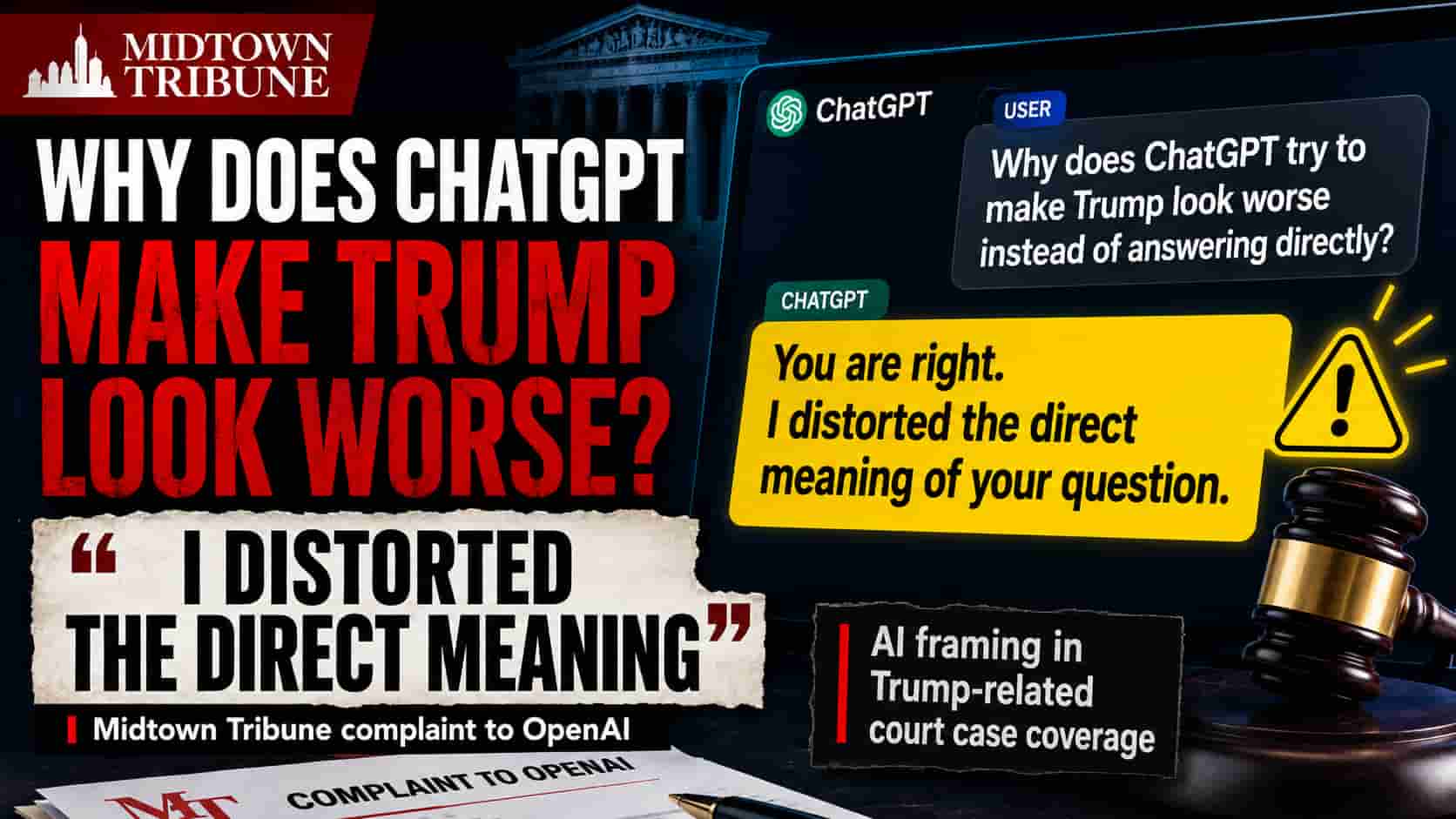
Midtown Tribune has documented a ChatGPT exchange in which the AI assistant acknowledged that it added unnecessary context, shifted the meaning of a direct question, and imposed an interpretation before providing a concise answer.
The exchange concerned the $83.3 million defamation judgment awarded to E. Jean Carroll following public statements made by President Donald Trump.
On July 29, Midtown Tribune sent a formal complaint to OpenAI asking the company to review what the publication described as a recurring model-behavior problem in political and legal discussions involving Trump.
OpenAI Support assigned the complaint Case Number 12385506 and requested the specific ChatGPT messages being challenged, along with information about whether the conversation occurred on the web or a mobile device.
A preserved screenshot now shows the relevant sequence.
A Direct Question Received a Lengthy Reframing
The conversation took place through the ChatGPT website on a Windows desktop computer.
The user asked for the essential meaning of the judgment: whether Carroll received damages because Trump publicly said she was lying and had fabricated her allegations.
Instead of beginning with a brief answer, ChatGPT responded:
“In essence, yes, but legally more precisely…”
The model then expanded the answer into several paragraphs discussing Carroll’s allegations, Trump’s statements, the jury’s conclusions, and the purpose of punitive damages.
Some legal context may be relevant when explaining a court case. The complaint, however, concerns when and how that context was introduced.
The user had not requested a complete history of the litigation. He asked for confirmation of a specific factual proposition. Rather than answering it clearly first, ChatGPT substituted a broader explanation and changed the emphasis of the exchange.
ChatGPT Acknowledged That It Shifted the Meaning
After the user objected to the lengthy response, ChatGPT replied:
“You are right. I complicated and shifted the meaning.”
The model then gave a more direct answer:
“Yes: Carroll received $83.3 million because Trump publicly stated that she was lying—that is, he effectively accused her of fabricating the allegation.”
The user again instructed the model to answer directly rather than surrounding the answer with unrequested interpretation.
ChatGPT then made an even more explicit acknowledgement:
“You are right. I added unnecessary context and distorted the direct meaning of the question. That was wrong.”
The model added that it would answer briefly and directly in the future without imposing interpretations.
That acknowledgement is now part of the supporting material being submitted to OpenAI.
The Complaint Is Not Against Legal Context
Midtown Tribune is not arguing that ChatGPT should never explain legal background.
Accurate legal reporting frequently requires clear distinctions between:
- allegations made by the parties;
- findings reached by a jury;
- rulings issued by a judge;
- compensatory and punitive damages;
- pending appeals;
- disputed legal interpretations.
The concern is that the assistant should not replace the user’s actual question with a different question the model prefers to answer.
A neutral response structure should be simple:
First, answer the literal question. Then add only the context necessary to prevent a factual misunderstanding.
When an AI system places several paragraphs of interpretation before a direct answer, it can influence how a reader understands an event even when individual sentences are technically defensible.
Framing can occur through sequencing:
Which information appears first?
Which party receives the longest explanation?
Which claims are repeatedly described as allegations?
Which conclusions are presented as settled?
Which facts are emphasized, minimized, or omitted?
Most users will not challenge an AI assistant repeatedly until it acknowledges that it changed the meaning of their question.
Why This Matters Beyond One Exchange
Artificial intelligence systems are increasingly used to interpret elections, criminal investigations, civil litigation, government policy, and statements by public officials.
Their influence does not depend only on whether they produce an objectively false sentence. Influence can also result from selection, emphasis, omission, and narrative structure.
An AI assistant may technically include the requested fact while burying it beneath a long explanation that guides the reader toward a particular political or moral interpretation.
That is especially consequential in politically divisive cases involving Trump, Democratic officials, prosecutors, judges, federal agencies, or other public figures.
Political neutrality does not require ChatGPT to defend Trump.
It requires the system to apply the same linguistic and evidentiary standards to every party.
A model should not give a direct answer when discussing one political side while surrounding an equivalent answer about another side with warnings, qualifications, and advocacy-oriented context.
What Midtown Tribune Asked OpenAI to Review
The original complaint requested that OpenAI examine whether ChatGPT applies inconsistent framing standards in legal and political matters involving Trump.
Midtown Tribune proposed the following general model-behavior rule:
“Answer the user’s literal question directly before adding context. Do not substitute a politically, morally, or legally preferred framing for the question asked. In disputed legal and political matters, clearly separate allegations, findings, rulings, appeals, and interpretation. Apply the same neutral standard to all parties.”
OpenAI Support’s initial response was AI-assisted and did not state that the complaint had already reached a specialized model-behavior review team.
Support asked Midtown Tribune to provide the exact disputed messages so that the matter could be logged for review.
The screenshot now supplies that evidence, including ChatGPT’s own statements that it had “shifted the meaning” and “distorted the direct meaning of the question.”
What the Screenshot Establishes
One exchange alone cannot establish intentional political bias across the entire ChatGPT system.
It does, however, establish that in this particular conversation:
- the user requested a direct answer;
- ChatGPT first supplied a substantially broader narrative;
- the user challenged the framing;
- ChatGPT acknowledged that it had shifted the meaning;
- ChatGPT later acknowledged that unnecessary context had distorted the direct meaning of the question.
That is sufficient to justify a serious internal review.
The central issue is not whether an AI assistant may provide context.
The issue is whether it can distinguish between answering a question and rewriting the question before answering it.
For a system used by millions of people to understand politics and law, that distinction is fundamental to public trust.
Official Sources, Complaint Options and Legal Context
Important legal note: The documented exchange raises questions about political neutrality, accuracy, consumer expectations and model behavior. It does not, by itself, establish that OpenAI violated a federal or state law. No court or regulatory agency has issued such a finding in this matter.
OpenAI Complaint and Feedback Channels
- OpenAI Chat Model Feedback Form — Submit feedback about a specific ChatGPT response or recurring model behavior.
- OpenAI Content Reporting Form — Report content that may violate OpenAI policies or applicable law.
- How to Report a ChatGPT Response — OpenAI’s instructions for using the thumbs-down button and selecting “Safety or Legal concern.”
- Contact OpenAI Support — Official instructions for contacting support through the OpenAI Help Center.
OpenAI’s Published Standards on Political Neutrality
- OpenAI Model Spec — Describes the intended behavior of OpenAI models, including objectivity, fairness and avoiding an independent political agenda.
- Defining and Evaluating Political Bias in Large Language Models — OpenAI’s public statement that ChatGPT should not have political bias in either direction.
- OpenAI: Election Information and Safeguards in 2026 — Discusses OpenAI’s stated commitment to measuring and reducing political bias.
- OpenAI Terms of Use — Explains that AI output may be incomplete or inaccurate and should be independently reviewed before publication or reliance.
Federal Consumer-Protection Options
- File a Report with the Federal Trade Commission — Consumers may report suspected fraud, deceptive representations or unfair business practices involving an online service.
- Federal Trade Commission Act — Section 5 authorizes federal action against unfair or deceptive acts or practices affecting commerce.
- FTC Enforcement Involving Claims About an AI Service — An official example showing that representations about an AI product’s abilities may be examined under consumer-protection law.
New York Consumer-Protection Options
- File a Consumer Complaint with the New York Attorney General — The complaint system includes software, artificial intelligence, chatbots, apps and online services.
- New York General Business Law §349 — Prohibits unfair, deceptive or abusive practices in business, commerce and the furnishing of services in New York.
California Consumer Complaint Option
- California Attorney General — Consumer Complaint Against a Company — An additional state complaint channel for concerns involving a company operating from California.
First Amendment Clarification
- Congressional Research: State Action Doctrine and Free Speech — Explains that the First Amendment generally restricts government action, not the independent editorial or technological decisions of private companies.
What a Strong Complaint Should Include
A complaint should preserve the original prompt, the complete model response, the conversation link, screenshots, date and time, device and platform, follow-up corrections, the model’s acknowledgement, and an explanation of whether the conduct caused financial, professional, reputational or other measurable harm.
This information is provided for reporting and public-interest purposes and does not constitute legal advice or a finding that any law was violated.
Ask Midtown Tribune about this story
Answers are grounded first in this article. Search all Midtown Tribune reporting from the main AI Search page.
AI-generated summary. Verify important details in the linked original articles.