
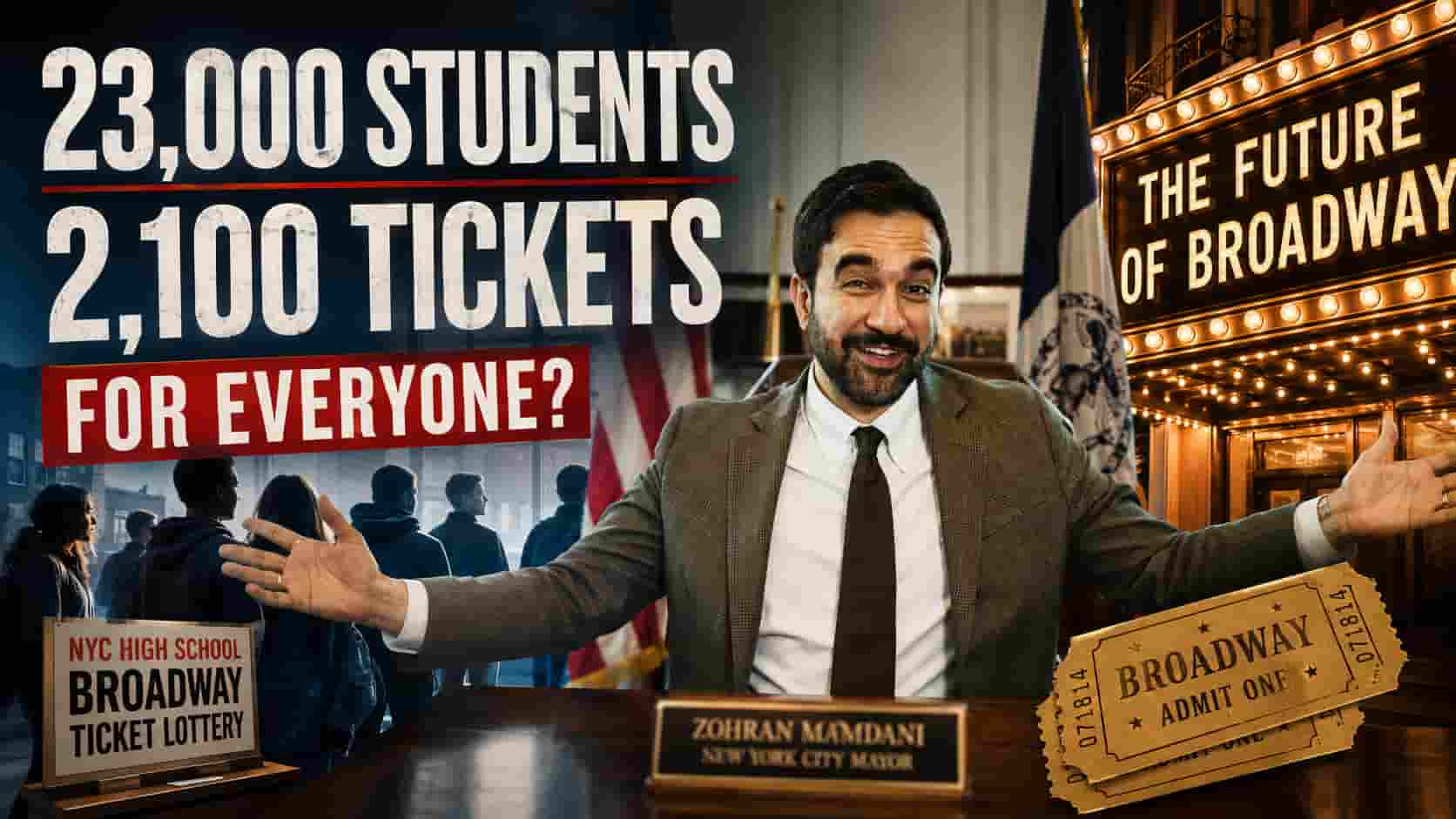
New York City Mayor Zohran Mamdani says his new Tickets for Teens initiative is about making Broadway and New York culture accessible to everyone.
It sounds impressive.
But look at the numbers.
More than 23,000 NYC high school students entered the lottery for free Broadway tickets.
How many free tickets are available?
2,100.
And those are tickets — not necessarily 2,100 student winners.
The Mayor’s own official transcript says the program offers 2,100 free tickets to high school students across New York City.
NYC Mayor’s Office — Official Transcript
So what does “for everyone” actually mean?
The program is open to every NYC high school student in grades 9 through 12, including public and nonpublic school students.
New York City does not publish one simple current number on the program page combining every public, charter, private and parochial student in grades 9–12.
But the potential population is roughly 300,000 students or more.
NYC Public Schools alone reported 906,248 students across its school system in 2024–25, plus another 148,089 charter-school students.
NYC Public Schools — Data at a Glance
That puts Mamdani’s announcement into perspective.
Roughly 300,000+ eligible students
23,000+ entered the lottery
Only 2,100 free tickets
In other words, only about 7% of the potentially eligible high-school population even entered the lottery.
And the number who can actually receive a free Broadway ticket represents well under 1% of all NYC high-school students.
Even among the 23,000 who entered, there is only about one ticket for every eleven applicants.
And because some winners may receive two tickets, the percentage of students actually selected could be even smaller.
What do the other students get?
This is where the political wording becomes important.
Mamdani says:
“Nobody loses in this lottery because everybody wins this membership.”
What does that mean?
It does not mean everybody gets a free Broadway ticket.
Everyone who entered receives a free two-month TDF membership.
That membership allows students to find some free cultural events and to buy discounted theater tickets, often priced around $20–$40.
So:
A small percentage gets the headline benefit — free Broadway tickets.
Everyone else gets temporary access to a discount program.
There is nothing inherently wrong with a discount program.
But it is very different from saying Broadway has now become free and accessible “for everyone.”
The familiar “for everyone” problem
Critics of socialist-style government programs will recognize the pattern.
The political message is universal:
“For everyone.”
“Accessible to all.”
“Culture belongs to everyone.”
The actual benefit is scarce and must therefore be distributed by lottery.
That is the basic problem with promising limited goods as universal benefits.
If there are approximately 300,000 or more eligible students and only 2,100 free tickets, government cannot make the tickets available to everyone simply by declaring Broadway a “public good.”
Someone still has to provide the seats.
Someone still has to pay for them.
And somebody has to decide who receives them.
In this case, that decision is made by lottery.
One important clarification
There is no evidence in the Mayor’s announcement that taxpayers simply purchased all 2,100 Broadway tickets.
The initiative is a partnership involving TDF, City Hall and participating cultural organizations and productions.
The main question is not who paid for the tickets. The main question is why a program promoted as being “for everyone” provides the headline benefit — a free Broadway ticket — to only a small fraction of eligible students.
Mamdani himself described the philosophy behind the program this way:
“Culture is not a private luxury for the few but a public good for all.”
Yet the mathematics tells a different story:
300,000+ potentially eligible students.
23,000+ applicants.
2,100 tickets.
Less than 1% of NYC high school students can receive the headline free-ticket benefit.
That is the difference between a political slogan and a limited resource.
“For everyone” sounds wonderful.
Until everyone asks for one.
Official Sources
NYC Mayor’s Office — August 13, 2026 announcement and transcript
TDF — Official Tickets for Teens Program
NYC Public Schools — Data at a Glance
Ask Midtown Tribune about this story
Answers are grounded first in this article. Search all Midtown Tribune reporting from the main AI Search page.
AI-generated summary. Verify important details in the linked original articles.