
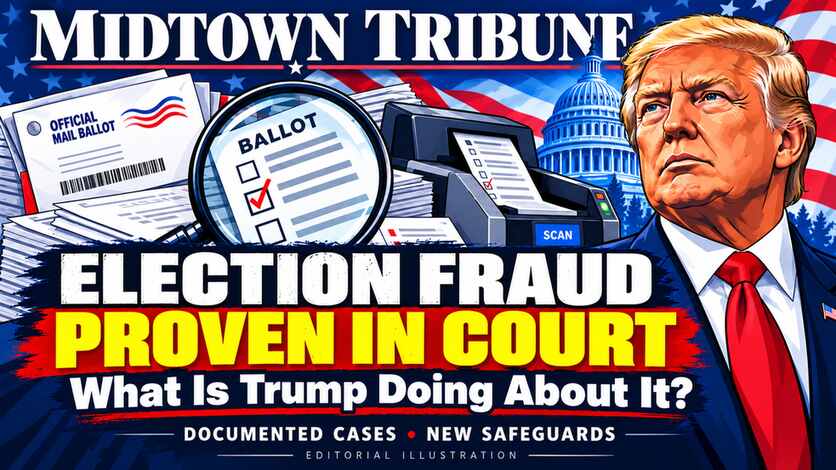
An organized mail-ballot scheme, voting twice in the same election and knowingly voting without U.S. citizenship have all resulted in guilty pleas and sentences. The Trump administration is pursuing additional election safeguards—but several measures face legal challenges.
Midtown Tribune | October 22, 2026
Election fraud is more than a hypothetical concern. Federal prosecutions have established specific cases in which people submitted unauthorized ballots, voted repeatedly or knowingly participated despite being ineligible.
Those cases demonstrate weaknesses that election safeguards must address. They do not establish that an entire national election was fraudulent, and the official documents reviewed do not identify each prosecution as a direct reason for President Donald Trump’s executive actions.
New Jersey: Unauthorized Mail Ballots Were Counted
Former Atlantic City Council President Craig Callaway pleaded guilty to organizing a scheme involving fraudulent mail-in ballots in the November 2022 election.
According to the U.S. Attorney’s Office for New Jersey, participants received approximately $30 to $50 to obtain ballots as purported authorized messengers.
Instead of delivering those ballots to voters, they handed them to Callaway or his associates. Many were subsequently cast in the names of people who confirmed that they had neither voted nor authorized anyone to vote for them.
Prosecutors reported that many of those ballots were counted.
On July 23, 2025, Callaway received 24 months in federal prison, followed by three years of supervised release. www.justice.gov
Voting Twice: Confirmed Cases in Multiple States
Miya Pack admitted voting in person in Bergen County, New Jersey, on October 26, 2024, and then voting again in Philadelphia on November 5. Both ballots included the presidential election.
On October 1, 2026, she was sentenced to three years of probation and 75 hours of community service. Read the federal prosecution announcement. www.justice.gov
In Illinois, Brenda Knuth admitted voting early and again on Election Day in November 2024, despite knowing that a second vote was prohibited. She received three years of probation and a $2,500 fine. Read the Justice Department’s account. www.justice.gov
Noncitizen Voting Also Produced Convictions
The U.S. Attorney’s Office for Southern Florida announced three separate cases involving Brazilian, Haitian and Cuban nationals.
All three pleaded guilty and were sentenced. According to prosecutors, the defendants admitted knowingly voting in federal elections despite lacking U.S. citizenship.
These are established offenses. The cases alone do not establish the nationwide prevalence of noncitizen voting. www.justice.gov
What Trump Has Proposed
On March 31, 2026, Trump signed Executive Order 14399, “Ensuring Citizenship Verification and Integrity in Federal Elections.”
The initiative addresses citizenship verification and federal requirements for mail-ballot processing, including unique barcodes on ballot envelopes. Its implementation raises legal questions about federal authority over elections administered by states. www.whitehouse.gov
Separately, the 2026 CISA Election Infrastructure Security Plan calls for post-election manual audits of paper ballots to verify voting-system results. www.cisa.gov
These safeguards address different problems. Eligibility checks concern who may vote; ballot tracking concerns handling; manual audits examine whether machines accurately counted the paper record. An accurate machine count cannot, by itself, establish that every ballot was lawfully submitted.
Announced Measures Are Not All in Force
The administration’s mail-ballot requirements have faced continuing litigation. An August Supreme Court decision suspended one injunction on procedural grounds rather than conclusively approving the entire policy.
On September 4, a federal district court issued another injunction against mandatory provisions of the final USPS rule. The decision is available in the Supreme Court’s case filings. www.supremecourt.gov
The documented prosecutions provide concrete reasons to strengthen election controls. Whether particular federal measures effectively prevent those offenses—and remain within lawful authority—must be assessed separately.
Sources
- DOJ: Craig Callaway’s mail-ballot fraud sentence
- DOJ: Double voting in New Jersey and Pennsylvania
- DOJ: Double voting in Illinois
- DOJ: Three noncitizen voting convictions
- White House: Executive Order 14399
- CISA: 2026 Election Infrastructure Security Plan
Ask Midtown Tribune about this story
Answers are grounded first in this article. Search all Midtown Tribune reporting from the main AI Search page.
AI-generated summary. Verify important details in the linked original articles.