
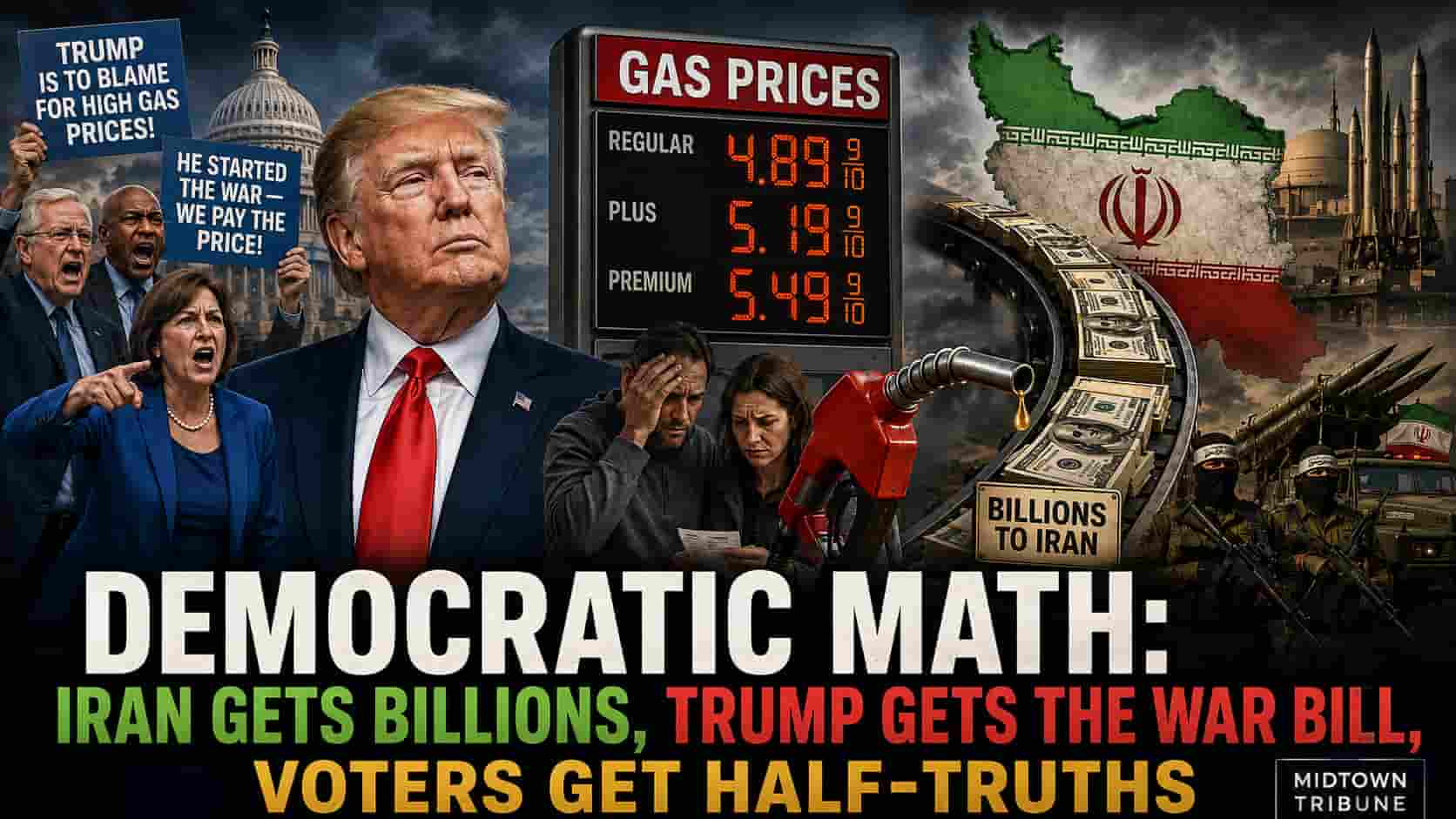
New York Assembly Democrats blame President Trump for the Iran war and higher gasoline prices—while omitting Biden-era price records, New York’s own fuel taxes, Iran’s nuclear buildup, and the Obama administration’s $1.7 billion cash settlement with Tehran.
By Midtown Tribune Editorial Staff | August 6, 2026
The Democratic majority in the New York State Assembly has discovered the suffering of motorists.
In a Facebook post, New York State Assembly Majority declared that New Yorkers had paid $2.2 billion more for gasoline since the Iran war began, supposedly costing the average household $405.
“The numbers are in,” the post announced, before urging politicians to remain focused on lowering costs for working families.
It is an effective political message: show voters a frightening number, connect it to President Donald Trump, and present a complex international crisis as though Washington had simply added a $405 “Trump war surcharge” to every New York household.
The numbers are real estimates. The presentation is the half-truth.
Where the $2.2 billion figure came from
The New York Assembly did not independently audit household gasoline purchases.
Its figures came from the Democratic staff of Congress’s Joint Economic Committee, which estimated that Americans had spent an additional $56.4 billion on gasoline between February 28 and July 12. The committee assigned approximately $2.216 billion of that amount to New York, or $405 per household.
The estimate was constructed using daily AAA gasoline prices, state-by-state consumption data from the Federal Highway Administration, and national gasoline-demand data from the U.S. Energy Information Administration.
That makes it a model—not a household-by-household accounting.
More importantly, it measures the difference between actual gasoline spending and what consumers might have spent had prices remained near their prewar level. It does not establish that every additional dollar was caused exclusively by one decision made by Trump.
“Prices increased after the war began” is a factual observation.
“Trump personally imposed the entire increase” is a political conclusion.
Gasoline remains below its Biden-era peak
The Assembly majority also left out an inconvenient comparison.
According to the U.S. Energy Information Administration, the national average price of regular gasoline was $4.079 per gallon during the week of August 3, 2026.
That is expensive. It is also substantially below the approximately $5.01-per-gallon peak recorded in June 2022, when Joe Biden was president.
Therefore, two statements can be true at the same time:
Gasoline became more expensive following the outbreak of the current conflict, while gasoline still remains cheaper nationally than it was at the Biden-era peak.
The Assembly majority showed voters only the comparison that served its political argument.
Apparently, an increase under Trump is a presidential failure, while an even higher price under Biden is ancient history that no longer belongs in the spreadsheet.
A gasoline price is not produced by one politician
The Energy Information Administration explains that retail gasoline prices are affected by several major components: crude-oil prices, refining costs and margins, distribution and marketing expenses, and taxes. Supply disruptions, inventories, regional fuel requirements, transportation limitations and local competition also affect what motorists pay.
A war involving Iran can clearly influence oil markets. Iran’s location, regional shipping routes, military threats and fears of interrupted supply all create risk premiums.
But that still does not transform a partisan congressional estimate into proof that Trump personally created every cent of the increase.
The Assembly’s presentation removes every complicating factor because complications weaken campaign slogans.
Albany forgot to mention Albany’s taxes
The New York Assembly majority says it wants to protect working families from expensive fuel.
It might begin by discussing the portion of the price controlled in Albany.
For 2026, New York imposes a 15.8-cent-per-gallon petroleum business tax on motor fuel. The state also imposes 8.05 cents per gallon through the motor-fuel excise tax and petroleum-testing fee.
New York’s sales-tax structure adds another state charge, while New York City applies its own 4.5% local sales-tax rate to qualified fuel.
Those taxes did not necessarily cause the postwar increase because most were already in place. They do, however, contribute to the final price paid by every driver.
If Assembly Democrats believe gasoline costs constitute an emergency for working families, they possess legislative authority over part of that cost.
Instead, their public message contains a remarkable division of responsibility:
When the price rises, blame Trump.
When New York collects taxes from the same gallon, change the subject.
The war did not emerge from nowhere
The Assembly post also treats the Iran conflict as though Trump spontaneously created a war against a harmless country.
The International Atomic Energy Agency estimated that Iran’s enriched-uranium stockpile included 440.9 kilograms enriched to 60% uranium-235 as of June 13, 2025. The agency verified most of that quantity but subsequently reported that it lacked sufficient access to determine the stockpile’s current size, composition and whereabouts.
The White House states that Operation Epic Fury was launched to eliminate Iran’s nuclear threat, degrade its ballistic-missile forces, disrupt proxy networks and weaken its naval capabilities. That is the administration’s stated justification and should not be confused with an independent determination that every military decision was necessary or correctly executed.
Voters are entitled to debate the operation, its legal basis, its costs and its strategy.
They should also be told what the operation is officially intended to confront.
Showing only the gasoline receipt while deleting the nuclear program, missile forces and Iranian attacks from the discussion is not analysis. It is message management.
The Obama administration sent Iran $1.7 billion in foreign banknotes
The historical context becomes even more uncomfortable for Democrats.
In 2016, during the Obama administration, the United States settled a decades-old financial dispute with Iran. The settlement involved $400 million in principal and approximately $1.3 billion in interest, for a total of about $1.7 billion.
The Treasury Department later testified that the $400 million was converted into foreign currency and physically transported to Geneva before being provided to an official from Iran’s central bank.
Treasury also stated that the $1.3 billion interest payment was converted into foreign currency and disbursed as banknotes in two installments. Treasury explained that cash was used because sanctions had largely separated Iran from the international financial system.
Joe Biden was vice president at the time. It was an Obama administration policy, not a payment independently ordered by Biden.
The administration maintained that the money belonged to Iran under the settlement of a longstanding legal claim. Critics argued that delivering such a large quantity of liquid funds to the Iranian government strengthened a regime already financing proxies, missiles and regional violence.
Did those exact dollars purchase particular weapons?
There is no public official accounting that traces a specific banknote from the 2016 settlement to a particular missile, drone or rifle used in the current conflict.
Midtown Tribune therefore does not claim that investigators have identified the exact serial numbers of the money used for individual weapons purchases.
But money is fungible.
When a government receives $1.7 billion in readily usable funds, it can spend those funds on one obligation while redirecting its other revenues toward military programs, proxies, missiles or nuclear development.
The relevant political question is not whether one particular banknote was taped to one particular missile.
The question is whether years of sanctions relief, financial access and attempted accommodation gave Iran additional resources without permanently ending the nuclear and military threat.
The Assembly majority’s post does not acknowledge that question at all.
Why present voters with only half the story?
We cannot prove the private intentions of every person who prepared or shared the post.
Its political purpose, however, is evident from its structure.
The message turns an international conflict into a household invoice, assigns that invoice to Trump, and removes every fact that could complicate the accusation:
- Gasoline was more expensive at the 2022 Biden-era peak.
- New York adds its own taxes to the price of every gallon.
- Gasoline prices are affected by several market and regulatory forces.
- Iran had accumulated uranium enriched to 60%.
- The United States had lost reliable visibility into the current stockpile.
- The Obama administration delivered a $1.7 billion settlement in foreign banknotes.
- The confrontation developed through the policies and failures of several administrations.
That is why the post is misleading even though its headline number was not simply invented.
It supplies a calculation while withholding the context necessary to understand it.
Democratic arithmetic
The Assembly majority wants voters to believe that history began when Trump responded to Iran.
Under that formula:
Iran receives billions.
Iran develops missiles, supports armed proxies and advances its nuclear program.
Trump inherits the confrontation.
The price of gasoline rises.
Democrats mail Trump the entire bill.
And New York voters receive only the portion of the story selected for Facebook.
That is not economic analysis.
It is democratic arithmetic: Iran gets billions, Trump gets the war bill, and voters get half-truths.
Official Sources and Government Records
The figures, historical comparisons, tax rates and government positions discussed in this article can be reviewed in the following official records:
- U.S. Joint Economic Committee Democrats — $56.4 billion national gasoline-cost estimate and New York’s $2.216 billion / $405-per-household calculation
- U.S. Energy Information Administration — weekly national retail price history for regular gasoline
- U.S. Energy Information Administration — official discussion of the June 2022 gasoline-price peak
- U.S. Energy Information Administration — crude oil, refining, distribution and taxes as components of gasoline prices
- U.S. Energy Information Administration — taxes, supply conditions and fuel requirements affecting regional gasoline prices
- New York State Department of Taxation and Finance — 2026 petroleum business tax, motor-fuel excise tax and testing fee
- New York State Department of Taxation and Finance — state and local sales-tax rates on motor fuel effective June 1, 2026
- International Atomic Energy Agency — June 2026 report on Iran’s enriched-uranium stockpile and verification restrictions
- The White House — official statement describing the objectives of Operation Epic Fury
- U.S. Department of the Treasury — 2016 testimony detailing the $400 million principal and $1.3 billion interest payments to Iran in foreign banknotes
- U.S. Department of State archive — announcement of the Hague Claims Tribunal settlement with Iran
- New York State Assembly — official website
Editorial note: Official records confirm the value and method of the 2016 settlement payments. They do not publicly trace specific settlement funds to individual Iranian weapons purchases. The article discusses the broader fiscal and strategic consequences of providing liquid resources to the Iranian government.
Ask Midtown Tribune about this story
Answers are grounded first in this article. Search all Midtown Tribune reporting from the main AI Search page.
AI-generated summary. Verify important details in the linked original articles.