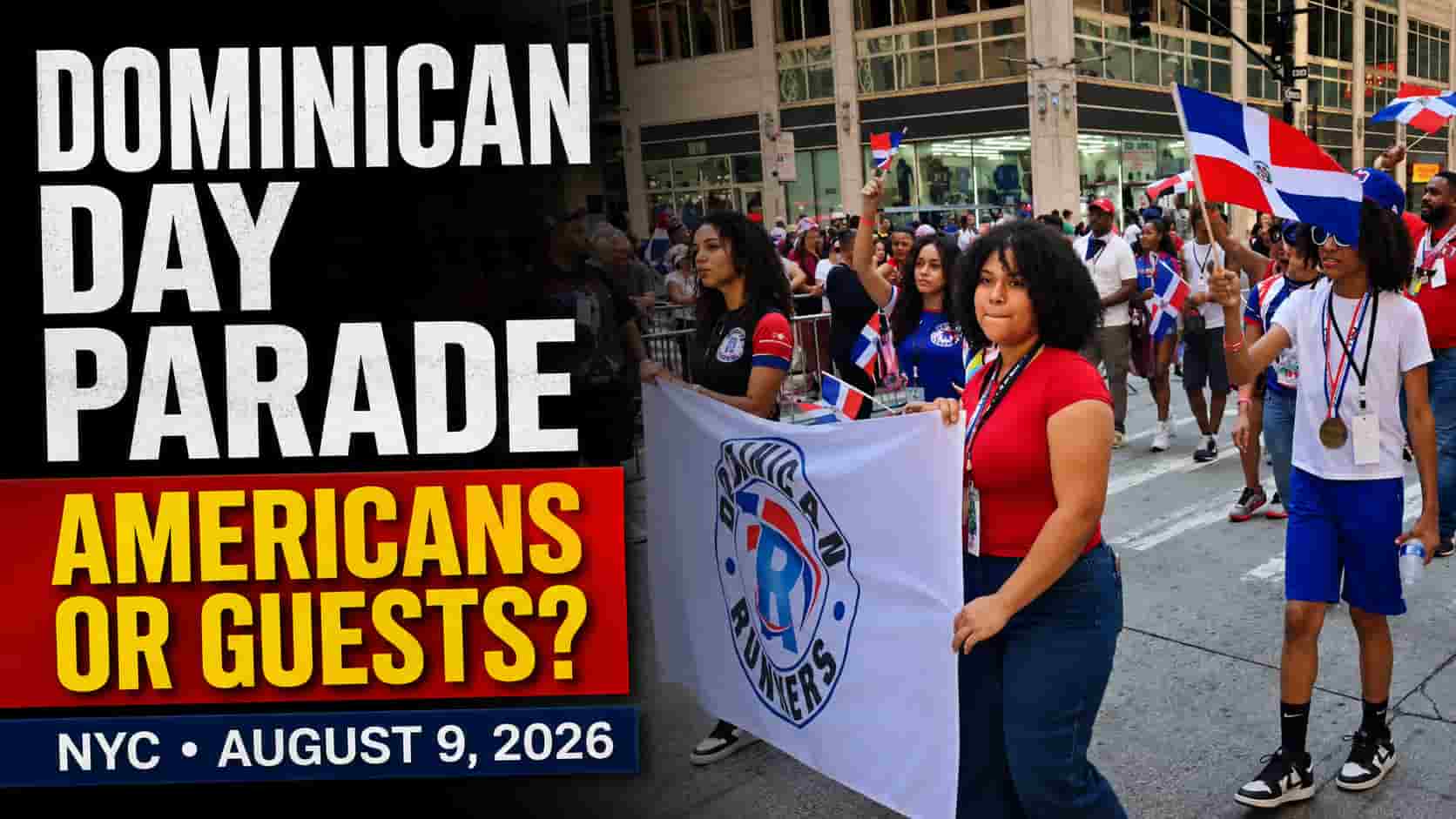
The 44th National Dominican Day Parade ended Sunday afternoon in Midtown Manhattan after filling Sixth Avenue with Dominican flags, music and thousands of marchers. But the spectacle raises a larger question about modern New York: When hundreds of thousands gather beneath the flag of another country, what country do they consider their own?
NEW YORK — August 9, 2026, updated after 4 p.m. — The 44th annual National Dominican Day Parade concluded Sunday afternoon after transforming Sixth Avenue in Midtown Manhattan into a massive celebration of Dominican culture, identity and political influence.
For hours, Dominican Republic flags dominated the avenue as floats, musicians, dancers, community organizations, businesses, public officials and thousands of marchers traveled north through Manhattan.
Organizers describe the parade as an annual celebration featuring more than 10,000 marchers. City officials had expected approximately 400,000 spectators.
The 2026 theme was:
“Dominicanos: Identidad y Cultura” — “Dominicans: Identity and Culture.”
And that theme raises an interesting question that is larger than one parade:
Are these Dominicans visiting America — or Americans celebrating Dominican heritage?
The visual impression on Sixth Avenue can make the question seem simple.
There were Dominican flags everywhere.
But legally and demographically, the answer is far more complicated.
A Dominican flag tells us something about the identity or heritage a person wishes to celebrate.
It does not tell us that person’s citizenship.
Someone waving a Dominican flag in Manhattan could be:
- an American citizen born in New York to Dominican parents;
- a naturalized U.S. citizen born in the Dominican Republic;
- a dual U.S.-Dominican citizen;
- a lawful permanent resident;
- another non-citizen resident of the United States;
- or a visitor from the Dominican Republic.
There is no publicly available count establishing the immigration or citizenship status of Sunday’s parade participants and spectators.
Calling the entire crowd “foreign visitors” would therefore be inaccurate.
But asking what national identity means when an American city’s streets are covered overwhelmingly with the symbols of another sovereign country is a legitimate civic question.
What Is Their Country?
For an American citizen of Dominican ancestry, the legal answer is straightforward:
The United States is his or her country.
If that individual also possesses Dominican citizenship, however, the Dominican Republic is legally a country of nationality as well.
The U.S. Department of State explicitly recognizes dual nationality.
American law does not require a U.S. citizen to choose between U.S. citizenship and another nationality.
A person may therefore be both American and Dominican at the same time.
That distinction matters.
“Dominican” can describe nationality.
But it can also describe ancestry, ethnicity, family history and culture.
Those are not the same thing.
More Than 700,000 Dominican New Yorkers
The scale of the community helps explain why the parade has become one of New York’s largest ethnic celebrations.
New York City Department of City Planning Population FactFinder data list approximately 702,330 New York City residents identifying as Dominican, representing about 8 percent of the city’s population.
Dominicans are the city’s largest detailed Hispanic-origin group in those data.
The City’s newly released Newest New Yorkers 2026 report also identifies the Dominican Republic as New York City’s largest source country for foreign-born residents.
That means the community itself contains several generations.
Some New Yorkers were born in the Dominican Republic.
Others were born in Washington Heights, the Bronx, Brooklyn, Queens or elsewhere in the United States.
The children of immigrants born in New York are generally not “immigrants.” They are native-born Americans.
This is why a sea of Dominican flags should not automatically be interpreted as a sea of foreign nationals.
Mamdani Says More Than One in Eight New Yorkers Have Dominican Roots
Mayor Zohran Mamdani highlighted the community’s size during an official NYPD security briefing two days before the parade.
He said:
“More than one in eight New Yorkers have Dominican roots.”
He described Dominican heritage as integral to New York City’s history and referred repeatedly to “our Dominican New Yorkers.”
There is an interesting statistical distinction worth noting.
NYC Planning’s Population FactFinder reports approximately 702,330 residents identifying as Dominican, or about 8 percent of the population.
“One in eight” would mean more than 12 percent.
That does not necessarily make the mayor’s statement incorrect, because the phrase “Dominican roots” can describe a broader population than people who selected Dominican as their specific Census ethnicity.
But City Hall did not explain the methodology behind the “one in eight” figure during the briefing.
For a city increasingly governed through the language of ethnic and community identity, that distinction is worth understanding.
Dominican-American — Which Word Comes First?
There is another question beneath Sunday’s celebration.
What does Dominican-American mean politically and culturally?
Is the emphasis on “Dominican”?
On “American”?
Or equally on both?
America has historically allowed communities to preserve ancestral traditions while becoming part of a common national identity.
New York has Irish parades, Italian celebrations, Greek festivals, Caribbean celebrations, Asian cultural events and countless other expressions of immigrant heritage.
Celebrating an ancestral flag therefore does not, by itself, demonstrate rejection of the American flag or American citizenship.
But there is still room for a serious civic discussion.
When a public event takes over a major avenue of an American city and overwhelmingly displays another nation’s flag, should the Stars and Stripes be equally visible?
Should public officials emphasize ethnic identity, American citizenship, or both?
And when politicians speak of “Dominican New Yorkers,” are they describing an ethnic community within America — or encouraging political identity to remain permanently organized around countries of origin?
Those are political questions.
They cannot be answered simply by counting flags.
The Dominican Republic Is a Real Country — Not an Ethnicity Alone
There is another reason terminology matters.
The Dominican Republic is not merely a cultural label.
It is an independent sovereign nation in the Caribbean with its own government, constitution, citizenship, elections, military, borders and national flag.
Someone who is solely a citizen of the Dominican Republic living temporarily in the United States is a Dominican national in America.
Someone who becomes an American citizen is an American citizen regardless of birthplace.
Someone possessing both nationalities can legally be both.
And someone born in New York to Dominican parents may be American from birth while maintaining a powerful Dominican cultural identity — and may also qualify for Dominican nationality under Dominican law.
The individuals walking Sixth Avenue Sunday therefore cannot all be assigned the same answer to the question, “What is your country?”
For some, the answer is America.
For others, the Dominican Republic.
For dual nationals, legally, it can be both.
A Major NYPD Security Operation
While Sunday’s parade was a celebration, the city treated security seriously.
At Friday’s official briefing, NYPD Commissioner Jessica Tisch said authorities were aware of no specific or credible threat to the National Dominican Day Parade.
Nevertheless, the NYPD deployed a substantial security operation involving uniformed officers, traffic personnel, Emergency Service Unit personnel, mounted officers, K-9 teams, counterterrorism resources, drones and helicopters.
Police also used a two-layer barricade system — described by Tisch as a “double moat” — to separate spectators from the parade route.
The preparations came after previous crowd-control problems at the Manhattan parade and recent violence around a separate Dominican parade in the Bronx.
Sunday’s National Dominican Day Parade proceeded along Sixth Avenue from the West 30s toward West 55th Street.
By shortly after 4 p.m., the principal parade activity had concluded.
Politics Was Never Far Away
The event also demonstrated the political importance of New York’s Dominican community.
Mayor Mamdani marched in the parade.
Rep. Adriano Espaillat — the first Dominican-American member of Congress — participated in the security preparations and has longstanding ties to the parade.
NYPD Commissioner Jessica Tisch stood alongside city and community officials before the event.
The parade therefore represented more than music and dancing.
It displayed a constituency that has become deeply embedded in New York’s electoral, governmental, business and civic life.
That fact itself helps answer the original question.
Many of the people celebrating Dominican identity on Sixth Avenue are not standing outside American society looking in.
They are part of American society.
Some vote.
Some serve in government.
Some work for the NYPD.
Some own New York businesses.
Some were born here.
Some became citizens here.
Others are still immigrants.
And some may indeed have been visitors.
The Question New York Should Be Able to Ask
The choice does not have to be between banning ethnic identity and pretending national identity no longer matters.
An American can celebrate where his parents or grandparents came from.
But America also has a national identity of its own.
That makes Sunday’s parade an opportunity for a broader discussion:
Can New York celebrate Dominican culture while also reinforcing a shared American civic identity?
Should an American-born child of Dominican parents think of America as his country and the Dominican Republic as his heritage?
Can someone comfortably regard both countries as part of his identity?
And should public institutions distinguish more carefully between ethnicity, ancestry, immigration status and citizenship when describing New Yorkers?
Those questions become increasingly important in a city where millions of residents either immigrated themselves or are children of immigrants.
Perhaps the most accurate lesson from Sunday’s sea of Dominican flags is not that New York suddenly became a foreign country.
It is that America’s continuing immigration experiment has produced citizens whose national, cultural and family identities do not always fit into a single word.
The harder question is whether those identities ultimately strengthen a common American identity — or gradually replace it.
That is a debate New Yorkers should be able to have openly.
OFFICIAL SOURCES
NYC Mayor’s Office — Security Briefing Ahead of Dominican Day Parade
Official transcript of Mayor Zohran Mamdani, NYPD Commissioner Jessica Tisch, Rep. Adriano Espaillat and parade officials:
NYC Department of Transportation — Weekend Traffic Advisory
Official NYC information on street closures for the Dominican Day Parade:
https://www.nyc.gov/html/dot/html/motorist/wkndtraf.shtml
NYC Department of City Planning — Population FactFinder
Official city demographic data, including approximately 702,330 New Yorkers identifying as Dominican:
https://popfactfinder.planning.nyc.gov
NYC Department of City Planning — The Newest New Yorkers 2026
Official city report on New York’s foreign-born population and countries of origin:
https://www.nyc.gov/site/planning/planning-level/nyc-population/newest-new-yorkers.page
U.S. Department of State — Dual Nationality
Official federal explanation of U.S. dual-nationality law:
National Dominican Day Parade — Official Organization
Official parade website:
National Dominican Day Parade — Official Instagram
https://www.instagram.com/natddp
National Dominican Day Parade — Official Facebook
OFFICIAL VIDEO AND SOCIAL MEDIA
National Dominican Day Parade — Official Organizer Video: “Dominicanos: Identidad y Cultura”
Official National Dominican Day Parade video celebrating the 2026 theme:
National Dominican Day Parade — Official Instagram
Official organizer’s parade posts, reels and updates:
NYPD — Official Dominican Day Parade Security Preparations Video
Official NYPD video briefing on preparations for the 2026 parade:
FULL PARADE VIDEO / MEDIA COVERAGE
ABC7 New York — Full 2026 National Dominican Day Parade Live Coverage
Full live broadcast from Sixth Avenue:
ABC7 New York — National Dominican Day Parade Marches Through Midtown Manhattan
CBS News New York — National Dominican Day Parade
CBS reported that approximately 400,000 spectators were expected:
https://www.cbsnews.com/newyork/news/national-dominican-day-parade-nyc-2026
CBS News New York — Mamdani and NYPD Security Plan
https://www.cbsnews.com/newyork/news/zohran-mamdani-nypd-dominican-day-parade-nyc-security
NBC New York — Dominican Day Parade Street Closures and Event Information
Ask Midtown Tribune about this story
Answers are grounded first in this article. Search all Midtown Tribune reporting from the main AI Search page.
AI-generated summary. Verify important details in the linked original articles.