
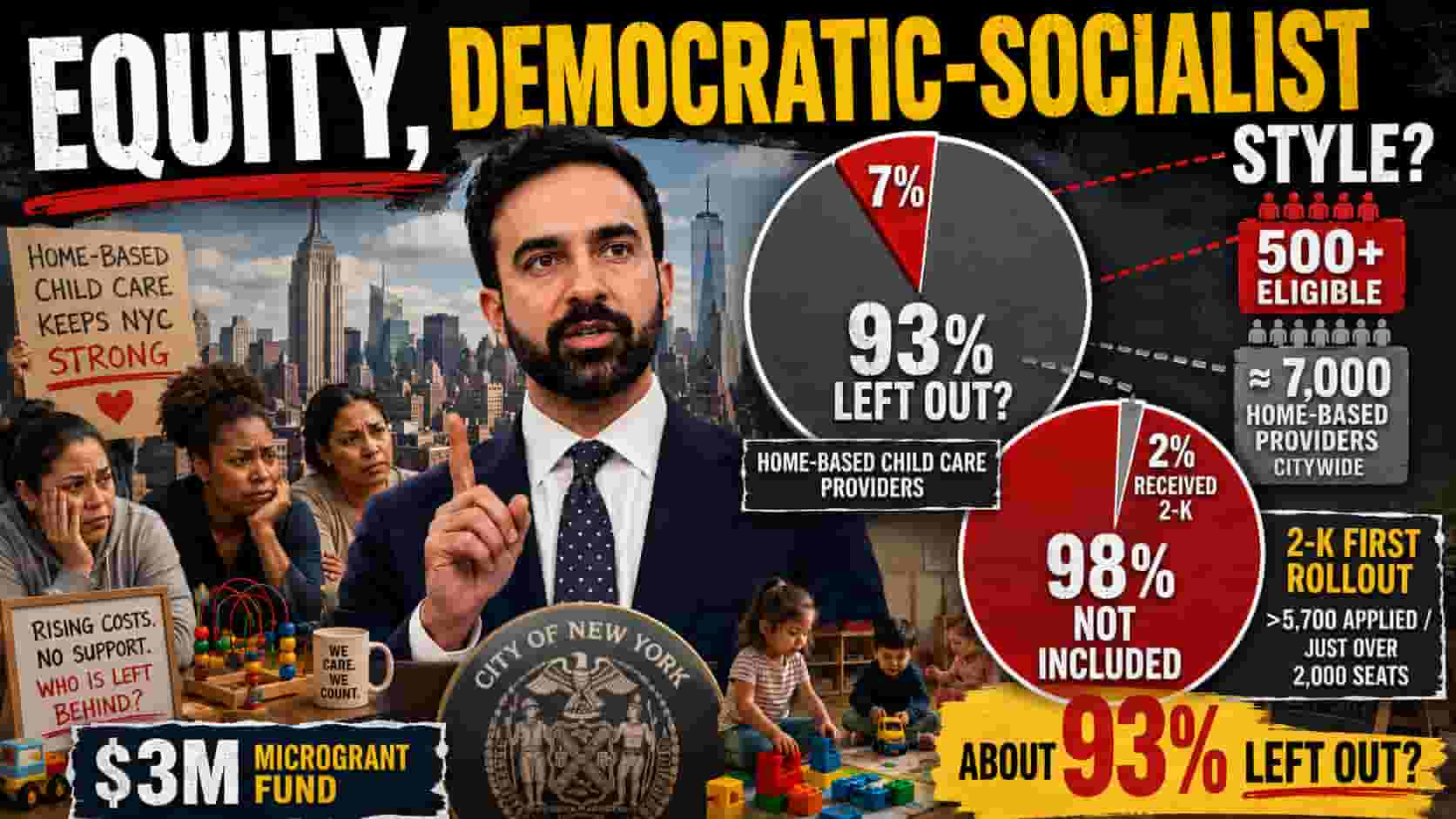
New York City is launching a $3 million emergency microgrant fund for home-based child care providers. Mayor Zohran Mamdani says the initiative is another step toward a system that “values every provider and every family.” But City Hall says only “more than 500” providers will be eligible, while a Midtown Tribune review of New York State child care records puts the number of regulated Family Day Care and Group Family Day Care programs across the five boroughs at roughly 7,000. And now there is another unanswered question: How much will it cost to administer the “equitable” distribution of that money?
Mayor Zohran Mamdani announced the new $3 million Emergency Microgrant Fund on August 7, 2026, saying it will help licensed home-based child care providers deal with sudden emergencies that could otherwise force them to close.
The grants will range from $1,000 to $10,000. City Hall cited examples including a broken refrigerator, a burst pipe, storm damage, or another urgent expense threatening a provider’s ability to continue operating.
Helping a small child care business survive a genuine emergency is not, by itself, a controversial idea.
The more interesting questions begin when we look at the numbers — and at the machinery being created to decide who gets the money.
“More Than 500” Out of Roughly 7,000
City Hall’s own announcement states that:
“More than 500 licensed providers will be eligible” for emergency microgrants.
New York State’s Office of Children and Family Services maintains the official database of regulated child care programs. The state database identifies FDC as Family Day Care and GFDC as Group Family Day Care, the principal regulated home-based child care categories relevant to this program. The database is maintained at the program level and updated regularly by OCFS.
A Midtown Tribune review of the current OCFS data for New York City produces a figure of roughly 7,000 active licensed or registered FDC/GFDC programs across the five boroughs.
Now compare the scale.
If “more than 500” ultimately means something close to 500, then approximately 7% of roughly 7,000 programs would fall within that number.
That leaves approximately 93% outside it.
That is why the question mark in our headline matters.
City Hall has not said exactly 500 providers will receive grants. Nor has it said that precisely 93% will be rejected. In fact, the final program design has not yet been completed.
But when a government-backed initiative addresses a field numbering in the thousands while announcing assistance for “more than 500,” asking what percentage can realistically be helped is not political rhetoric.
It is arithmetic.
And Here Comes the Word “Equitably”
The most revealing language comes not from a campaign speech but from the City of New York’s own procurement process.
The Childcare Microgrants Administrator RFP is being issued through the Mayor’s Fund to Advance New York City. It seeks an outside organization to administer the program. The procurement notice was published August 7, and proposals are due August 31, 2026, at 5:00 p.m.
According to the RFP, the administrator is expected to create a system capable of distributing grants:
“quickly, equitably, and with appropriate fiscal controls.”
There it is: equitably.
That is not Midtown Tribune’s terminology. It is the city’s own stated standard for administering the fund.
Which raises the obvious question:
How will “equity” determine who receives limited assistance — and who does not?
The public does not yet have a final detailed formula for ranking potentially eligible providers.
City Hall itself says the Mayor’s Office of Child Care and Early Childhood Education will work with the selected administrator to finalize the program’s design and launch it before the end of 2026.
So the city has already announced an “equitable” assistance program before its final operating rules have been published.
Who Will Decide Who Is “Eligible”?
There is another noteworthy detail.
City Hall says the Emergency Microgrant Fund was co-designed with a working group of home-based child care providers and advocates.
According to the mayor’s office, the group participated in developing the initiative’s guiding principles, goals and eligibility.
That makes transparency especially important.
Who participated in the entire working group?
How were those participants selected?
What eligibility rules did they recommend?
Will working-group members, their organizations, affiliates, members or clients themselves be eligible to benefit?
Those questions are not allegations of favoritism or wrongdoing.
There is currently no evidence establishing such misconduct.
But whenever a limited fund is being distributed among thousands of similarly situated small businesses, transparency about who helped design the eligibility rules should be elementary good governance.
A New Question: How Much Will It Cost to Administer the “Equity”?
This brings us to another issue that deserves attention.
The city is not simply assigning an existing employee to distribute the grants.
It has issued a formal Request for Proposals to select an outside organization to serve as the Childcare Microgrants Administrator. The procurement notice lists the Mayor’s Fund to Advance New York City as the issuing entity and says proposals are due August 31.
But as of the published procurement notice, no administrator has yet been selected.
More importantly, the public-facing City Record notice does not state a salary for an administrator, a management fee, or a total administrative contract amount.
That creates another straightforward question:
How much of the announced $3 million will actually reach child care providers — and how much will be spent administering the program?
City Hall’s August 7 announcement describes a $3 million Emergency Microgrant Fund, with individual awards of $1,000 to $10,000, but does not provide a public breakdown showing whether administrator compensation, staffing, technology, outreach, application review, audit, compliance or other operating costs will come out of that same $3 million or be funded separately.
Until the contract and final program budget are published, Midtown Tribune cannot say what the administration will cost.
That is precisely why the number should be disclosed.
If the full $3 million goes directly to providers and administrative expenses are paid separately, the city should say so.
If administrative costs are deducted from the $3 million, New Yorkers should know exactly how much.
An “equitable” grant program should begin with transparent accounting.
What Is the Administrator Actually Being Hired to Do?
The procurement notice makes clear that this is more than a clerical assignment.
The city wants an outside organization to administer an emergency grant program for home-based child care providers — businesses that, as the RFP itself notes, often operate on thin margins, face rising costs and have limited access to flexible capital.
That means the administrator could potentially play a significant role in the process through which applications are received, evaluated, processed and grants distributed.
And the city still plans to work with the selected organization to finalize the program design.
So another question should be added to the list:
Will the administrator simply process applications under objective rules established in advance — or will the administrator have discretion in deciding which providers receive priority?
The difference matters.
“Every Provider and Every Family”
In announcing the fund, Mamdani said the program is another step toward building a child care system that “values every provider and every family.”
That is an attractive slogan.
But words such as every, universal and equity become more interesting when they meet numbers.
City Hall says home-based child care providers serve as many as 100,000 children across New York City. It simultaneously says that more than 500 licensed providers will be eligible for the new grants.
There is nothing inherently wrong with starting a new program on a limited scale.
There is, however, an important distinction between saying:
“We are launching a limited emergency grant program for several hundred providers”
and surrounding a limited initiative with broader language about equity, universality and every provider.
That difference deserves public scrutiny.
We Have Seen the Same Tension With 2-K
The same tension between universal language and a limited initial rollout appeared only days earlier with the Mamdani administration’s new 2-K program.
On August 4, City Hall announced that more than 5,700 families applied for just over 2,000 seats in the inaugural 2-K application season.
The administration itself summarized the result as nearly three applications for every available seat.
The mayor nevertheless described the larger goal as “free, universal child care” and said the city will continue expanding the program until every family that wants a seat can obtain one.
That future promise is important.
But it does not change the present numbers.
The administration’s own official transcript states:
more than 5,700 applications for 2,000 seats, with about 3,700 families on waitlists at that stage.
So the first rollout is a step toward universal 2-K.
It is not yet universal 2-K.
Likewise, the new microgrant fund may help hundreds of providers.
It is not assistance available at comparable scale to every home-based provider in New York City.
A Good Idea Does Not Eliminate the Need for Equal Rules
Emergency assistance for a home-based daycare facing a burst pipe, storm damage or failed refrigeration can make economic sense.
These providers are small businesses.
A closure can hurt the provider, employees, parents and children simultaneously.
The city’s own RFP acknowledges that many family child care businesses operate with thin margins, rising costs and limited flexible capital.
That is an argument for emergency assistance.
It is also an argument for making the selection process exceptionally transparent.
If thousands of comparable businesses could suffer sudden emergencies, assistance should be distributed according to rules that are:
published in advance, understandable to every applicant, applied consistently, and auditable afterward.
“Equity” should not become a substitute for explaining the rules.
If the rules are fair, publish them.
Seven Questions City Hall Should Answer Before the First Grant Is Awarded
Midtown Tribune believes City Hall should provide clear public answers before money is distributed.
1. How many providers can actually receive grants?
Not simply “more than 500.” What is the realistic maximum?
2. What objective criteria will determine eligibility and priority?
First-come, first-served? Severity of emergency? Lottery? Income? Geography? Demographics? Number of children served?
3. Who makes the final decision on individual applications?
The Mayor’s Fund? MOCCECE? The outside administrator? A review committee?
4. What discretion will the outside administrator have?
Will it merely verify eligibility or rank competing applicants?
5. Who participated in the working group that helped design eligibility?
Will the city disclose the full membership and any potential conflicts of interest?
6. What will administration cost?
What is the administrator’s contract value? How much will go toward salaries, overhead, application processing, technology, outreach, auditing and compliance?
7. How much of the $3 million will reach providers directly?
Will the city publish a final report showing applications received, grants approved, amounts distributed, administrative costs and awards by borough?
Those answers would tell New Yorkers much more about the practical meaning of “equity” than another slogan.
One Important Clarification: The $3 Million Is Not Clearly Taxpayer Money
Critics should also be precise about where the money comes from.
The official City Record procurement notice explains that the Child Care Action Fund, housed at the Mayor’s Fund to Advance New York City, was created to enable philanthropies and private donors to support child care initiatives connected to the city’s universal-childcare agenda.
The mayor’s office says the Emergency Microgrant Fund will be financed through that Child Care Action Fund.
Based on the documents currently published, Midtown Tribune therefore does not characterize the $3 million itself as taxpayer-funded without additional evidence.
That does not make transparency less important.
The program is being announced by the mayor, designed in conjunction with a mayoral office and administered through the Mayor’s Fund. The public has a legitimate interest in knowing how recipients are selected and how much administration costs.
Why “Democratic-Socialist Style”?
The political description in the headline is not an invention of Mamdani’s opponents.
The official NYC Democratic Socialists of America website identifies Mamdani as a “Democratic Socialist and DSA member.”
After his 2025 mayoral election, the national Democratic Socialists of America called his victory a major electoral victory for the socialist movement.
That makes it reasonable to examine how concepts frequently emphasized by his political movement — including universality and equity — operate when translated into actual government programs.
The Real Test of “Equity”
Perhaps the final microgrant program will establish transparent, neutral and easily understood eligibility rules.
Perhaps virtually all administrative expenses will be covered separately and nearly all of the announced $3 million will go directly to providers.
Perhaps the administrator will have little or no subjective discretion.
If so, City Hall should have no difficulty publishing those facts.
But today, the information publicly available leaves several important questions unanswered.
We know the fund is advertised as $3 million.
We know grants are supposed to range from $1,000 to $10,000.
We know City Hall says more than 500 licensed providers will be eligible.
We know there are thousands of regulated home-based child care programs across New York City.
We know an outside administrator is being sought.
We know the final program design is not yet complete.
What we do not yet know is exactly how many providers will ultimately receive money, how competing applicants will be prioritized, how much discretion the administrator will possess — or how much administering this new layer of “equity” will cost.
Government should ultimately be judged by results and rules, not vocabulary.
Until those rules and numbers are public, the appropriate response is simple:
Show us the criteria.
Show us the administrative costs.
Show us where the $3 million goes.
And show everyone the same rules.
Official Sources
NYC Mayor’s Office — Emergency Microgrant Fund for Home-Based Child Care Providers, August 7, 2026.
NYC City Record — Childcare Microgrants Administrator RFP, published August 7, 2026; proposals due August 31, 2026.
New York State Office of Children and Family Services — Child Care Regulated Programs database.
NYC Mayor’s Office — More Than 5,700 Applications for Just Over 2,000 2-K Seats, August 4, 2026.
NYC Mayor’s Office — Official 2-K Transcript.
NYC Democratic Socialists of America — official Mamdani page.
Democratic Socialists of America — National Political Committee statement on Mamdani’s election.
Methodology note: The approximately 7% / 93% comparison is a Midtown Tribune editorial calculation comparing City Hall’s statement that “more than 500” providers will be eligible with the approximate number of active regulated FDC/GFDC programs identified through New York State OCFS data. Because “more than 500” is not a final recipient count, 93% is an approximate illustration of the announced program’s scale, not a claim that exactly 93% of providers have already been denied grants.
Ask Midtown Tribune about this story
Answers are grounded first in this article. Search all Midtown Tribune reporting from the main AI Search page.
AI-generated summary. Verify important details in the linked original articles.