
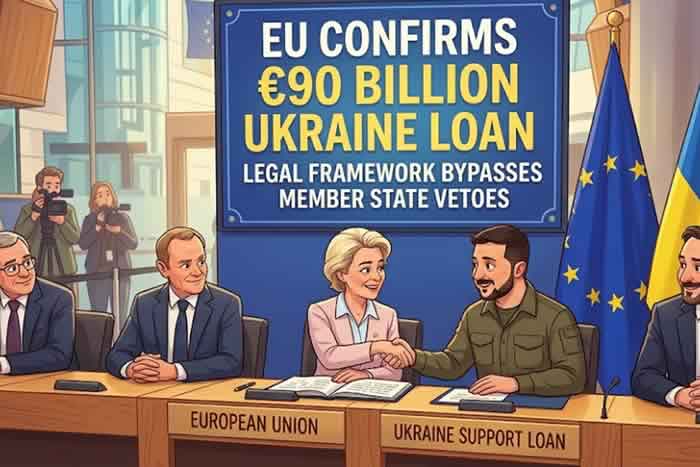
BRUSSELS — The European Commission has confirmed that the first disbursement of the landmark €90 billion Ukraine Support Loan is on track for the end of the second quarter of 2026. This funding milestone marks a critical phase in the 2026–2027 macro-financial assistance cycle. As of April 14, 2026, technical preparations—including the finalization of the Memorandum of Understanding and essential updates to the Ukraine Plan—are being fast-tracked to ensure liquidity reaches Kyiv by late June.
Here are the key details of this “Ukraine Support Loan” package:
- The Total: The €90 billion package is split between military assistance (approximately €60 billion) and direct budget support (€30 billion).
- The 2026 Tranche: For the current year, the EU aims to mobilize €45 billion, with the first payout intended to provide immediate liquidity and cover urgent defense procurement, particularly for drones.
- Political Context: The recent political shift in Hungary following the April 12 elections has notably cleared the diplomatic “traffic jam” in Brussels. While Hungary (along with Czechia and Slovakia) remains outside the loan’s financial liability under the enhanced cooperation model, the new leadership in Budapest is no longer expected to veto the broader implementation framework.
This funding is a massive bridge for Ukraine’s economic and military resilience, especially as it links repayment to potential future reparations from immobilized Russian assets.
there are several official legislative documents from the European Parliament confirming that this funding has been legally structured to bypass Hungary’s veto.
Specifically, on February 11, 2026, the European Parliament adopted three key legislative acts to implement the €90 billion support package. The primary mechanism used to move forward without Hungary’s approval (as well as Czechia and Slovakia) is the “Enhanced Cooperation” procedure.
Key Official Documents & Actions
The following legislative steps were taken to ensure the money reaches Ukraine:
- Regulation on the Ukraine Support Loan (COM(2026) 20): This is the core document implementing the loan under Article 212 TFEU and Article 329(1) TFEU (the legal basis for enhanced cooperation). This allowed 25 member states to proceed together, exempting Hungary from financial liability and, crucially, from its ability to block the loan’s establishment.
- Amendment to the Ukraine Facility (COM(2026) 22): The Parliament voted to amend the existing Ukraine Facility to allow it to be the primary channel for the €30 billion portion of the loan dedicated to budget support.
- Final Signing (February 24, 2026): Following the Parliament’s adoption, both the loan regulation and the amended Facility were officially signed into law by the Presidents of the European Parliament and the Council.
How it Bypasses the Veto
By utilizing Article 212 of the Treaty on the Functioning of the European Union (TFEU), the EU moved the loan’s legal basis away from Common Foreign and Security Policy (which requires unanimity) to “economic, financial and technical cooperation” (which can use the ordinary legislative procedure).
Current Status as of April 14, 2026
While the “Enhanced Cooperation” model successfully bypassed Hungary’s veto on the loan itself, the previous Orbán administration had still been blocking a related amendment to the Multiannual Financial Framework (MFF) required for the budget guarantees.
However, following the April 12, 2026, election results, where Viktor Orbán conceded to Péter Magyar, the European Commission has signaled that these remaining technical hurdles are being cleared. The Commission is now working on the Memorandum of Understanding with Ukraine to begin disbursements before the end of June.
European Parliament has published several official documents and legislative acts confirming that the €90 billion support package is moving forward without the participation (or approval) of Hungary, Czechia, and Slovakia.
As of today, April 14, 2026, the following official EU legislative records confirm this:
1. The Legislative Acts (Adopted Feb 11, 2026)
The European Parliament adopted a package of three specific legislative acts that established the legal framework for the loan. According to the European Parliament Press Service, these were passed with a clear majority:
- Regulation on the Ukraine Support Loan: This established the “Enhanced Cooperation” mechanism.
- Amendment to the Ukraine Facility: This allows the existing Facility to channel €30 billion of the loan for budget support.
- MFF (Multiannual Financial Framework) Amendment: This secures the “headroom” of the EU budget to guarantee the loans.
2. The “Enhanced Cooperation” Mechanism
Official EU documents (specifically EPRS Briefing 782649) clarify that the funding is legally anchored in Article 20 of the Treaty on European Union (TEU) and Article 329(1) of the Treaty on the Functioning of the European Union (TFEU).
- Legal Basis: By using Article 212 TFEU (economic and financial cooperation with third countries) instead of foreign policy rules, the EU moved the decision to the Ordinary Legislative Procedure.
- Result: This allowed 24 member states to move forward as a “willing group.” Because it is structured as “Enhanced Cooperation,” Hungary is legally excluded from both the decision-making and the financial liability of the loan, effectively nullifying their veto power.
3. Signing and Implementation
The documents were officially signed by the President of the European Parliament and the President of the Council on February 24, 2026.
- Official Status: The legislation is currently in force and published in the Official Journal of the European Union.
- Disbursement Tranche: The European Commission’s technical departments are now finalizing the Memorandum of Understanding (MoU). This is the final administrative step required to release the first payment by June 2026.
Summary of the Funding Split
| Category | Amount | Source/Mechanism |
| Military Assistance | €60 Billion | Ukraine Support Loan (Enhanced Cooperation) |
| Budget Support | €30 Billion | Ukraine Facility (Amended) |
| Total Package | €90 Billion | 2026–2027 Period |
Following the Hungarian elections on April 12, 2026, the European Commission has noted that while the “Enhanced Cooperation” path is already legally secure, the new administration in Budapest is expected to align more closely with the technical implementation of these funds, further speeding up the process.
Sources: Here is the list of official European Union sources and documents (europa.eu domains) confirming the structure and mechanism for the €90 billion loan, bypassing the vetoes of individual member states:
1. Official Timeline of EU Support for Ukraine
On this page, the European Commission records all key decisions, including the leaders’ agreement from December 19, 2025, regarding the €90 billion package for the 2026–2027 period.
2. European Parliament Press Release on “Enhanced Cooperation”
The official announcement regarding MEPs’ approval of the Enhanced Cooperation procedure. This legal pathway allowed 24 member states to move forward without the participation of Hungary, Czechia, and Slovakia.
3. EPRS Briefing on Support for 2026–2027
A detailed analytical document from the European Parliamentary Research Service describing the legislative acts passed on February 11, 2026, and the legal justification for the loan structure.
4. Regulation (EU) 2024/792 (Base of the Ukraine Facility)
While the €90 billion package is a new expansion, it is built upon the architecture of this specific regulation. All 2026 amendments were integrated into this base legislative document.
Key Documents Mentioned in These Sources:
Decision (EU) 2026/L329: Council Decision on the use of Article 329(1) TFEU to trigger the Enhanced Cooperation mechanism.
COM(2026) 20: Proposal for a Regulation on the Ukraine Support Loan.
COM(2026) 22: Amendment to the Ukraine Facility instrument to integrate new funding tranches.
F.B. Ana is a senior contributor at the Midtown Tribune, specializing in international relations and European Union policy. With a focus on geopolitical finance and legislative shifts in the Eurozone, she has covered the evolving framework of transatlantic support for Ukraine since 2024. Follow her for updates on EU-Ukraine diplomatic relations and global economic policy.
Midtown Tribune Independent USA news from New York
Ask Midtown Tribune about this story
Answers are grounded first in this article. Search all Midtown Tribune reporting from the main AI Search page.
AI-generated summary. Verify important details in the linked original articles.