
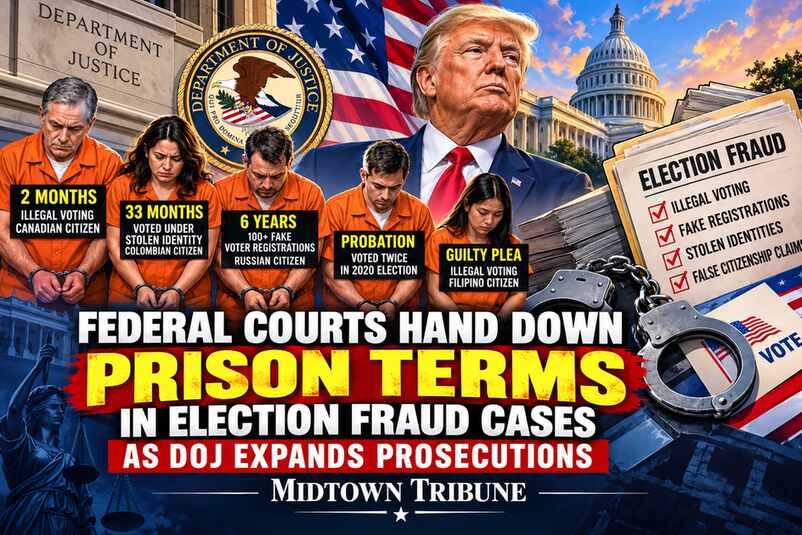
WASHINGTON — Federal prosecutors are securing convictions and prison sentences in a series of cases involving illegal voting, fraudulent voter registration, false claims of U.S. citizenship and identity fraud, while the Justice Department continues to announce new election-related prosecutions across the country.
A Midtown Tribune review of official U.S. Department of Justice and U.S. Attorney’s Office records found several 2026 cases that have already resulted in prison sentences, guilty pleas or other criminal penalties.
At the same time, DOJ announced charges against 16 additional people on September 18 and four more defendants in Pennsylvania on September 24.
The cases are not identical. Some involve noncitizens accused of casting ballots, one involves voting twice, while another involved more than 100 fraudulent voter registrations created as part of a broader synthetic-identity and financial-fraud operation.
Six Years in Federal Prison in Scheme Involving More Than 100 Fake Voter Registrations
Dmitry Shushlebin, a 45-year-old Russian citizen living in Miami Beach, Florida, was sentenced in September to six years in federal prison followed by three years of supervised release.
He was also ordered to pay $458,839.69 in restitution.
According to the Justice Department, Shushlebin organized an identity-theft and financial-fraud operation that included the submission of more than 100 fraudulent voter registration applications to the Pinellas County Supervisor of Elections in Florida in February and March 2023.
DOJ said one purpose of registering the fictitious voters was to create synthetic identities that could then be used to obtain fraudulent credit cards and loans.
Shushlebin pleaded guilty to conspiracy to provide false information in registering to vote and to submit fraudulent voter registrations, wire fraud, making false statements and aggravated identity theft.
It is important to distinguish this case from a simple illegal-voting prosecution: the six-year sentence arose from a much broader identity-theft and financial-fraud conspiracy that also included election-related offenses.
Official source:
U.S. Department of Justice — Russian National Sentenced for Synthetic Identity Theft Fraud Scheme and Conspiring to Submit Fraudulent Voter Registrations.
33 Months in Prison After Voting Under a Stolen Identity
In Massachusetts, Lina Maria Orovio-Hernandez, a Colombian national, was sentenced to 33 months in federal prison after a jury convicted her of offenses including fraudulent voting, identity theft and theft of federal benefits.
According to federal prosecutors, Orovio-Hernandez lived in the United States for more than two decades using the stolen identity of a U.S. citizen born in Puerto Rico.
DOJ said she used that identity to obtain government identification and federal benefits and voted in the 2024 presidential election in Boston.
Federal prosecutors said she improperly received more than $259,000 in Section 8 housing assistance, more than $100,000 in Disability Benefits and more than $40,000 in SNAP benefits.
The court also ordered approximately $404,000 in restitution.
A federal jury had convicted her in February of offenses including false representation of a Social Security number, passport-related false statements, aggravated identity theft, receiving stolen government funds and fraudulent voting.
Official source:
U.S. Attorney’s Office, District of Massachusetts — Woman Sentenced for Voter Fraud, Identity Theft and Federal Benefit Fraud.
Canadian Citizen Sentenced After Voting in Nine Federal Elections
Denis Bouchard, a 70-year-old Canadian citizen, received two months in federal prison in North Carolina for making false claims of U.S. citizenship in order to vote.
According to the U.S. Attorney’s Office for the Eastern District of North Carolina, Bouchard had lived in the United States since the 1960s but never became an American citizen.
Federal voting records showed that he unlawfully cast ballots in nine federal elections between 2004 and 2024.
DOJ said the conduct included voting in the 2022 elections and the 2024 presidential election.
Bouchard pleaded guilty to two counts involving false claims of U.S. citizenship for voting purposes. In addition to the prison term, he received one year of supervised release and faces immigration consequences.
Official source:
U.S. Attorney’s Office, Eastern District of North Carolina — Alien Sent to Prison for Illegally Voting in North Carolina Elections.
Man Convicted of Voting Twice Gets Probation and Home Confinement
Not every federal election-fraud conviction results in prison.
Matthew Laiss, 32, of Bethlehem, Pennsylvania, was convicted at trial of voting more than once in connection with the 2020 presidential election.
Federal prosecutors said Laiss had been registered to vote in Pennsylvania before moving his primary residence to Florida and registering there.
A jury convicted him in March 2026 of voting more than once in a federal election and voter fraud.
In July, a federal judge sentenced him to three years of probation, with the first six months on home confinement, plus a $6,000 fine and a $200 special assessment.
Official source:
U.S. Attorney’s Office, Eastern District of Pennsylvania — Bethlehem Man Sentenced for Election Fraud Offenses.
Three Noncitizens Pleaded Guilty in South Florida
The U.S. Attorney’s Office for the Southern District of Florida announced in June that three noncitizens had pleaded guilty in separate federal cases to illegally voting in federal elections and related offenses.
According to prosecutors, the defendants admitted that they registered and voted despite knowing that they were not U.S. citizens and were therefore not eligible to participate in federal elections.
These cases illustrate another important distinction: a guilty plea or conviction does not necessarily mean that a prison sentence has already been imposed.
Official source:
U.S. Attorney’s Office, Southern District of Florida — Three Noncitizens Convicted of Illegal Voting and Related Election Offenses.
Filipino National Pleads Guilty to Voting in the 2024 Election
Federal prosecutors in Hawaii announced September 22 that Bernadette Acaso, a Filipino national and lawful permanent resident, had pleaded guilty to unlawfully voting as an alien.
According to her plea agreement, Acaso came to the United States in 2018 and later became a lawful permanent resident, but she was not a U.S. citizen.
She admitted that she nevertheless cast a mail-in ballot in the 2024 election and understood at the time that she was not eligible to vote.
She faces up to one year in prison. Her final sentence will be determined by a federal judge.
Official source:
U.S. Attorney’s Office, District of Hawaii — Filipino National Pleads Guilty to Unlawfully Voting as an Alien.
Haitian National Pleads Guilty After Voting in 2024
Also on September 22, federal prosecutors in South Florida announced that Valery Zidor, a 23-year-old Haitian national, pleaded guilty after falsely claiming U.S. citizenship on voter-registration forms and casting a ballot in the 2024 general election.
Zidor pleaded guilty to two counts of making a false claim of U.S. citizenship in order to vote and one count of voting as an alien.
She faces up to five years in federal prison. Sentencing has not yet occurred.
Official source:
U.S. Attorney’s Office, Southern District of Florida — Haitian National Pleads Guilty to Illegally Voting in 2024 General Election.
DOJ Announces 16 Additional Election-Related Defendants
The enforcement effort is continuing.
On September 18, the Justice Department announced charges against 16 individuals in cases involving alleged illegal voting, illegal voter registration and related election-fraud schemes around the country.
According to DOJ, the cases include allegations of:
- unlawful voting by noncitizens in federal elections;
- false claims of U.S. citizenship to register or vote;
- fraudulent voter registration;
- wire fraud;
- naturalization and passport fraud; and
- other offenses discovered during election-related investigations.
The prosecutions span several federal judicial districts.
These defendants are charged, not convicted. The allegations must be proven in court beyond a reasonable doubt.
Official source:
U.S. Department of Justice — 16 Individuals Charged for Illegal Voting and Related Election Crimes.
Four More Defendants Charged in Pennsylvania
On September 24, federal prosecutors announced election-related charges against four additional noncitizens in Pennsylvania.
One defendant, Cliff Sanon, a Haitian national residing in Philadelphia, was charged with submitting a fraudulent voter-registration application.
According to the criminal complaint, investigators allege that the application was one of eight fraudulent registrations submitted by Sanon and that he also voted in the November 2022 election.
Three other defendants — Dilea Ochoa-Perez, Sade Guppy and Eduardo Gallardo Maldonado — were charged with voting as noncitizens in federal elections.
These are allegations, not convictions. DOJ states that every defendant is presumed innocent unless and until proven guilty.
Official source:
U.S. Attorney’s Office, Eastern District of Pennsylvania — Four Aliens Charged With Election Fraud.
What the Federal Cases Establish — and What They Do Not
The official federal records demonstrate that election-related crimes do occur and that some cases have resulted in convictions and actual prison sentences.
Among the verified 2026 outcomes reviewed by Midtown Tribune are:
- Six years in federal prison in a broader identity-fraud scheme involving more than 100 fraudulent voter registrations;
- 33 months in prison in a case involving voting under a stolen identity and extensive federal-benefit fraud;
- Two months in prison for a Canadian citizen who unlawfully voted in nine federal elections;
- Probation and home confinement for voting twice in the 2020 presidential election;
- multiple additional guilty pleas for unlawful voting by noncitizens; and
- new election-related prosecutions that remain pending.
These cases, however, do not by themselves establish how frequently election fraud occurs nationwide or that the offenses changed the outcome of a particular election. Individual criminal cases establish or allege the conduct of particular defendants.
Were the Defendants Democrats or Republicans?
The official Justice Department materials reviewed for these cases generally do not identify the defendants’ political-party affiliation.
They also generally do not state which presidential or congressional candidates received the defendants’ ballots.
Therefore, these cases cannot responsibly be described from the cited federal records as prosecutions of “Democrats” or “Republicans.”
That distinction matters when election-crime statistics circulate on social media: a conviction for illegal voting establishes the criminal conduct proved in that case, but it does not establish a partisan affiliation unless evidence separately supports that claim.
Arrest, Charge, Conviction and Sentence Are Not the Same Thing
Election-enforcement numbers can also become misleading when different stages of a criminal case are combined.
- Arrest: authorities have taken a person into custody.
- Charge or indictment: prosecutors formally allege a crime, but guilt has not yet been established.
- Guilty plea or conviction: the defendant has admitted guilt or been found guilty.
- Sentencing: the court determines the punishment after conviction.
For example, the 16 cases announced by DOJ on September 18 are not “16 prison sentences.” They are prosecutions that must still proceed through the federal judicial process.
Primary Government Sources
- DOJ — Dmitry Shushlebin Sentenced to Six Years
- U.S. Attorney’s Office, Massachusetts — Lina Maria Orovio-Hernandez Sentenced to 33 Months
- U.S. Attorney’s Office, North Carolina — Denis Bouchard Sentenced for Illegal Voting
- U.S. Attorney’s Office, Pennsylvania — Matthew Laiss Sentenced for Election Fraud Offenses
- U.S. Attorney’s Office, Southern District of Florida — Three Noncitizens Convicted
- U.S. Attorney’s Office, Hawaii — Bernadette Acaso Pleads Guilty
- U.S. Attorney’s Office, Southern District of Florida — Valery Zidor Pleads Guilty
- DOJ — 16 Individuals Charged With Illegal Voting and Related Election Crimes
- U.S. Attorney’s Office, Eastern District of Pennsylvania — Four Aliens Charged With Election Fraud
Midtown Tribune based this report on official U.S. Department of Justice and U.S. Attorney’s Office records. Defendants facing pending charges are presumed innocent unless and until proven guilty in court. Convictions, guilty pleas and sentences are identified separately.
Ask Midtown Tribune about this story
Answers are grounded first in this article. Search all Midtown Tribune reporting from the main AI Search page.
AI-generated summary. Verify important details in the linked original articles.