
Trump Administration Wins Protection for Federal Agents’ Operations, While Hochul Preserves Limits on Local Police Cooperation With ICE
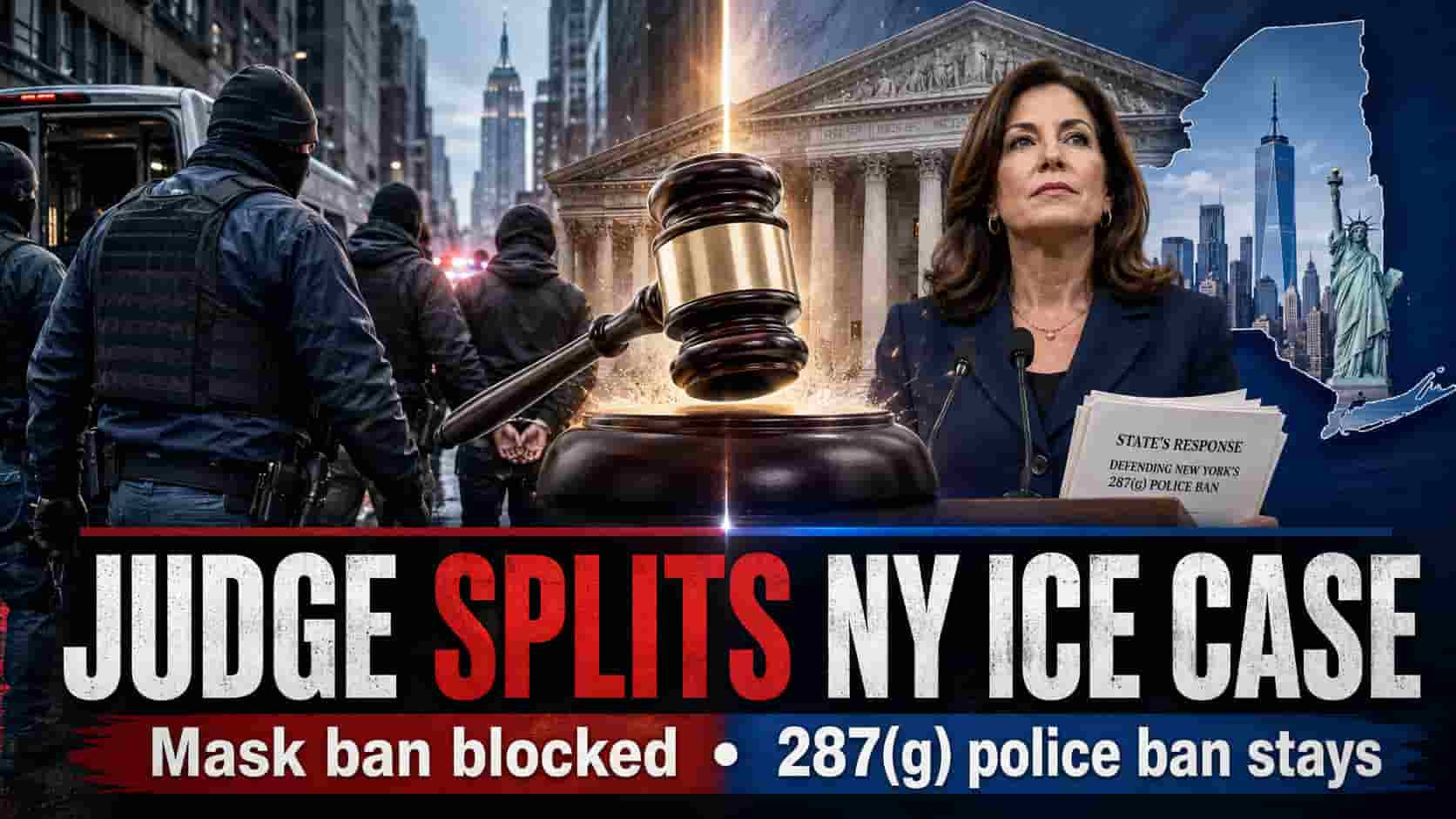
A federal judge has divided one of New York’s most closely watched immigration-enforcement battles into two very different results.
The Trump administration won a major preliminary victory against New York’s attempt to prohibit federal immigration officers from wearing masks and require them to display personal identifying information.
At the same time, New York Governor Kathy Hochul and Attorney General Letitia James successfully defended—for now—the state’s separate ban on agreements that allow local police departments to perform certain immigration-enforcement functions for U.S. Immigration and Customs Enforcement.
The result is not a complete victory for either side.
Federal agents may continue following federal operational and identification policies. But New York can continue preventing its own local governments and law-enforcement agencies from entering into ICE partnerships under Section 287(g) of federal immigration law while the litigation proceeds.
Court Says New York Cannot Control Federal Officers’ Uniforms
U.S. District Judge Mae D’Agostino granted a preliminary injunction preventing New York from enforcing its mask and identification provisions against federal officers.
The court concluded that the federal government had shown a likelihood of success on its constitutional claim that a state cannot directly regulate the way federal law-enforcement officers perform their official duties.
That dispute centers on the Constitution’s Supremacy Clause.
The federal government argued that New York cannot decide what federal agents may wear, how they protect their identities or which identification procedures they must follow during federal operations.
The Justice Department also argued that exposing individual officers’ identities could increase the danger of harassment, doxing, threats and violence against agents and their families.
New York officials presented the issue differently. They said masked officers without clearly visible identification can create fear, confusion and uncertainty over whether the people conducting an arrest are legitimate law-enforcement agents.
The judge acknowledged New York’s stated interest in transparent policing but emphasized that the immediate legal question was constitutional authority—not which policy the court considered preferable.
Because the order is a preliminary injunction, it does not constitute the final resolution of the entire lawsuit. It prevents enforcement of the challenged provisions while the case continues.
New York Keeps Its Ban on 287(g) Agreements
The Trump administration did not win every part of its request.
The court declined to block New York’s prohibition on agreements made under Section 287(g) of the Immigration and Nationality Act.
The federal 287(g) program allows ICE to delegate specified immigration-enforcement functions to trained state and local officers operating under federal supervision.
ICE describes the program as a partnership that expands cooperation between federal immigration authorities and participating local law-enforcement agencies.
New York’s new law takes the opposite approach. It prohibits state and local agencies from entering formal or informal agreements that use local personnel, facilities or public resources for federal civil immigration enforcement.
Hochul and James argue that local officers should concentrate on local crimes rather than perform ICE’s work at the expense of New York taxpayers.
The court’s refusal to issue a preliminary injunction means that New York’s 287(g) prohibition remains enforceable during the continuing litigation.
One Case, Two Questions
The split ruling reflects an important constitutional distinction.
New York may have broader authority to regulate its own agencies, employees, contracts and public spending than it has to regulate federal officers carrying out federal duties.
That helps explain why the state’s attempt to control masks and identification used by federal agents was temporarily blocked, while its restrictions on local police partnerships survived the federal government’s preliminary challenge.
The decision therefore produces two practical outcomes:
Federal authority: New York cannot currently enforce its mask and identification requirements against federal law-enforcement officers.
State and local authority: New York can continue preventing its own police agencies and local governments from participating in 287(g) immigration-enforcement agreements.
Both Sides Can Claim a Partial Victory
For the Trump administration, the ruling protects the federal government’s authority to establish operational and safety rules for its own officers.
For Hochul and James, the ruling preserves one of the state’s central immigration policies: keeping local police and local taxpayer resources out of federal civil immigration enforcement.
The New York officials said they are reviewing their legal options concerning the mask provisions while maintaining that the 287(g) ban is lawful.
Additional motions, appeals or a full decision on the merits could change the legal picture. For now, however, the boundary drawn by the court is relatively clear:
New York may decide whether its local agencies cooperate with ICE, but it cannot presently decide what federal agents wear while enforcing federal law.
Official Sources
Official statement confirming that the court declined to block New York’s 287(g) ban but enjoined enforcement of the state’s mask prohibition.
The Justice Department’s official explanation of its constitutional, officer-safety and federal-authority arguments.
The federal government’s court complaint challenging the mask, identification and 287(g) provisions.
Official New York State description of the mask restriction, the Local Cops, Local Crimes policy and related measures.
ICE’s official description of partnerships that delegate specified immigration-enforcement functions to trained state and local officers.
The official United States Code provision containing Section 287(g).
Current New York statutory language governing state and local participation in immigration-enforcement agreements.
Ask Midtown Tribune about this story
Answers are grounded first in this article. Search all Midtown Tribune reporting from the main AI Search page.
AI-generated summary. Verify important details in the linked original articles.