
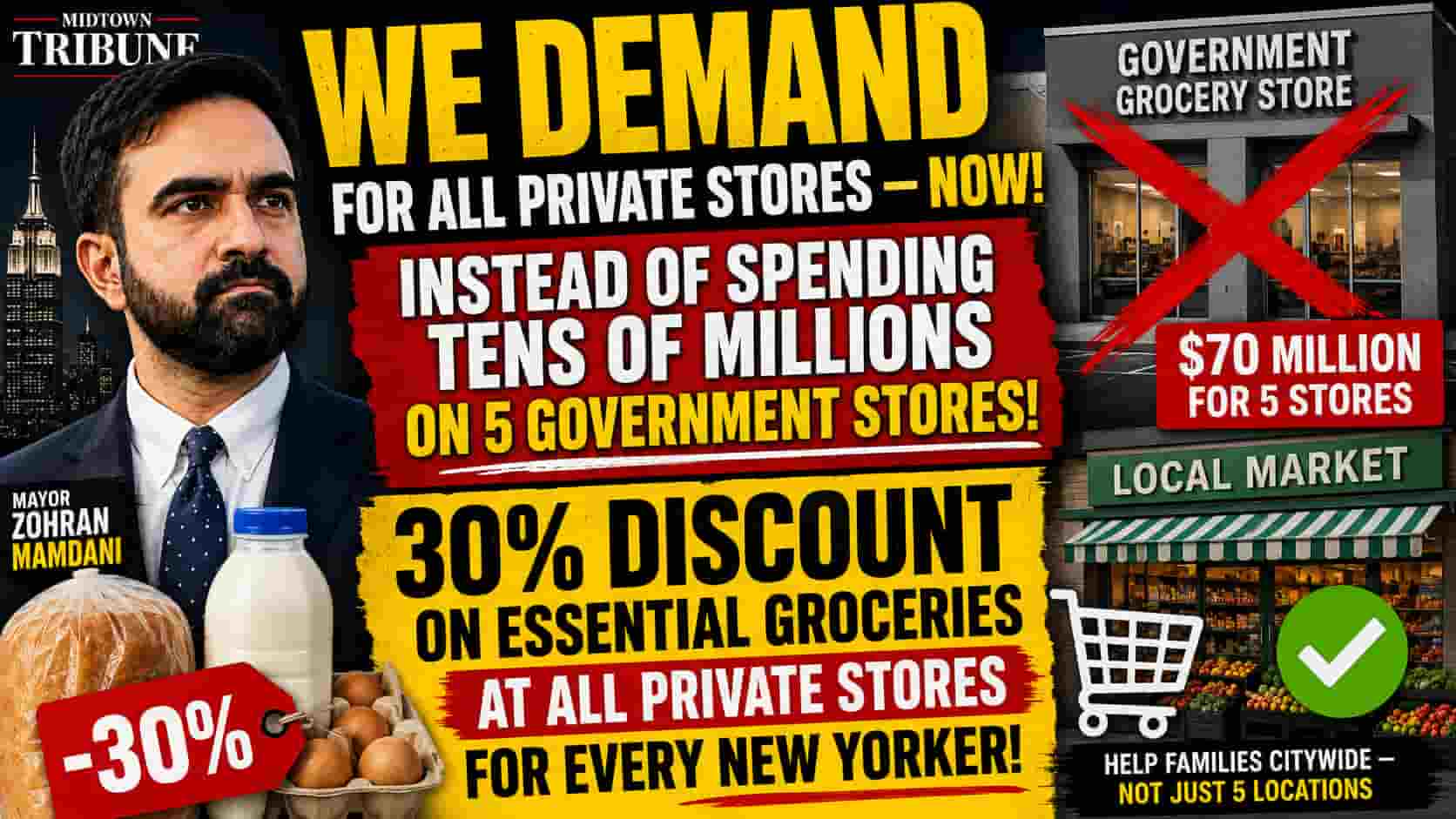
Subsidizing bread, milk and eggs at existing private stores would reach every neighborhood—but even a limited universal program could cost approximately $430 million a year.
Midtown Tribune Commentary
Mayor Zohran Mamdani has announced that a core basket of groceries will cost 30% less at New York City’s planned network of five municipal grocery stores.
The administration says the discount will apply regardless of income and could save participating households about $90 per month. The city has already committed $70 million in capital funding to construct and equip the five locations—one in each borough.
But the $70 million construction budget is not the entire public cost.
According to NYCEDC, the city will also provide grocery-ready locations, cover rent and property taxes, finance the initial buildout and create a common public brand. Private operators will manage the stores, but taxpayers will provide much of the financial foundation.
Free Food Assistance Already Exists
New Yorkers facing an immediate food emergency can already obtain free groceries or meals through the city-supported Community Food Connection network. The program funds more than 700 food pantries and community kitchens across the five boroughs.
That system is not a complete answer to grocery affordability, especially for working households that earn too much for certain benefits but still struggle with rising prices. Nevertheless, it raises an obvious question:
Why spend tens of millions building a new government-sponsored grocery network before determining whether existing stores could deliver the same assistance more quickly and fairly?
What Would a Citywide 30% Discount Cost?
Consider a much narrower alternative: allow every New York City household to receive a 30% discount on only three basic products purchased from participating private stores:
- One one-pound loaf of bread per week
- One gallon of milk per week
- One dozen eggs per week
Using the June 2026 national average prices reported by the U.S. Bureau of Labor Statistics:
- Bread: $1.814
- Milk: $4.317
- Eggs: $2.141
The weekly basket would cost approximately $8.27. A 30% public subsidy would equal approximately $2.48 per household per week, or $129 per year.
New York City has approximately 3.33 million households. If every household used the full benefit, the annual taxpayer cost would be approximately:
$430 million per year
That figure excludes the cost of administering the program, processing transactions, auditing participating stores, investigating fraud and maintaining the necessary payment technology.
Participation by half of city households would still cost approximately $215 million annually.
This calculation is an illustration, not an official city estimate. It uses national BLS prices as a standardized benchmark and assumes one unit of each product per household per week.
Fairer—but Not Free of Problems
A subsidy delivered through existing supermarkets, independent groceries and bodegas would have several advantages.
It could become available across all neighborhoods immediately instead of being concentrated in five locations. It would also support existing private businesses, their employees, distributors and property owners rather than placing publicly supported stores in competition with them.
But such a program would create serious risks of its own.
Government reimbursement could encourage stores to raise listed prices, misclassify products, report transactions that never occurred or coordinate with customers to generate fraudulent claims. Political favoritism could influence which retailers are approved. A poorly designed subsidy could distort competition and reward stores that become most effective at navigating the government reimbursement system.
In other words, subsidizing private purchases would also interfere with the market and could produce new opportunities for corruption and “schemes.”
Yet it would at least be geographically fairer than offering a universal public discount through only five stores.
Publish the Full Cost Before Expanding
The city should disclose more than the initial $70 million construction allocation.
New Yorkers deserve to know:
- The annual rent and property-tax cost of each municipal store
- The operating subsidy expected for each location
- The taxpayer cost for every dollar of customer savings
- The effect on nearby private supermarkets and bodegas
- The cost of branding, consultants, audits and contract administration
- The safeguards against political favoritism, losses and fraud
The real policy choice is not simply between government stores and doing nothing.
The city could compare municipal supermarkets with grocery vouchers, an EBT-based discount, a refundable grocery credit or a tightly controlled reimbursement program involving existing retailers.
A citywide subsidy would be expensive and vulnerable to abuse. But if the city insists that a 30% discount should be available to every New Yorker regardless of income, it should explain why equal treatment should depend on whether someone happens to live near one of five government-supported stores.
The question is straightforward: Is City Hall’s objective to help New Yorkers buy food—or to place City Hall in the grocery business?
Official Sources
- NYC Mayor’s Office: Mayor Unveils 30% Grocery Discount
- NYC Economic Development Corporation: N.Y.C. Groceries Program
- NYC Comptroller: Comments on the FY2027 Preliminary Budget
- U.S. Bureau of Labor Statistics: Average Retail Food Prices
- U.S. Census Bureau: New York City Household Data
- NYC Human Resources Administration: Community Food Connection
Ask Midtown Tribune about this story
Answers are grounded first in this article. Search all Midtown Tribune reporting from the main AI Search page.
AI-generated summary. Verify important details in the linked original articles.