
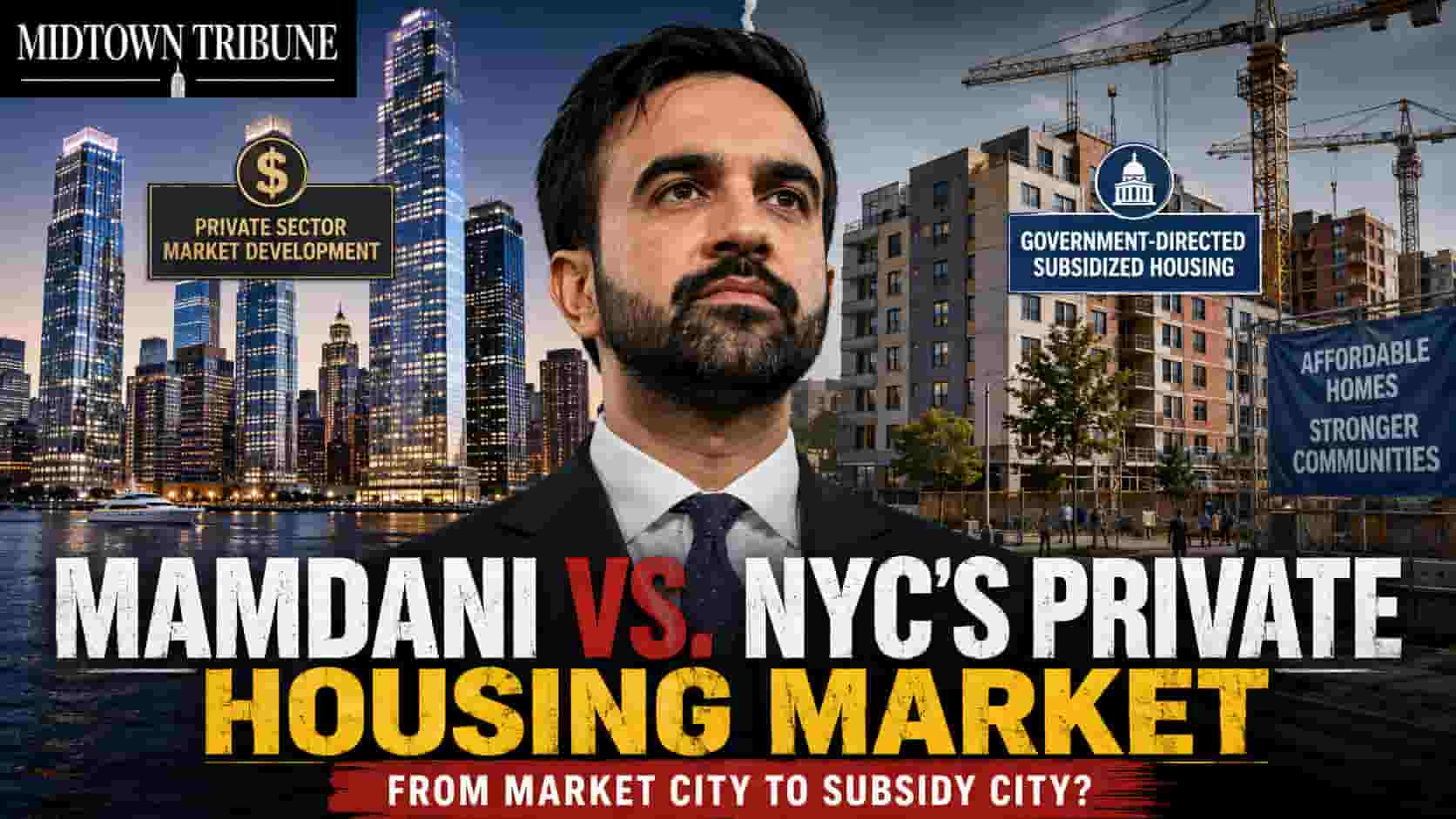
The new $230 million Fresh Kills Sanitation Complex is an impressive piece of municipal infrastructure. But the most consequential part of the announcement may have little to do with garbage trucks or road salt. By moving sanitation operations out of New Brighton, the Mamdani administration is clearing city-owned land for 232 government-defined “affordable” apartments — another step in a much larger effort to make public subsidy, rent regulation and government-directed housing a central organizing principle of New York City.
Mayor Zohran Mamdani opened the new Fresh Kills complex on Staten Island on August 18, announcing that the former Department of Sanitation property at 539 Jersey Street will be redeveloped into 232 affordable homes, public open space and a grocery store.
Official Mayor’s Office announcement:
https://www.nyc.gov/mayors-office/news/2026/08/mayor-mamdani-opens–230-million-fresh-kills-sanitation-complex-
There is nothing inherently wrong with converting an obsolete municipal facility into housing.
New York desperately needs more homes.
The larger question is what kind of housing system the city is building.
Under Mamdani, the answer increasingly appears to be one in which government does more than establish zoning, infrastructure and safety rules and then allow private capital to build.
Instead, City Hall increasingly seeks to determine:
- what housing is built;
- where it is built;
- which income categories it serves;
- what rents may be charged;
- what public subsidies make projects financially viable;
- which city-owned properties are converted to housing;
- and which applicants qualify for below-market units.
That is a fundamentally different vision of New York.
Fresh Kills Is Part of a Much Larger Program
The 232 apartments planned for Jersey Street should not be viewed in isolation.
Mamdani’s own housing plan, “Block by Block,” establishes a goal of creating 200,000 new affordable homes and preserving another 200,000 over the next decade.
Official Mayor’s Office housing plan:
https://www.nyc.gov/mayors-office/news/2026/05/mayor-mamdani-releases–block-by-block–the-housing-plan-for-a-n
The administration says it will achieve this through a combination of city capital, publicly owned land, financing programs, rent regulation, enforcement against landlords and zoning changes.
The adopted city budget contains an extraordinary $22 billion for affordable housing over five years, including nearly $5 billion in capital funding for new affordable housing over the next two years.
Official Mayor’s Office announcement:
https://www.nyc.gov/mayors-office/news/2026/07/mayor-mamdani-launches-lift-tracker-to-build-affordable-housing-
The administration has already identified more than 100 city-owned properties where it says upwards of 50,000 affordable homes could eventually be constructed.
Official Mayor’s Office transcript:
https://www.nyc.gov/mayors-office/news/2026/07/transcript–mayor-mamdani-launches-lift-tracker-to-build-afforda
This is no longer a collection of isolated housing programs.
It is a governing philosophy.
From a Market City to an Administered Housing System
For generations, one of New York’s defining characteristics was that people of radically different incomes competed in one enormous housing market.
Some housing was cheap.
Some was modest.
Some was expensive.
Some was extraordinarily luxurious.
Developers built because they believed people would pay for the product.
Neighborhoods changed because millions of individual buyers, renters, builders, landlords and investors made independent decisions.
That system was imperfect.
New York has always regulated housing to some degree.
But the market remained an extraordinarily powerful mechanism for determining what was built and who lived where.
The Mamdani approach increasingly reverses that relationship.
Government is moving from referee toward participant, financier, regulator and allocator.
That distinction matters.
A city dominated by private construction asks:
What are people willing to build and pay for?
A city dominated by subsidized affordability increasingly asks:
What housing does government believe should exist, at what price, for which income category, and with what level of taxpayer assistance?
Those are very different economic models.
The Rent Freeze Is Part of the Same Philosophy
Housing production is only one side of the administration’s agenda.
On June 25, the New York City Rent Guidelines Board voted to freeze rents on both one- and two-year rent-stabilized leases beginning October 1, 2026.
Mamdani celebrated the decision.
Official Mayor’s Office statement:
https://www.nyc.gov/mayors-office/news/2026/06/mayor-mamdani-s-statement-on-the-rent-guidelines-board-s-final-v
The city itself says almost half of New York City rental apartments are rent stabilized.
Official NYC rent-stabilization information:
https://www.nyc.gov/site/mayorspeu/programs/rent-stabilization.page
That means government decisions now directly constrain rent changes across an enormous portion of the private rental market.
Supporters call this tenant protection.
But there is another side to the equation.
Apartment buildings have:
- property taxes;
- insurance;
- labor costs;
- heating expenses;
- repairs;
- financing costs;
- water bills;
- regulatory compliance;
- capital improvements.
Those costs do not freeze simply because rents do.
If government limits revenue while operating expenses continue rising, the economic pressure does not disappear.
It moves somewhere else.
It can appear as:
- deferred maintenance;
- reduced property values;
- fewer private transactions;
- weaker incentives to construct rental housing;
- greater dependence on tax incentives;
- greater dependence on public financing.
And once private development becomes less attractive without government assistance, the city has created the justification for even more government intervention.
That is how dependency can become structural.
Government Subsidizes the System It Increasingly Regulates
The Mamdani administration is also creating new public mechanisms to reduce costs for regulated and subsidized housing.
In June, the city announced a $100 million city-backed insurance initiative designed initially to cover 20,000 homes and eventually as many as 100,000 affordable and rent-stabilized apartments.
Official Mayor’s Office announcement:
https://www.nyc.gov/mayors-office/news/2026/06/mamdani-administration-takes-on-skyrocketing-insurance-costs-wit
Again, the objective is understandable.
Insurance costs have become extremely expensive.
But the economic structure is revealing.
Government regulates rents.
Operating expenses rise.
Then government creates another taxpayer-backed mechanism to help regulated properties absorb those expenses.
The result risks becoming a circular system:
regulate the market → weaken normal economics → subsidize the consequences → expand the subsidized sector.
That is not a free housing market.
It is an increasingly administered one.
$1 Billion More for Supportive Housing
The administration has also announced $1 billion over two fiscal years for supportive housing.
Official Mayor’s Office announcement:
https://www.nyc.gov/mayors-office/news/2026/08/mayor-mamdani–the-doe-fund-break-ground-on-new-supportive-and-a
Supportive housing serves a legitimate and often necessary purpose, particularly for people emerging from homelessness or requiring services.
The issue is not whether such housing should exist.
Of course it should.
The policy question is one of proportion.
How much of New York’s future housing stock should depend on:
- city capital;
- federal subsidy;
- housing vouchers;
- regulated rents;
- tax incentives;
- government land;
- publicly controlled financing?
And how much should be allowed to function through normal private investment and market pricing?
New York Needs More Housing — Including Expensive Housing
One of the great political mistakes in housing policy is treating “luxury housing” as if it were harmful simply because it is expensive.
New York should want wealthy people to build, buy and rent expensive apartments here.
Why?
Because affluent residents:
- pay enormous city and state taxes;
- spend money in restaurants and stores;
- employ service workers;
- finance construction;
- support cultural institutions;
- create demand for professional services;
- and absorb housing that otherwise increases competition elsewhere in the market.
A $5 million condominium purchased without subsidy does not require taxpayers to finance the buyer’s housing.
It does the opposite.
It brings private capital into New York.
A healthy housing market should therefore produce everything:
luxury apartments, middle-market apartments, starter homes, rental housing, subsidized housing, senior housing and emergency supportive housing.
The objective should be abundance, not ideological uniformity.
New York should be a city where people can rise economically — not a city where remaining “affordable” increasingly means qualifying for another government program.
The Jersey Street Question
That brings us back to Staten Island.
The city will take the former DSNY garage at 539 Jersey Street and create 232 affordable homes.
City Hall presents that as an obvious public benefit.
But taxpayers and Staten Island residents are entitled to ask another question:
Why must this valuable city-owned property become exclusively government-directed affordable housing?
Why not auction the property to private developers?
Why not permit a substantially larger mixed-income project?
Why not combine market-rate condominiums, rental apartments and a defined affordable component?
Why not use the proceeds from private development to improve infrastructure or fund housing assistance for people who genuinely need it?
Those alternatives would bring private capital into the project rather than making public policy the dominant mechanism determining its economics.
The issue is not whether affordable housing should exist.
The issue is whether every available piece of public land must increasingly become another instrument of the city’s subsidized housing system.
And There Is a Political Question
There is also a politically sensitive issue that should be discussed carefully rather than ignored.
Staten Island has traditionally been the most Republican-leaning borough in New York City.
Housing determines population.
Population determines voters.
Therefore, any large-scale housing policy inevitably has potential long-term electoral consequences.
That does not mean there is evidence that the 232 Jersey Street apartments are being constructed to import Democratic voters.
There is no evidence in the official documents reviewed by Midtown Tribune establishing such a motive.
And the city does not simply choose residents based on politics.
HPD requires city-sponsored affordable housing to follow formal resident-selection procedures designed to provide equal opportunity.
Official HPD rules:
https://www.nyc.gov/site/hpd/services-and-information/marketing.page
Applications are generally processed through NYC Housing Connect, with eligibility based heavily on household income and household size.
Official NYC Housing Connect:
https://access.nyc.gov/programs/nyc-housing-connect/
Housing Connect says some lotteries can also contain authorized preferences, including for seniors, people with disabilities or, in some circumstances, people connected to particular geographic areas.
HPD states that applications are selected for review through a lottery process.
Official HPD guide:
https://www.nyc.gov/site/hpd/services-and-information/housing-connect-application-guides.page
So it would be wrong to claim that City Hall simply selects Democratic voters and places them into apartments.
It does not.
But that does not make the broader political question illegitimate.
Government Housing Policy Can Change Electorates Without Selecting Voters
When government determines the income bands eligible for thousands of apartments, decides where those apartments will be built and massively expands subsidized housing in particular neighborhoods, it influences future demographic composition even without asking anyone how they vote.
That is simply a consequence of housing policy.
The same would be true in the opposite direction.
If a Republican administration replaced hundreds of affordable apartments with $3 million single-family homes, that policy could also change the demographic and eventually electoral character of the neighborhood.
The political effect would not have to be the stated purpose for the effect to exist.
For Staten Island residents, therefore, the reasonable question is:
As the Mamdani administration expands government-directed affordable housing on public land, what long-term effect could that have on the demographic and electoral composition of New York City’s most Republican borough?
That is a legitimate subject for public debate.
It should be examined with data, not conspiracy theories.
Who Can Apply?
There is another relevant feature of the city’s system.
NYC Housing Connect states that people may apply for many affordable housing lotteries regardless of citizenship or immigration status.
Official NYC Housing Connect information:
https://access.nyc.gov/programs/nyc-housing-connect/
That does not mean non-citizens can legally vote in federal or New York State elections.
They cannot.
Housing eligibility and voting eligibility are separate legal questions.
But it illustrates the broader distinction between a market transaction and a government-administered housing program.
In the private market, the essential question is whether landlord and tenant can agree on a lawful transaction.
In subsidized housing, government establishes additional categories, income ranges, preferences, subsidy structures and eligibility rules.
The city therefore plays a much larger role in determining the characteristics of the housing population.
“Affordable” Does Not Mean Free
Another source of confusion is the word affordable.
Affordable apartments are not necessarily free apartments.
Many are privately developed and privately managed.
Many tenants pay substantial rent.
Projects can contain complex combinations of:
- private debt;
- developer equity;
- tax-exempt bonds;
- Low-Income Housing Tax Credits;
- city subsidies;
- state financing;
- federal programs;
- rental assistance.
The criticism is therefore not that every affordable apartment is “public housing.”
That would be inaccurate.
The deeper criticism is that the economics of an increasingly large portion of the housing market become dependent on government-created financial structures rather than ordinary market pricing.
And that changes incentives throughout the entire system.
Mamdani Is Explicit About Government’s Role
This interpretation is not based on speculation about the administration’s philosophy.
Mamdani himself describes his program in explicitly governmental terms.
His housing plan calls for 200,000 new affordable homes, another 200,000 preserved affordable homes, unprecedented city capital investment and aggressive use of public land.
His administration says it wants to prove:
“government can deliver.”
Official Mayor’s Office transcript:
https://www.nyc.gov/mayors-office/news/2026/05/transcript–mayor-mamdani-releases–block-by-block–the-housing-
That is a coherent political philosophy.
The question is whether it is the right philosophy for New York.
The Alternative: Build More, Regulate Less
There is another model.
Instead of continually trying to make scarce housing affordable through regulation and subsidy, New York could focus far more aggressively on making housing less scarce.
That means:
- dramatically expanding buildable density;
- speeding private permits;
- allowing taller residential buildings;
- reducing parking and other unnecessary mandates;
- making conversion of commercial property easier;
- reducing construction delays;
- lowering taxes and regulatory costs;
- encouraging condominium construction;
- protecting property rights;
- allowing market rents to signal where housing is needed;
- reserving targeted subsidies for people who genuinely cannot participate in the market.
The principle is simple:
If housing is expensive because New York does not have enough housing, build much more housing.
Do not attempt to solve scarcity primarily by deciding who gets access to the scarce apartments.
Create abundance.
New York Should Be a City of Aspiration
New York became one of the world’s great cities because millions of people came here believing they could build something larger than what they had before.
They opened businesses.
They bought buildings.
They invested.
They failed.
They tried again.
They moved from a small apartment to a larger apartment.
From renting to owning.
From working for someone else to employing other people.
The city should preserve that ladder.
The danger of an ever-expanding subsidy model is cultural as much as economic.
People can gradually stop asking:
“How do I earn enough to afford this?”
and increasingly ask:
“Which program do I qualify for?”
A social safety net is necessary.
A city organized around permanent dependence on the safety net is something very different.
Fresh Kills Is a Small Project With a Much Bigger Meaning
The Fresh Kills complex itself is a useful investment.
Staten Island needs sanitation services.
DSNY workers deserve modern facilities.
Moving heavy sanitation trucks out of a residential neighborhood can improve quality of life.
The argument is not against the garage.
Nor is it against building homes at Jersey Street.
The question is what the project symbolizes.
The Mamdani administration is rapidly constructing a housing system in which:
government owns the land,
government helps finance construction,
government regulates rents,
government establishes affordability bands,
government defines eligibility,
government subsidizes operating costs,
and increasingly,
government decides what kind of housing New York will become.
That should concern anyone who believes New York’s success has historically depended on private investment, economic mobility and open markets.
The Question Staten Island Should Ask
The 232 Jersey Street apartments will not transform Staten Island by themselves.
But they are part of an administration planning hundreds of thousands of government-directed affordable homes throughout New York City.
So Staten Islanders — and New Yorkers generally — should ask:
Are we building a city where more people can succeed in the private market?
Or:
Are we building a city where an ever-growing share of the population must depend on government to make housing affordable?
Those are not the same thing.
Affordable housing can be an important tool.
It should not become New York’s economic identity.
The better goal is a city with so much construction, investment, competition and opportunity that fewer people need subsidy in the first place.
New York should not merely make dependency affordable.
It should make prosperity attainable.
What the Official Documents Confirm
- The Fresh Kills project clears the former Jersey Street sanitation property for 232 affordable homes, public space and a grocery store.
- Mamdani’s housing plan targets 200,000 new affordable homes and 200,000 preserved affordable homes over ten years.
- The administration says the city is investing $22 billion in affordable housing over five years.
- The city has identified more than 100 publicly owned sites capable of producing upwards of 50,000 affordable homes.
- The Rent Guidelines Board approved a rent freeze for rent-stabilized leases beginning in October 2026.
- The administration is launching a $100 million city-backed insurance initiative for affordable and rent-stabilized housing.
- Mamdani has committed $1 billion over two years to supportive housing.
- NYC Housing Connect determines eligibility largely through income and household criteria, and HPD requires formal fair-housing resident-selection procedures.
- Housing Connect applications are selected for review through a lottery system rather than partisan political selection.
What Is Analysis
The argument that these policies represent a shift from a market-oriented housing system toward a subsidy-dependent or government-administered system is Midtown Tribune’s analysis, based on the scale and structure of the programs described above.
There is no official evidence that the Jersey Street project or the broader affordable-housing program is intended to change Staten Island’s partisan voting composition.
Any eventual electoral effect would be an indirect consequence of demographic change, not evidence by itself of political intent.
Official Sources
NYC Mayor’s Office — Fresh Kills Sanitation Complex / 232 Affordable Homes
https://www.nyc.gov/mayors-office/news/2026/08/mayor-mamdani-opens–230-million-fresh-kills-sanitation-complex-
NYC Mayor’s Office — Block by Block Housing Plan
https://www.nyc.gov/mayors-office/news/2026/05/mayor-mamdani-releases–block-by-block–the-housing-plan-for-a-n
NYC Mayor’s Office — $22 Billion Affordable Housing Investment / LIFT
https://www.nyc.gov/mayors-office/news/2026/07/mayor-mamdani-launches-lift-tracker-to-build-affordable-housing-
NYC Mayor’s Office — LIFT: 100+ City Sites / 50,000 Homes
https://www.nyc.gov/mayors-office/news/2026/07/transcript–mayor-mamdani-launches-lift-tracker-to-build-afforda
NYC Mayor’s Office — Rent Guidelines Board Freeze
https://www.nyc.gov/mayors-office/news/2026/06/mayor-mamdani-s-statement-on-the-rent-guidelines-board-s-final-v
NYC Rent Guidelines Board
https://www.nyc.gov/site/rentguidelinesboard/index.page
NYC Mayor’s Office — City-Backed Housing Insurance Program
https://www.nyc.gov/mayors-office/news/2026/06/mamdani-administration-takes-on-skyrocketing-insurance-costs-wit
NYC Mayor’s Office — $1 Billion Supportive Housing Investment
https://www.nyc.gov/mayors-office/news/2026/08/mayor-mamdani–the-doe-fund-break-ground-on-new-supportive-and-a
NYC HPD — Affordable Housing Marketing and Resident Selection
https://www.nyc.gov/site/hpd/services-and-information/marketing.page
NYC Housing Connect — Eligibility
https://access.nyc.gov/programs/nyc-housing-connect/
NYC HPD — Housing Connect Application Process
https://www.nyc.gov/site/hpd/services-and-information/housing-connect-application-guides.page
Official Government Sources
- NYC Mayor’s Office — Fresh Kills Sanitation Complex and 232 Affordable Homes
- NYC Mayor’s Office — Block by Block Housing Plan
- NYC Mayor’s Office — $22 Billion Affordable Housing Investment and LIFT
- NYC Mayor’s Office — More Than 100 City-Owned Sites Identified for 50,000+ Affordable Homes
- NYC Mayor’s Office — Rent Guidelines Board Rent Freeze
- NYC Rent Guidelines Board — Official Rent Guidelines
- NYC Mayor’s Office — $100 Million City-Backed Housing Insurance Program
- NYC Mayor’s Office — $1 Billion Supportive Housing Investment
- NYC HPD — Affordable Housing Marketing and Resident Selection Rules
- NYC Housing Connect — Eligibility and Application Rules
- NYC HPD — Housing Connect Lottery Process
Ask Midtown Tribune about this story
Answers are grounded first in this article. Search all Midtown Tribune reporting from the main AI Search page.
AI-generated summary. Verify important details in the linked original articles.