
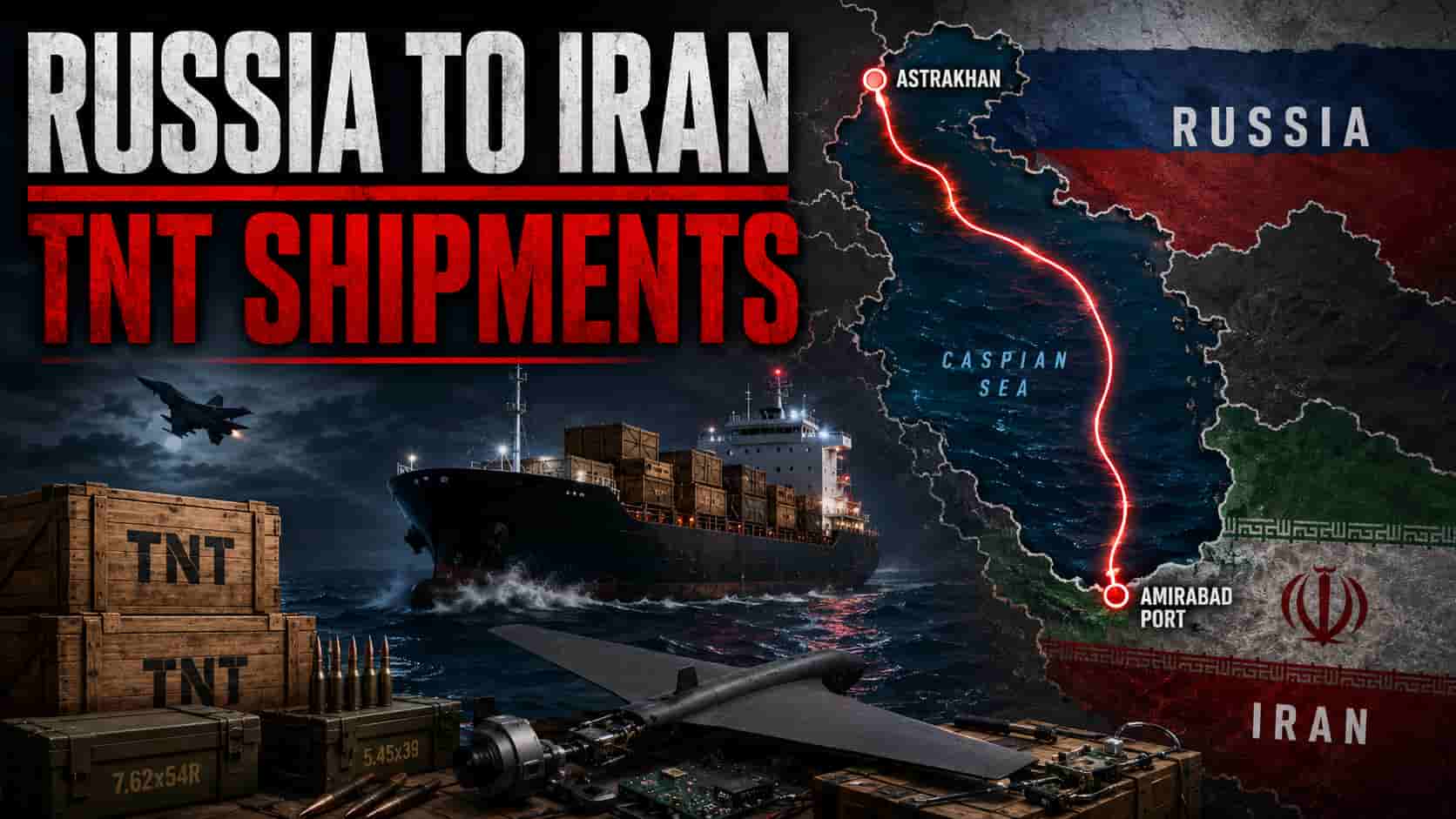
NBC News reportedly said Russia was shipping TNT, ammunition and drone components to Iran across the Caspian Sea. But the underlying European government document has not been made public, no shipping manifests have been released, and the most dramatic claims now circulating go far beyond what has actually been shown.
A striking story has spread rapidly across American media and military commentary:
Russia is allegedly shipping TNT explosives, ammunition and drone components to Iran through the Caspian Sea.
From there, the claim has grown into something even more dramatic:
Iran’s military-industrial base has supposedly been damaged so badly that Tehran can no longer produce enough explosive material on its own and must rely on Russia.
That conclusion may eventually prove correct.
But at this point, the public evidence does not establish it.
The central problem is simple:
the document behind the story has not been made public.
There are no publicly released cargo manifests identifying TNT aboard specific Russian ships.
There are no official photographs of the cargo.
There is no publicly available U.S. government document confirming the specific 2026 TNT shipments.
And the European government said to have produced the underlying intelligence document has not been publicly identified.
So while the story may be true, it currently remains an unverified media report rather than a publicly demonstrated fact.
Where Did the TNT Story Come From?
The new claim traces back to an August 18, 2026 NBC News report.
According to subsequent summaries of that report, NBC said it had obtained a European government document describing Russian shipments to Iran through the Caspian Sea.
The reported cargo included:
- drone components;
- ammunition;
- TNT explosives.
The report also allegedly described more than two dozen Russian vessels delivering cargo to Amirabad Port in northern Iran.
The August 22 video “Iran Importing EXPLOSIVES From Russia Is Worse Than You Think” by Max Afterburner then amplified the story and argued that the TNT imports were evidence of major damage to Iran’s domestic weapons-production capacity.
In the video, the shipment is treated almost as a “damage report” on Iran’s military-industrial base.
But that is already an interpretation layered on top of the original media report.
The Underlying Document Has Not Been Published
This is the key weakness.
The public has not been shown:
- the European government document itself;
- the name of the government that produced it;
- a complete list of ships allegedly carrying TNT;
- shipping manifests;
- customs documentation;
- loading records;
- unloading records;
- photographs confirming the contents of the cargo;
- or a public government statement independently verifying the TNT shipments.
That does not prove the report is false.
But it does mean that the central claim currently depends on the credibility of the media report and its unnamed sources.
That is not the same evidentiary standard as a released document that readers can inspect themselves.
Multiple Articles Do Not Necessarily Mean Multiple Independent Confirmations
Another problem is the appearance of media repetition.
Critical Threats Project / ISW summarized the reported shipments, but its source for the TNT claim was NBC News.
Just Security also referenced the NBC report.
This matters because five websites repeating one original report do not create five independent sources.
If all of them trace back to the same unpublished document and the same reporting chain, the underlying evidence remains essentially the same.
That is how an information echo can create the appearance of broad confirmation.
What Is Actually Confirmed by the U.S. Government?
There is real and important official evidence of military shipping between Russia and Iran through the Caspian Sea.
On September 10, 2024, the U.S. Department of the Treasury sanctioned individuals, companies and vessels connected to Iran’s transfer of lethal military assistance to Russia.
Treasury said vessels operated by the Russian shipping company MG-FLOT regularly transited the Caspian Sea while moving cargo between Iran and Russia.
The official Treasury action identified vessels including:
- PORT OLYA-3
- PORT OLYA-4
- BORIS KUSTODIEV
- KOMPOZITOR RAKHMANINOV
The same vessels were also identified in an official Office of Foreign Assets Control — OFAC sanctions action.
This is publicly documented government evidence.
Treasury Also Identified Missile Transportation
The Treasury Department went further.
According to the official September 2024 Treasury release, Russia’s Ministry of Defense used PORT OLYA-3 to transport Iranian close-range ballistic missiles from Iran to Russia.
That establishes an important fact:
the Caspian Sea has already been used as a military logistics corridor between Iran and Russia.
But it does not establish another claim:
that Russia shipped TNT to Iran in 2026.
Those are two separate propositions.
Evidence for one cannot simply be converted into proof of the other.
The Direction of the Confirmed Arms Flow Was Iran to Russia
This distinction is particularly important.
The publicly available U.S. Treasury material documents Iranian weapons flowing:
Iran → Russia
The 2026 NBC story alleges military materials flowing:
Russia → Iran
That reversal is certainly plausible.
Russia and Iran have extensive military ties.
The ships and logistics network already exist.
But plausibility is not proof of a specific cargo.
The existence of a shipping lane does not establish what was inside a particular vessel on a particular voyage.
How the Story Became More Dramatic
The original report, as summarized publicly, was essentially:
Russia reportedly shipped TNT, ammunition and drone components to Iran.
The next analytical step became:
Iran must have a shortage of TNT.
Then:
Iranian explosive production must have been seriously damaged.
Then:
American and Israeli strikes must have destroyed the relevant industrial infrastructure.
And finally:
Iran can no longer make TNT on its own.
Each step is stronger than the one before it.
But the publicly available evidence does not grow stronger with each step.
That is the central problem.
Does Importing TNT Prove Iran Cannot Produce It?
No.
Even if the reported Russian TNT shipments are completely accurate, importing a product does not prove that domestic production has disappeared.
A country can import military material because:
- domestic production has been reduced;
- wartime demand exceeds domestic supply;
- existing stockpiles are being replenished;
- raw materials are temporarily scarce;
- foreign supply is faster;
- production facilities are being repaired;
- or military planners want redundant sources.
Any of those scenarios could explain imports.
Therefore:
“Iran is importing TNT”
and
“Iran can no longer manufacture TNT”
are not equivalent statements.
The second requires much more evidence than the first.
The GBU-28 Is Real — But It Does Not Prove the TNT Story
Max Afterburner’s video also discusses the American GBU-28 bunker-buster and the F-15E Strike Eagle.
The technical information about those weapons is real.
The United States Air Force describes the GBU-28 as an approximately 5,000-pound laser-guided weapon intended for hardened targets.
The official U.S. Air Force F-15E Strike Eagle fact sheet describes the aircraft’s deep-strike and ground-attack role.
Official historical material from Eglin Air Force Base also documents the rapid development of the GBU-28 during the Gulf War.
Those are established facts.
But they do not prove that:
specific GBU-28 strikes destroyed Iranian TNT production, or that the alleged Russian shipments resulted directly from those strikes.
That connection remains analytical.
Why the Caspian Route Is Plausible
The geography does make the broader story plausible.
The Caspian Sea is bordered by:
- Russia;
- Iran;
- Kazakhstan;
- Turkmenistan;
- Azerbaijan.
Its legal regime is distinct from ordinary open-ocean maritime space.
The Ministry of Foreign Affairs of Kazakhstan describes the 2018 Convention on the Legal Status of the Caspian Sea, signed by all five coastal states.
For Russia and Iran, the Caspian therefore provides a strategically valuable bilateral logistics corridor.
For the United States, it is a very different operating environment from the Persian Gulf or Arabian Sea.
Again, however, geography explains why a shipment would be feasible.
It does not prove what the shipment contained.
What Would Constitute Stronger Evidence?
To move this story from an unverified media report toward a demonstrable fact, the public would ideally need to see at least one of the following:
- the European government document cited by NBC;
- identification of the government that produced it;
- names of specific vessels carrying TNT;
- cargo manifests;
- port records;
- customs documentation;
- satellite imagery tied to specific cargo movements;
- sanctions imposed specifically over these alleged shipments;
- or a public statement from the U.S. or another government confirming the cargo.
At present, those materials have not been publicly produced in the sources reviewed for this article.
Is the NBC Story a Fake?
That question also requires caution.
There is not enough evidence to conclude that NBC knowingly published false information.
The underlying intelligence document could be genuine.
The unnamed official could have had reliable knowledge.
The reported shipments could ultimately be verified.
So calling the story a proven fake would go beyond the evidence in the opposite direction.
But there is also not enough publicly available evidence to present the TNT shipment as a fully established fact.
The most accurate description today is:
NBC News reported that Russia was shipping TNT, ammunition and drone components to Iran, citing an unpublished European government document and an unnamed Western official. Publicly available independent evidence confirming the specific TNT cargo has not yet been presented.
What Is Confirmed
Russia and Iran have used the Caspian Sea for military logistics
Official source: U.S. Department of the Treasury
MG-FLOT vessels regularly transported cargo between Russia and Iran
Official source: U.S. Department of the Treasury
PORT OLYA-3 was used to move Iranian ballistic missiles to Russia
Official source: U.S. Department of the Treasury
Several vessels were formally sanctioned
Official source: U.S. Treasury / OFAC
The GBU-28 is a real U.S. hard-target weapon
Official source: United States Air Force
What Is Reported but Not Publicly Demonstrated
Russia shipped TNT to Iran in 2026
The claim currently traces to the NBC report and its unpublished source material.
More than two dozen vessels carried the reported military cargo
This figure also comes through the reporting chain rather than a publicly released government manifest.
Iran can no longer manufacture TNT
There is currently no publicly available evidence establishing that conclusion.
U.S. bunker-buster attacks caused the alleged TNT imports
No publicly released evidence establishes that direct causal chain.
The Larger Media Problem
This story demonstrates how easily the information environment can compress several different evidentiary categories into one.
First:
“A media outlet says a source says a document says…”
Then:
“Russia is shipping TNT.”
Then:
“Iran has run out of TNT.”
Then:
“Iran’s explosive industry was destroyed.”
By the time the claim reaches social media, the uncertainty surrounding the original source has largely disappeared.
That is precisely when readers should go back to the first document and ask:
Where is the evidence?
In this case, that first document still has not been publicly shown.
Midtown Tribune Conclusion
The alleged Russian TNT shipments to Iran may eventually prove completely accurate.
There is already strong official evidence that Russia and Iran use the Caspian Sea for military logistics, and the geopolitical relationship makes such shipments entirely plausible.
But that is not the same as proof of the specific 2026 TNT cargo.
For now, the most defensible conclusion is:
The NBC report remains an unverified media claim based on unpublished source material. The much stronger assertion that Iran can no longer manufacture TNT is even less substantiated.
Until the underlying document, cargo records or official government confirmation become public, the story should be presented as a reported allegation — not an established fact.
Official Sources
U.S. Department of the Treasury
Treasury Designates Actors Facilitating Iran’s Transfer of Lethal Aid to Russia
https://home.treasury.gov/news/press-releases/jy2570
U.S. Treasury — Office of Foreign Assets Control
Sanctions Designations — September 10, 2024
https://ofac.treasury.gov/recent-actions/20240910
United States Air Force
F-15E Strike Eagle — Official Fact Sheet
https://www.af.mil/About-Us/Fact-Sheets/Display/Article/104499/f-15e-strike-eagle/
United States Air Force
GBU-28 — Official Information
https://www.af.mil/News/Art/igphoto/2001490060/
Eglin Air Force Base / U.S. Air Force
Official Historical Chronology — GBU-28/B
https://www.eglin.af.mil/Portals/56/documents/history/AFD-141104-075.pdf
Ministry of Foreign Affairs of the Republic of Kazakhstan
Legal Status of the Caspian Sea
https://www.gov.kz/memleket/entities/mfa/press/article/details/591?lang=en
Sources for the Unverified TNT Claim
Critical Threats Project / ISW
Summary of the August 18 NBC reporting:
https://www.criticalthreats.org/analysis/iran-update-special-report-august-18-2026
Just Security
Reference to the same NBC reporting:
https://www.justsecurity.org/154447/early-edition-august-18-2026/
Max Afterburner — Official YouTube Channel
Iran Importing EXPLOSIVES From Russia Is Worse Than You Think — August 22, 2026
https://youtu.be/lYkY972fXio
The video goes beyond the underlying report by arguing that importing explosive fill demonstrates severe degradation of Iran’s domestic industrial capacity. That remains an analytical conclusion rather than a publicly established fact.
Ask Midtown Tribune about this story
Answers are grounded first in this article. Search all Midtown Tribune reporting from the main AI Search page.
AI-generated summary. Verify important details in the linked original articles.