
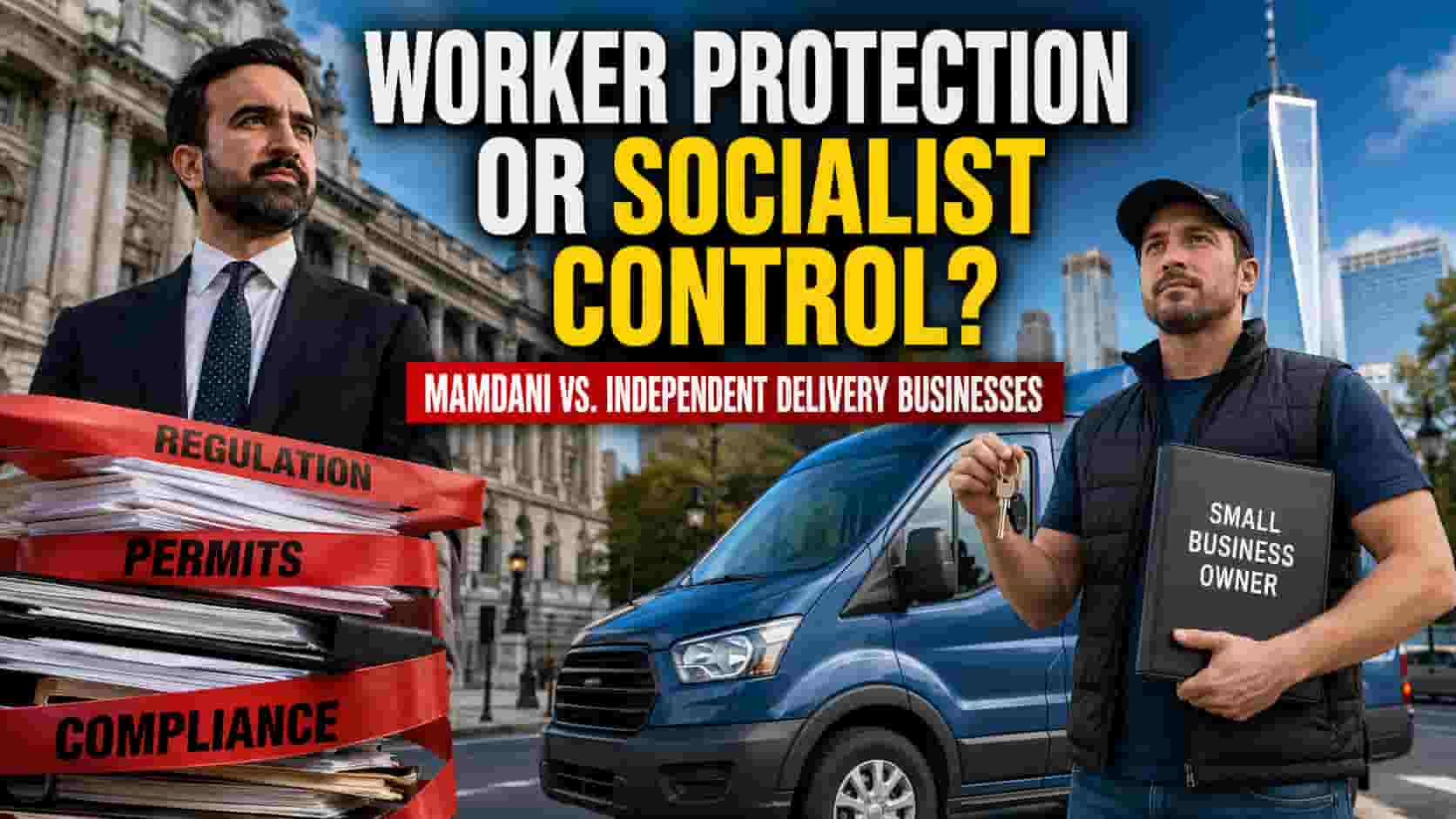
Worker Protection or Socialist Control? How Mamdani Wants to Replace Independent Delivery Businesses With a Direct-Employment System
The Delivery Protection Act promises safety and workplace protections, but it would also prohibit the industry’s primary subcontracting model. Could replacing incentives for results with a heavily regulated employment system be a step away from free enterprise—and toward an economic model painfully familiar to refugees from the so-called “socialist paradise”?
Mamdani Backs the Delivery Protection Act: Worker Safety Reform or a Threat to 5,000 NYC Jobs?
New York City Mayor Zohran Mamdani has endorsed legislation that could fundamentally change how Amazon and other large delivery companies operate in the five boroughs. Supporters promise safer streets and stronger worker protections. Amazon warns that the measure could eliminate more than 5,000 jobs, destroy dozens of local delivery businesses, and force operations outside the city. Midtown Tribune examined the actual bill and the official claims from both sides.
On August 10, 2026, the official NYC Mayor’s Office channel released a video titled, “It’s time Amazon played by the same rules as everyone else.”
In the video, a driver wearing an Amazon-branded vest argues that Amazon determines workers’ routes, schedules, uniforms, and workplace expectations—but distances itself from responsibility when drivers are injured or involved in crashes because they are formally employed by independent delivery contractors.
Mayor Mamdani used the video to announce his support for the Delivery Protection Act, sponsored by Council Member Tiffany Cabán.
The video accurately reflects the central argument behind the legislation. However, it is also advocacy produced by the administration: it presents the case made by the bill’s supporters without explaining the possible costs, job losses, business closures, or disruptions raised by its opponents.
What is the Delivery Protection Act?
The legislation is currently registered as Introduction 518-2026.
As of August 11, 2026, it has not become law. The City Council’s Committee on Consumer and Worker Protection held a hearing on April 9 and then laid the bill over in committee.
The official legislative record lists 35 Council members as sponsors or co-sponsors. That indicates substantial support, but sponsorship is not the same as final passage. The measure still must move out of committee, pass the City Council, and be signed by the mayor before becoming law. The official City Council record is available here.
What would the bill actually do?
The legislation is not limited to Amazon. It would regulate certain “last-mile facilities”—warehouses and distribution centers from which packages are dispatched to their final destinations in New York City.
Introduction 518 would:
- Require last-mile facility operators to obtain a license from the NYC Department of Consumer and Worker Protection, or DCWP.
- Establish a $500 annual licensing fee for each facility.
- Require facility operators to employ workers performing core warehouse and delivery services directly.
- Generally prohibit the use of staffing agencies and subcontractors for those core services.
- Require operators to offer employment to certain contractor employees displaced by the transition.
- Establish at least six hours of annual worker and driver safety training.
- Require 30 days’ notice before termination, except in cases of defined egregious misconduct.
- Prohibit retaliation against employees who exercise protected labor rights.
- Allow DCWP to suspend or revoke licenses for patterns of labor, safety, environmental, or consumer-protection violations.
- Permit workers to seek damages and other relief through administrative complaints or private lawsuits.
The direct-employment requirement would take effect 12 months after the measure becomes law. Some existing contracts could receive extensions, but generally no later than 24 months after enactment.
During a permitted transition period, a facility continuing to use contracted drivers would have to maintain extensive employment, driving, insurance, and route records. The driver’s actual employer would have to be identified more prominently than any non-employer brand on the worker’s clothing and vehicle.
The operator would also have to post a $500,000 bond for each non-employee delivery worker, which could be used to satisfy a judgment arising from a road incident involving that worker or employer.
Would the bill really force Amazon to hire every driver?
Not automatically in every situation. This is an important legal distinction missing from the mayor’s video.
The bill places the direct-employment obligation on the “facility operator.” The term includes a person or entity that owns, leases, manages, or operates a last-mile facility and controls its core services.
The Mamdani administration and the Teamsters argue that Amazon exercises enough control over routes, schedules, productivity standards, uniforms, and other working conditions to be held responsible.
But the bill itself does not name Amazon. Determining which business is the responsible facility operator could depend on ownership arrangements, contracts, and the degree of actual control over a particular location.
Therefore, saying that the bill would simply “make every Amazon driver an Amazon employee” may be politically understandable, but it is not the most precise description of the statutory language.
What does the city’s official research show?
The Mamdani administration cites a 2025 report from the NYC Comptroller’s Office examining last-mile warehouses, workplace injuries, traffic crashes, and pollution.
According to the report:
- Eighteen large last-mile facilities opened in New York City beginning in 2017.
- Fourteen of the 18 surrounding areas—about 78%—experienced an increase in injury-causing crashes after the facilities opened.
- Injury-causing crashes increased by an average of 16% across all studied locations.
- Average annual crashes near major FedEx and Amazon facilities in Maspeth increased by 53% and 48%, respectively.
- OSHA data showed elevated workplace injury rates at the facilities analyzed.
The report establishes a geographic and chronological association between warehouse openings and increased crashes nearby. However, a before-and-after analysis within a half-mile radius does not by itself prove that every additional crash was caused by a particular warehouse or company.
The distinction matters: the official data supports legitimate safety concerns, but it should not be presented as proof that Amazon vehicles caused every documented increase. The Comptroller’s complete official report is available here.
Mamdani and the Teamsters make the case for direct employment
Mayor Mamdani argues that major corporations use networks of smaller contractors to control delivery operations while limiting their responsibility for workers and road safety.
The Teamsters say the legislation would effectively end Amazon’s Delivery Service Partner model within New York City. The union argues that direct employment would make it easier to enforce workplace protections, improve job stability, and hold the company controlling the delivery system accountable.
Supporters also contend that direct liability would give companies a stronger financial incentive to create realistic routes, provide safer vehicles, reduce dangerous delivery quotas, and train drivers properly.
These are the positions of the legislation’s advocates. They should not be treated as an existing court ruling that every Amazon contractor is a sham company or that Amazon is already legally responsible for every driver and accident.
Amazon warns of job losses and relocation
Amazon formally opposes Introduction 518.
In written testimony submitted to the City Council, Amazon said that it works with more than 40 local Delivery Service Partners employing more than 5,000 people in New York City.
According to the company, NYC drivers employed by those partners have earned an average of nearly $24 per hour since January 2025. Amazon says its partners must offer health coverage to full-time employees and paid leave exceeding the city minimum.
The company argues that Delivery Service Partners make their own decisions about hiring, fleet management, capacity planning, and route assignments while using Amazon’s logistics network.
Amazon also says that:
- 25% of its NYC partners are owned by Black or Hispanic entrepreneurs.
- 10% are veteran-owned.
- More than 180,000 drivers have completed the company’s in-person safety training.
- Amazon has invested more than $2.5 billion in safety improvements since 2019.
- Its serious crash rate in New York City improved by 35.7% between 2024 and 2025.
These figures come from Amazon and should be identified as company-reported information rather than an independent government audit.
Amazon warns that the bill could eliminate its agreements with more than 40 small delivery businesses, jeopardize over 5,000 jobs, and force the company to consider moving facilities and delivery operations outside New York City. Amazon’s complete official testimony can be read here.
Who would ultimately pay?
The proposal could provide delivery workers with clearer employment status, mandatory safety training, stronger job protections, and an identifiable company responsible for workplace violations.
It could also increase operating expenses through direct employment, annual training, termination requirements, insurance obligations, compliance costs, and the elimination of much of the existing subcontractor model.
Those costs could be absorbed by corporate profits. They could also be passed to customers through higher delivery charges, changes to Prime service, reduced same-day delivery, automation, facility relocation, or fewer jobs.
The mayor’s announcement does not guarantee that prices will remain unchanged or that all current workers will keep their jobs.
Amazon’s warning that more than 5,000 jobs are at risk is also a projection—not an established or inevitable outcome. The bill instructs facility operators to offer jobs to certain displaced contractor employees before hiring other workers, although that provision would not necessarily prevent operational reductions or relocation.
Midtown Tribune conclusion
The main premise of the mayor’s video is consistent with the legislation: the Delivery Protection Act seeks to replace much of the last-mile subcontracting model with direct employment and greater responsibility for facility operators.
But the video tells only one side of a significant economic dispute.
Introduction 518 could strengthen worker protections and corporate accountability. It could also eliminate the current business model of more than 40 local Amazon delivery partners, change delivery prices and service levels, and affect thousands of jobs.
Before voting, the City Council should provide the public with clear answers:
- Which company would be legally designated as the operator of each facility?
- What would implementation and enforcement cost?
- How many contractor businesses are likely to close?
- How would workers be protected if major delivery companies move facilities outside the city?
- What effect could the law have on delivery prices, speed, congestion, and small businesses?
The question is not simply whether Amazon should accept responsibility for deliveries carrying its name. The question is whether New York City can impose that responsibility without unintentionally transferring the cost to workers, local entrepreneurs, and customers.
Official Sources and Primary Documents
Midtown Tribune reviewed government records, official statements from the parties, and the original Mayor’s Office video.
-
New York City Council — Introduction 518-2026
Official legislative record, complete bill text, sponsors, hearing history, attachments, and current status.
council.nyc.gov — Delivery Protection Act, Int. 518-2026 -
NYC Mayor’s Office — Mayor Mamdani’s announcement
Official August 10, 2026 statement announcing the mayor’s support for the Delivery Protection Act.
nyc.gov — Mayor Mamdani Backs the Delivery Protection Act -
Office of the New York City Comptroller
Official report analyzing traffic crashes, workplace injuries, pollution, and last-mile facilities in New York City.
comptroller.nyc.gov — Fast Shipping, Slow Justice -
NYC Mayor’s Office — Official video
“It’s time Amazon played by the same rules as everyone else,” published by the official NYC Mayor’s Office channel.
YouTube — NYC Mayor’s Office -
Amazon — Official testimony opposing the bill
Amazon’s written testimony submitted to the New York City Council Committee on Consumer and Worker Protection.
About Amazon — Testimony on Introduction 518-2026 -
International Brotherhood of Teamsters
The union’s official August 10, 2026 statement supporting the Delivery Protection Act.
Teamsters — Support for the Delivery Protection Act
Editor’s note: As of August 11, 2026, Introduction 518-2026 remains under consideration in committee and has not become New York City law. Statements about future prices, job losses, relocations, and safety improvements are projections or positions of the respective parties unless otherwise indicated.
Ask Midtown Tribune about this story
Answers are grounded first in this article. Search all Midtown Tribune reporting from the main AI Search page.
AI-generated summary. Verify important details in the linked original articles.