
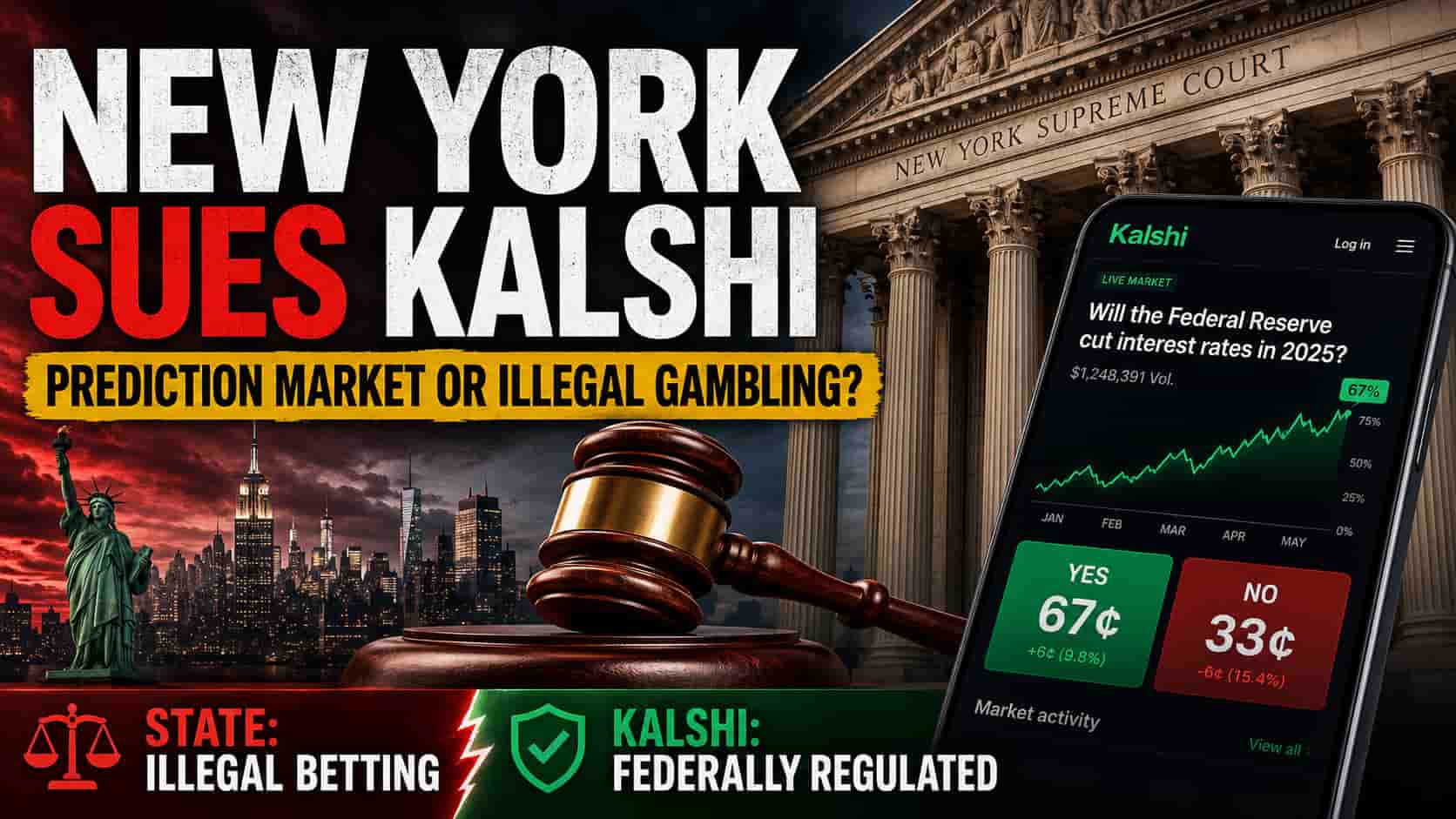
New York has launched a major legal challenge against Kalshi, accusing the federally regulated prediction-market platform of operating an unlicensed gambling business. Kalshi says the lawsuit is an attack on federal financial regulation that could affect exchanges across the United States.
New York Governor Kathy Hochul and Attorney General Letitia James announced on July 31, 2026, that the state has sued KalshiEX LLC, alleging that the company operates an illegal and unlicensed gambling platform through its prediction markets.
The lawsuit places one of the fastest-growing financial technology businesses at the center of a fundamental regulatory dispute:
Is Kalshi operating a legitimate federally regulated exchange, or has it simply transformed conventional betting into a financial product?
New York says Kalshi allows users to wager on sports, elections, cultural events and other uncertain outcomes without obtaining a state gambling license.
Kalshi rejects that characterization. The company argues that users trade event contracts on a federally regulated exchange rather than placing bets with a sportsbook.
The eventual outcome could determine how prediction markets are regulated throughout the United States.
What New York Alleges
According to the New York Attorney General’s Office, Kalshi launched sports-related “trading” in 2025 and offered contracts tied to major sporting events to users across all 50 states.
The state alleges that these contracts meet New York’s legal definition of gambling because users risk money on uncertain events beyond their control.
New York also argues that Kalshi has avoided requirements imposed on licensed casinos and mobile sports-betting operators, including licensing, taxation, age restrictions and consumer-protection rules.
The lawsuit seeks a court order preventing Kalshi from operating as an unlicensed gambling business in New York. The state is also seeking fines, forfeiture of alleged illegal proceeds and restitution for users.
The allegations have not yet been proven at trial, and Kalshi continues to contest the state’s authority.
The Dispute Over Users Under 21
One of New York’s central arguments involves the legal gambling age.
Mobile sports betting in New York is restricted to people who are at least 21 years old. Kalshi, however, has allegedly made its contracts available to users between the ages of 18 and 20.
Attorney General James argues that the difference exposes younger New Yorkers to gambling-related financial and psychological risks without the safeguards required of licensed betting platforms.
For the state, this is evidence that Kalshi is competing with licensed sportsbooks while avoiding the rules that govern them.
For Kalshi, the age difference reflects the fact that it operates as a financial exchange under federal regulation rather than as a state-regulated casino.
Kalshi’s Federal Status
Kalshi’s strongest defense begins with the Commodity Futures Trading Commission.
In November 2020, the CFTC granted KalshiEX the status of a designated contract market, or DCM. That designation places the exchange under the Commodity Exchange Act and CFTC oversight.
The CFTC determined that Kalshi had demonstrated an ability to comply with federal requirements applicable to designated contract markets.
Designated contract markets are generally treated as federally regulated exchanges comparable in certain respects to traditional futures markets.
Kalshi therefore argues that its event contracts are financial instruments governed by federal commodities law—not betting products governed separately by every state.
Kalshi Representative Calls Lawsuit “Lawfare”
In a CNBC interview following the announcement, Kalshi board member Brian Quintenz called New York’s lawsuit an “unhinged and extraordinarily egregious piece of lawfare.”
Quintenz is a former CFTC commissioner and currently serves as a senior adviser to the Coalition for Prediction Markets.
He argued that New York is attempting not only to restrict sports-related contracts but also to establish a precedent that could allow individual states to interfere with federally regulated exchanges.
According to Quintenz, allowing every state to impose separate rules would create an unworkable patchwork of regulation for national financial markets.
“Federal regulation over federal markets is supreme,” he said, arguing that federal law preempts conflicting state restrictions.
That remains Kalshi’s legal position, not a settled conclusion.
Exchange Trading Versus Sports Betting
Quintenz also emphasized what Kalshi considers a structural difference between a prediction market and a sportsbook.
In a conventional sportsbook or casino, the operator establishes the odds and generally profits from the losses of its customers.
Kalshi says its users instead buy and sell contracts against one another through an exchange. The platform matches trades and collects fees rather than directly taking the opposite side of every customer’s position.
Supporters of prediction markets argue that this structure can produce valuable information about the probability of future events.
They also contend that event contracts may provide businesses and individuals with opportunities to hedge risks related to inflation, government policy, weather, elections or other developments.
New York’s response is that changing the structure and terminology does not necessarily change the underlying transaction.
When a user risks money based on whether a team wins a game, the state argues, the activity remains sports wagering regardless of whether it is described as buying a contract.
A Federal Judge Has Already Rejected Kalshi’s Preliminary Request
The current lawsuit follows an earlier federal case filed by Kalshi against the New York State Gaming Commission.
In that case, Kalshi sought a temporary restraining order and preliminary injunction preventing New York officials from enforcing state gambling laws against its sports-event contracts.
On July 7, 2026, U.S. District Judge Analisa Torres denied Kalshi’s request.
The court concluded at the preliminary stage that Kalshi had not demonstrated a sufficiently strong likelihood of proving that the Commodity Exchange Act preempts New York gambling laws as applied to sports-event contracts.
The ruling did not finally determine every issue in the case. However, it allowed New York to continue enforcing its gambling laws while the broader litigation proceeds.
Judge Torres also rejected Kalshi’s argument that compliance with both federal and state law would necessarily be impossible.
The opinion stated that federal rules do not require Kalshi to offer every contract nationwide and suggested that the company could seek a New York license or limit access geographically.
Courts Across the Country Are Divided
The New York decision is part of a broader national legal conflict.
The July 7 federal opinion noted that courts in different jurisdictions have reached different preliminary conclusions in cases involving Kalshi.
Some courts have granted injunctions protecting the company from state enforcement. Others have allowed state gambling regulators to proceed.
That division strengthens Kalshi’s argument that the country needs a single federal standard.
It also supports the states’ contention that prediction markets are attempting to enter regulated gambling markets without complying with local laws.
Could the Fight Reach the Supreme Court?
Quintenz predicted that the growing number of state cases could eventually be consolidated and reach the U.S. Supreme Court.
He argued that the Court has historically protected federal control over federally regulated markets.
That outcome is possible, but it is not guaranteed.
The cases would first have to move through federal appellate courts. The Supreme Court would then decide whether to accept a case.
The likelihood of Supreme Court review could increase if federal appeals courts issue conflicting decisions over whether state gambling laws are preempted by the Commodity Exchange Act.
CNBC Discloses Its Financial Relationship With Kalshi
During the interview, CNBC disclosed that it has a commercial relationship with Kalshi.
The network said the relationship includes customer acquisition and a minority investment in the company.
That disclosure does not invalidate the interview or Quintenz’s arguments. It does, however, provide important context for readers evaluating the coverage.
Media organizations routinely disclose financial relationships when reporting on companies in which they or their corporate affiliates hold an interest.
Why the Case Matters Beyond Kalshi
The legal dispute could reshape both the financial and gambling industries.
A victory for New York could require prediction-market companies to obtain state gambling licenses before offering sports-related contracts. Platforms might also have to comply with state taxes, age restrictions, responsible-gambling requirements and geographic limitations.
A victory for Kalshi could establish that federally regulated exchanges may offer event contracts nationwide without separate approval from each state.
That could create a national alternative to conventional sportsbooks, including in states where sports betting is limited or prohibited.
The dispute could also affect contracts tied to elections, government decisions, entertainment, weather and economic statistics.
Prediction Market or Rebranded Casino?
The most difficult question may be where to draw the line.
A contract tied to inflation or an interest-rate decision can have an obvious economic or hedging purpose.
A contract asking whether the New York Yankees will win the World Series looks much closer to a conventional sports bet.
Kalshi argues that both can exist within the same federally regulated exchange.
New York argues that financial terminology cannot be used to remove traditional gambling activities from state oversight.
The courts will now have to decide whether the regulatory identity of a product depends on how the platform is organized—or on what users are actually wagering money on.
What New York Users Should Know
The filing of the lawsuit does not itself mean that Kalshi has already been found liable or that every contract on the platform has been declared illegal.
The litigation remains active, and Kalshi is expected to continue challenging New York’s claims.
Users should nevertheless understand that:
- Kalshi’s legal status in New York remains disputed.
- The availability of sports contracts could change.
- Restitution requested by the state has not yet been ordered.
- Federal registration does not eliminate financial risk.
- Event contracts can result in the loss of the entire amount paid for a position.
Conclusion
New York’s case against Kalshi is not simply a dispute over one application.
It is a test of whether a federally regulated exchange can offer products that resemble sports betting without obtaining licenses from individual states.
New York says Kalshi is operating an illegal gambling business and avoiding rules designed to protect consumers.
Kalshi says it operates a legitimate national financial exchange and that New York is unlawfully intruding into federal jurisdiction.
For now, neither description represents a final judicial determination.
The courts must decide whether Kalshi’s contracts belong primarily to the world of financial markets—or whether the platform has built a sportsbook under a different name.
Official Sources and Court Documents
- New York Attorney General — New York Announces Lawsuit Against Kalshi
- State of New York v. KalshiEX LLC — Full Petition
- New York Attorney General — Statement on the July 2026 Court Ruling Against Kalshi
- KalshiEX LLC v. New York State Gaming Commission — Opinion and Order
- New York Attorney General — Bipartisan Coalition Defending State Gambling Laws
- Commodity Futures Trading Commission — KalshiEX Designated as a Contract Market
- CFTC — Official Kalshi Designated Contract Market Filing and Registration Record
- CFTC — Official List of Designated Contract Markets
- CFTC — KalshiEX Amended Order of Designation
Editorial note: The filing of a civil lawsuit does not establish liability. New York alleges that Kalshi is operating an unlicensed gambling platform, while Kalshi argues that its exchange is governed by federal commodities law and regulated by the Commodity Futures Trading Commission.
Ask Midtown Tribune about this story
Answers are grounded first in this article. Search all Midtown Tribune reporting from the main AI Search page.
AI-generated summary. Verify important details in the linked original articles.