
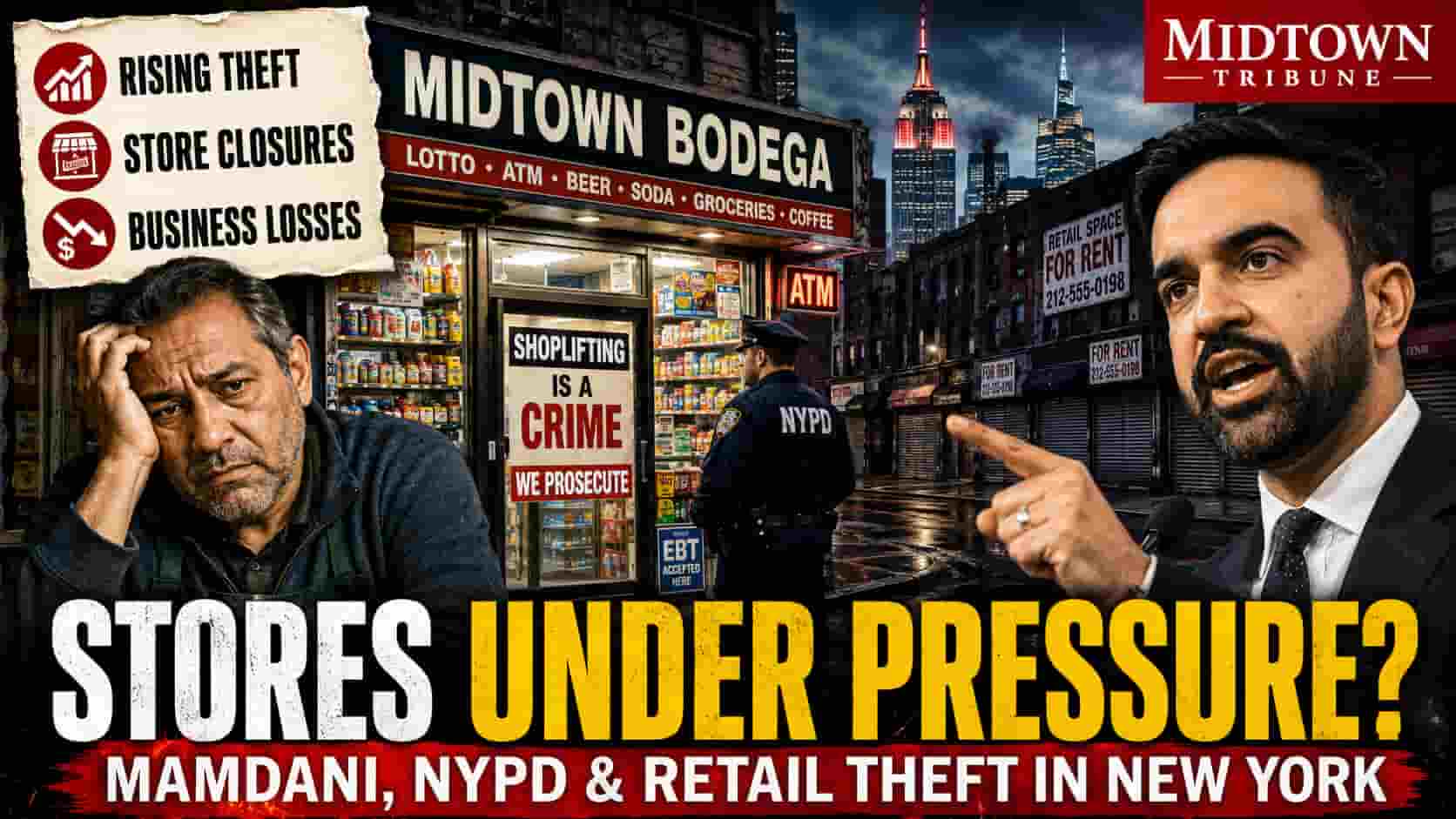
New York YouTuber Cash Jordan released a video on August 25 with the explosive headline: “Mamdani BANS POLICE IN STORES… Wiping 17,000 Businesses OFF THE MAP.” But did Mayor Zohran Mamdani actually order police to stop enforcing shoplifting laws? A review of official city records shows a more complicated story: there is no such police ban, but there is a real political campaign to reduce arrests for certain low-level offenses — while City Hall is simultaneously preparing to open taxpayer-supported municipal grocery stores.
On August 25, 2026, New York YouTuber Cash Jordan published a video connecting several contentious issues: retail theft, Mayor Zohran Mamdani’s criminal-justice policies, demands from activist groups to move away from so-called Broken Windows policing, and the mayor’s plan to establish city-supported grocery stores.
The video’s headline makes an extraordinary claim:
“Mamdani BANS POLICE IN STORES.”
A review of official NYPD and New York City records, however, does not show any executive order, NYPD directive, or city policy prohibiting police officers from responding to shoplifting or making retail-theft arrests.
In fact, current NYPD data indicate the opposite.
NYPD Is Still Enforcing Retail-Theft Laws
According to the NYPD’s crime statistics for the first half of 2026, reported retail theft declined 16.3% compared with the same period a year earlier.
NYPD reported:
22,482 retail-theft incidents in the first half of 2026, compared with 26,874 during the same period in 2025.
During the second quarter alone, retail theft declined another 12.2%, from 13,136 incidents to 11,535.
Police attribute the decline not to abandoning enforcement, but to a more targeted strategy.
According to NYPD, that strategy includes:
- identifying recurring theft patterns;
- deploying officers to retail locations experiencing repeated theft;
- concentrating enforcement during high-risk hours;
- identifying repeat offenders;
- and conducting longer-term investigations rather than treating every theft as an isolated incident.
Earlier this year, the NYPD reported a 20.1% decline in retail theft during the first quarter of 2026, from 13,738 incidents to 10,973.
That makes the literal claim that Mamdani has “banned police from stores” unsupported by the city’s own records.
So Where Is the Controversy Coming From?
There is a real political dispute — but it is not the same as a police ban.
In August, a coalition that included Court Watch NYC, the Drug Policy Alliance, Freedom Agenda, Justice Committee, the Legal Aid Society, SURJ NYC, and VOCAL-NY criticized the Mamdani administration for continuing what the groups describe as Broken Windows policing.
In an official statement published by the Justice Committee, the organizations complained that New Yorkers were still being arrested and brought to court for low-level offenses.
That distinction is crucial.
If the Mamdani administration had already prohibited police from enforcing low-level offenses, activists would have little reason to accuse the administration of continuing those arrests.
Their complaint is essentially the opposite:
They believe NYPD is still making too many low-level arrests.
Shoplifting Is at the Center of the Debate
One of the most controversial statements highlighted in Cash Jordan’s video came from New York State Assemblymember Emily Gallagher.
Discussing cases observed by criminal-justice activists, Gallagher described many of them as:
“crimes of poverty.”
She specifically referred to people accused of stealing items such as toothpaste and soap, suggesting that the theft of basic necessities can reflect economic need.
Cash Jordan uses those comments to illustrate a broader political philosophy in which at least some shoplifting is viewed principally as a consequence of poverty rather than as a traditional property crime.
But another distinction matters.
Emily Gallagher does not control the NYPD.
She is a member of the New York State Assembly.
Court Watch NYC, Justice Committee and the other advocacy groups also do not have authority to order NYPD officers to stop making arrests.
Their position represents a political demand — not a police directive.
What Activists Actually Want
The activist coalition is calling on Mayor Mamdani to reduce enforcement of certain quality-of-life offenses.
According to the Justice Committee statement, the organizations argue that low-level policing disproportionately affects poor New Yorkers and minority communities.
They want Mamdani to follow through on campaign promises to move away from what they describe as the criminalization of poverty, homelessness and mental-health problems.
For retailers, however, that debate raises an obvious practical question:
Where would the city draw the line when the low-level offense is shoplifting?
A substantial reduction in enforcement of petit larceny could directly affect bodegas, pharmacies, supermarkets and independent neighborhood stores.
But as of August 2026, there is no evidence of a blanket city order telling police to stop enforcing shoplifting laws.
A Second Conflict: Mamdani’s Municipal Grocery Stores
At the same time, the Mamdani administration is moving forward with another controversial economic experiment: city-supported grocery stores.
In July, City Hall announced plans for five municipal grocery stores — one in each borough.
The administration has committed $70 million in capital funding to the initiative.
According to the Mayor’s Office announcement, selected staple foods are expected to be sold at approximately 30% below typical retail prices.
The discounted categories are expected to include:
- fruits and vegetables;
- meat;
- seafood;
- milk;
- cheese;
- eggs;
- bread;
- pasta;
- rice;
- beans;
- flour;
- and other basic groceries.
City Hall estimates that a typical shopper could save approximately $90 per month, or more than $1,000 per year.
The first location is planned for Hunts Point in the Bronx, with all five expected to open over the course of Mamdani’s first term.
How Does a Private Grocery Store Compete With City Hall?
This is where Cash Jordan raises a substantially stronger economic argument.
A privately owned grocery store must generally cover the normal costs of doing business:
rent, payroll, insurance, utilities, security, inventory, property-related expenses and losses caused by theft.
The city-supported model is different.
According to the official transcript of the NYC Groceries announcement, the city is designing the operating structure while also requiring major discounts on a basket of essential products.
That creates an unusual competitive environment.
A private grocery owner could potentially find himself operating across the street from a competitor whose economic model has been specifically designed and supported by municipal government.
This concern is not hypothetical.
Reporters directly asked Mamdani about complaints from bodega and grocery-store owners worried that city-supported stores could take away customers.
The mayor acknowledged the concern but argued that the program is limited enough to avoid widespread harm to existing retailers.
Mamdani’s Answer to Bodega Owners
The mayor argues that five municipal stores will not displace New York City’s existing private grocery industry.
First, the administration notes that the program initially involves only five stores in a city with a very large private grocery sector.
Second, the municipal stores are not expected to sell several products that are important revenue sources for neighborhood bodegas, including:
- cigarettes;
- alcohol;
- lottery tickets;
- and hot prepared foods.
Mamdani’s argument is that the municipal stores can reduce the price of essential groceries without eliminating the broader role played by privately owned neighborhood stores.
His full explanation can be found in the Mayor’s Office transcript of the July 27 announcement.
That is the administration’s position.
Whether it proves correct remains unknown because the new stores have not yet begun operating.
Cash Jordan Connects Two Separate Policies
Cash Jordan’s broader argument combines two separate questions.
The first is:
What happens to small retailers if New York reduces enforcement against shoplifting?
The second is:
What happens to those same retailers if they must also compete against grocery stores supported by city government?
In Jordan’s interpretation, the two policies reinforce one another.
A private store may have to:
- pay market rent;
- pay taxes and fees;
- cover payroll;
- purchase security systems;
- absorb shoplifting losses;
- comply with extensive city regulations;
- and compete with a government-supported retailer offering certain products at lower prices.
That is an economic and political argument — not a documented finding from the city.
But it is a legitimate question for policymakers and business owners.
What About the Claim That 17,000 Businesses Could Disappear?
This is one of the weakest factual elements of the video’s headline.
We found no official NYC, NYPD or economic-development study stating that Mamdani’s policies will cause 17,000 businesses to close.
There is no verified official forecast establishing that:
17,000 stores are about to disappear;
or that:
17,000 businesses are directly threatened by the city’s shoplifting policy.
Therefore, “Wiping 17,000 Businesses OFF THE MAP” should be understood as a dramatic characterization by the video’s creator unless supporting evidence is produced.
It should not be presented as an established statistic.
But Retail Theft Is a Real Problem
Rejecting an exaggerated headline does not mean that retail theft is insignificant.
NYPD itself has treated shoplifting as serious enough to warrant specialized enforcement strategies.
In its previous crime reporting, the department described tactics including:
- police foot posts near high-theft locations;
- increased focus on petit larceny;
- repeat-offender identification;
- coordination with transit officers;
- and review of theft patterns through CompStat.
Those measures are described in an official NYPD report on its retail-theft strategy.
The department therefore clearly does not treat retail theft as something police should simply ignore.
The Mamdani Policy Paradox
Three things are happening simultaneously in New York City.
1. NYPD Is Still Enforcing Retail-Theft Laws
According to NYPD, retail theft declined 16.3% during the first half of 2026.
Police continue to target repeat offenders and high-theft retail locations.
2. Progressive Activists Want Fewer Low-Level Arrests
Court Watch NYC, Justice Committee and allied organizations are pressuring Mamdani to reduce enforcement of low-level offenses and move away from Broken Windows policing.
3. City Hall Is Entering the Grocery Business
The administration is putting $70 million into five municipal grocery stores and plans to sell selected staple products at approximately 30% below typical retail prices.
The interaction among these three policies — policing, criminal justice and municipal retail — is where the real controversy lies.
What Is Confirmed — and What Is Not
Confirmed
NYPD continues to enforce retail-theft laws.
Retail theft fell 16.3% during the first half of 2026, according to NYPD.
Police continue targeted enforcement against repeat offenders and high-theft locations.
Activist groups are publicly demanding fewer low-level arrests.
Assemblymember Emily Gallagher did describe some theft involving necessities as connected to poverty and need.
Mamdani is moving forward with five city-supported grocery stores.
The city has committed $70 million to the program.
Selected staple products are expected to be sold approximately 30% below typical retail prices.
Private grocery and bodega owners have publicly raised concerns about competing with government-supported stores.
Not Confirmed
There is no verified blanket order from Mamdani prohibiting NYPD from responding to shoplifting.
We found no NYPD directive telling officers to stay out of stores.
We found no citywide policy ordering police to ignore retail theft.
We found no official forecast showing that 17,000 businesses will close because of Mamdani’s policies.
Analysis
The phrase “Mamdani bans police from stores” is not supported by the official record.
NYPD continues to make retail-theft enforcement a priority and says reported shoplifting has fallen substantially in 2026.
But the underlying political dispute raised by Cash Jordan is real.
Progressive organizations are openly pressuring the administration to reduce arrests for low-level offenses.
Some elected officials are framing certain thefts of necessities as consequences of poverty.
And at the same time, the Mamdani administration is preparing to use public resources to introduce municipal competitors into the grocery market.
The more important question, therefore, is not:
Did Mamdani ban police from stores?
Based on the evidence, no.
The more consequential question is:
What happens to thousands of privately owned bodegas and grocery stores if New York simultaneously reduces enforcement against low-level theft and begins competing with them through publicly supported retail stores?
That question has not yet been answered.
And it deserves close scrutiny as the city’s new policies move from campaign promises to real-world implementation.
Sources
NYPD
NYPD — First Half 2026 Crime Statistics
Retail theft fell 16.3%; NYPD describes its targeted enforcement strategy.
Official NYPD source
NYPD — First Quarter 2026 Crime Statistics
Retail theft fell 20.1% during the first quarter.
Official NYPD source
NYPD — Retail-Theft Enforcement Strategy
Foot posts, repeat-offender investigations, petit-larceny enforcement and CompStat monitoring.
Official NYPD source
NYC Groceries / Mayor’s Office
Mayor’s Office — Mamdani Unveils 30% Discount at Municipal Grocery Stores
Five stores, $70 million in capital funding and the planned 30% discount on staple foods.
Official NYC Mayor’s Office source
Mayor’s Office — Full NYC Groceries Announcement Transcript
Details of the operating model and Mamdani’s response to concerns from private grocery and bodega owners.
Official NYC Mayor’s Office transcript
Broken Windows / Low-Level Arrests
Justice Committee — Community Groups Decry Low-Level Arrests Under Mayor Mamdani
Statement from Court Watch NYC, Drug Policy Alliance, Legal Aid Society, VOCAL-NY and allied organizations.
Read the original Justice Committee statement
Original Video
Cash Jordan — “Mamdani BANS POLICE IN STORES… Wiping 17,000 Businesses OFF THE MAP” — August 25, 2026
Watch the original video on YouTube
Ask Midtown Tribune about this story
Answers are grounded first in this article. Search all Midtown Tribune reporting from the main AI Search page.
AI-generated summary. Verify important details in the linked original articles.