
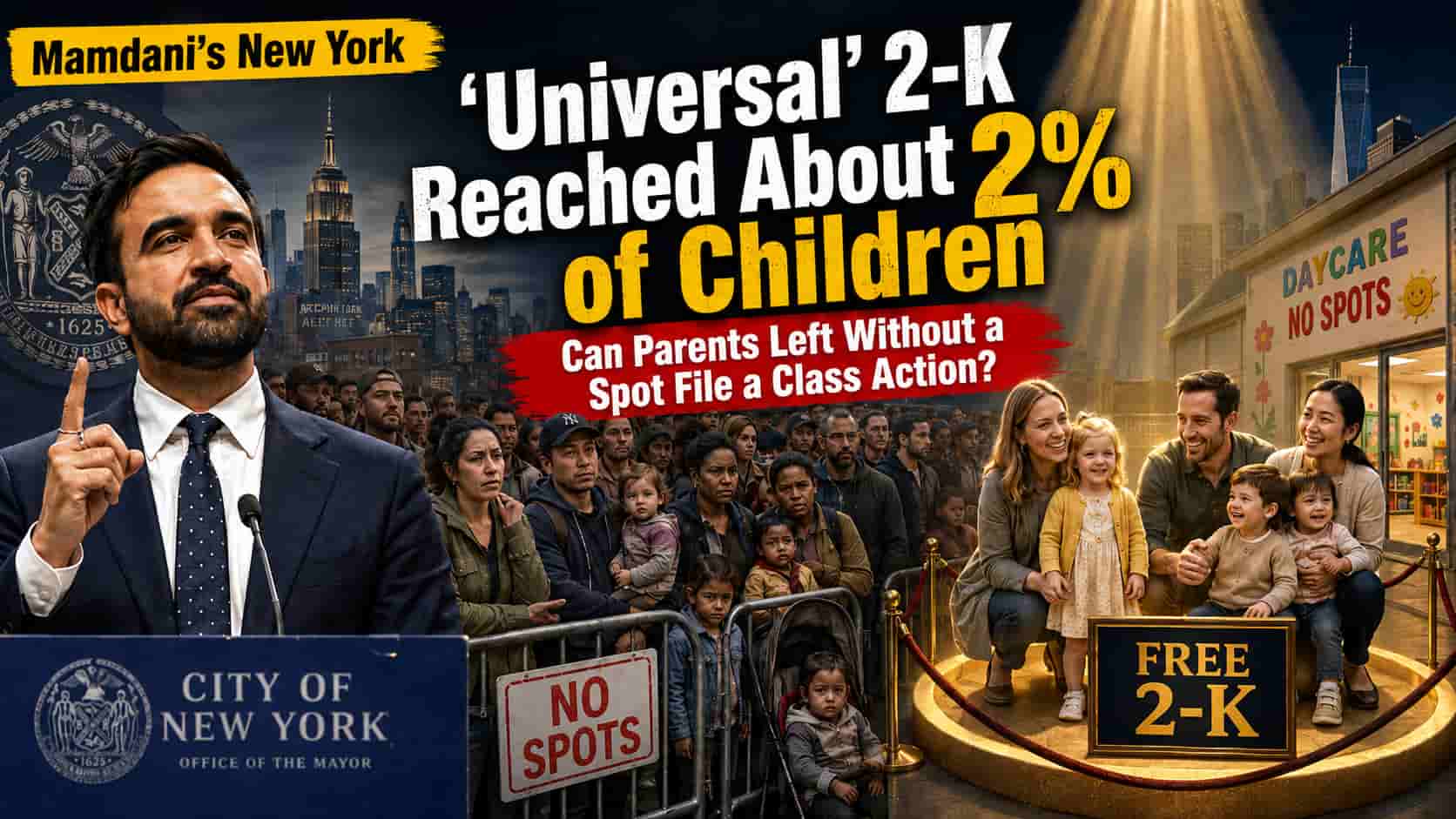
More than 5,700 families applied for roughly 2,000 free seats. Thousands were waitlisted, while most New York parents never had a realistic chance of receiving the taxpayer-funded benefit.
By Midtown Tribune Editorial Staff | August 5, 2026
New York City Mayor Zohran Mamdani and Governor Kathy Hochul are celebrating the first round of offers under the city’s new free 2-K program.
The administration announced on August 4 that more than 2,000 children had received offers for the inaugural class. More than 5,700 families applied, meaning there were nearly three applicants for every available seat. City officials said approximately 3,700 applicants were placed on waiting lists. Each successful family is expected to save an average of approximately $26,000 per year.
For the roughly 2,000 families receiving the benefit, that is undeniably valuable assistance.
But calling the program “universal” raises a much larger question: universal for whom?
About 2,000 Seats in a City With a Typical Annual Birth Cohort Near 100,000
All New York City children born in 2024 were formally permitted to apply for fall 2026 admission. But the initial program is available only in five school districts: Districts 6, 10, 18, 23 and 27. Children living in those districts receive admissions priority, along with children continuing at a participating provider and those with siblings enrolled at the same program.
The city has not yet published a final count of all children born in 2024 who currently live in New York City and are eligible for 2-K.
The latest complete city birth report provides a useful benchmark, however. According to the New York City Department of Health and Mental Hygiene, 98,389 children were born in the city in 2023. Compared with that typical annual birth cohort, approximately 2,000 initial seats represent roughly 2%.
That is an approximate comparison, not an exact enrollment percentage. Some children born in New York may have moved away, while some current city residents were born elsewhere. Nevertheless, the comparison demonstrates the enormous gap between the political language of universality and the actual scale of the inaugural program.
Even the 2027 expansion promised by the administration—to approximately 12,000 seats—would still serve only a fraction of a typical annual age cohort. The mayor says the program will eventually expand until every family seeking a seat can receive one, but that remains a future promise rather than a current entitlement.
The 5,700 Applications Do Not Necessarily Represent Total Demand
City Hall presents the 5,700 applications as evidence of extraordinary demand. That is reasonable—but the number may substantially understate how many families would use genuinely universal free child care.
The program’s seats were concentrated in five districts, and residents of those districts received priority. A family living elsewhere could apply, but the practical likelihood of receiving a conveniently located seat was considerably weaker.
It is therefore reasonable to infer that many parents did not apply because they understood that the program was geographically restricted, heavily oversubscribed and unlikely to provide a useful placement near their home or workplace. The city has not released research showing why eligible families did or did not submit applications.
The result is a two-tier system.
A small group of families receives a benefit valued by the administration at approximately $26,000 per year. Tens of thousands of other families—who also pay city and state taxes—must continue paying for private child care, reduce their working hours, rely on relatives or leave the workforce.
That does not automatically make the program illegal. Governments routinely establish pilot programs, geographic priorities and limited benefits.
But it does make the word “universal” misleading when used to describe the present program.
How Were the 2,000 Families Selected?
City officials say they used a published priority system similar to the procedures used for 3-K, pre-K and kindergarten.
Priority was given to:
- children living in the five selected 2-K districts;
- children already attending a participating provider;
- children with siblings enrolled at the program.
Within each priority group, officials said placements were essentially determined through a lottery. Families could rank as many as 12 programs, and the city attempted to match applicants with their highest available choice.
There is currently no public evidence that seats were distributed through personal favoritism, nepotism or political connections.
The legitimate criticism is not that the city has provenly rewarded friends or insiders. It is that a taxpayer-funded benefit of substantial value is being provided to a very small, geographically favored minority while being marketed under the language of universality.
Can Parents File a Class Action?
A class action is theoretically possible, but the shortage of seats by itself is unlikely to be enough.
Under Section 901 of New York’s Civil Practice Law and Rules, a proposed class must be sufficiently numerous, present common legal or factual questions, have representative plaintiffs with claims typical of the class and satisfy other requirements making collective litigation appropriate.
With thousands of unsuccessful applicants, numerosity would not be difficult to establish.
The more serious problem is identifying an underlying legal violation.
New York Education Law expressly guarantees tuition-free public-school attendance to qualifying residents who are over five and under 21. It does not establish an equivalent statutory right for every two-year-old to receive a free 2-K seat.
Therefore, parents cannot simply argue:
“My family pays taxes, another family received free 2-K, so the city owes me $26,000.”
The $26,000 figure is the administration’s estimate of the average annual savings for a family receiving a seat. It is not a cash benefit legally promised to every New York parent.
A successful lawsuit would likely require something more specific.
1. A Challenge to Incorrect or Arbitrary Admissions Decisions
Parents may have a stronger claim if NYC Public Schools:
- incorrectly determined their address or school district;
- failed to apply a published admissions priority;
- placed a lower-priority applicant ahead of a higher-priority applicant;
- used undisclosed selection criteria;
- changed the rules after applications were submitted;
- failed to conduct the promised lottery properly;
- treated similar applicants inconsistently.
Such an administrative decision may potentially be challenged through an Article 78 proceeding in New York State Supreme Court.
Article 78 permits judicial review of government decisions alleged to have violated lawful procedure, involved an error of law, exceeded the agency’s authority, or been arbitrary and capricious.
The general deadline is short: an Article 78 proceeding ordinarily must be commenced within four months after the challenged determination becomes final and binding.
Parents considering this route should request a written explanation of their child’s admissions result, priority classification and waitlist position.
2. A Class Action Based on a Systemic Admissions Defect
A collective case becomes more plausible if many parents can demonstrate the same systemic problem.
Examples could include:
- a defective matching algorithm;
- widespread failure to honor district or sibling priorities;
- a concealed admissions preference;
- incorrect treatment of children with disabilities;
- inconsistent treatment of applicants requiring language assistance;
- demographic evidence suggesting unlawful discrimination;
- a policy that contradicts the city’s published admissions rules.
In that situation, parents might seek an order requiring the city to correct the process, rerun part of the admissions system, disclose the selection methodology or reconsider affected applications.
The realistic remedy would more likely involve procedural correction or equitable relief than automatic payments of $26,000 to every unsuccessful family.
3. Discrimination Complaints
Geographic inequality is not automatically unlawful discrimination. Governments generally have significant authority to select particular neighborhoods for pilot programs when they can provide a rational policy explanation.
A different legal question arises if families were disadvantaged because of a protected characteristic, including race, national origin, disability, sex or another category protected by applicable federal, state or city law.
The U.S. Department of Education’s Office for Civil Rights accepts complaints alleging discrimination based on race, color, national origin, ancestry, sex, disability or age by covered educational entities.
NYC Public Schools also states that its Office of Equal Opportunity investigates discrimination complaints. The New York City Commission on Human Rights can investigate matters falling within the NYC Human Rights Law.
A parent would need evidence connecting the adverse treatment to a protected characteristic. The mere fact that another neighborhood received the program first would ordinarily not be sufficient.
4. An Appeal to the State Education Commissioner
New York Education Law Section 310 permits an aggrieved party to petition the state commissioner of education concerning certain actions taken by school authorities.
Whether a particular 2-K admissions decision falls within that procedure would depend on the nature of the decision and any administrative remedies established by NYC Public Schools.
Parents should obtain legal advice before relying on this option because administrative-appeal deadlines can be significantly shorter than ordinary civil-litigation deadlines.
5. A Taxpayer Action Over Illegal Spending
New York General Municipal Law Section 51 allows qualifying taxpayers to seek relief against illegal official acts or waste of municipal property and funds.
But dissatisfaction with a policy is not enough.
Parents would need evidence of something such as:
- unlawful contracts;
- fraudulent invoices;
- payments for nonexistent seats;
- conflicts of interest;
- corruption;
- expenditures outside the authorized budget;
- deliberate waste or diversion of program funds.
A court is unlikely to treat an expensive or politically controversial program as illegal solely because it benefits a limited number of residents.
What About Parents Who Never Applied?
Parents who did not apply face an additional legal obstacle: the city can argue that it never denied them anything.
Without an application, there may be no final individual decision for a court to review.
However, the administration says families may continue joining 2-K waiting lists even if they did not apply during the June application period.
Parents who want to preserve their position should consider:
- joining all reasonably accessible 2-K waiting lists;
- saving screenshots of available programs and admissions information;
- requesting written confirmation of their waitlist positions;
- documenting the distance between their home and available providers;
- retaining records of private child-care expenses and lost working hours;
- preserving all communications with NYC Public Schools.
Taking those steps does not guarantee standing or a successful lawsuit. It does create a record showing that the family attempted to obtain the publicly advertised benefit.
Parents Should Demand the Records Before Filing Suit
Before launching a class action, parents, journalists and civic organizations should obtain the underlying records.
NYC Public Schools states that the Freedom of Information Law allows the public to request Department of Education records in writing through the agency’s records officer, email or the city’s Open Records portal.
A focused FOIL request should seek:
- the complete 2-K admissions-priority rules;
- the matching and lottery methodology;
- application totals by district and program;
- numbers of successful and unsuccessful applicants by priority group;
- applications submitted by families outside the five selected districts;
- anonymized demographic information;
- waitlist totals and subsequent offers;
- contracts with participating providers;
- the cost per funded seat;
- administrative and promotional expenses;
- documents explaining why the five districts were selected;
- internal projections of the eligible population and expected demand.
Those documents could reveal whether the city operated a lawful but extremely limited pilot program—or whether it committed procedural errors serious enough to support administrative litigation or a class action.
Taxes Are Citywide, but the Benefit Is Not
The first 2-K placements will undoubtedly provide meaningful relief to approximately 2,000 families.
The problem is not that those children should lose their seats.
The problem is that City Hall is using the political vocabulary of universality to describe a program that currently reaches only a small fraction of New York’s two-year-old population and concentrates its benefits in five selected school districts.
Taxes are collected throughout all five boroughs. The financial relief is not.
For the families receiving free 2-K, government has effectively removed an expense estimated at $26,000 per year. For everyone else, the child-care bill remains exactly where it was: in the family’s mailbox.
Parents left outside the program may not yet have an automatic right to damages. But they have every reason to demand transparency, equal administration of the published rules, full disclosure of spending and a clear explanation of how a benefit advertised as “universal” became available to roughly 2% of a typical city age cohort.
Legal notice: This article provides journalistic and general legal analysis. It is not individual legal advice. Deadlines and available remedies depend on the specific facts of each family’s case.
Official Sources and Legal References
Official 2-K Announcement and Press Conference
-
Video: Mayor Mamdani Holds Press Conference to Make 2-K Announcement
Full video of the August 4, 2026 press conference announcing the first 2-K offers and application results. -
NYC Mayor’s Office: More Than 2,000 Children Receive 2-K Offers
The official release states that more than 5,700 families applied for just over 2,000 seats and estimates average savings of $26,000 per year for families receiving a free seat. -
Official Transcript of the Mamdani–Hochul 2-K Press Conference
The transcript includes the administration’s statements about applications, available seats, admissions results and expected family savings.
Eligibility, Locations and Admissions Priorities
-
NYC Public Schools: Official 2-K Admissions Information
The official page explains eligibility, admissions priorities, waitlists and the five school districts where 2-K is available for the fall 2026 launch. -
NYC Mayor’s Office: Opening of the First 2-K Application Period
The June 2026 announcement confirms that the initial application process covered programs in School Districts 6, 10, 18, 23 and 27.
New York City Birth Statistics
-
NYC Department of Health: Summary of Vital Statistics, 2023
The official report records 98,389 live births in New York City in 2023. This figure provides an approximate benchmark for the size of a typical annual age cohort; it is not an exact count of current 2-K-eligible residents.
Class Actions and Judicial Review
-
New York CPLR §901: Prerequisites for a Class Action
Establishes the principal requirements for maintaining a class action, including numerosity, common legal or factual questions, typical claims and adequate representation. -
New York CPLR §7803: Grounds for an Article 78 Proceeding
Provides for review of certain government determinations alleged to violate lawful procedure, involve an error of law, exceed authority, or be arbitrary and capricious. -
New York CPLR §217: Article 78 Time Limit
Most Article 78 proceedings must be commenced within four months after the challenged determination becomes final and binding, unless another deadline applies. -
New York Education Law §310: Appeals to the Education Commissioner
Authorizes appeals concerning certain official acts or decisions by school authorities. Applicability to an individual 2-K dispute depends on the facts and procedural posture. -
New York Education Law §3202: Tuition-Free Public Education
Establishes tuition-free public-school rights primarily for qualifying residents over age five and under age 21. It does not expressly guarantee every two-year-old a free 2-K seat.
Public Records, Spending and Discrimination Complaints
-
NYC Public Schools: Freedom of Information Law Requests
Information on requesting NYC Public Schools records, including admissions rules, program contracts, spending records and documents concerning the selection of participating districts. -
New York General Municipal Law §51: Taxpayer Actions
Provides a potential remedy in certain cases involving illegal official acts, waste or misuse of municipal property and funds. Political disagreement with a program alone is not sufficient. -
U.S. Department of Education: File a Civil Rights Complaint
Official information on filing education-related discrimination complaints with the Department’s Office for Civil Rights.
Legal notice: These sources are provided for public information and journalistic research. The availability of a class action, Article 78 proceeding, administrative appeal or other remedy depends on the specific facts, standing, evidence and applicable filing deadlines.
Ask Midtown Tribune about this story
Answers are grounded first in this article. Search all Midtown Tribune reporting from the main AI Search page.
AI-generated summary. Verify important details in the linked original articles.