
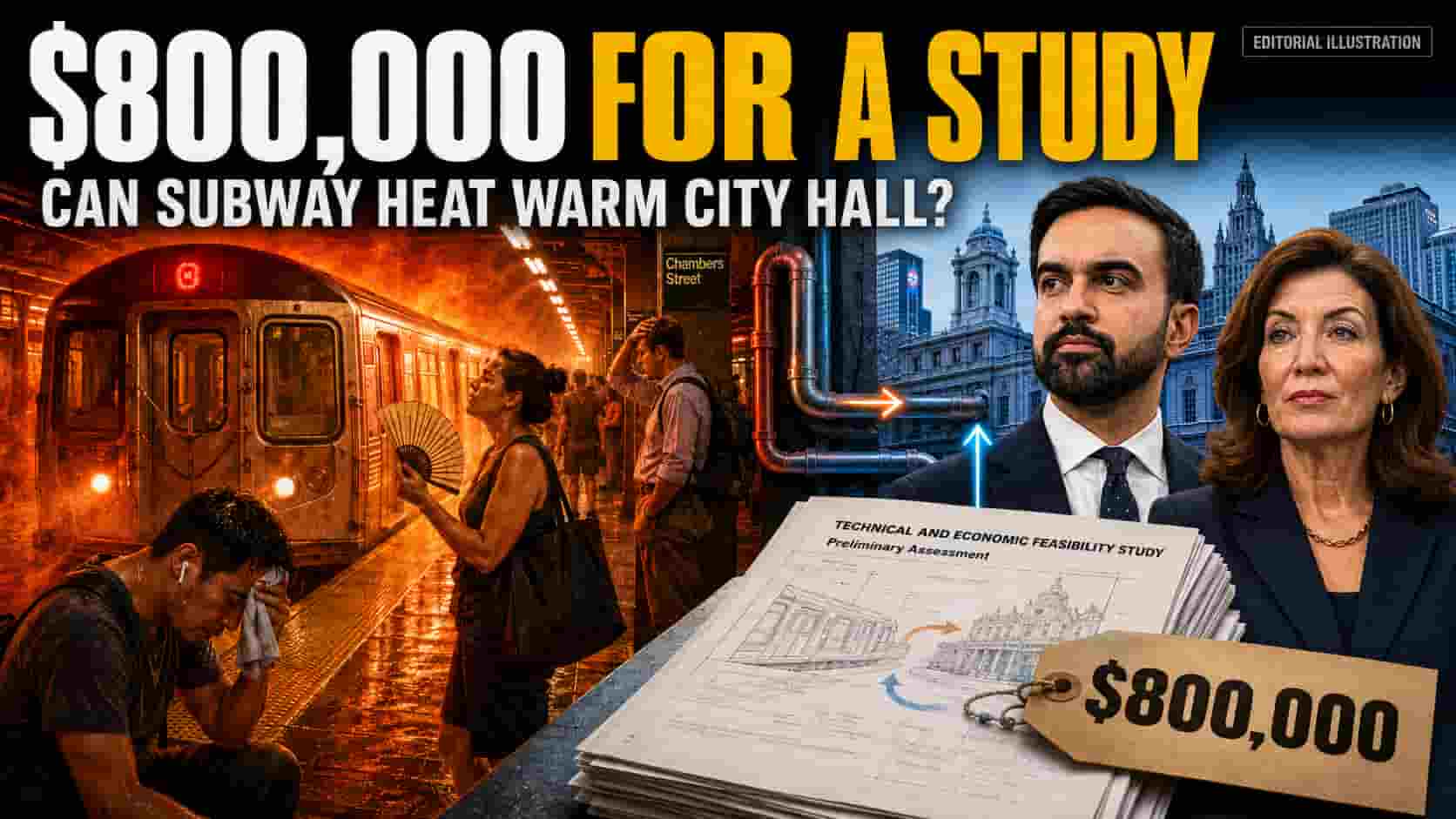
Mayor Zohran Mamdani, Governor Kathy Hochul, and the MTA have announced an unusual proposal: capture excess heat from Lower Manhattan subway platforms, store it underground, and use it to heat municipal buildings during the winter. But despite the ambitious presentation, New York has not yet approved or funded construction of the system. For now, officials are paying to study whether the idea can work.
New York City and the Metropolitan Transportation Authority announced the joint initiative on August 10, 2026, at the Chambers Street J/Z station in Lower Manhattan.
The proposed Thermal Energy Network, or TEN, would connect the Brooklyn Bridge–City Hall 4/5/6 station and the Chambers Street J/Z station complex with nearby city-owned buildings.
If ultimately constructed, officials say it would be the first thermal energy network integrated into an operating U.S. transit system.
How Hot Does the Station Get?
According to official statements from City Hall and Governor Hochul’s office, Brooklyn Bridge–City Hall is one of the hottest stations in the subway system, with temperatures reaching an average of approximately 96 degrees Fahrenheit during the summer months of 2025.
The station’s heat comes from several sources. Subway trains generate heat while braking, operating electrical equipment, and running air-conditioning systems that discharge hot air onto platforms. The problem is especially noticeable at Brooklyn Bridge–City Hall because 6 trains may remain in the terminal before beginning their next trip.
Traditional air conditioning is difficult inside century-old stations with open entrances, stairways, tunnels, ventilation shafts, and other pathways through which outside air continually enters.
MTA Chair and CEO Janno Lieber acknowledged that the proposed system would not create an office-like, air-conditioned environment. He said that reducing peak temperatures by even a few degrees could represent a meaningful improvement for riders.
How Would the Thermal Network Work?
Under the preliminary concept:
- Radiant cooling panels containing circulating chilled water would absorb heat from the Brooklyn Bridge–City Hall platforms and potentially Chambers Street.
- Pipes would carry the captured thermal energy away from passenger areas.
- Geothermal boreholes would be drilled beneath the abandoned center platform at Chambers Street.
- The boreholes would extend approximately 500 to 600 feet underground.
- Heat collected during warmer months could be stored underground and reused during colder months.
The surrounding municipal campus includes the David Dinkins Municipal Building, City Hall, Tweed Courthouse, and Surrogate’s Court.
Chambers Street may be particularly suitable for the experiment because its unused center platform could provide space for drilling and equipment without occupying active passenger areas. Existing underground connections between nearby government buildings may also make distributing the stored heat easier than it would be at many other subway stations.
Is the City Spending $800,000?
During the official press conference, CBS New York reporter Marcia Kramer said the feasibility study would cost approximately $800,000. Lieber did not dispute the figure.
However, that amount is for studying the concept — not building the thermal network.
Officials have not yet disclosed:
- The projected construction cost
- Annual operating and maintenance expenses
- The amount of heat the system could capture
- The actual reduction in platform temperatures
- The projected reduction in steam consumption
- The net savings to taxpayers
- A construction schedule or completion date
Lieber said those are among the central questions the study is intended to answer.
How Much Does the City Spend Heating the Dinkins Building?
Mayor Mamdani said it costs the city approximately $1.4 million annually to heat the David Dinkins Municipal Building.
Earlier during the same press conference, Comptroller Mark Levine cited a slightly different figure of approximately $1.5 million per year.
No supporting energy bill or separate financial report was presented during the announcement. The difference does not invalidate the basic argument that heating the building is expensive, but it means the precise figure should not yet be treated as independently established.
Officials also have not shown that the proposed thermal network could replace all — or even most — of the building’s current heating needs.
Any projected savings should therefore be treated as a possibility, not a guaranteed outcome.
When Could the System Be Built?
Officials expect the contract for the feasibility study to be awarded in fall 2026.
Mamdani said the city hopes to determine geothermal feasibility by the end of the calendar year. If the findings are favorable, design work could begin in early 2027.
That does not mean construction will begin in 2027.
The administration has not announced a construction budget, approval process, completion date, or schedule for expanding the technology to other stations.
A Separate Project: The Chambers Street Renovation
The proposed thermal network should not be confused with the already announced comprehensive renovation of the 113-year-old Chambers Street J/Z station.
That separate capital project is expected to include:
- Structural repairs
- Leak mitigation and ceiling repairs
- Stairway and door improvements
- New station lighting
- Additional security cameras
- Replacement and restoration of damaged tiles
- Restoration of mosaics, terra-cotta decorations, and marble bases
- Improvements to passenger areas
The renovation is part of the MTA’s 2020–2024 Capital Plan and is being funded through congestion-pricing revenue. The MTA expects to award a contract for the work by the end of 2026.
The official August 7 announcement did not provide a final cost for the renovation.
During the August 10 press conference, Comptroller Levine said it would be “$100 million or more, I believe.” Because he qualified that statement and no official budget was published, $100 million should not yet be reported as the confirmed project cost.
What Has Been Confirmed?
The following points are supported by official City, State, and MTA materials:
- A feasibility study for a thermal energy network is planned.
- The study will focus on Brooklyn Bridge–City Hall and Chambers Street.
- Officials expect to award the study contract in fall 2026.
- Design work could begin in 2027 if the concept is found feasible.
- Chambers Street is receiving a separate comprehensive renovation.
- Congestion-pricing revenue will fund the station renovation.
What Has Not Been Established?
Officials have not yet demonstrated:
- That the thermal network will be constructed
- That it will substantially cool the platforms
- That enough summer heat can be stored to heat nearby buildings effectively
- That energy savings will exceed construction and operating costs
- How much the completed system will cost
- When passengers might experience any improvement
- Whether the concept can be replicated throughout the subway system
Midtown Tribune Analysis
Capturing subway heat and putting it to productive use is a legitimate engineering concept worth studying. Chambers Street may also offer unusually favorable conditions because of its abandoned platform, nearby municipal buildings, and existing underground connections.
But the distinction between an experiment and a completed public-works project matters.
New York is currently preparing to spend approximately $800,000 to determine whether the idea is technically and financially practical. Officials hope the system could lower platform temperatures by a few degrees while reducing municipal heating expenses.
Whether those savings would justify the cost of designing, building, operating, and maintaining the network remains unanswered.
Until the feasibility study is published, this should be described as a promising but unproven proposal — not as a solution that has already arrived.
Official Sources and Fact-Check References
-
NYC Mayor’s Office — Official Project Announcement
City Hall’s description of the proposed Thermal Energy Network, participating stations, preliminary technology, and expected timeline.
NYC.gov — Plan to Lower Subway Platform Temperatures -
NYC Mayor’s Office — Official Press Conference Transcript
Full transcript containing questions about the approximately $800,000 study, projected cooling, heating expenses, savings, and project timeline.
NYC.gov — Official Press Conference Transcript -
Office of Governor Kathy Hochul
New York State’s official confirmation of the City-MTA partnership, geothermal concept, station conditions, and study schedule.
Governor.NY.gov — Lower Manhattan Thermal Energy Plan -
Office of Governor Kathy Hochul — Chambers Street Renovation
Official August 7, 2026, announcement of the comprehensive modernization of the 113-year-old Chambers Street J/Z station.
Governor.NY.gov — Chambers Street Modernization -
MTA — Congestion Pricing and Transit Improvements
Official explanation of how congestion-pricing revenue supports capital improvements across the MTA system.
MTA.info — Congestion Pricing Makes for Better Transit -
MTA — 2025–2029 Capital Plan
Official information about station renewals, infrastructure repairs, climate resilience, accessibility, and other planned MTA investments.
MTA — 2025–2029 Capital Plan -
NYC Mayor’s Office — Official Video
Full video of the August 10, 2026, press conference at Chambers Street.
YouTube — Mayor Holds Press Conference With MTA
Midtown Tribune reviewed the principal claims using official materials published by the City of New York, New York State, and the MTA. As of August 11, 2026, no final construction cost, completion date, or confirmed performance estimate for the Thermal Energy Network has been published.
The Main Questions About the Project
Does “storing” summer heat underground violate the laws of thermodynamics? No. Seasonal underground heat storage is a real technology, although an electric heat pump is generally required to raise the recovered heat to a temperature suitable for heating buildings.
How much of the stored heat could be recovered? That remains unknown: City Hall has not published projected thermal losses, the system’s energy balance, or its electricity consumption.
Could the boreholes damage the ground or nearby foundations? Properly engineered closed-loop systems generally do not destroy the ground, but temperature cycles, groundwater movement, inadequate sealing, and proximity to foundations require a site-specific geotechnical analysis. This is especially important because the proposed boreholes would extend 500–600 feet underground, while New York State is still developing specific regulations for closed-loop geothermal boreholes deeper than 500 feet.
Could the city use conventional air conditioning instead? MTA Chair Janno Lieber said conventional station air conditioning is difficult because the subway has open entrances, stairways, vents, and tunnels that prevent the creation of a sealed environment. However, neither the city nor the MTA has published a cost comparison showing what conventional ventilation, spot cooling, radiant cooling, or other platform improvements could be provided for the same approximately $800,000. The available evidence therefore does not establish which alternative would be the most cost-effective. Taxpayers should be shown the study’s detailed scope, the alternatives considered, expected electricity consumption, safety analysis, and measurable performance targets.
Official Sources and Technical Fact-Check
-
NYC Mayor’s Office — Official Project Description
City Hall’s announcement describing the proposed Thermal Energy Network, geothermal boreholes, platform cooling, and possible winter heat reuse.
NYC.gov — Thermal Energy Network Announcement -
NYC Mayor’s Office — Official Press Conference Transcript
Questions and answers concerning the approximately $800,000 study, projected cooling, potential savings, and the preliminary timeline.
NYC.gov — Official Press Conference Transcript -
U.S. Department of Energy — Underground Storage and Thermal Networks
Official technical information about Borehole Thermal Energy Storage, geothermal boreholes, thermal networks, and the heat pumps required to recover usable building heat.
Energy.gov — Geothermal Energy Storage and Thermal Networks -
U.S. Department of Energy — Geothermal Heat Pumps
Explanation of how ground-source heat pumps operate, consume electricity, and transfer heat between the ground and buildings.
Energy.gov — Guide to Geothermal Heat Pumps -
New York State Department of Environmental Conservation
Current regulatory status of closed-loop geothermal boreholes extending more than 500 feet below the surface in New York State.
DEC.NY.gov — Closed-Loop Boreholes Deeper Than 500 Feet -
U.S. Environmental Protection Agency
Potential environmental concerns involving geothermal boreholes, including sealing, aquifers, heat-transfer fluids, groundwater, and proper system decommissioning.
EPA.gov — Environmental Issues Related to Geothermal Systems -
MTA — Earlier Search for Subway Cooling Technologies
The MTA’s official 2023 request for cost-effective technologies capable of providing localized cooling in subway passenger areas.
MTA.info — Subway Platform Cooling Technologies -
NJ Transit — Official Cooling-System Cost Comparison
A $4.62 million contract, plus contingency, to replace chillers and cooling towers at Newark Penn Station.
NJTransit.com — Newark Penn Station Cooling Upgrade
As of August 11, 2026, officials have not published the proposed system’s complete energy balance, seasonal heat-recovery rate, heat-pump electricity consumption, site-specific geotechnical analysis, final construction cost, or completion date.
Ask Midtown Tribune about this story
Answers are grounded first in this article. Search all Midtown Tribune reporting from the main AI Search page.
AI-generated summary. Verify important details in the linked original articles.