
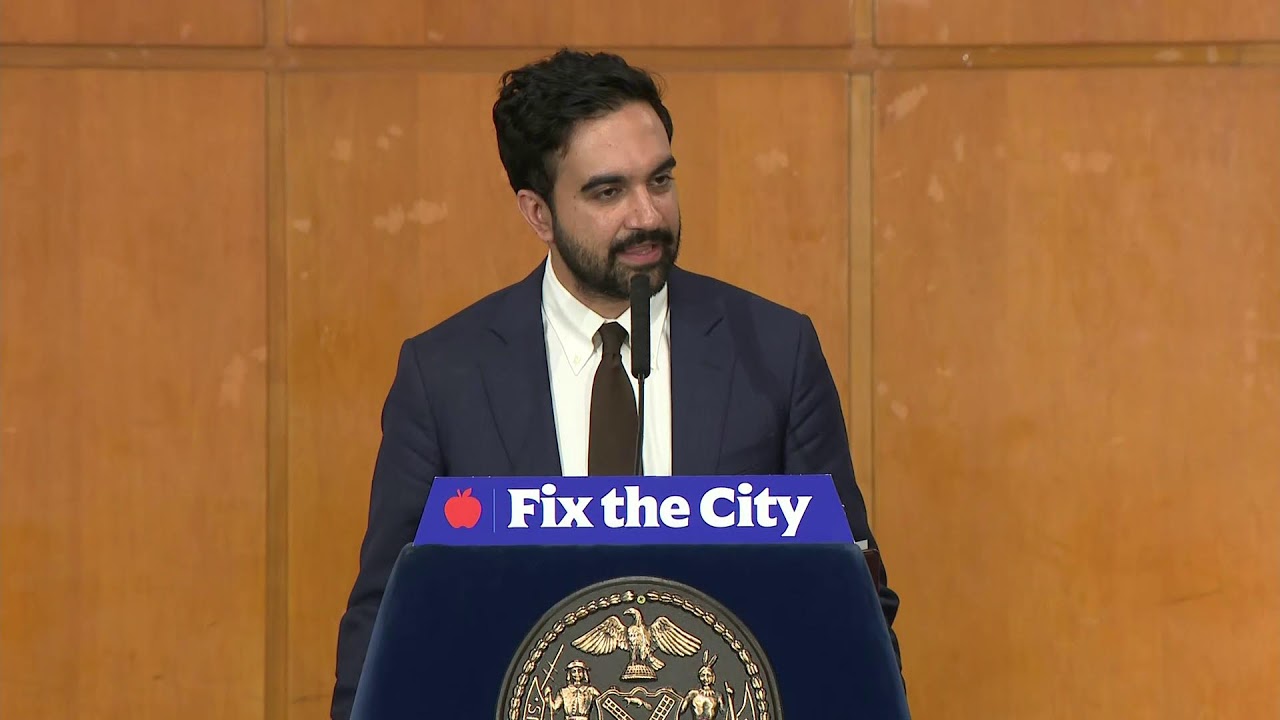
Mayor Zohran Mamdani announced on August 25 that New York City’s most serious Housing Court enforcement cases will be accelerated. The policy is being presented as a tenant-protection measure. But for property owners, it raises another fundamental question: If the owner can be removed from managing the building while remaining legally responsible for the property, who ultimately pays the bills?
On August 25, 2026, Mayor Zohran Mamdani appeared at New York City Housing Court to announce a new fast-track process for some of the city’s most serious housing cases.
Under the initiative, emergency cases involving dangerous building conditions will move through Housing Court more quickly.
For qualifying cases, judges will require the parties to return to court within five days after service is completed, according to the mayor’s announcement.
Mamdani described the measure as necessary because tenants living with severe violations can currently wait weeks or months for cases to move through the judicial system.
But buried inside what sounds like a procedural reform is a much larger property-rights issue.
In some of the cases being accelerated, a court can appoint a 7A administrator to operate a privately owned building in place of its owner.
The owner still owns the property.
But the owner may no longer manage it.
The owner may no longer collect the rent.
And money spent by the government on certain repairs can potentially become debt owed by the owner and a lien against the property.
That creates an obvious question:
If You Own the Building but Cannot Control It, What Exactly Does Ownership Mean?
New York City’s official description of its 7A Program is remarkably clear.
Under the program, a court-appointed administrator can operate a privately owned building when conditions threaten tenants’ life, health or safety. The administrator acts under a court order, collects the rents and uses that money for essential services and repairs.
The New York City Housing Court explains it even more directly: Article 7A permits qualifying tenants or HPD to ask a judge to appoint an administrator to “run the building in place of the owner.”
That is not technically confiscation.
The deed does not automatically transfer to the city or to the administrator.
But the practical consequences can still be enormous.
New York Courts’ own tenant guide explains that when a 7A administrator is appointed, the owner still owns the building but is removed as the active manager. The administrator collects rent and uses the money for repairs. Control may later be returned to the owner if the court is satisfied with the condition of the property.
A City Council hearing described the arrangement similarly. An HPD official testified that a 7A administrator effectively “step[s] into the shoes of the landlord.” The owner retains legal ownership, but recovering control requires returning to Housing Court and obtaining the judge’s approval.
That distinction matters.
This is not confiscation of title.
But it can amount to a court-ordered separation between ownership and control.
What Cases Will Mamdani’s Fast Track Cover?
According to Mamdani’s August 25 announcement, the new accelerated procedure is aimed at severe cases, including buildings where:
- at least one-third of units are subject to an open vacate order;
- at least one-third have open immediately hazardous violations involving essential services such as heat, hot water, electricity or gas;
- elevators are out of service and there is a qualifying open DOB Class 1 violation;
- conditions are sufficiently serious for the city or tenants to seek appointment of new management through a 7A proceeding.
Mamdani specifically said the fast track would include the most serious and complex cases.
The administration’s argument is straightforward: when an apartment building is unsafe, procedural delays should not leave tenants living without heat, electricity, working elevators or other essential services.
But accelerating the 7A process also potentially means accelerating the point at which an owner can lose day-to-day control over his or her property.
Mamdani: If You Cannot Follow the Law, You Should Not Be the Landlord
One reporter raised precisely the issue many smaller property owners are likely to ask.
What happens when a landlord is not deliberately negligent but says he simply cannot afford a new boiler, elevator or other major repair because expenses exceed revenue?
Mamdani’s response left little ambiguity about his administration’s position.
He emphasized that the initiative targets severe violations and then said:
“If a landlord is not able to follow the law, then they should not be a landlord of that property.”
That may become one of the most consequential statements from the August 25 press conference.
The mayor is essentially arguing that inability to finance legally required repairs does not excuse an owner from meeting housing standards.
From the tenant’s perspective, that is easy to understand: whether an elevator is broken because of deliberate neglect or because an owner lacks cash makes little difference to a disabled tenant trapped on the tenth floor.
But from the property owner’s perspective, another problem emerges.
If government removes the owner’s ability to operate the property and redirects rental income to an outside administrator, what happens to the owner’s continuing financial obligations?
Who Collects the Rent?
Once a 7A administrator is appointed, the administrator can collect the rent.
HPD states that administrators use rental income to provide essential services and perform necessary repairs.
The administrator can have broad operational authority.
New York case law describes powers that can include receiving rents and security deposits, purchasing labor and materials, correcting Housing Code violations, renting vacant apartments, hiring a superintendent and obtaining financing for repairs.
That means an owner may continue to hold legal title while losing one of the most important economic benefits normally associated with ownership: control over the building’s rental revenue.
Who Pays for Repairs?
This is where the arrangement becomes especially important for property owners.
Rental income controlled by the administrator is generally directed toward operating the building and making repairs.
But rental income is not necessarily enough to rehabilitate a severely distressed property.
HPD can provide financing for certain major work through its 7A Financial Assistance program.
And New York law provides a crucial answer to the question of who ultimately owes certain government expenditures.
Under Article 7A, money expended by the relevant government department for authorized work can become “a debt recoverable from the owner and a lien upon the building and lot”, as well as upon rents and other income.
That is a significant distinction.
The government has not confiscated the property.
But the owner may have lost management control while certain government-funded expenditures can still become his debt secured against his property.
What About Existing Violations and Fines?
Appointment of a 7A administrator does not simply erase the property’s violations.
NYC’s Housing Maintenance Code states that “the owner shall be responsible for the correction of all violations.” The law does allow owners to present certain defenses or mitigating circumstances when civil penalties are sought, but the basic statutory responsibility remains attached to the owner.
HPD similarly states that Housing Court can impose civil penalties when an owner fails to comply with violations and correction requirements.
This does not mean that every fine arising after appointment of a 7A administrator automatically becomes the personal responsibility of the owner. Liability can depend on the type and timing of the violation, the court order, the administrator’s conduct and the applicable statute.
Indeed, New York courts have heard cases in which tenants sought repair orders against a 7A administrator, demonstrating that an administrator is not immune from judicial scrutiny once that administrator is operating the property.
But the critical point for owners remains:
Appointment of an administrator does not automatically wipe away the owner’s financial exposure.
And What About Property Taxes and Liens?
The owner also does not simply cease being a property owner for tax and lien purposes.
Article 7A establishes priorities for rental income handled by an administrator. Funds may be used for required repairs, the administrator’s expenses and fees, outstanding property-tax liens, emergency-repair liens and other municipal liens before any remaining surplus is paid to the owner.
Even getting the building back may require resolving those obligations.
New York law limits when a court may discharge a 7A administrator, including requirements involving outstanding property-tax liens, emergency-repair liens and certain other municipal charges.
A 2025 New York appellate decision illustrates how difficult regaining control can become. The court held that payment of municipal charges alone was not necessarily enough: the owner also had to demonstrate that the underlying reasons for the 7A appointment had been addressed and that there was a viable plan for continued maintenance.
So the practical structure can look like this:
You own the building.
Someone else manages it.
Someone else collects the rent.
Rental income may be spent before you receive anything.
Government repair expenditures may become liens against your property.
And you may need court approval to regain control.
Legally, that is not confiscation.
Economically, however, it is a very substantial restriction on the ordinary powers of ownership.
Can an Owner Lose All Control?
There are already real New York examples showing how far a 7A order can go.
In one enforcement case described by HPD, a court-appointed 7A administrator took over management of a Hell’s Kitchen building. According to the city, the owner was prohibited from collecting rent or having any presence in the building while the administrator managed the property and major repairs were undertaken.
Again, the city did not take title to the building.
But it is difficult to describe that situation as normal private control of property.
The owner possesses the title, while the practical authority to operate the building has been transferred elsewhere by court order.
Mamdani Wants That Process to Move Faster
That is what makes the August 25 announcement particularly important.
Article 7A is not a new invention of the Mamdani administration. It has existed under New York law for decades.
Mamdani did not announce a new power allowing City Hall simply to seize apartment buildings.
Instead, his administration is supporting a system under which some of the most serious Housing Court proceedings — including proceedings that can result in 7A management — move significantly faster.
HPD Commissioner Dina Levy explained that delays can leave seriously neglected buildings deteriorating while courts consider replacing irresponsible management. The administration views faster judicial action as another enforcement tool against landlords it considers willfully negligent.
Mamdani also made clear that his administration does not view lack of money as a sufficient answer when legal safety requirements are not being met.
The Property-Rights Question New York Should Ask
There are two legitimate interests here.
Tenants should not be forced to live for months without heat, hot water, electricity, gas or a functioning elevator while a court case moves slowly.
But private property rights also require serious scrutiny whenever government uses judicial power to transfer control of privately owned assets.
The central question is therefore not simply:
“Does the owner keep the deed?”
A more meaningful question is:
What rights and responsibilities remain with the owner after the government-backed court process removes the owner’s ability to manage the property and collect its income?
If the owner remains responsible for taxes, liens, existing violations and potentially government-funded repairs, while an administrator controls rents and operations, New York should be transparent about precisely how those risks are divided.
That issue becomes even more important if Mamdani’s new fast-track system dramatically increases the number of buildings entering 7A administration.
When reporters asked how many cases could qualify for the accelerated pathway, the mayor acknowledged that the administration did not yet have an exact estimate.
That number should now be closely watched.
Bottom Line
Calling the Mamdani policy “confiscation” would not be legally accurate based on what was announced August 25.
The owner retains title.
But saying that nothing happens to the owner’s property rights would be equally misleading.
A 7A administrator can replace the owner as active manager, collect the property’s rent and direct that revenue toward operation and repairs. Government repair expenditures can in certain circumstances become debts and liens against the owner’s building, and the owner may need another court order to regain control.
Mamdani’s August 25 initiative is designed to make some of those proceedings happen faster.
For tenants, the administration calls that faster justice.
For property owners, it raises a different question that deserves an equally direct answer:
If you still own the building but government can remove your control over it, redirect its income and leave financial obligations attached to your property — where exactly does ownership end and government control begin?
Official Sources
Mayor Mamdani — August 25, 2026 Housing Court Press Conference
Watch the full press conference on YouTube
NYC Department of Housing Preservation and Development — 7A Program
Official HPD 7A Program
New York City Housing Court — Article 7A Proceedings
Official New York Courts explanation
New York State Legislature — RPAPL Article 7-A
New York State Open Legislation
NYC HPD — Penalties and Fees
Official HPD civil penalties information
NYC Housing Maintenance Code
Official Housing Maintenance Code
Ask Midtown Tribune about this story
Answers are grounded first in this article. Search all Midtown Tribune reporting from the main AI Search page.
AI-generated summary. Verify important details in the linked original articles.