
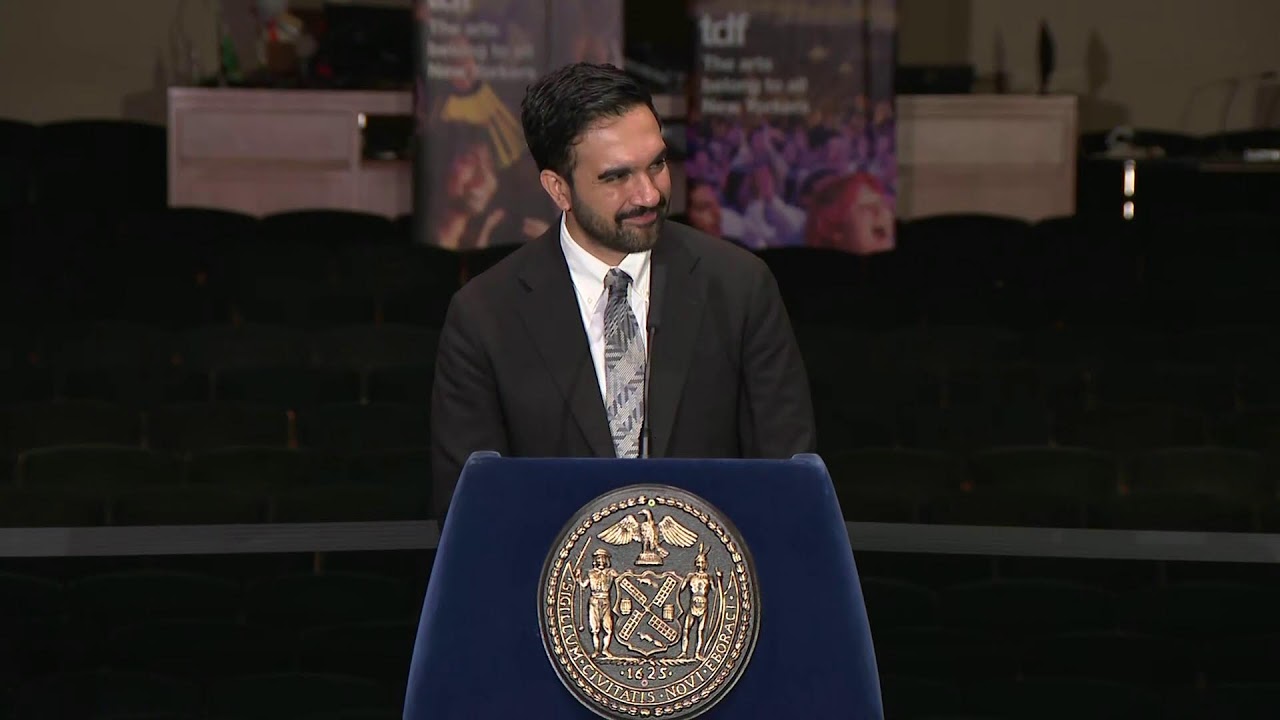
The August 13 celebration honored generations of Dominican New Yorkers, from small-business owners and health-care workers to artists and community organizers. But the Gracie Mansion reception also became a platform for Mayor Zohran Mamdani to promote his administration’s housing, child-care, transportation and small-business agenda.
NEW YORK — August 14, 2026. Mayor Zohran Kwame Mamdani hosted a Dominican Heritage Reception at Gracie Mansion on August 13, bringing Dominican community leaders, city officials, nonprofit representatives and elected officials into what the mayor repeatedly described as “the people’s house.”
The full event can be watched in the official video of the Dominican Heritage Reception, while the Mayor’s Office has published an official transcript of Mamdani’s remarks.
The event celebrated Dominican culture and New York’s deep Dominican roots, but it also offered an unusually clear picture of how the Mamdani administration is trying to connect its broader policy agenda to one of the city’s largest immigrant communities.
Small Business Commissioner: Entrepreneurship Is a Path to the Middle Class
NYC Department of Small Business Services Commissioner Kenny Minaya, the son of Dominican small-business owners, opened the evening by emphasizing the role Dominican entrepreneurs have played in building New York.
Minaya spoke about immigrants arriving with ambition and creating businesses ranging from bodegas and supermarkets to barber shops, salons, restaurants and bakeries. He argued that small-business ownership remains a critical route into the middle class for Dominican and other immigrant families.
His personal connection is documented by the NYC Department of Small Business Services, which says Minaya’s parents emigrated from the Dominican Republic and have owned a New York City small business for more than 40 years.
Minaya tied that history directly to the Mamdani administration’s recently announced OPEN for Small Business initiative.
The administration announced the package on July 20, describing it as more than 50 regulatory reforms intended to reduce paperwork, fees and bureaucratic obstacles affecting the city’s roughly 180,000 small businesses, which City Hall says collectively employ about one million New Yorkers. The full policy is available through the Mayor’s Office announcement on OPEN for Small Business.
For Dominican-owned bodegas, restaurants and neighborhood businesses, the administration says some changes will make it easier to sell fruit and flowers outside stores, simplify licensing and reduce other regulatory hurdles.
That part of the evening represented perhaps the clearest overlap between the cultural celebration and a concrete economic policy.
Housing Organizer Praises City Hall’s Tenant Agenda
Community organizer Alisa Martinez of Housing Conservation Coordinators told guests that she grew up in a rent-stabilized apartment in Washington Heights and had watched relatives, friends and neighbors get priced out of the communities they knew.
She described housing not simply as a roof, but as the ability to remain close to family, culture and community.
Martinez also praised the administration’s effort to bring City Hall closer to tenants, specifically referring to door-to-door outreach and conversations about apartment conditions.
Housing was later one of the central themes of Mamdani’s own remarks.
The mayor said his administration was providing what he called the strongest tenant protections in the nation through its Block by Block housing agenda.
The actual Block by Block housing plan sets a goal of building 200,000 new affordable homes and preserving another 200,000 over the next decade, backed by major city capital commitments.
Whether those long-term production targets will ultimately be achieved remains to be seen. The plan is a decade-long commitment, not 400,000 homes already delivered.
Health Care and Nonprofits Take the Stage
The reception also featured Dr. Ramon Tallaj, founder and chairman of SOMOS Community Care, who spoke about decades of treating immigrant communities and the role Dominican physicians and families have played in New York.
Tallaj argued that health cannot be separated from housing, food, employment and dignity.
His presence was not unusual for a Dominican heritage event at Gracie Mansion. NYC records also list Tallaj as a SOMOS founder and honoree at the city’s 2022 Dominican Heritage celebration.
Annie Minguez, executive director of the Mayor’s Office of Nonprofit Services, also described herself as a Dominican American raised in Washington Heights and spoke about her own path through nonprofit organizations and public service.
Together, the speakers presented a portrait of the Dominican community not simply as an immigrant community, but as an established part of New York’s business, health-care, nonprofit and government infrastructure.
Mamdani: Dominican History in New York Goes Back to 1613
When Mamdani took the podium, he began with Dominican history.
He pointed to Juan — or Jan — Rodriguez, who arrived in Manhattan in 1613 from Santo Domingo, before the Dutch establishment of New Amsterdam.
This claim is backed by the federal government.
The National Park Service describes Jan Rodrigues as the first non-Native resident of Manhattan, saying he was raised in Santo Domingo and arrived in 1613 as an interpreter aboard a Dutch trading vessel.
NYC historical records similarly describe Rodrigues as the first non-Indigenous person known to have resided on Manhattan.
Mamdani then traced later Dominican migration through the 1960s and 1970s and highlighted the community’s role in factories, restaurants, hospitals, taxis, small businesses and public service.
From Bachata to Bodegas
The mayor spent an unusually large part of his remarks on culture.
He spoke about bachata, describing its origins as working-class Dominican music that was once dismissed by elites before becoming a global cultural form.
That history also has an independent official source: UNESCO inscribed the Music and Dance of Dominican Bachata on its Representative List of the Intangible Cultural Heritage of Humanity in 2019. UNESCO’s official bachata entry is available here.
Mamdani connected that cultural development to Dominican neighborhoods in New York, including Inwood and Mott Haven, and to the bodegas, barbershops and other businesses that became neighborhood institutions.
Census data supports the larger demographic point that New York is a major center of Dominican life in the United States. The U.S. Census Bureau reported that New York State had 867,304 people identifying as Dominican in the 2020 Census — the largest Dominican population of any state.
The Celebration Becomes a Policy Speech
About halfway through Mamdani’s remarks, the speech shifted noticeably from heritage to City Hall policy.
The mayor highlighted four major elements of his administration’s agenda:
- universal child care;
- the Block by Block housing plan and tenant protections;
- faster buses;
- more than 50 small-business regulatory changes.
On child care, this is not merely a campaign promise. Mamdani and Gov. Kathy Hochul announced a state-city program earlier this year to establish free child care for two-year-olds and move toward universal child care in New York City. The city later announced that the first phase would begin with more than 2,000 free 2-K seats in four communities in fall 2026, with a stated goal of wider expansion over four years. The official March announcement is available through City Hall.
On small businesses, the mayor again promoted the administration’s more than 50 regulatory changes.
And on housing, he pointed to the previously released Block by Block plan.
What Was Actually Announced for Dominican New Yorkers?
This is where the distinction between the celebration and public policy becomes important.
Despite the extensive discussion of Dominican history, Dominican-owned businesses, housing pressures and immigrant families, the official event transcript contains no announcement of a new Dominican-specific city program, funding allocation, grant or economic-development initiative.
Instead, Mamdani used the reception to connect existing citywide programs to the Dominican community. That is a legitimate political and civic function of a heritage reception, but it is different from announcing a new targeted investment. This is an inference from the official Mayor’s Office transcript, which lists the administration’s existing child-care, housing, transportation and small-business initiatives but contains no new Dominican-specific funding commitment.
That distinction matters particularly for small-business owners.
Dominican entrepreneurs have built a major commercial presence in New York largely through privately owned bodegas, supermarkets, restaurants, barber shops and professional practices. Minaya himself described entrepreneurship as a path into the middle class.
For those businesses, the measurable question will be whether City Hall’s promised regulatory reductions actually decrease the cost and time required to operate — not simply whether the reforms sound business-friendly at a reception.
Midtown Tribune Analysis
The August 13 reception succeeded at one obvious objective: it placed Dominican New Yorkers at the center of Gracie Mansion and recognized a community whose history in the city extends centuries.
It also highlighted something frequently lost in political discussions about immigration: the Dominican story in New York is deeply connected to private enterprise.
Bodegas, supermarkets, bakeries, barber shops, salons, restaurants and medical practices were not side notes in the evening’s speeches. They were repeatedly described as mechanisms through which immigrant families built economic independence and entered the middle class.
That makes City Hall’s small-business policies worth watching closely.
The administration’s decision to remove or revise more than 50 regulations could provide measurable benefits if it genuinely reduces licensing delays, fines, compliance costs and bureaucratic uncertainty. The city’s own documents acknowledge that small businesses face thousands of rules and regulations.
At the same time, several of the mayor’s biggest claims at the reception — universal child care, hundreds of thousands of affordable homes, stronger tenant protections and faster buses — describe programs that are still being implemented or long-term targets rather than completed results.
The reception therefore offered both a celebration and a benchmark.
City Hall has told Dominican New Yorkers what it intends to deliver.
The next question is what those promises will look like in actual costs, permits, rents, business openings, housing production and everyday life in neighborhoods where Dominican New Yorkers have already been building the city for generations.
Sources
Official Government Sources
NYC Mayor’s Office — Transcript: Mayor Mamdani Hosts Dominican Heritage Reception, August 13, 2026
NYC Department of Small Business Services — Commissioner Kenny Minaya Biography
NYC Mayor’s Office — OPEN for Small Business: More Than 50 Regulatory Reforms
NYC Mayor’s Office — Block by Block Housing Plan
NYC Mayor’s Office — First Four Communities for Free 2-K Child Care
National Park Service — The Life of Jan Rodrigues
U.S. Census Bureau — Detailed Hispanic Origin Population, 2020 Census
Primary Video and Cultural Source
Official Video — Mayor Mamdani Hosts Dominican Heritage Reception
UNESCO — Music and Dance of Dominican Bachata
Ask Midtown Tribune about this story
Answers are grounded first in this article. Search all Midtown Tribune reporting from the main AI Search page.
AI-generated summary. Verify important details in the linked original articles.