
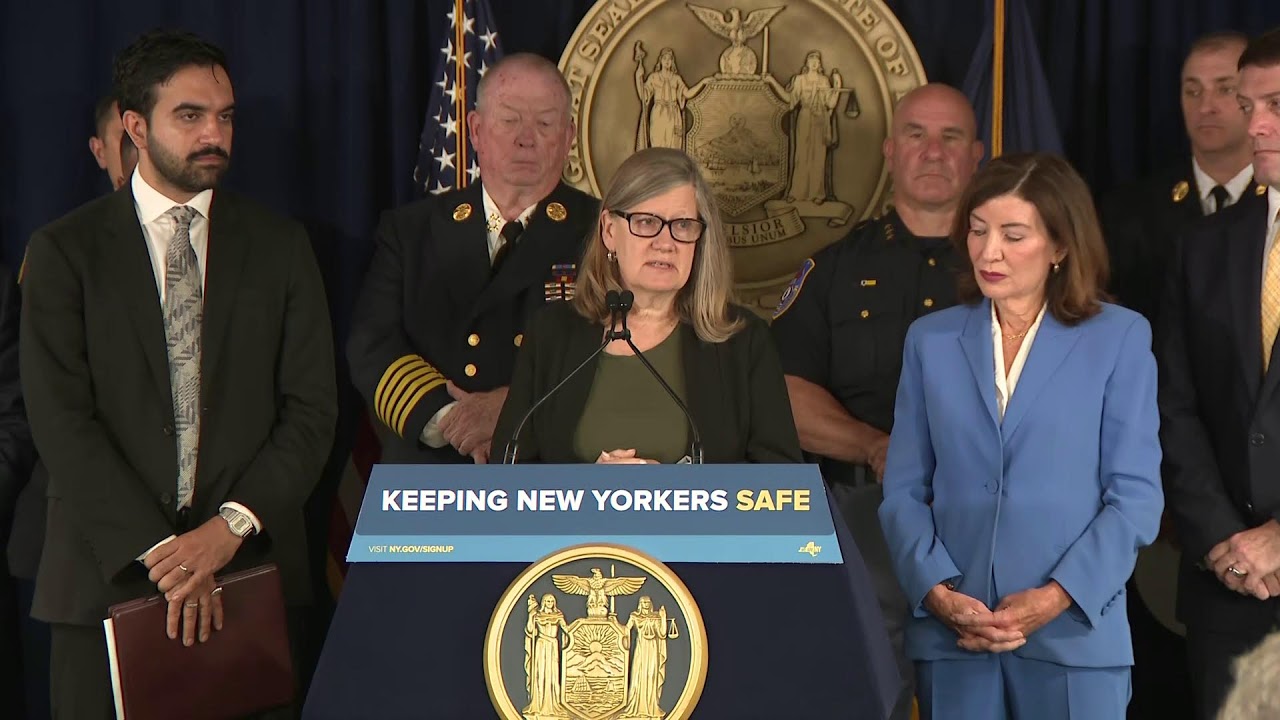
New York leaders accuse the Trump administration of withholding critical terrorism-prevention funds. What received far less emphasis at their press conference is the broader confrontation over ICE, sanctuary policies and New York laws restricting cooperation with federal immigration enforcement.
Mayor Zohran Mamdani joined Governor Kathy Hochul on September 1 to demand that the Trump administration release $87 million in federal homeland-security funding that New York says remains withheld.
Standing with state emergency and law-enforcement officials just ten days before the 25th anniversary of the September 11 attacks, Hochul accused President Donald Trump of “defunding the police,” while Mamdani said the money is needed for bomb squads, FDNY emergency communications, radiological response capabilities, cybersecurity and other counterterrorism operations.
According to New York City’s official transcript, Hochul said the outstanding $87 million represents roughly 40 percent of the state’s expected counterterrorism allocation. Mamdani said the reduction would affect NYPD, FDNY, NYC Emergency Management and other agencies.
But the dispute cannot be understood solely as Washington suddenly refusing to finance New York’s fight against terrorism.
It is part of a much larger confrontation between the Trump administration and New York over federal immigration enforcement.
New York Has Explicitly Restricted Cooperation With ICE
Earlier this year, Governor Hochul signed a sweeping immigration package as part of New York’s FY2027 budget.
Among other provisions, the state says the laws:
- prohibit local governments, police departments and corrections agencies from entering into 287(g) agreements or similar arrangements that allow local officers and facilities to be used for federal civil immigration enforcement;
- prohibit state and local resources and personnel from being used for federal civil immigration enforcement;
- restrict immigration authorities from entering non-public areas of schools, hospitals, libraries, shelters, parks, childcare facilities and other government-operated locations without a judicial warrant;
- prohibit law-enforcement officers, including federal officers in many circumstances, from concealing their identities with masks;
- establish a state cause of action allowing people to sue government officials for alleged constitutional violations;
- restrict public employees and schools from assisting with civil immigration enforcement.
Hochul herself described the purpose of the Local Cops, Local Crimes Act as preventing local police from being “deputized by ICE” for federal civil immigration enforcement. The governor argues that local officers should concentrate on state and local crime while federal immigration enforcement remains a federal responsibility.
That is the policy Washington is fighting.
Justice Department Says New York Is Obstructing Federal Law Enforcement
The Trump Justice Department takes the opposite position.
In June, DOJ sued New York State, Governor Hochul and Attorney General Letitia James over portions of the new immigration package.
The Justice Department specifically challenged New York’s restrictions on officers wearing masks and identification requirements and criticized the state’s prohibition on cooperative 287(g) arrangements.
DOJ called the measures an unconstitutional attempt by the state to regulate or interfere with federal law-enforcement operations.
The federal government has also officially designated New York State and New York City as sanctuary jurisdictions, saying their laws and policies materially impede federal immigration enforcement.
Separately, the Justice Department sued New York City in 2025 over its sanctuary-city laws, arguing that restrictions on cooperation with federal immigration authorities conflict with federal law.
New York disputes those claims and says its rules do not prevent cooperation in legitimate criminal investigations.
Mamdani Defended Sanctuary Policies at the Same Press Conference
This part of the September 1 event is particularly important.
A reporter told Hochul and Mamdani that DHS Secretary Markwayne Mullin, who was also in New York that day, was accusing their administrations of making New York less safe and specifically cited the 287(g) issue.
Hochul defended her decision to prevent New York counties from turning local officers into civil immigration-enforcement agents.
Mamdani went further.
He said:
“We are proud as New York City to be a city that has sanctuary policies.”
Mamdani argued that sanctuary rules encourage undocumented immigrants to report crimes rather than fear contact with police. He said the city still cooperates with federal authorities in connection with more than 170 serious crimes.
That exchange is important because it demonstrates that the counterterrorism-funding fight and the immigration-enforcement confrontation were being discussed at the same press conference.
Was Federal Security Funding Actually Tied to Immigration Cooperation?
There is substantial official evidence that the Trump administration has attempted to make federal security funding conditional on immigration-enforcement cooperation.
New York Attorney General Letitia James said that in September 2025, FEMA and DHS reduced Homeland Security Grant Program allocations to states that refused to use their state and local law-enforcement resources to assist the administration’s immigration-enforcement program.
According to the New York Attorney General’s office, New York initially suffered a 79 percent reduction totaling more than $100 million in one round of Homeland Security Grant Program funding.
New York and other states sued.
A federal court ruled against DHS, and in May 2026 the Trump administration dropped its appeal, preserving the restored funding.
The Attorney General described the original action explicitly as FEMA cutting funding from states that “refused to support the administration’s mass deportation agenda.” That is New York’s characterization, but it was also the central issue litigated in the case.
Another federal court dispute produced an even more explicit record.
When FEMA eliminated almost $34 million in transit-security funding previously designated for the MTA, the federal government acknowledged in the litigation that the action was based on New York City’s sanctuary-city status. A federal judge ruled that withholding unlawful and ordered the funding restored.
So the broader relationship between federal security money and New York’s refusal to participate in federal immigration enforcement is not hypothetical.
It has already been the subject of federal litigation.
But There Is an Important Distinction About the Current $87 Million
That history does not automatically prove that the remaining $87 million now demanded by Hochul and Mamdani is being withheld exclusively as punishment for the state’s ICE policies.
At the September 1 press conference, a reporter directly asked Hochul whether the current funding dispute was a reaction to New York’s immigration policies.
Hochul responded:
“We’re not aware that there’s a connection between our policies and these funds.”
She maintained that the money had been properly allocated by Congress and simply had not been released.
That qualification is important.
The evidence establishes a broader federal policy of attempting to condition some homeland-security funding on immigration cooperation, and the administration was publicly criticizing New York’s 287(g) and sanctuary policies on the same day.
But the publicly available documents reviewed by Midtown Tribune do not establish that the entire outstanding $87 million was withheld solely because of those policies.
Where Did the $87 Million Come From?
The history is complicated.
New York says its Homeland Security Grant Program funding was initially expected to total approximately $217 million, but the FY2025 federal allocation reduced that amount by about $87 million, or 40 percent.
The dispute then became even larger.
In September 2025, DHS and FEMA made an additional reduction of approximately $102.7 million, prompting litigation by New York and other states.
That later reduction was successfully challenged in court and funding was restored.
The original approximately $87 million gap, however, remained.
New York officials are now demanding that Washington close it.
According to state Homeland Security Commissioner Terence O’Leary, the remaining reductions include approximately $37.6 million from the State Homeland Security Program and a major reduction in the Urban Area Security Initiative.
He said New York City’s impact includes approximately $11 million from SHSP and $55.6 million from UASI.
Hochul’s Argument: Washington Is Endangering New York
Hochul framed the matter almost entirely as a counterterrorism issue.
She said the loss of funding could affect NYPD intelligence operations, FDNY specialized teams, National Guard deployments, bomb squads and county law-enforcement programs.
“Release the $87 million you owe us,” Hochul demanded.
Mamdani similarly emphasized the direct public-safety consequences, saying the funding supports 12 certified bomb squads, emergency communications and preparation for radiological threats.
New York officials also noted that the federal Homeland Security Grant Program was developed precisely because states and cities—particularly high-risk jurisdictions such as New York—bear extraordinary counterterrorism responsibilities.
Washington’s Argument: New York Cannot Demand Federal Help While Restricting Federal Enforcement
The Trump administration’s broader position is fundamentally different.
DOJ maintains that New York has enacted laws and policies that obstruct or restrict federal immigration enforcement.
The administration argues that cooperation between federal, state and local law enforcement is itself a public-safety issue.
The disagreement can therefore be summarized this way:
Hochul and Mamdani say: Immigration enforcement and terrorism funding are separate matters. New York can restrict local participation in civil ICE enforcement while still being entitled to federal counterterrorism funding.
The Trump administration says: New York’s sanctuary and anti-287(g) policies interfere with enforcement of federal law, and Washington has sought to condition some federal funding on compliance and cooperation.
The courts have already ruled against the administration in several specific attempts to withdraw homeland-security money, but litigation over New York’s newer restrictions continues.
The Missing Context in the September 1 Announcement
The official Mayor’s Office headline reads:
“Mayor Mamdani Joins Governor Hochul to Demand Release of Federal Counterterrorism Funding.”
That description is accurate—but incomplete.
The $87 million fight is occurring against the backdrop of one of the largest federal-state confrontations over immigration enforcement in the country.
New York has:
banned 287(g) agreements, limited use of state and local personnel for ICE civil enforcement, restricted ICE access to government facilities without judicial warrants, imposed identification requirements on federal agents and maintained sanctuary policies in New York City.
Washington has responded with lawsuits, sanctuary-jurisdiction designations and—in previous cases—attempts to make security funding dependent on cooperation with federal immigration policy.
That context changes the nature of the story.
This is not simply a dispute over whether Washington remembered to send New York a check.
It is part of a broader constitutional and political fight over a fundamental question:
Can New York refuse to assist the federal government with civil immigration enforcement while continuing to demand full federal homeland-security funding?
New York says yes.
The Trump administration has repeatedly argued otherwise.
And federal courts are increasingly being asked to decide where the constitutional line lies.
Official Sources
NYC Mayor’s Office — September 1 transcript of Mamdani/Hochul counterterrorism funding event. Official NYC transcript
Governor Kathy Hochul — May 28 immigration-enforcement legislation. New York immigration package
Governor Kathy Hochul — FY2027 budget immigration provisions. FY2027 New York budget provisions
U.S. Department of Justice — lawsuit challenging New York immigration-enforcement laws. DOJ lawsuit announcement
U.S. Department of Justice — sanctuary-jurisdiction designation. DOJ sanctuary jurisdiction list
New York Attorney General — May 2026 counterterrorism-funding case. NY Attorney General funding litigation
Ask Midtown Tribune about this story
Answers are grounded first in this article. Search all Midtown Tribune reporting from the main AI Search page.
AI-generated summary. Verify important details in the linked original articles.