
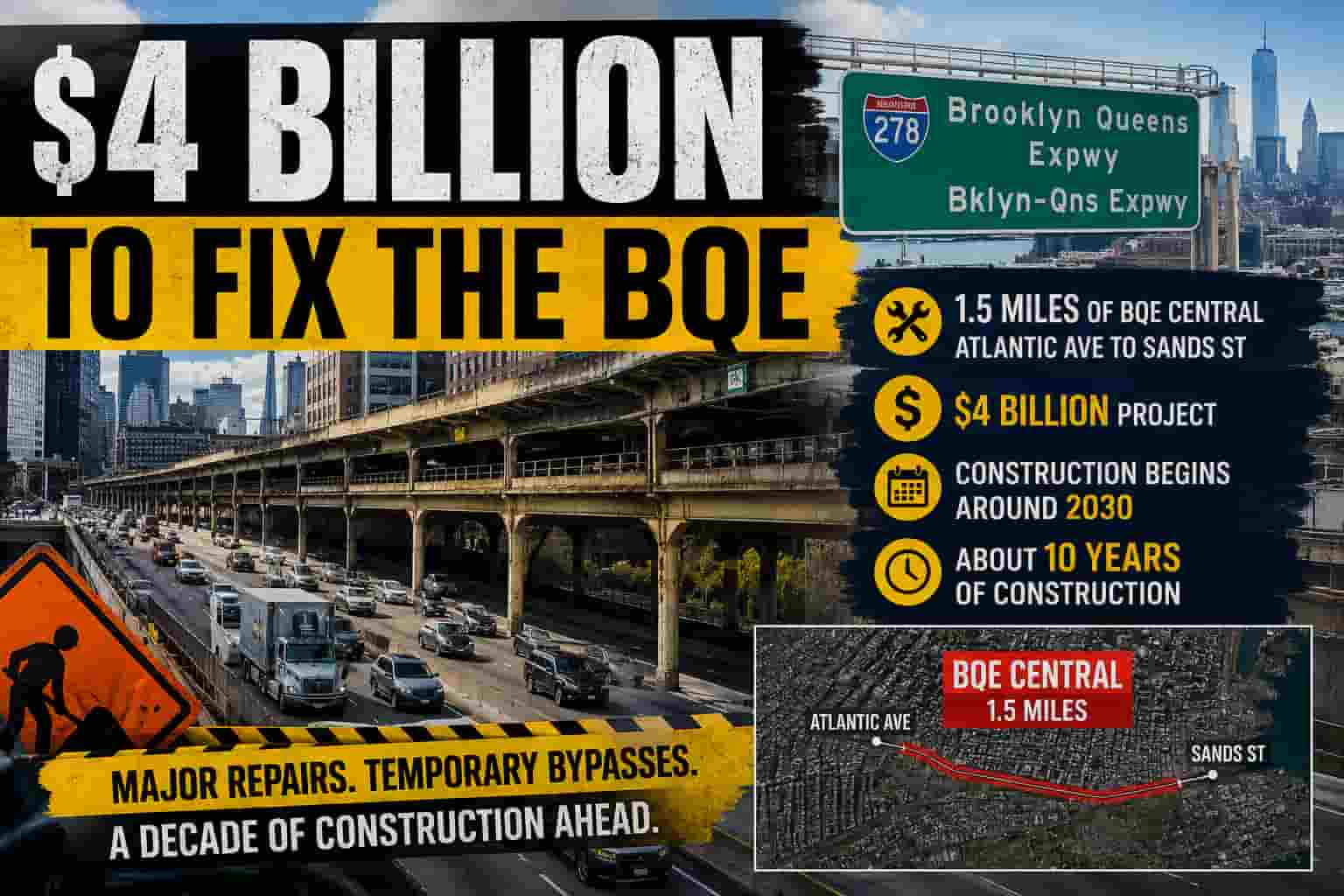
New York City is moving ahead with an approximately $4 billion rehabilitation of the city-owned section of the Brooklyn-Queens Expressway, one of the most expensive and technically difficult highway projects currently facing the city. The plan targets just 1.5 miles of the BQE — but includes the aging Triple Cantilever, major bridge structures, ramps and retaining walls in the heart of Brooklyn.
Mayor Zohran Mamdani and the New York City Department of Transportation announced the new plan on August 24, 2026, saying the city can no longer afford to postpone a long-term repair of BQE Central.
NYC Mayor’s Office — Official BQE Announcement, August 24, 2026
$4 Billion — But Not for the Entire BQE
The first important point is that the approximately $4 billion price tag does not cover the entire Brooklyn-Queens Expressway.
The project is focused on BQE Central, the roughly 1.5-mile city-owned portion of Interstate 278 running from the Atlantic Avenue interchange to the Sands Street interchange in Brooklyn.
According to NYC DOT, the section includes numerous bridge structures, ramps and retaining walls, as well as the historic 0.4-mile Triple Cantilever beneath the Brooklyn Heights Promenade.
The rest of the BQE in Brooklyn is largely under New York State jurisdiction and is outside the scope of this particular $4 billion project.
The Highway Is Already Past Its Design Life
City Hall says the infrastructure along BQE Central is approximately 20 years beyond its design life.
At the same time, approximately 130,000 vehicles travel through the central section each day, according to the mayor’s office — more than twice the traffic volume for which it was originally designed.
The broader BQE carries approximately 150,000 vehicles per day, according to NYC DOT, including about 13,000 trucks.
That makes the expressway not merely a commuter route but one of New York City’s critical freight corridors.
Closing the road for an extended reconstruction could therefore send large volumes of cars and trucks onto ordinary Brooklyn streets.
That is one of the biggest engineering challenges facing the city.
The Solution: Build Temporary Highways Before Fixing the Existing One
New York does not intend simply to close BQE Central for years while crews rebuild it.
Instead, the administration proposes constructing temporary bypass structures to keep traffic moving while major portions of the existing highway are rehabilitated.
City Hall says the bypasses are intended to protect surrounding neighborhoods from severe traffic congestion while maintaining access to major destinations, including the Brooklyn Heights Promenade and Brooklyn Bridge Park.
The basic construction strategy is straightforward, even if executing it will be extraordinarily complicated:
Build temporary bypasses → move BQE traffic onto them → rehabilitate the existing highway → reopen the permanent roadway → remove the temporary infrastructure.
That means part of the $4 billion cost is associated not simply with repairing the existing highway, but with creating infrastructure necessary to keep one of Brooklyn’s busiest transportation corridors functioning during construction.
Why Does 1.5 Miles Cost About $4 Billion?
The number is striking.
If $4 billion were simply divided by 1.5 miles, it would equal more than $2.6 billion per mile.
But BQE Central is not a conventional surface road.
A significant portion of the corridor is carried by complex bridge structures. An earlier NYC DOT bridge report identified 21 bridge structures within the Atlantic Avenue-to-Sands Street section, along with retaining walls and the Triple Cantilever.
The Triple Cantilever itself is unusual.
Traffic runs on two stacked roadway levels while the Brooklyn Heights Promenade forms another level above them.
The highway also sits beside densely developed neighborhoods and Brooklyn’s waterfront, leaving comparatively little room to stage a major reconstruction.
NYC DOT — Official BQE Central Information
New York City Says It Will Pay
One of the most consequential details came during Mayor Mamdani’s August 24 press conference.
A reporter asked whether New York hoped to obtain federal money for the reconstruction or whether the city intended to pay for it through its existing capital resources.
Mamdani replied:
“What we have announced today is something that will be done through city funds.”
He argued that the cost of continuing to delay the reconstruction has become too high.
NYC Mayor’s Office — Official August 24 Transcript
That distinction matters for taxpayers.
Previous BQE planning efforts had emphasized the opportunity to obtain substantial federal infrastructure funding.
In 2022, for example, the Adams administration specifically cited federal funding opportunities under the Bipartisan Infrastructure Law while advancing its BQE planning process.
The Mamdani administration is now saying it intends to move forward with the announced reconstruction using city funds rather than waiting for federal funding.
City Hall: Every Year of Delay Costs Another $160 Million
The administration’s argument for acting now is based partly on the escalating cost of postponement.
Mamdani said that every year New York City fails to act on BQE Central costs the city at least $160 million.
In other words, City Hall argues that waiting for a politically easier or cheaper solution is itself becoming increasingly expensive.
That figure will likely become central to the debate over the $4 billion project.
The administration’s position is essentially that New York must choose between an extremely expensive reconstruction now and an even more expensive problem later.
This Problem Predates Mamdani
The deteriorating BQE did not suddenly become a problem in 2026.
New York has spent years — and several mayoral administrations — debating how to repair or replace the central section.
The city’s own documents have long warned that the structures between Atlantic Avenue and Sands Street require extensive rehabilitation or replacement.
A 2017 NYC DOT bridge report, for example, described the 1.5-mile corridor, its 21 bridge structures and its aging Triple Cantilever as requiring reconstruction or replacement.
In 2021, NYC DOT outlined interim measures intended to extend the useful life of BQE Central, including stopping water infiltration, improving drainage, restoring waterproofing and continuing structural maintenance.
NYC DOT — Brooklyn-Queens Expressway Program and Interim Repairs
Then-Mayor Eric Adams presented new BQE Central concepts in 2022 and 2023, while the city continued working toward a long-term solution.
The current administration has therefore inherited an infrastructure problem that City Hall has been discussing for many years.
Construction Could Define Much of the 2030s
The project is not expected to become a full-scale construction site immediately.
Major infrastructure reconstruction of this kind requires environmental review, engineering, permitting, procurement, traffic planning and final design.
The city has indicated that construction is expected to begin around 2030 and could continue for roughly a decade.
If that timetable holds, BQE reconstruction could become one of the defining Brooklyn construction projects of the 2030s.
For nearby residents and businesses, the consequences could include years of construction activity, changing traffic patterns, temporary roadway structures and disruptions around one of the most densely developed sections of Brooklyn.
The $4 Billion Number Deserves Scrutiny
There is a crucial distinction between asking whether BQE Central needs major work and asking whether $4 billion is the correct price.
The structural problem is extensively documented by NYC DOT.
But taxpayers should also expect a detailed public accounting of where billions of dollars will go.
As the project advances, important questions include:
How much will the temporary bypasses cost?
How much will be spent directly rehabilitating the Triple Cantilever?
How much will go toward other bridges, retaining walls, ramps and drainage systems?
How much will be allocated to engineering, environmental review and construction management?
What contingencies are included in the $4 billion estimate?
How much could the price increase before major construction even begins around 2030?
And perhaps most importantly:
Which contractors will receive the largest contracts, and will the city make their bids and contract modifications easy for taxpayers to examine?
Key Facts
Estimated project cost: approximately $4 billion.
Project area: BQE Central, Atlantic Avenue to Sands Street in Brooklyn.
Length: approximately 1.5 miles.
Triple Cantilever: approximately 0.4 miles.
Traffic: roughly 130,000 vehicles per day through BQE Central.
BQE freight traffic: approximately 13,000 trucks per day across the broader corridor.
Condition: City Hall says the infrastructure is about 20 years beyond its design life.
Funding announced: City funds.
Cost of additional delay: City Hall estimates at least $160 million per year.
Expected construction start: around 2030.
Potential construction period: approximately 10 years.
Confirmed
NYC has formally announced a long-term rehabilitation of the city-owned BQE section between Atlantic Avenue and Sands Street.
The project carries an estimated price tag of approximately $4 billion.
The city plans to use temporary bypasses to maintain traffic during construction.
Mayor Mamdani has said the announced project will be funded with city money.
The BQE Central corridor contains the historic Triple Cantilever and numerous other bridge structures.
Still Unknown
A final detailed breakdown of the full $4 billion cost is not yet available in the public announcement.
Major construction contracts have not yet established the ultimate price taxpayers will pay.
The final cost could change as environmental review, engineering, procurement and construction proceed.
The precise impact of a decade of work on surrounding neighborhoods will also depend on the final construction plan.
Analysis
New York is facing an infrastructure dilemma with no inexpensive solution.
Doing nothing is not free: the BQE is aging, heavily traveled and essential to freight movement.
But committing approximately $4 billion of city resources to only 1.5 miles of highway is also a decision that deserves unusually close scrutiny.
The central question should therefore not be reduced to whether New York should “fix the BQE.”
The more useful question is:
Can New York City rebuild this extraordinarily complicated section of infrastructure for approximately $4 billion and within a decade — or will the $4 billion estimate eventually become only the starting price?
For New York taxpayers, that is the number worth watching.
Official Sources
NYC Mayor’s Office — August 24, 2026: After Decades of Delay, Mayor Mamdani Moves to Fix the City-Owned Section of the Brooklyn-Queens Expressway
Official announcement
NYC Department of Transportation — BQE Central Project
Official project page
NYC Mayor’s Office — August 24, 2026 Press Conference Transcript
Includes Mayor Mamdani’s statement that the announced project will use city funds and his $160 million annual cost-of-delay estimate.
Official transcript
NYC DOT — Brooklyn-Queens Expressway Program
Background on preservation, maintenance, drainage and previous interim repairs.
Official NYC DOT page
NYC DOT — 2017 Bridge Report
Earlier official engineering documentation describing the 1.5-mile corridor, its bridge structures and reconstruction needs.
Official NYC DOT bridge report
NYC Mayor’s Office — 2022 BQE Central Planning
Background on the Adams administration’s earlier long-term BQE planning and federal funding strategy.
Official 2022 announcement
Ask Midtown Tribune about this story
Answers are grounded first in this article. Search all Midtown Tribune reporting from the main AI Search page.
AI-generated summary. Verify important details in the linked original articles.