
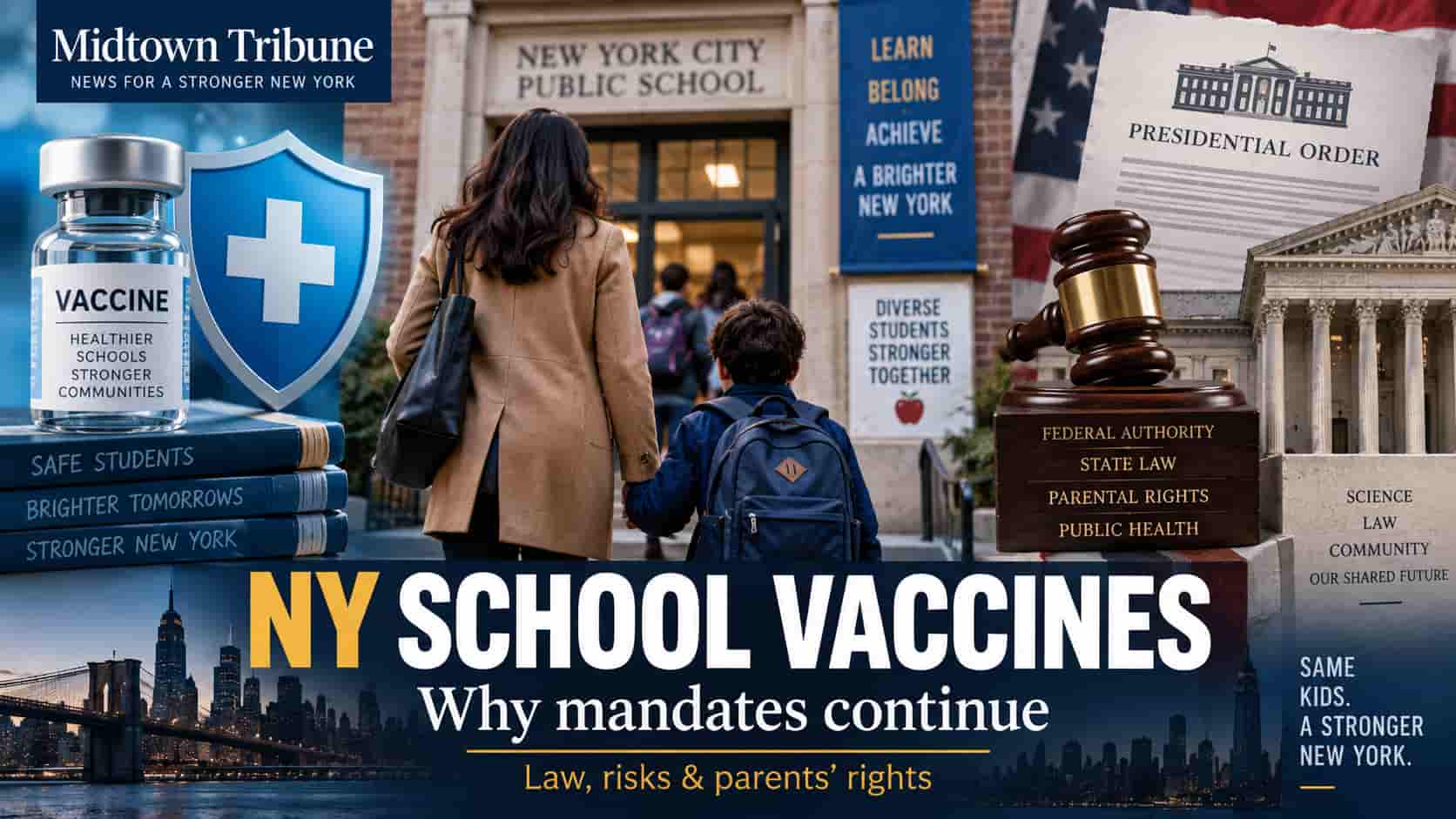
NEW YORK – September 18, 2026. New York parents may wonder why schools can still exclude children who do not meet state vaccination requirements after President Donald Trump issued an executive order opposing coercive COVID-19 vaccine mandates in education.
The short answer is that the federal order and New York law address different things.
Trump’s February 2025 executive order targets COVID-19 vaccination mandates. New York’s broader childhood school immunization requirements arise under New York Public Health Law Section 2164. The presidential order did not repeal that New York statute.
Key Facts
- Trump’s executive order specifically addresses COVID-19 vaccine mandates in schools.
- COVID-19 vaccination is not currently listed among routine vaccines required for K-12 attendance in New York City.
- New York requires vaccines including DTaP, polio, MMR, varicella and hepatitis B.
- Additional requirements apply by age and grade, including Tdap and meningococcal vaccination.
- New York eliminated its religious exemption from school vaccination requirements in 2019.
- A medical exemption remains available when a licensed physician documents an appropriate medical contraindication.
What Trump’s Executive Order Actually Says
President Trump signed the executive order “Keeping Education Accessible and Ending COVID-19 Vaccine Mandates in Schools” in February 2025.
The order addresses schools requiring COVID-19 vaccination for in-person education and directs federal agencies to address the use of federal funding in connection with such mandates. It does not repeal state statutes requiring other childhood vaccines.
The White House – Executive Order
Why New York Can Still Require Other Vaccines
New York’s school vaccination requirements come primarily from Public Health Law Section 2164 and related state regulations.
New York Public Health Law Section 2164
New York State Department of Health – Immunization Laws and Regulations
What Vaccines Does New York City Require?
NYC Public Schools lists routine requirements including DTaP, polio, MMR, varicella and hepatitis B. Additional requirements apply for some age groups and grades.
NYC Public Schools – Immunization Requirements
Are Vaccines Completely Risk-Free?
No medical intervention is completely risk-free. Official CDC vaccine-safety information recognizes common side effects and rare serious adverse events following some vaccines.
MMR and Febrile Seizures
CDC reports a small increased risk of febrile seizures after MMR vaccination in young children, estimated at approximately one febrile seizure for every 3,000 to 4,000 vaccinated children.
Severe Allergic Reactions
CDC states that anaphylaxis after vaccination is rare and occurs at roughly one case per million doses for many vaccines.
CDC – Preventing and Managing Adverse Reactions
What Does VAERS Show?
The federal Vaccine Adverse Event Reporting System, or VAERS, collects reports of medical events occurring after vaccination. A VAERS report does not by itself prove that a vaccine caused the reported event.
CDC explains that reports can include real adverse reactions, coincidental events, incomplete reports or events still requiring investigation.
CDC – VAERS Explanation and Limitations
What About Rising Childhood Conditions?
Parents sometimes point to rising rates of autism diagnoses, autoimmune conditions, allergies and other chronic childhood disorders and ask whether vaccination could be contributing.
A rise in diagnoses over time does not by itself establish causation. Establishing causation requires appropriately designed studies, comparison groups and additional evidence.
Vaccine-Preventable Disease Is Also a Risk
Public-health officials also point to outbreaks of vaccine-preventable diseases when defending school vaccination requirements.
CDC – Measles Cases and Outbreaks
Why New York Has No General Religious Exemption
New York repealed its religious exemption from school vaccination requirements in 2019. Parents generally cannot currently obtain an exemption based solely on religious or personal objection. The main statutory exception is medical.
How Does a Medical Exemption Work?
Public Health Law Section 2164 provides for a medical exemption when a New York-licensed physician certifies that a particular immunization may be detrimental to a child’s health.
A strong medical exemption request should generally identify the specific vaccine, the child’s relevant medical condition, why that vaccine may be harmful to that child, and how long the contraindication is expected to last.
What Can Parents Legally Do?
1. Obtain an Individual Medical Evaluation
If a child experienced a serious prior reaction or has a condition that may make a vaccine medically inappropriate, parents can seek an evaluation from a New York-licensed physician.
2. Apply for a Medical Exemption
Parents can submit the required medical documentation to the school.
3. Request the Denial in Writing
If the school denies an exemption, parents should retain the written decision, medical records and all related correspondence.
4. Appeal to the Commissioner of Education
New York provides an administrative appeal process for certain school vaccination disputes.
New York State Education Department – Commissioner’s Decisions
5. Consider an Article 78 Proceeding
After applicable administrative remedies are addressed, a parent may consult an attorney about an Article 78 proceeding in New York Supreme Court. Article 78 can be used to challenge certain agency decisions as arbitrary, capricious or contrary to law.
6. Consider Constitutional or Disability Claims
Depending on the facts, parents may consult counsel about due process, equal protection, disability law, parental-rights or religious-liberty claims. Existing New York precedent creates significant legal obstacles to broad challenges, so individual facts and medical documentation matter.
Can Parents Try to Change the Law?
Yes. Bills have been introduced in Albany that would change the current system.
S266 – Religious Exemption Proposal
Senate Bill S266 proposes restoring a religious exemption.
A2045 – Parental Choice Proposal
Assembly Bill A2045 proposes a broader parental opt-out framework.
Bottom Line
New York continues to enforce school vaccination requirements because Trump’s executive order addresses COVID-19 vaccine mandates, while New York’s requirements for other childhood vaccines arise independently under state law.
Parents currently do not have a general religious or personal-belief exemption. They may seek an individualized medical exemption, use administrative appeals, consult counsel about judicial review, or advocate for legislative changes.
Official safety data also require precision. Vaccines are not literally risk-free, but raw VAERS reports cannot be treated as confirmed vaccine injuries. At the same time, vaccine-preventable diseases themselves present measurable health risks.
Official Sources
The White House – Executive Order
New York Public Health Law Section 2164
New York State Department of Health
NYC Public Schools – Immunizations
NYSED – Commissioner’s Decisions
Ask Midtown Tribune about this story
Answers are grounded first in this article. Search all Midtown Tribune reporting from the main AI Search page.
AI-generated summary. Verify important details in the linked original articles.