
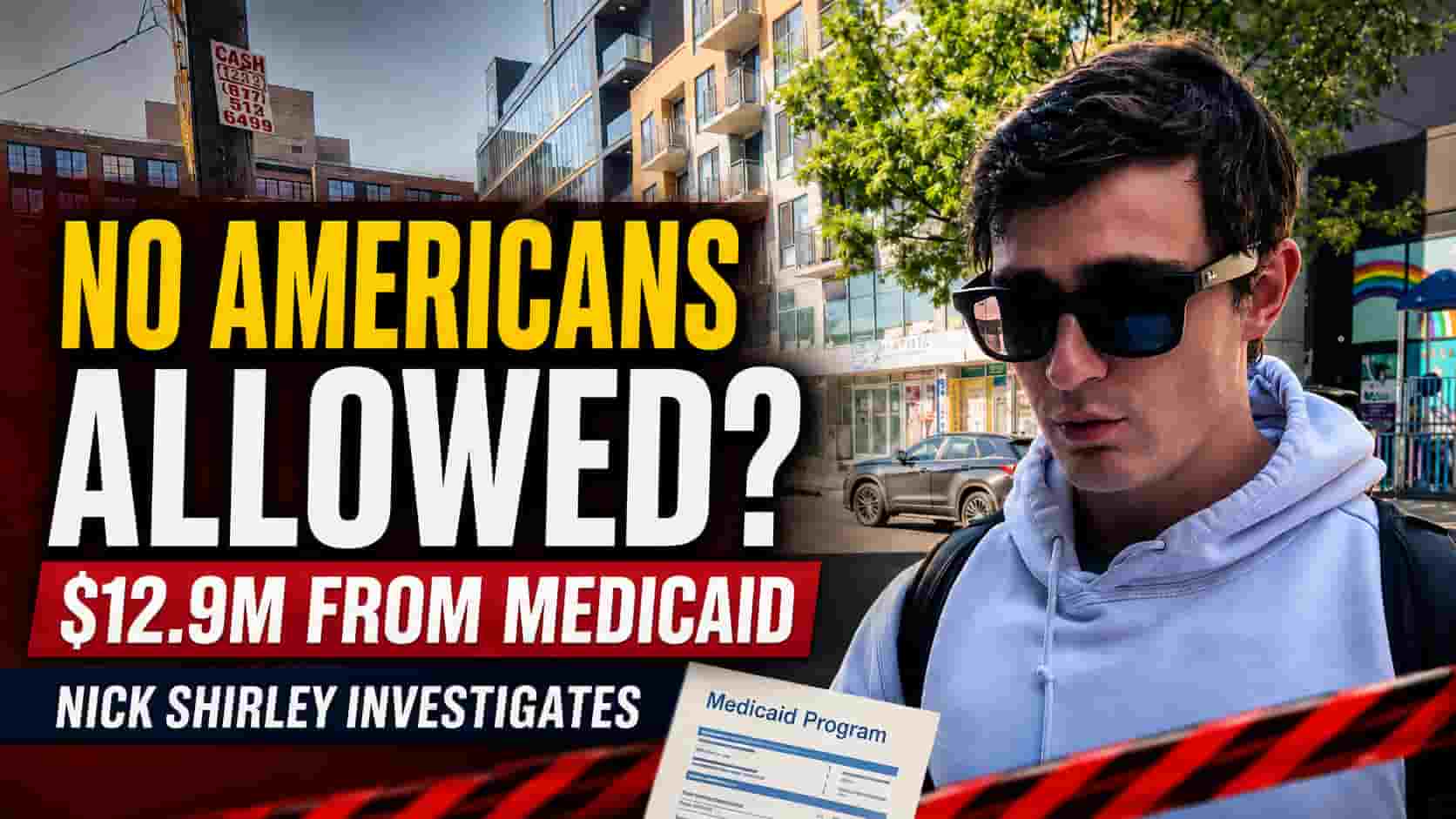
Did independent journalist Nick Shirley find a place in New York City where Americans are not welcome? That was the immediate impression created by the first answer he received inside Sunrise Senior Service in Flushing, Queens.
Shirley told an employee that he wanted to enroll his American grandmother, “Debbie,” in the adult day care program.
“She’s American, right?” the employee asked. Then came the sentence that changed the entire encounter:
“But no American here.”
“So you’re discriminating against Americans?” Shirley responded.
The employee denied discriminating. She explained that the center’s participants were Korean and generally did not speak English, so an English-speaking American might have difficulty communicating with them. When Shirley said his supposed grandmother spoke Korean, the employee replied that her enrollment would not be a problem.
The exchange does not prove that Sunrise has a formal rule excluding Americans. But it raises a legitimate civil-rights question: Can an organization receiving millions of Medicaid dollars effectively serve only one ethnic or language community, and what safeguards ensure equal access for other New Yorkers?
That question was only the beginning.
Shirley then displayed the numbers that brought him to the second-floor center: $12.9 million in reported Medicaid payments during 2024, 7,899 “patients,” 216,312 claim lines and fourfold growth. Of that total, the chart in the video attributed approximately $10.8 million to adult day services and $2.1 million to transportation.
How could a center operating on one floor generate those figures? Were elderly participants being offered cash to enroll? Were Medicaid claims tied to real attendance and transportation? And why did similar allegations against Sunrise appear in a federal lawsuit filed years before Shirley arrived with his camera?
A conversation about “Grandma Debbie” turns into a confrontation
After the initial discussion about language and enrollment, Shirley asked whether his grandmother could receive money for joining the program — a possible “kickback.”
A man who identified himself as the owner repeatedly denied it.
“We don’t offer kickbacks,” he said. He also denied committing fraud.
Shirley then asked about the payment data. The owner acknowledged that the displayed division between adult day care and transportation appeared accurate but declined to disclose the center’s number of members. When pressed about the figure of 7,899, he said Sunrise did not have 7,000 members and that he did not know how the public database calculated the number.
Shirley treated that response as evidence of overbilling. The owner asked the journalists to leave and later called the police.
Outside, Shirley asked an elderly woman whether the center paid her to attend. She answered “yeah.” But the clip does not establish whether she understood the compound question, whether she meant cash, transportation or another benefit, or whether she was describing anything illegal. No money, bank record, false invoice or identified whistleblower testimony was shown in that exchange.
The video therefore presents questions and potential leads, not a completed criminal case.
What do “7,899 patients” actually mean?
If 7,899 represented 7,899 different people, every one of them should have received at least one service attributed to the provider during the year. For an adult day program operating on one floor, that would be an extraordinary number requiring a clear public explanation.
But the underlying HHS Medicaid Provider Spending by HCPCS dataset does not provide a clean annual list of 7,899 unduplicated individuals.
The public data are aggregated by a combination of:
- billing provider;
- servicing provider;
- HCPCS service code; and
- month of service.
The “unique beneficiaries” field is unique within an individual provider-service-month combination. The same regular participant may appear again in another month, under another service code or in a different billing/servicing-provider combination. Because the public file does not reveal beneficiary identities, an outside analyst cannot reliably remove those repetitions when producing a yearly total.
Therefore, if the “7,899 patients” shown in the video were calculated by adding monthly cells, the number would not mean 7,899 separate members. It would be a sum that may count the same people repeatedly.
That distinction does not make the other figures unimportant. 216,312 claim lines equal an average of approximately 858 lines for each of roughly 252 business days. A single participant can generate more than one claim line on the same day — for example, one for attendance and another for transportation. But the volume still warrants comparison with attendance logs, authorized capacity, transportation manifests and individual Medicaid records.
The right question is not simply, “How could 7,899 people fit on one floor at the same time?” It is:
How many unduplicated people did Sunrise serve, how many attended each day, how many claim lines were generated per participant, and do those claims match actual attendance and transportation records?
Public Medicaid data can identify anomalies and providers deserving an audit. It cannot, by itself, prove that a particular claim was false.
A former Sunrise employee made similar allegations in federal court
The most important fact not discussed in Shirley’s video is that Sunrise had already faced similar allegations.
On January 27, 2022, former Sunrise social worker Dong In Kang filed a federal qui tam complaint in the Eastern District of New York: United States of America et al. v. Sunrise Senior Service LLC et al., No. 1:22-cv-00501.
The lawsuit alleged, among other things, that Sunrise participants received kickbacks, that Medicare and Medicaid were billed through arrangements involving allegedly false diagnoses and medically unnecessary services, and that Sunrise also billed for transportation. These were allegations made by a relator — not facts established by a judge or jury.
The case was terminated on May 20, 2026 through a voluntary stipulation of dismissal. The relator’s claims were dismissed with prejudice, meaning that he could not refile them. Potential claims belonging to the United States and New York State were dismissed without prejudice, preserving the governments’ ability to pursue their own claims later.
The dismissal did not produce a judicial finding that Sunrise committed fraud. It also did not produce a decision on the merits declaring the allegations false.
The overlap between the former employee’s complaint and the questions raised in Shirley’s new video — participant payments, medical necessity, daily billing and transportation — makes the matter more than a random sidewalk accusation. Oversight agencies should explain whether the allegations were investigated, what was found and whether the sharp payment growth reported for 2024 received additional scrutiny.
When does an incentive become an illegal kickback?
The federal Anti-Kickback Statute makes it a crime to knowingly and willfully offer, pay, solicit or receive remuneration to induce or reward referrals or business paid for by a federal health care program, including Medicaid.
Separate civil monetary penalty rules can apply when something of value is offered to a Medicare or Medicaid beneficiary in a way likely to influence that person’s choice of provider.
That means recurring cash payments or gift cards offered specifically to persuade Medicaid beneficiaries to enroll in a center or generate reimbursable visits may be illegal.
But not every benefit given to an elderly participant is automatically a kickback. Meals, transportation, social services and carefully limited incentives may be part of an authorized program or fall within a legal exception. The central questions are why the benefit was provided, what conditions were attached, who paid for it and whether it was intended to steer federally funded business.
Authorities have prosecuted real versions of this alleged scheme in New York. In February 2026, the Justice Department charged operators of two other Queens adult day care centers — Royal Adult Daycare and Happy Life — with paying illegal cash kickbacks and billing for services that allegedly were unnecessary, not provided or exceeded permitted capacity. In July 2026, the owner of an unrelated Brooklyn center, Prime Life Adult Day Care, began serving a 57-month sentence after a $3.2 million fraud and kickback case.
Those cases show that the alleged business model is real. They do not establish that Sunrise committed the same offenses.
Was the statement about Americans illegal discrimination?
The phrase “But no American here” is troubling, especially when spoken by an employee of an organization associated with publicly funded services.
The rest of the conversation, however, matters. The employee did not ultimately say that an American could never enroll. She explained that participants spoke Korean and agreed that a Korean-speaking American could attend.
Based on this short exchange, it is impossible to establish that Sunrise actually denied anyone service because of citizenship or national origin.
Language-specific and culturally focused programs are not automatically illegal. They may help older adults who would otherwise face isolation. But a provider that qualifies as a public accommodation cannot deny service because of a protected characteristic such as race or national origin. New York City’s Human Rights Law also provides broad protection involving immigration or citizenship status.
A proper civil-rights test would require a real applicant, actual eligibility, consistent treatment of applicants and documentation of the center’s enrollment policy — not only a hypothetical grandmother used during an undercover interview.
Was Nick Shirley legally allowed to record the encounter?
New York is generally a one-party-consent state for recording conversations. A person who participates in a conversation may ordinarily record it without obtaining the other participant’s permission. Shirley’s recording of a discussion in which he participated was therefore not automatically illegal eavesdropping.
That does not create a right to remain indefinitely on private property. Under New York Penal Law §140.05, a person commits trespass when knowingly entering or remaining unlawfully on premises. Once permission to remain is withdrawn, a journalist should leave. In the video, the owner told the group to leave, and Shirley said they would leave. The available footage does not provide enough information to conclude that he committed trespass.
The owner had the legal right to call the police and had no obligation to answer a journalist’s questions.
On the public sidewalk, recording and asking questions are generally lawful. Persistent following or conduct intended to alarm or seriously annoy someone could potentially raise harassment issues, depending on the facts. The video does not provide enough evidence to establish such an offense.
HIPAA also requires careful distinction. HIPAA primarily regulates covered health care entities and their business associates; it does not automatically make an independent journalist liable for recording every person near a health-related business. A covered provider generally cannot invite media into areas where protected health information is accessible without prior patient authorization. Here, the center did not invite the journalists and eventually directed them to leave.
Still, publishing recognizable images of vulnerable elderly people who may not have understood the encounter creates a serious privacy and journalistic-ethics issue. Responsible outlets should blur the faces of participants who did not clearly consent to publication.
Strong investigation, risky accusation
Shirley’s direct questioning uncovered matters worthy of official scrutiny. But the title of the video calls a man a “Korean Mafia Fraudster,” and the narration repeatedly describes him as a fraudster before presenting a government charge or adjudicated finding against Sunrise.
Ethnicity is not evidence of a billing scheme. Refusing an interview, calling the police, operating from a small location and receiving a large amount of Medicaid money do not constitute an admission of guilt.
Presenting an unproven accusation as an established fact can create defamation risk. The accurate editorial formulation is:
Nick Shirley raised allegations; Sunrise denied them; the public payment data require explanation; a former employee previously made similar claims in court; and no final judicial finding of fraud against Sunrise has been identified.
What should happen now?
There are several lawful and practical next steps:
- Sunrise should receive a written request for comment. It should be asked to confirm 2024 Medicaid payments, explain how beneficiary and claim-line totals were calculated, disclose average daily attendance and authorized capacity, describe its policy on cash and gift cards, identify its contracted managed long-term-care plans and state whether it has undergone audits.
- The video and supporting data can be submitted to the New York State Office of the Medicaid Inspector General. OMIG accepts online allegations and reports at 1-877-873-7283.
- A complaint can be filed with the New York Attorney General’s Medicaid Fraud Control Unit. The unit investigates improper or fraudulent Medicaid billing by providers.
- The information can be reported to HHS-OIG. The federal hotline accepts allegations involving fraud, waste and abuse in Medicare, Medicaid and other HHS programs at 1-800-HHS-TIPS.
- NYC Aging’s Social Adult Day Care Ombuds Office can review program-related complaints. New Yorkers can use the online form or call 311.
- Participants should review their own Medicaid payment histories. The strongest initial evidence would be a paid service recorded on a date when the beneficiary did not attend or receive transportation.
- Journalists can file FOIL requests. NYC Aging and the New York State Department of Health may possess registration, certification, inspection, complaint or enforcement records, although privacy law and active-investigation exemptions may restrict disclosure.
No one should offer or request a kickback as a “test,” impersonate a government inspector, obtain another person’s medical records through deception, enter restricted areas or remain after being directed to leave. Journalists can preserve evidence and ask precise questions. Investigators with legal authority must examine claims, attendance records, transportation manifests and bank transactions.
Conclusion: Calling the police did not answer the questions
Nick Shirley’s encounter revealed more than one provocative sentence about Americans. It connected a culturally specific adult day care center to $12.9 million in reported 2024 Medicaid payments, 216,312 claim lines, rapid growth and allegations resembling those made by a former employee in federal court four years earlier.
That combination provides a strong basis for a transparent, independent audit and a detailed public response from Sunrise.
The video alone does not prove that Sunrise paid kickbacks. Nor can the “7,899 patients” figure be called 7,899 different members unless the calculation method is disclosed. The responsible conclusion is narrower but still serious: repeated allegations and unusual public data require investigation, while no final judicial finding of fraud against Sunrise has been established.
Calling the police ended the uncomfortable interview. It did not explain who received the $12.9 million, what services generated 216,312 claim lines, whether those services matched real attendance or why the former employee’s allegations never received a public answer.
Those questions now belong before agencies that can examine the records.
Editor’s note: This article reviews public records and the contents of the video; it is not a legal opinion. Midtown Tribune will publish a substantive response from Sunrise Senior Service and update this report if official findings become available.
Official Sources, Court Documents and Reporting Links
-
HHS Open Data — Medicaid Provider Spending by HCPCS
Official provider-level Medicaid spending data aggregated by provider, HCPCS service code and month. View the HHS dataset -
CMS — NPI Registry
Official federal registry for verifying provider information, including NPI 1396223780. Search the CMS NPI Registry -
HHS-OIG — Federal Anti-Kickback Statute and fraud laws
Official explanation of federal fraud-and-abuse laws governing Medicare and Medicaid business. Read the HHS-OIG guidance -
HHS-OIG — Report Fraud, Waste and Abuse
Federal reporting portal for allegations involving Medicare, Medicaid and other HHS programs. Submit an HHS-OIG complaint -
New York State Office of the Medicaid Inspector General
Submit a Medicaid fraud allegation online or call 1-877-873-7283. File an allegation with OMIG -
New York Attorney General — Medicaid Provider Fraud
Complaint form for the Medicaid Fraud Control Unit, which investigates fraudulent provider billing. File a complaint with the New York Attorney General -
NYC Aging — Social Adult Day Care Complaint
Submit a complaint or inquiry concerning a New York City social adult day care program; residents may also call 311. Open the NYC Aging complaint form -
New York State Department of Health — Social Adult Day Care Compliance
Official certification and compliance information for SADC programs contracting with MLTC plans. View NYSDOH compliance information -
DOJ — Royal Adult Daycare and Happy Life Case
Official announcement of charges involving alleged kickbacks and false claims at separate Queens businesses not identified as Sunrise. Read the Justice Department announcement -
DOJ — Prime Life Adult Day Care Sentencing
Official announcement of a 57-month sentence in a separate Brooklyn Medicaid kickback and false-billing case. Read the Justice Department announcement -
Federal Complaint Concerning Sunrise — Case No. 1:22-cv-00501
Public copy of relator Dong In Kang’s complaint. The allegations in a complaint are not judicial findings of fact. Read the filed complaint -
Stipulation Dismissing the Sunrise Case
Public copy of the 2026 stipulation: the relator’s claims were dismissed with prejudice, while claims of the United States and New York were dismissed without prejudice. Read the stipulation of dismissal -
White House — Fraud Ledger
Official page noting federal charges against an owner of a Minnesota day care featured in one of Nick Shirley’s earlier investigations. View the White House Fraud Ledger -
New York Penal Law §140.05 — Trespass
Official text of New York’s basic trespass provision. Read the statute -
New York Penal Law §250.00 — Eavesdropping Definitions
Official statutory definitions relevant to recording and interception of conversations. Read the statute -
HHS — HIPAA and Media Filming
Official guidance on media access to areas where protected health information may be visible or audible. Read the HHS guidance -
Original Nick Shirley Video
The complete video reviewed in this article. Watch on YouTube
Ask Midtown Tribune about this story
Answers are grounded first in this article. Search all Midtown Tribune reporting from the main AI Search page.
AI-generated summary. Verify important details in the linked original articles.