
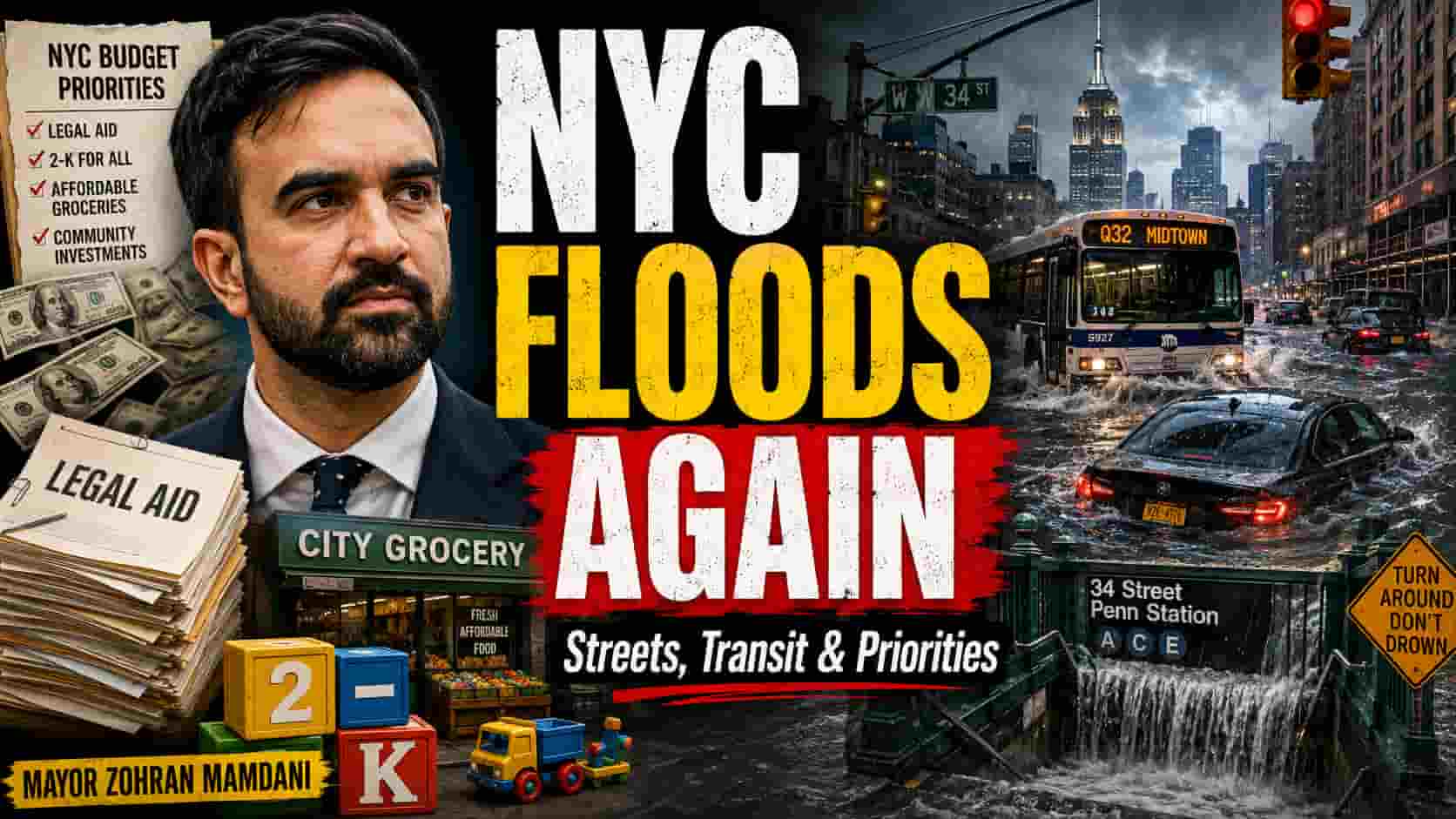
A powerful rainstorm once again turned New York City streets into rivers, stalled vehicles, disrupted transit, and flooded local businesses. YouTuber Cash Jordan used the scenes to raise a broader question about Mayor Zohran Mamdani’s priorities: if City Hall can find hundreds of millions of dollars for new social programs, why do basic municipal functions still fail so visibly?
This Is Really a Debate About Priorities
Cash Jordan’s video carries a deliberately provocative title:
“Mamdani BANS ALL Sewer Repairs… Then Floods WIPED OUT NYC.”
Brighton Beach News found no evidence that Mayor Zohran Mamdani literally issued an order banning all sewer repairs.
But that is not the strongest argument in Jordan’s video.
His broader point is about budget priorities.
As floodwaters cover streets and interfere with buses, cars and businesses, Jordan argues that New York continues to spend heavily on new political and social initiatives while residents still struggle with some of the most basic responsibilities of city government:
- functioning streets and roads;
- drainage and sewer capacity;
- reliable public transportation;
- sanitation and garbage collection;
- protection of homes and businesses from recurring flooding.
At one point Jordan summarizes his criticism bluntly: New York is “spending money on everything except the stuff the city needs to run.”
That is a much more important claim to examine.
More Than $150 Million for Immigration Legal Services
The Mamdani administration has substantially increased funding for immigration-related legal services.
In the FY2027 budget, New York City committed approximately $153 million to immigration legal services.
Mayor Mamdani has publicly emphasized that the city’s investment in this area now exceeds $150 million.
The administration describes the spending as necessary to protect immigrant New Yorkers and guarantee access to legal representation.
That may be a legitimate policy goal.
But taxpayers are also entitled to ask a different question:
Is this the right scale of spending when New York still struggles to keep streets passable and infrastructure functioning during heavy rain?
Mayor’s Office — Immigration Legal Services
$70 Million for Five City-Run Grocery Stores
Another major Mamdani initiative is the creation of five city-owned grocery stores, one in each borough.
The administration has allocated approximately $70 million in capital funding for the program.
The first stores are expected to open over the next several years.
Mamdani argues that municipal grocery stores can lower food costs and improve access in underserved neighborhoods.
But New York already has an enormous food-assistance network.
Current NYC information lists more than 550 food pantries and community kitchens, while other official city materials have described an emergency food network involving 800 or more providers and partner organizations.
So the policy question is not whether food insecurity exists.
It clearly does.
The question is whether New York needs to build a new government-operated grocery system — or whether some of that capital should instead be directed toward drainage, road maintenance, transit reliability, sanitation and other basic infrastructure.
Mayor’s Office — Municipal Grocery Stores
2-K: About 2,000 Seats for Roughly 100,000 Two-Year-Olds
Mamdani has also made universal childcare a centerpiece of his affordability agenda.
The first phase of the city’s 2-K program offers approximately 2,000 seats.
New York City has roughly 100,000 children in a single age cohort, meaning the initial 2-K rollout reaches only about 2% of two-year-olds — roughly one child out of every 50.
The first 2,000 seats are supported by approximately $73 million in funding, with spending expected to rise sharply as the program expands.
The administration says this is only the beginning and that the ultimate goal is universal access.
That distinction matters.
The program may eventually become much larger.
But today, its actual reach remains small compared with the size of the population and the political attention devoted to it.
Meanwhile, New Yorkers Are Still Wading Through Floodwater
On August 20, intense rainfall again caused serious localized flooding across New York City.
Cars were trapped or forced to stop.
Buses pushed through standing water.
Businesses reported water entering storefronts and basements.
In Cash Jordan’s video, local business owners describe neighborhoods where flooding occurs repeatedly whenever heavy rain hits.
For a small business, that is not merely an inconvenience.
Flooding can mean:
- destroyed inventory;
- damaged equipment;
- lost business hours;
- vehicle damage;
- inaccessible streets;
- delayed emergency response;
- dangerous conditions for basement apartments.
And when buses and emergency vehicles cannot move normally, the issue goes beyond economics.
It becomes a basic question of whether the city is functioning.
Yes, New York Is Still Spending on Sewer Infrastructure
Accuracy matters.
Mayor Mamdani has not stopped sewer investment.
His administration announced approximately $108 million to replace and improve more than 6,700 catch basins and purchase new cleaning equipment.
NYC Department of Environmental Protection also maintains a multibillion-dollar capital plan covering sewers, drainage, wastewater systems and stormwater infrastructure.
So it would be inaccurate to claim that New York is spending nothing on sewer repairs.
But that does not end the debate.
It changes the question.
The real question becomes:
Is New York investing enough in basic infrastructure relative to the enormous amount of money being committed to new social programs?
Mayor’s Office — $108 Million Sewer Performance Investment
Cash Jordan’s Stronger Argument
Cash Jordan’s sharpest criticism is not really about a literal ban on sewer repairs.
It is about the philosophy of city government.
On one side are expanding government programs:
municipal grocery stores, immigration legal services, childcare programs and other affordability initiatives.
On the other are the basic services residents depend on every day:
streets, roads, drainage, public transportation, sanitation and infrastructure.
That creates a straightforward question:
What should a mayor fund first?
A mayor can propose ambitious new programs.
But before expanding the role of city government into grocery retail, legal services or additional social programs, residents may reasonably expect City Hall to ensure that:
- streets remain usable;
- buses can move;
- subway systems operate reliably;
- garbage is collected;
- drainage works;
- businesses are not repeatedly flooded.
This Is Not an Argument Against Helping People
There is no need to create a false choice.
Childcare can be valuable.
Legal assistance can be valuable.
Food assistance can be valuable.
But every public budget involves tradeoffs.
A dollar committed to one program cannot simultaneously be spent somewhere else.
The proper question is therefore not simply:
“Is this program good?”
It is:
“Is this the highest-priority use of limited taxpayer money right now?”
That question becomes especially important when city agencies are simultaneously being asked to find savings.
Hundreds of Millions in New Priorities
Consider just several initiatives:
Immigration legal services: approximately $153 million.
Five municipal grocery stores: approximately $70 million in capital funding.
Initial 2-K rollout: approximately $73 million for roughly 2,000 seats.
Together, these represent hundreds of millions of dollars in public spending or committed public resources.
At the same time, New Yorkers continue to see flooded streets, damaged businesses, transit disruptions and recurring infrastructure failures.
That does not prove City Hall is ignoring infrastructure.
But it does raise a legitimate question about the order in which priorities are being funded.
The Question for Mayor Mamdani
The strongest criticism of Mamdani is not:
“He banned sewer repairs.”
Brighton Beach News found no evidence of such a literal ban.
The stronger and more defensible question is:
If New York City can find hundreds of millions of dollars for new political and social initiatives, why are the basic systems a mayor is expected to manage — streets, roads, drainage, transit and sanitation — still failing so visibly?
Affordability is not only about groceries, childcare or legal services.
For a working New Yorker, affordability also means being able to get to work.
It means a bus that can travel down the street.
It means a store that is not flooded several times a year.
It means garbage being collected.
It means infrastructure that works.
And when a major American city repeatedly fails those basic tests, taxpayers have every right to ask whether City Hall has its priorities in the right order.
Official Sources
NYC Immigration Legal Services:
Mayor’s Office
Municipal Grocery Stores — $70 Million:
Mayor’s Office
NYC Food Assistance Network:
NYC.gov
2-K Program:
Mayor’s Office
Sewer Performance Investment:
Mayor’s Office
Ask Midtown Tribune about this story
Answers are grounded first in this article. Search all Midtown Tribune reporting from the main AI Search page.
AI-generated summary. Verify important details in the linked original articles.