
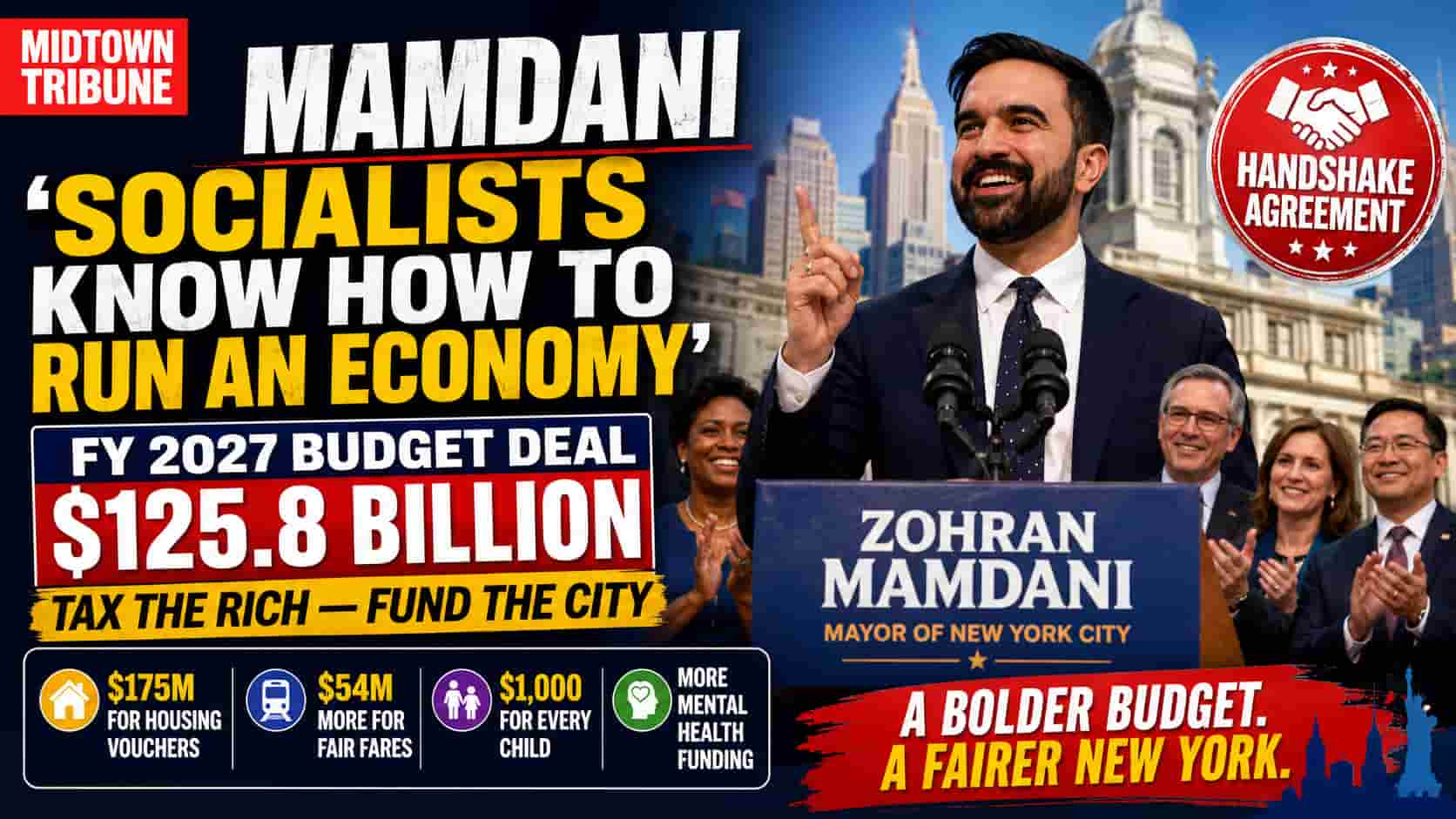
Mayor Mamdani Announces $125.8B NYC Budget Deal for Fiscal Year 2027
New York City Mayor Zohran Mamdani stood inside City Hall Rotunda on June 30, 2026, to announce what his administration framed as a major political and fiscal victory: a handshake agreement with the City Council on a $125.8 billion budget for Fiscal Year 2027.
Standing alongside City Council Speaker Julie Menon, Finance Chair Linda Lee, budget officials, and council members, Mamdani presented the agreement as proof that his administration can combine progressive policy, higher taxes on the wealthiest New Yorkers, and what he called fiscal responsibility.
The mayor said that when he took office, New York City was facing a $12 billion deficit — a fiscal crisis he described as larger than any since the Great Recession. He blamed the problem on years of budget gimmicks, hidden costs, ignored fiscal cliffs, and deferred decisions.
According to Mamdani, his administration closed that gap without forcing working New Yorkers to carry the burden and without slashing key public services, cultural institutions, or public transportation.
But the most politically memorable moment came when Mamdani invoked Austrian economist Friedrich Hayek, a famous critic of socialism.
“If socialists understood economics, they wouldn’t be socialists,” Mamdani said, quoting the familiar anti-socialist line. Then he turned it around.
The mayor argued that the past months proved the opposite: that socialists not only understand economics, but can fix years of what he described as mismanagement by previous administrations.
That line may become the headline of the budget fight.
For supporters, it was a declaration that progressive government can balance a budget while expanding social programs. For critics, it sounded like a bold attempt to rebrand higher spending and higher taxes as financial discipline.
What Is in the Budget?
The budget agreement includes several major policy areas.
The city will create a new $175 million housing voucher program for New Yorkers in need. The administration and City Council also announced a settlement path around the long-running CityFHEPS fight, with the council saying the new structure will expand housing help while containing costs.
The city will expand Fair Fares by increasing funding by $54 million and broadening eligibility to residents earning up to 200 percent of the federal poverty level. Speaker Menon called it the largest Fair Fares expansion in City Council history, potentially helping nearly 1.3 million working New Yorkers.
The budget also includes a major expansion of NYC Kids Rise. Under the plan described at City Hall, every public school kindergartener would receive a $1,000 college savings account that could be used for vocational school, community college, or a four-year college.
Mamdani also announced more than $34 million for a public portal releasing city documents related to post-9/11 air quality and health risks. He said New Yorkers affected by post-9/11 illness deserved transparency that should have been available long ago.
The budget adds funding for mental health services, mobile treatment teams, crisis respite centers, immigrant legal support, the New York City Commission on Human Rights, cultural organizations, parks, libraries, senior meals, deed theft prevention, and community programs.
The mayor also said the city is adding $350 million to the general reserve, presenting that as evidence of fiscal restraint.
Council’s Message: Affordability, Stability, Opportunity
Speaker Julie Menon described the budget as a victory for New Yorkers facing the cost-of-living crisis.
She emphasized three major investments: expanded housing vouchers, Fair Fares, and NYC Kids Rise. Her argument was that affordability is not one issue, but a chain of pressures: rent, transportation, education, food, legal services, and neighborhood quality of life.
Finance Chair Linda Lee highlighted funding for parks, libraries, mental health, older adults, home-delivered meals, and immigrant legal services. She said the budget shows that responsible stewardship and compassionate government do not have to be competing priorities.
The Council also celebrated additional funding for cultural institutions, seven-day library service, affordable housing connected to libraries, deed theft prevention, and nonprofit legal providers.
Questions From Reporters: NYPD, Cash Flow, CityFHEPS, Free Buses
Reporters quickly turned to the pressure points.
Asked why the budget did not appear to increase NYPD headcount, Mamdani said the city would keep the department at the previously authorized level of 35,000 officers. He said he and the police commissioner identified ways to meet public safety needs and implement new programs without increasing headcount.
On nonprofit cash-flow concerns, the administration said eligible nonprofits would receive 50 percent advance payments in compliance with the Council law. Budget officials said they reviewed tax revenues, grant flows, and city outflows with the comptroller’s office and Department of Finance.
On CityFHEPS, Mamdani and Menon said the city is moving toward resolving litigation inherited from the prior administration. Menon said the new bill would shift the program toward a structure administered by HPD and subject to appropriations, rather than an open-ended entitlement model.
Asked whether the Fair Fares expansion replaces Mamdani’s campaign promise of free buses, the mayor said no. He described free buses as part of his medium- and long-term vision, while Fair Fares expansion is an immediate affordability measure.
The Political Meaning
This was not only a budget announcement. It was a governing manifesto.
Mamdani is trying to define his administration around a claim that is both ideological and practical: that a socialist mayor can manage America’s largest city budget without austerity, without service cuts, and without abandoning progressive goals.
The budget’s supporters will point to housing assistance, transit affordability, college savings, mental health services, senior meals, legal aid, and reserves.
Its critics will likely focus on the scale of spending, the reliance on taxing the wealthy, the long-term cost of expanded voucher programs, and whether the city can sustain this model if revenues weaken.
But inside City Hall Rotunda, the message was clear: Mamdani wants Fiscal Year 2027 to be remembered as the year New York City tested a new formula — tax the rich, expand the safety net, build reserves, and call it fiscal responsibility.
For New York, the question is no longer only whether City Hall can spend more.
The question is whether this new administration can prove that its economic philosophy works after the applause ends.
Official Sources
-
NYC Mayor’s Office: Mayor Mamdani and Speaker Menin Reach Handshake Agreement on Balanced Fiscal Year 2027 Budget
Official June 30, 2026 City Hall release on the $125.8 billion FY2027 budget agreement. -
NYC Mayor’s Office Video: Mayor Mamdani Announces Handshake Agreement on Fiscal Year 2027 Budget
Official video of the City Hall Rotunda budget announcement. -
NYC Office of Management and Budget: Budget Publications
Official NYC OMB page for budget documents, financial plans, and adopted/executive budget materials. -
NYC Mayor’s Office: Mayor Mamdani Releases $124.7 Billion Executive Budget for Fiscal Year 2027
Official May 2026 executive budget release that preceded the final handshake agreement. -
New York City Council: Preliminary Budget Response for Fiscal Years 2026 and 2027
Official City Council budget response outlining its fiscal priorities and alternative path to closing the shortfall. -
New York City Council: Mayor Mamdani and Speaker Menin Urge Albany to Help Close City Budget Gap
Official Council release on city-state revenue negotiations connected to the FY2027 budget process. -
NYC Comptroller: Comments on New York City’s Executive Budget for Fiscal Year 2027
Official fiscal analysis from the Office of the New York City Comptroller. -
NYC Independent Budget Office
Nonpartisan official city budget research and analysis from New York City’s Independent Budget Office.
Midtown Tribune Independent USA news from New York
Ask Midtown Tribune about this story
Answers are grounded first in this article. Search all Midtown Tribune reporting from the main AI Search page.
AI-generated summary. Verify important details in the linked original articles.