
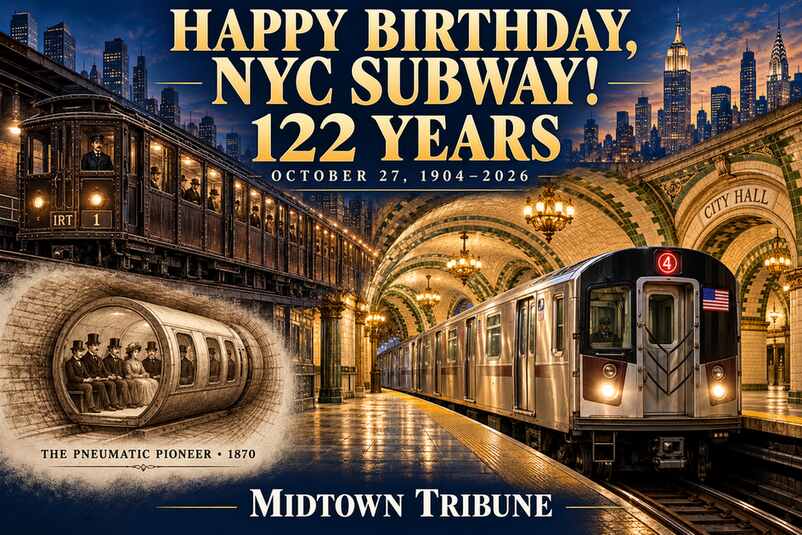
October 27, 2026 | Midtown Tribune
New York City’s subway turns 122 today. On October 27, 1904, the Interborough Rapid Transit Company opened the underground line that became the foundation of today’s subway system: 28 stations along a 9.1-mile route through Manhattan. www.nytransitmuseum.org
The anniversary celebrates a turning point in the city’s history. Yet New Yorkers had already experienced an underground passenger railway decades earlier — aboard an experimental carriage powered by air.
Before the Subway: An Air-Powered Train Beneath Broadway
On February 26, 1870, inventor Alfred Ely Beach unveiled Beach Pneumatic Transit, a demonstration railway beneath Broadway in Lower Manhattan.
Its single passenger car traveled through a tunnel approximately 312 feet long, propelled by air from a powerful blower. The station offered an unexpectedly elegant welcome, complete with chandeliers, a grand piano and a fountain stocked with goldfish. www.aps.org
Beach’s experiment never developed into a citywide transportation network. Nevertheless, it established an important place in New York history: passengers were traveling beneath Broadway 34 years before the IRT opened.
That distinction explains today’s anniversary. The modern subway system dates to 1904; New York’s pioneering pneumatic underground railway dates to 1870. www.mcny.org
Opening Day: The Mayor at the Controls
On the afternoon of October 27, 1904, Mayor George B. McClellan Jr. took the controls of the inaugural subway train departing from City Hall.
According to the Library of Congress, the train left shortly after 2:30 p.m. and reached 145th Street 26 minutes later. The system opened to the general public at 7 p.m. www.loc.gov
For those first passengers, traveling underground aboard an electric train was an event worth lining up for. The fare was five cents, and the Museum of the City of New York cites an estimated 150,000 passengers on opening day. www.mcny.org
One Route Connected What Are Now Separate Lines
The original subway followed a route that would look unusual on today’s map.
From City Hall, it traveled north to Grand Central, crossed west beneath 42nd Street to Times Square, then continued north along Broadway to 145th Street. Sections now associated with separate services originally formed one continuous route.
The first line also incorporated express and local tracks — a design that helped establish the operating pattern familiar to generations of New Yorkers. www.nytransitmuseum.org
City Hall: A Grand Entrance to the Underground Age
The original City Hall station was designed as the subway’s architectural showpiece. Its curved platform, tiled vaulted ceilings, skylights and brass chandeliers gave the new transportation system a ceremonial entrance.
But its beauty could not resolve its practical limitations. Nearby Brooklyn Bridge station attracted more passengers, while City Hall’s tight curve made platform expansion difficult as the system needed to accommodate longer trains.
Passenger service ended on December 31, 1945. www.mcny.org
The station survives, and its tracks remain in use as a turnaround for the 6 train. The New York Transit Museum offers guided visits to museum members through separately reserved tours, preserving access to one of the subway’s most distinctive historic spaces. www.nytransitmuseum.org
How Three Systems Became One
The subway did not begin as the unified network riders know today.
The privately operated IRT was eventually joined by the Brooklyn-Manhattan Transit system, or BMT, and the city-owned Independent Subway System, or IND. In 1940, the three systems were brought together under city ownership.
The New York Transit Museum describes the resulting network as the world’s largest subway operating around the clock, with 472 stations and more than 800 miles of track. Track mileage counts individual tracks, including those running alongside one another; it is different from route mileage. www.nytransitmuseum.org
Watch the Day It Opened
The opening of the subway survives on film. The Library of Congress preserves footage of the October 27, 1904, opening ceremonies, offering a moving glimpse of the city at the beginning of its subway era. www.loc.gov
Today’s anniversary connects that moment with the everyday journeys of New Yorkers more than a century later. What began as a nine-mile Manhattan line became an essential part of how the city works — carrying people to jobs, schools, appointments and home.
Happy 122nd birthday to the New York City Subway.
Sources and historical materials
- New York Transit Museum: Subway Day and the original IRT route
- Library of Congress: October 27 — New York City Subway Opens
- Library of Congress: Film of the 1904 opening ceremonies
- Museum of the City of New York: Beach Pneumatic Transit
- The Henry Ford: Beach’s pneumatic transit tunnel
- New York Transit Museum: Old City Hall Station
Midtown Tribune Independent USA news from New York
Ask Midtown Tribune about this story
Answers are grounded first in this article. Search all Midtown Tribune reporting from the main AI Search page.
AI-generated summary. Verify important details in the linked original articles.