
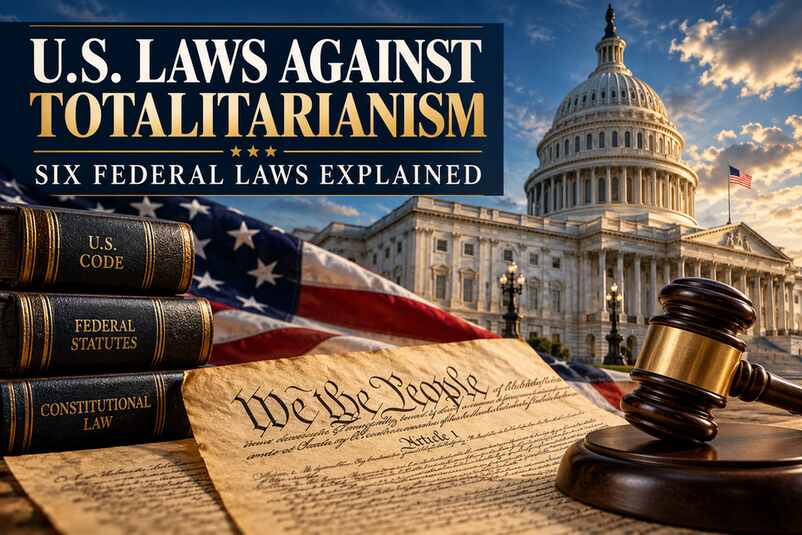
Several American laws dating to the Cold War remain on the books, including provisions restricting immigration, naturalization, federal employment, and activities aimed at the violent overthrow of the constitutional government.
By Midtown Tribune | October 27, 2026
WASHINGTON, D.C. — The United States has long maintained federal laws addressing communist and totalitarian organizations, threats to constitutional government, and efforts to overthrow American institutions through force or violence.
Some of these laws originated during the Cold War. Others are rooted in the Constitution itself.
Several provisions remain part of federal law today, including restrictions on immigration and naturalization for members of communist and other totalitarian parties, prohibitions on federal employment for individuals advocating the overthrow of the constitutional form of government, and criminal penalties for certain activities involving violent revolutionary movements.
One of the most significant pieces of legislation in this history is the McCarran–Walter Act of 1952, formally known as the Immigration and Nationality Act.
Although the law has been substantially amended over the decades, several provisions concerning totalitarian organizations remain relevant to American immigration and citizenship law.
However, federal restrictions on immigration, federal employment, and eligibility for elected office operate under different legal standards. Membership in an organization does not automatically disqualify an American citizen from holding public office.
Six Important Federal Laws
| Federal Law | Principal Provision |
|---|---|
| 8 U.S.C. § 1182(a)(3)(D) | Restricts immigration by people who are or have been members of communist or other totalitarian parties, subject to statutory exceptions. |
| 8 U.S.C. § 1424 | Restricts naturalization for certain individuals affiliated with totalitarian organizations or opposed to established government and law. |
| 5 U.S.C. § 7311 | Prohibits federal government employment for individuals advocating the overthrow of the constitutional form of government. |
| 18 U.S.C. § 2385 — Smith Act | Establishes criminal penalties for certain activities involving the advocacy or organization of the violent overthrow of government, subject to constitutional protections. |
| 18 U.S.C. § 1918 | Establishes criminal penalties for violations of specified federal employment restrictions under § 7311. |
| 14th Amendment, Section 3 | Disqualifies certain previously sworn public officials who engage in insurrection or rebellion against the Constitution or give aid or comfort to its enemies. |
These provisions address different legal circumstances and cannot be applied interchangeably.
1. Federal Immigration Restrictions on Members of Totalitarian Parties
8 U.S.C. § 1182(a)(3)(D)
One of the clearest surviving statutory restrictions appears in the Immigration and Nationality Act.
Under 8 U.S.C. § 1182(a)(3)(D), immigrants who are or have been affiliated with communist or other totalitarian parties may be found inadmissible to the United States.
The provision expressly addresses political party affiliation rather than membership in a particular religion.
Congress also established exceptions.
For example, the law recognizes circumstances in which an individual’s party membership was involuntary, occurred during childhood, resulted from legal requirements, or was necessary to obtain employment, food, or other essential necessities.
Additional statutory exceptions and waivers may apply.
The restriction therefore does not mean that every person who once belonged to a communist organization is automatically prohibited from immigrating.
Nevertheless, the provision demonstrates that Congress has explicitly recognized totalitarian political affiliations as a legitimate subject of immigration screening.
The U.S. Citizenship and Immigration Services maintains official guidance addressing these provisions.
See: USCIS Policy Manual — Immigrant Membership in a Totalitarian Party.
2. Restrictions on U.S. Citizenship for Supporters of Totalitarian Organizations
8 U.S.C. § 1424
Federal law also contains specific restrictions on obtaining American citizenship through naturalization.
The official title of 8 U.S.C. § 1424 is:
Prohibition upon the naturalization of persons opposed to government or law, or who favor totalitarian forms of government.
The statute identifies several categories of organizations, including:
- The Communist Party of the United States.
- Other totalitarian parties within the United States.
- Communist and other totalitarian parties of foreign countries.
- Certain subsidiaries, affiliates, and successor organizations.
The law also addresses other forms of opposition to organized government and constitutional institutions.
However, the statute includes exceptions for qualifying circumstances involving past membership, involuntary affiliation, and other situations specifically recognized by Congress.
This distinction matters.
A person who was required to join a ruling political party in a dictatorship to obtain employment or basic necessities may be treated differently from someone who voluntarily and actively supports a totalitarian political movement.
USCIS examines the applicable legal requirements and the circumstances of individual applicants.
3. Federal Government Employment and Advocacy of Overthrowing the Constitution
5 U.S.C. § 7311
Another important federal statute directly addresses eligibility for certain government positions.
5 U.S.C. § 7311 provides that individuals who advocate overthrowing the constitutional form of government may not accept or hold positions in the federal government or the government of the District of Columbia.
This provision is particularly relevant to questions about loyalty to the Constitution among federal employees.
It reflects the principle that individuals entrusted with exercising government authority have obligations to the constitutional system under which they serve.
But the statute does not create an automatic nationwide prohibition on running for elected office based solely on political ideology or organizational membership.
Moreover, enforcement must comply with the First Amendment and constitutional standards developed by the Supreme Court.
4. The Smith Act: Criminal Penalties for Violent Revolutionary Activity
18 U.S.C. § 2385
The Smith Act, codified at 18 U.S.C. § 2385, addresses specified activities involving the overthrow or destruction of government by force or violence.
Its statutory language covers certain forms of organizing, advocating, teaching, and knowingly participating in groups pursuing violent overthrow.
The law provides for penalties of up to 20 years in prison and a five-year prohibition on federal employment following conviction.
However, its application is substantially limited by Supreme Court decisions protecting political expression and freedom of association.
In Brandenburg v. Ohio (1969), the Supreme Court established that advocacy of unlawful conduct is generally protected unless it is directed toward producing imminent lawless action and is likely to produce such action.
This constitutional protection is critical.
An American may criticize the Constitution, advocate sweeping political changes, or express unpopular ideological views without automatically committing a federal crime.
The legal distinction concerns protected political expression versus conduct or advocacy meeting the constitutional requirements for criminal punishment.
See: Library of Congress — Incitement and Current First Amendment Doctrine.
5. Criminal Penalties for Violating Federal Employment Restrictions
18 U.S.C. § 1918
18 U.S.C. § 1918 establishes criminal penalties for violating specified prohibitions under 5 U.S.C. § 7311.
These include restrictions involving advocacy of overthrowing the constitutional form of government.
The provision reinforces Congress’s authority to establish lawful standards for certain federal government positions.
However, criminal liability requires the relevant statutory elements to be established, and the law remains subject to constitutional limitations.
A political disagreement with the government or criticism of elected officials is not itself proof of a violation.
6. The Constitution’s Insurrection Disqualification Clause
Fourteenth Amendment, Section 3
Unlike the immigration and federal employment statutes, Section 3 of the Fourteenth Amendment directly concerns eligibility for certain public offices.
Ratified after the Civil War, it restricts officeholding by certain individuals who previously swore to support the Constitution and subsequently engaged in insurrection or rebellion against it, or gave aid or comfort to its enemies.
The provision was adopted to address the participation of former Confederate officials in government after the Civil War.
It remains part of the Constitution.
Its application depends on specific constitutional requirements, including the prior oath, the conduct involved, the office at issue, and applicable enforcement procedures.
It is not a general prohibition on membership in unpopular political organizations.
See: Congress — Constitution Annotated.
Why Supreme Court Decisions Matter
The existence of a federal statute does not necessarily mean that every possible application of its original language is constitutionally permissible.
During the twentieth century, the Supreme Court reviewed numerous government restrictions involving communist affiliations, loyalty oaths, and political associations.
In Keyishian v. Board of Regents (1967), the Court invalidated New York provisions treating Communist Party membership as evidence of disqualification from public employment.
The decision reinforced constitutional protections for political beliefs and associations.
The Court’s broader First Amendment jurisprudence has also distinguished knowingly participating in unlawful activities from simply sharing beliefs with members of an organization.
As a result, statutes written during the Cold War must be interpreted in light of subsequent constitutional rulings.
See: Library of Congress — Loyalty Oaths and Supreme Court Decisions.
Can Members of Totalitarian Organizations Hold Public Office in America?
This question requires distinguishing between three categories.
First: Immigration and naturalization.
Congress has broad, though not unlimited, authority to establish legal requirements for admission to the United States and acquisition of citizenship.
Federal law expressly addresses membership in communist and other totalitarian parties in these contexts.
Second: Federal government employment.
Congress may establish constitutional standards for certain government positions, including requirements connected to loyalty and national security.
Such restrictions remain subject to First Amendment protections and other constitutional limitations.
Third: Elected public office.
Eligibility for elected positions is governed by the Constitution, applicable federal and state laws, and judicial decisions.
The rules for serving as a federal employee do not automatically establish eligibility requirements for Congress, the presidency, governorships, or municipal offices.
A blanket disqualification based solely on a person’s ideological affiliation would raise serious constitutional questions.
Can a Religious or Political Movement Be Classified as Totalitarian?
American law distinguishes religious identity from unlawful political conduct.
Article VI of the Constitution expressly prohibits religious tests for federal public office.
The First Amendment also protects religious liberty, political expression, and freedom of association.
Therefore, membership in Islam, Christianity, Judaism, or another religion is not by itself a lawful basis for disqualification from federal office.
However, individuals and organizations are not exempt from generally applicable criminal laws merely because they claim a religious or political motivation.
An organization involved in terrorism, violent conspiracy, criminal intimidation, or attempts to overthrow the government through unlawful force may be subject to relevant federal laws.
The legal determination must rest on evidence and applicable statutory requirements, not religious identity alone.
See: U.S. Constitution — Article VI, Clause 3.
The McCarran–Walter Act’s Continuing Significance
The Immigration and Nationality Act of 1952 remains an important foundation of American immigration law.
It emerged during an era when Congress was particularly concerned about communist influence, foreign political movements, espionage, and threats to national security.
Although Congress subsequently amended many provisions, the statutory framework continues to contain restrictions involving membership in communist and other totalitarian parties.
Claims that the McCarran–Walter Act once prohibited all Muslims from serving in government are incorrect.
The legislation did not establish such a prohibition.
Its relevant restrictions concerned specified political affiliations, immigration, and citizenship—not a general religious test for public office.
Conclusion: Defending the Constitution Within Constitutional Limits
The United States already possesses a legal framework for responding to certain threats from totalitarian movements and organizations seeking to overthrow constitutional government through force.
That framework includes immigration restrictions, naturalization requirements, federal employment rules, criminal statutes, and constitutional disqualification provisions.
However, these laws do not create a universal ban on political or religious groups that disagree with American institutions.
The distinction between lawful dissent and unlawful conduct is fundamental to the American constitutional system.
The central principle is that defending the Constitution requires both enforcing laws against genuine threats to constitutional government and preserving the constitutional freedoms those laws are intended to protect.
U.S. Laws Against Totalitarian Organizations — Regardless of Religious Affiliation
Federal laws in the United States provide legal measures against certain totalitarian organizations and activities aimed at violently overthrowing the constitutional government. These laws may apply regardless of religious affiliation, whether an organization identifies as Islamic, Christian, Jewish, Hindu, Buddhist, or nonreligious.
The determining legal factor is not religious identity but unlawful conduct. Such conduct may include terrorism, criminal conspiracies, threats of violence, and activities intended to overthrow the constitutional government of the United States by force.
The U.S. Constitution protects freedom of religion, political expression, and association. However, religious beliefs or ideological motivations do not provide immunity from generally applicable criminal laws.
At the same time, expressing political or religious views that conflict with American constitutional principles is not, by itself, necessarily a criminal offense.
The First Amendment protects peaceful advocacy, including unpopular or controversial ideas.
The fundamental distinction is between constitutionally protected beliefs and unlawful actions that threaten constitutional government, public safety, and the rights of American citizens.
These principles apply equally to religious and secular organizations. No religion is automatically classified as totalitarian under U.S. federal law.
Official Sources
- U.S. Code — 8 U.S.C. § 1182: Inadmissible Aliens
- U.S. Code — 8 U.S.C. § 1424: Naturalization and Totalitarian Organizations
- U.S. Code — 5 U.S.C. § 7311: Loyalty and Government Employment
- U.S. Code — 18 U.S.C. § 2385: Advocating Overthrow of Government
- U.S. Code — 18 U.S.C. § 1918: Disloyalty and Federal Employment
- U.S. Constitution — Fourteenth Amendment
- USCIS — Immigrant Membership in a Totalitarian Party
- Library of Congress — Loyalty Oaths and Supreme Court Decisions
- Library of Congress — First Amendment and Incitement
- U.S. Constitution — Religious Test Clause
Midtown Tribune Independent USA news from New York
Ask Midtown Tribune about this story
Answers are grounded first in this article. Search all Midtown Tribune reporting from the main AI Search page.
AI-generated summary. Verify important details in the linked original articles.