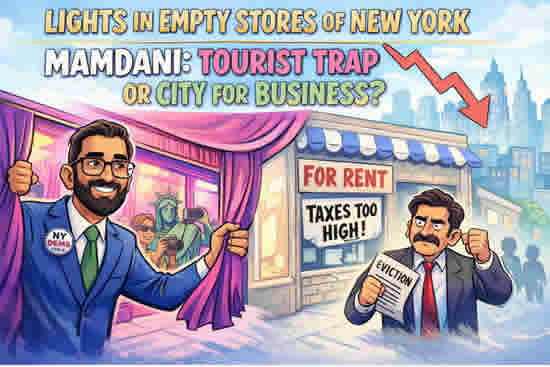
News 12 Brooklyn’s Post: The former Macy’s building in Downtown Brooklyn is lit up again, now glowing with vibrant fuchsia and purple lights as part of an installation called “In Every Transition, A Pattern” by Masary Studios.
Funded through a city program that awarded 13 public realm grants totaling just over $1 million, the project aims to reactivate commercial corridors and is a welcome change for some residents.
City and business leaders say the display is meant not only to beautify the vacant storefront, but also to boost foot traffic and support local businesses along Fulton Street.
Opinion: Maybe instead of handing out millions in taxpayer money to “friendly” nonprofits to create the illusion of a comeback, the city should cut—or even suspend—property taxes for both residents and businesses (yes, like “horrible Trump” has suggested) and make rent in that building affordable for real stores. What we’re getting now isn’t revitalization—it’s glowing, empty windows: retail ghosts.
At this point, it feels less like rebuilding and more like turning New York into a Potemkin showcase—lights on in vacant buildings to convince “tourists from the West” that progressive socialism is thriving.
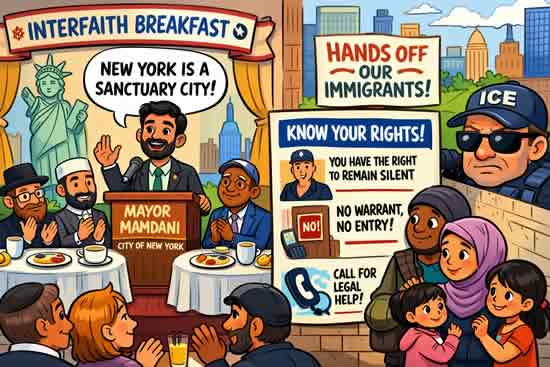
– Today ( February 6, 2026), at the first annual Interfaith Breakfast (The NYC mayor’s interfaith breakfast was established as an annual tradition by Mike Bloomberg in 2002, ) of his administration, Mayor Zohran Mamdani announced sweeping new actions to uphold New York City’s sanctuary city laws and protect immigrant New Yorkers. The breakfast brought together nearly 400 faith and community leaders from across the five boroughs.
During the event, Mayor Mamdani signed a comprehensive executive order to reaffirm the city’s commitment to being a sanctuary for all New Yorkers. The order protects the privacy and data of immigrants and all residents; bolsters restrictions on federal immigration enforcement on city property; initiates an audit to make sure city agencies are complying with sanctuary laws; and establishes a committee to coordinate crisis response across city government in the event of escalating federal immigration actions or other major events.
Mayor Mamdani also launched a citywide “Know Your Rights” push, distributing nearly 32,000 flyers and booklets in 10 languages for faith leaders to share with their congregations. The materials provide clear, accessible information about New Yorkers’ rights during interactions with federal immigration authorities, including the right to remain silent, the right to speak to an attorney, and the right to a translator.
“Across this country, day after day, we bear witness to cruelty that staggers the conscience. Masked agents, paid by our own tax dollars, violate the Constitution and visit terror upon our neighbors,” said Mayor Mamdani. “That is why this morning, I am signing an executive order that will strengthen our city’s protection of our fellow New Yorkers from abusive immigration enforcement. This order is a sweeping reaffirmation of our commitment to our immigrant neighbors. We have also prepared 30,000 guides to New Yorkers’ rights in ten languages spoken by some of the most heavily targeted populations in our city, teaching our neighbors what to do if ICE comes for them. These guides are here today, ready for you to take. If you run out, we will print more. I urge you to share these with your congregants — even those who are citizens, even those whom you think ICE may not target. These materials apply to us all: those who have been here for five generations, those who arrived last year. They apply to us all because the obligation is upon us all. To love thy neighbor, to look out for the stranger.”
Executive Order 13
Executive Order 13 takes critical steps to keep not only immigrant New Yorkers but all New Yorkers safe from aggressive, unlawful, and xenophobic federal actions as well as deepen trust between New Yorkers and their city government.
Executive Order 13 reaffirms that information collected by city agencies for city purposes must remain protected and cannot be shared with federal immigration authorities, except as required by law. Under the order, each agency has 14 days to appoint a privacy officer, conduct training, and certify compliance with sanctuary protections limiting information sharing.
Executive Order 13 also makes clear that city property — including parking garages, parking lots, schools, shelters, hospitals, and other public spaces — is for city purposes only. Federal authorities may not enter city property without a judicial warrant. The order also directs core agencies to develop and distribute training for city employees on how to interact with federal immigration authorities.
Moreover, Executive Order 13 requires agencies — including the NYPD, New York City Department of Correction (DOC), New York City Department of Probation (DOP), Administration for Children’s Services (ACS), and Department of Social Services (DSS) — to conduct comprehensive audits of all internal policies governing interactions with federal immigration authorities, update protocols and guidance as needed, and provide public transparency into any new policies that are created as a result.
Finally, Executive Order 13 establishes an Interagency Response Committee to coordinate crisis policy across city agencies and ensure a whole-of-government response.
“Know Your Rights” Push
As part of the new “Know Your Rights” push, the city is distributing nearly 32,000 flyers and booklets to faith institutions across New York City. The materials are available in English, Spanish, Mandarin, French, Bangla, Russian, Arabic, Kreyole, Urdu, and Yiddish – languages spoken by those most targeted by federal immigration crackdowns.
The materials outline key rights and options during encounters with Immigration and Customs Enforcement (ICE), including the right to remain silent, the right to ask for a judicial warrant, the right to speak with an attorney and the right to request an interpreter. They also explain New York City’s sanctuary laws and provide information about the Mayor’s Office of Immigrant Affairs (MOIA) Legal Support Hotline.
The hotline — available Monday and Wednesday from 9:00 AM to 8:00 PM; Tuesday, Thursday, and Friday from 9:00 AM to 6:00 PM; and on the last Saturday of each month from 9:00 AM to 5:00 PM — offers free information and referrals to immigration legal assistance at 1-800-354-0365. During his remarks, Mayor Mamdani called on faith leaders to help ensure this information reaches every corner of the city by distributing the flyers to their congregations.
Below are Mayor Mamdani’s remarks as prepared for delivery:
Good morning. What a privilege it is to be here with you all. I join everyone present in sending our best wishes to Rabbi Schneier, and our hopes for a quick recovery.
And I know that many of us are shocked by the news that we’ve just heard from Pakistan, where dozens of people were killed in a horrific attack on a Shia Mosque. Innaa lillaahi wa innaa ilaihi raajioon.
I look around this room, and I see the faces of friends I have marched with through searing heat and bracing cold. People I have mourned alongside, celebrated alongside, organized alongside. And I see so many others I have only just met, but whom I am eager to work alongside to improve New York.
And I see those whom the people of this city turn to for guidance and grace. This city may have only one Mayor, but it has countless leaders. When our neighbors seek to make sense of a world where sense is not there to be found, they often turn first not to those they elected, but to you.
Thank you for welcoming me today — and for all that you do, in ways seen and unseen, for those you serve.
I was raised in New York City as a Muslim kid with a Hindu mother. I celebrated Eid al-Fitr and Eid al-Adha with my family, lit diyas in Riverside Park for Diwali, and like any New Yorker, encountered faiths different from my own. I still remember coming home from a friend’s Bar Mitzvah one night and demanding an explanation from my father. “Baba,” I asked, “Why don’t Muslim kids have Bar Mitzvahs too?”
And over the past fifteen months, as I ran to become Mayor of our incredible city, that encounter only deepened as I came face-to-face with the living tapestry of faith that is New York.
Faith, we’re told, is the belief in things unseen. And while it certainly took faith to imagine a thing truly unseen—a path to victory—it was nothing compared to the faith I saw New Yorkers summon just to make it through the day. Faith that the bus would arrive. Faith that somehow, some way, the rent would get paid. Faith that a leader would place the concerns of the many before the interests of the few.
I saw that faith everywhere. On subways and street corners, at forums and front doors. And increasingly, as the winter snow melted into the renewal of spring and then the heat of summer, I found it where many New Yorkers return, week after week, in search of meaning.
You welcomed a stranger into your sanctuaries. And whether we were together at Shul, at church services on Saturday or Sunday morning, at a Gurdwara or a mosque or a mandir or a temple, New Yorkers told me of the worries they hold close, the dreams they refuse to let go.
What a gift they gave me. Not just understanding New York better — but understanding how close we truly are.
Because for all our different faiths, we share a common belief: that our city can be restored, and it must. That the wealthiest city in the wealthiest country in the history of the world has enough for everyone to live a life of dignity. That we need not worship the same God to share the same values, or to fight for the same future.
If anything unifies every religion across our city, it is an understanding of faith not solely as a tool for reflection, but as a call to action.
Standing before you today, I think of Deuteronomy 10:17-18, which describes the lord as one who: “shows no partiality and accepts no bribes. He defends the cause of the orphan and the widow, and loves the stranger residing among you, giving them food and clothing.”
Over the past fifteen months, New Yorkers of all faiths built a movement inspired by that cause of the orphan, the widow, and the stranger.
Seniors spent hours making phone calls to strangers because they believed every kid deserves child care. If that is not defending the cause of the orphan, what is?
Neighbors climbed six-floor walkups to knock doors because they believed a single mother in a rent-stabilized apartment should be able to sleep easily on the last night of the month, knowing that her rent would not climb the next day. If that is not defending the cause of the widow, what is?
And today, my friends, I want to reflect on the third charge: loving the stranger.
Across this country, day after day, we bear witness to cruelty that staggers the conscience. Masked agents, paid by our own tax dollars, violate the Constitution and visit terror upon our neighbors. They arrive as if atop a pale horse, and they leave a path of wreckage in their wake. People ripped from their cars. Guns drawn against the unarmed. Families torn apart. Lives shattered—quietly, swiftly, brutally.
If these are not attacks upon the stranger among us, what is?
This cruelty is no faraway concept. ICE operates here in New York. In our courthouses. Our workplaces. They skulk at 26 Federal Plaza—the same building where I waited in fear as my father had his citizenship interview.
If these are not attacks upon the stranger among us, what is?
ICE is more than a rogue agency — it is a manifestation of the abuse of power. And it is also new. It was founded only in 2002. Four Mayors ago, it did not exist. Its wrongs need not be treated as inevitable or inherited. In fact, there is no reforming something so rotten and base.
I think of a story that Reverend Galbreath — the senior pastor at Clarendon Road Church — shared recently. Two Haitian immigrants in his congregation, a father and son, had traveled to 26 Federal Plaza for fingerprinting. The man’s wife, the boy’s mother, had gone the week before without incident. They thought little of the trip. It was routine. In New York, surely one would be safe at an appointment like this.
And then, without explanation or warning, they were whisked away. ICE took them first to the Brooklyn Detention Center. The next day, they were flown to Louisiana. They felt hopeless and helpless, Reverend Galbreath said. Hopeless and helpless.
If these are not attacks upon the stranger among us, what is?
As the federal government attacks our neighbors — those who worship in the next pew over — they command us not to believe what we see. They compel us, as George Orwell wrote nearly eighty years ago, “to reject the evidence of our eyes and ears.” And they would succeed, were it not for the many among us who have not only read the scripture, but who live the scripture—those who refuse to abandon the stranger.
I speak of Renee Good, whose final words to the man who murdered her moments later were: “I’m not mad at you.”
I speak of Alex Pretti, who died as he lived, caring for the stranger. Here was a man who held the hand of the afraid and the afflicted in their final moments. Here was a man who dedicated his life to healing those he had never met. ICE shot him ten times because he did something they could never fathom doing themselves: he extended his arm towards a stranger—not to push her down, but to help her up.
I speak of the tens of thousands across our city and nation who took to snowbound streets in the dead of winter, refusing to allow those with the most power to impose their will upon those with the least.
If that is not love for the stranger among us, what is?
In a moment such as this, I look to the Bhagavad Gita, which teaches us that the highest calling is to become someone “who sees the true equality of all living beings and responds to the joys and sorrows of others as if they were their own.”
Each of us has been a stranger at one point in our lives. Each of us has known the feeling of arriving somewhere new alone, of depending on the kindness of someone else. As ICE fosters a culture of suspicion and fear, let this city of strangers set an example for how to make the sorrows of others our own. Let us offer a new path — one of defiance through compassion.
In so doing, we can offer something more expansive and durable than a mere rejection of atrocity. We can rely on our faith to offer an embrace of one another. After all, few forces hold as much power to extend humanity to all. As Dr. King once said: “The church is the one place where a doctor ought to forget that he’s a doctor. The church is the one place where the lawyer ought to forget that he’s a lawyer. When the church is true to its nature, it says, “Whosoever will, let him come.”
That doctrine—whosoever will, let him come — is not limited to Christianity. Each of our faiths asks the same of us.
I think of Exodus 23:9, the words of the Torah: “Thou shalt not oppress a stranger: for ye know the heart of a stranger, seeing ye were strangers in the land of Egypt.” Few have stood so steadfast alongside the persecuted as Jewish New Yorkers. I think of Michael Schwerner and Andrew Goodman, who gave their lives alongside James Chaney so that all could exercise the right to the franchise. I think of Rabbi Heschel and marched from Selma alongside Dr. King. And I think of Yip Harburg, born on the Lower East Side, who wrote ‘Somewhere Over the Rainbow,’ and uplifted Americans waiting on breadlines during the Great Depression.
I think of the freedom from suffering that Buddhism teaches us is only possible if we remove the three poisons of desire, hatred, and ignorance from our daily lives. We need not accept suffering as unchangeable. We need not treat hatred as the natural state. We have the power to set ourselves free.
And I consider my own faith, Islam, a religion built upon a narrative of migration. The story of the Hijra reminds us that Prophet Muhammad (SWT) was a stranger too, who fled Mecca and was welcomed in Medina. Sura An-Nahl 16:42 tells us: “As for those who emigrated in the cause of Allah after being persecuted, we will surely bless them with a good home in this world.”
Or, as the Prophet Muhammad (SWT) said: “Islam began as something strange and will go back to being strange, so glad tidings to the strangers.”
If faith offers us the moral compass to stand alongside the stranger, government can provide the resources. Let us create a new expectation of City Hall, where power is wielded to love, to embrace, to protect. We will stand with the stranger today, tomorrow, and all the days that are still to come.
That is why this morning, I am signing an executive order that will uphold our city’s protection not just of our fellow immigrant New Yorkers — but of all New Yorkers — from abusive immigration enforcement.
This order is a sweeping reaffirmation of our commitment to our immigrant neighbors and to public safety as a whole. We will make clear that ICE will not be able to enter New York City property without a judicial warrant. That means our schools, our shelters, our hospitals, our parking lots.
We will protect New Yorkers’ private data from being unlawfully accessed by the federal government and stand firmly against any effort to intrude on our privacy. No New Yorker should be afraid to apply for city services like child care because they are an immigrant.
This order will mandate that essential city agencies are complying with city laws and conduct thorough audits of all policies guiding agency interactions with immigration authorities.
And it will establish an Interagency Response Committee, so that in the event of a major crisis, we are ready and equipped to do the job of protecting New Yorkers. We will create a centralized mechanism for coordinating policy across agencies, so that government speaks with one voice in times of need.
City Hall will not look away.
But we need our faith leaders with us. Your moral clarity, your integrity — they are the pillars upon which countless movements for justice have been built. Many of you have long practiced the tradition of supporting the forgotten and the downtrodden. When our immigrant neighbors are in trouble, they often turn first to their faith networks — for counsel, for legal aid, for someone to accompany them to court.
Today, I call upon you to help us give language to courage. Help us remind New Yorkers that they are not alone.
We have prepared 30,000 guides to New Yorkers’ rights, in ten languages spoken by some of the most heavily targeted populations in our city, teaching our neighbors what to do if ICE comes for them. These guides are here today, ready for you to take. If you run out, we will print more.
I urge you to share these with your congregants — even those who are citizens, even those whom you think ICE may not target. These materials apply to us all: those who have been here for five generations, those who arrived last year. They apply to us all because the obligation is upon us all. To love thy neighbor, to look out for the stranger.
If we are truly to champion the cause of the stranger, let these materials serve as instructions for how to stand in solidarity. If anything can turn back the rising tide of hatred, it is a chorus of those who worship differently and live differently, singing the same undaunted song.
For we are all New Yorkers. And yet that has not always been accepted.
My friends — for as long as people have called New York home, a question has been contested: who is a New Yorker? At each juncture, many have sought to narrow the answer. The stranger has been ostracized on job postings, on placards denying entry to restaurants and shops, in neighborhoods where only some New Yorkers were allowed to live. Every conceivable crack has been exploited into a chasm of division.
On every occasion where the forces of darkness have raised the question, “Who is a New Yorker?” The people of this city have offered our own answer. All of us.
And yet we know that that answer is not permanent, nor is it predetermined. Each generation must assert what we know to be true, because New York serves as living proof—we are stronger when we welcome the stranger.
This will not be an easy contest. Those on the other side, the ICE agents of the world, hold power and weaponry and a sense of impunity. And yet, we hold one advantage over them, one advantage that no matter how hard they try, they cannot overcome, as they mask their faces to attack and murder: we are not ashamed of our answer.
So let us answer the question — who is a New Yorker? — once more, with conviction, and without shame. It is all of us.
So together, New York, let us advance the cause of the orphan.
Together, New York, let us advance the cause of the widow.
Together, New York, let us love the stranger among us, because we are them, and they are us.
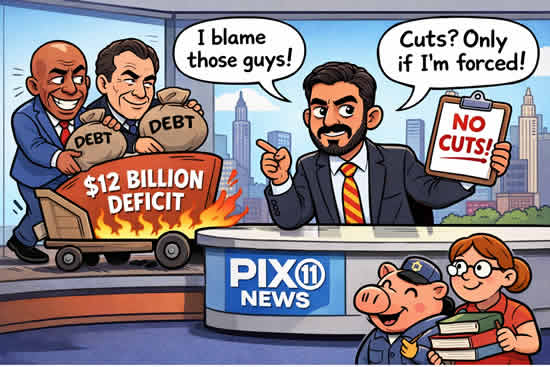
Appearing live in studio on PIX11 News on January 29, 2026, Mayor Mamdani addressed New York City’s reported $12 billion budget deficit, arguing it will take an “all-of-the-above” plan: pressuring Albany for a better revenue-share deal, seeking higher taxes on millionaires and highly profitable corporations, and launching a citywide hunt for operational efficiencies. In a made-for-TV moment, he signed an executive order on-air requiring every agency to appoint a Chief Savings Officer within five days and deliver a savings/efficiency review within 45 days, while insisting service cuts are a last resort unless state support and tax policy don’t change. He also condemned the car-ramming attack at 770, calling antisemitism a present-day threat, and said final interviews are underway for his Mayor’s Office antisemitism post.
New York. Mayor Mamdani Appears Live on PIX 11
Dan Mannarino: Mayor Zohran Mamdani has painted a grim picture for New York City’s budget, which now has a $12 billion budget deficit to fill. Mayor Mamdani pointed the finger at previous administrations, while saying that he will deliver an on-time, balanced budget on February 17th. So, the question is how? The mayor is joining me now live to talk about this and make an announcement. Mr. Mayor, great to see you.
Mayor Zohran Mamdani: Great to see you as well. Thank you for having me.
Mannarino: Of course, and great to have you here in studio. I think it’s your first as mayor so it’s great to have you here. Before we get to the announcement and the budget, I do want to talk about what we saw play out in Brooklyn last night at the synagogue there. Any indication as the investigation plays out that that individual is looking to commit a hate crime?
Mayor Mamdani: So, it’s currently being investigated. I have to say, I was there on the scene last night at 770 Chabad World Headquarters and it was a horrifying incident where a man repeatedly and intentionally crashed his car into the building and I am so thankful that no one was hurt and we know that this is a building that has immense meaning to so many Jewish New Yorkers and those across the world.
And yesterday’s attack also took place on the yahrzeit of Rabbi Schneerson and the leadership of Rabbi Menachem Mendel Schneerson, and this is just a day after the day when we remember the victims of the Holocaust, and we know that antisemitism is not simply something of the past to be learned about. It is a living, breathing thing that we have to combat every day.
Mannarino: Today, the City Council is expected to announce a task force to fight antisemitism and the question for you is: Have you found somebody to lead your own Office to Combat Antisemitism within the Mayor’s Office? When can we expect to see that up and running?
Mayor Mamdani: So, we are actually in our final interviews for that position. And that is going to be a key position that delivers on our commitment to root out antisemitism across the five boroughs, and make this a city where Jewish New Yorkers are not just safe, but frankly celebrated and cherished.
Mannarino: Sometime next week?
Mayor Mamdani: We’re working on the timeline but it is in the final stages.
Mannarino: Okay Mr. Mayor, and you are here today to talk about the big announcement, which is a $12 billion deficit. You said the city has not seen something like this since the Great Depression. You said you were given a poison chalice by previous administrations. So on behalf of so many New Yorkers who heard that noise and that news, what is the answer to bring So on behalf of so many New Yorkers who heard that noise and that news, what is the answer to budget down on time and on budget?
Mayor Mamdani: So, I think first, as you said, this is [a] $12 billion fiscal deficit. The last time New York saw a fiscal crisis anywhere close to this was the Great Recession. And yet, this actually eclipses that. This is a greater deficit than we saw at the time. It’s going to require an all-of-the-above approach. So, we said, this will require the city’s relationship with the state [to] change. What I mean by that is, today the city contributes 54.5 percent of the state’s revenue [and] receives 40.5 percent in return. The second is going to require a relationship change between the city and its wealthiest residents and most profitable corporations.
I’ve spoken a lot with you across New York City about how I think we should raise income taxes on those who make a million dollars or more by two percent, [and] how we should raise corporate taxes on the most profitable corporations. The third thing it’s also going to require is the city pursuing savings and efficiencies within its own operating budget. And so. that is something that I’m actually here to speak to you today about also, is the creation of savings officers within every single agency that will be tasked with assessing the efficacy of programs we have, the efficiencies that we currently have or are being denied, and what steps we need to take to make the kinds of changes to bring us back to a firm financial.
Mannarino: And you want that done yesterday. So, you have an executive order that you’re calling all city agencies to do right now in implementing and appointing these chief savings officers.
Mayor Mamdani: Yes, and that’s actually the executive order that I have with me right here. This is a directive that, within five days, every single agency head has to identify a chief savings officer. And then within 45 days, those officers have to come back to us with a full assessment of the savings that could be pursued, the efficiencies that we’re currently seeing, and the programs that frankly need to be sunsetted or are not effective.
Mannarino: Okay, so go ahead, put your John Hancock on that. And that will become officially an executive order as of this moment, right?
Mayor Mamdani: Yes, this is now an executive order, the first to be signed on PIX11.
Mannarino: There we go. So let me ask you what exactly that means. The previous administration, Eric Adams, cut from city agencies. For example, libraries were cut, right? Are you expecting agencies to look at some of these things and implement cuts? And how soon?
Mayor Mamdani: I think what we’re first talking about are efficiencies and savings. We’re talking about the things that we could be doing better.
Mannarino: Is that cuts?
Mayor Mamdani: No, I would say, cuts are a matter of last resort, right? We do not want to be cutting the services that New Yorkers are relying on. If the state does not change its relationship to the city, if it does not raise taxes on the wealthiest New Yorkers and the most profitable corporations, then all that leaves the city with, are the most painful tools. However, we want to do everything we can to ensure that those are not the tools we have to use.
Mannarino: But cuts could be on the table, as a last resort.
Mayor Mamdani: That is what we are left with if we are not able to change these relationships. That’s why we’re pursuing the relationship.
Mannarino: You talked a lot about Eric Adams and former Governor Andrew Cuomo, but the City Council was also involved in the budget-making process. Governor Kathy Hochul had four years to kind of implement some changes to Governor Cuomo’s budgets. Do you look at that as part of the reason we’re in this crisis, that there was failure on all levels?
Mayor Mamdani: I see the architects of this crisis being the prior mayor and the prior governor. I think that there have been steps taken in the past few years, especially under Governor Hochul’s leadership, to change some of that cost-sharing between the city and the state. It’s not been an exercise in cruelty towards the city coffers that we saw for about a decade. However, there’s more that needs to be done.
And what we have now, for the first time in a long time, is a directive from our own City Hall, from myself, to go to Albany and be honest and direct about what we need from Albany. That’s what we’re going to do.
Mannarino: What about President Trump? Does he play a role? Does he play a part in this crisis?
Mayor Mamdani: Well, I think President Trump has said himself in the Oval Office right after we had a meeting that the better New York City does, the happier he is. And what we’ve seen is that right now, New York City is in need of a change in its fiscal relationship with a number of the things I’ve listed, but also needs to be protected from some of the federal policies that are being put forward. And I’ve been honest about the fact that some of these proposals would devastate our city, and we’re going to fight them with everything that we have.
Mannarino: In the last couple days or weeks, have you had a conversation with President Trump about what he’s willing to send to New York or withhold from New York? As you go into the budget talks and negotiations now, knowing what you’re going to get from the federal government is huge. So, have you spoken to the president?
Mayor Mamdani: So, I keep those conversations between the president and myself private. What I will tell you, however—
Mannarino: When’s the last time you spoke to him?
Mayor Mamdani: Look, those are conversations that will always come back to New York City. And I think that that’s something that New Yorkers are expecting from me. And what they also know is that in a city of eight and a half million people, the wealthiest city in the wealthiest country in the world, we have one in four living in poverty. We have to find fiscal policy that lifts us all up.
Mannarino: What is your contingency? As you made that announcement, an hour later, Governor Hochul came out, and she said, “Newsflash, we’re not raising taxes in New York.” So, you had these conversations with the governor a number of times. You’re very complimentary to her, but she is adamant that they’re not raising taxes. So, if you don’t get that money, what is the contingency?
Mayor Mamdani: I think the first key thing is to make clear to New Yorkers why we need that money, how we got to this place. And some of [these] are the structural imbalances we’ve seen in our city’s fiscal health over many years. It would be all too easy to try and fix this budget. Only to get here next year. That’s why we’re looking for solutions that will last in the longer term, recurring ones, annualized ones. And so, we’re talking about these increased taxes on the wealthy.
Mannarino: She said no.
Mayor Mamdani: Look, I think politics is also an exercise in making the case and making clear what the stakes are. The tools that the city has, these are the most painful tools. We are talking about cuts. We are talking about property taxes, the things that I do not want to pursue. And yet, the scale of this fiscal crisis of $12 billion, this is not an ordinary crisis. This is not a mayor coming forward and saying, “It’s going to be a tough budget. “This is the likes of which we haven’t seen since the Great Recession. That requires an all of the above approach. That’s what we’re going to make clear.
Mannarino: So realistic[ally] [speaking], and you mentioned yesterday a number of times that you want to be really honest with New Yorkers and letting them know how we got to this point and what you’re planning to do about it. But there’s also a lot that you campaigned on, freezing the rent, fast and free buses. Could some of that take longer to implement, realistically talking, because of what we’re seeing?
Mayor Mamdani: I think this is a fiscal crisis that has to be [at the] front of mind for all of us. Now, I’m proud of the fact that we’ve already been able to advance our affordability agenda in the one month I’ve been in office. Day eight, we secured more than a billion dollars for universal child care. Freezing the rent is not something that requires a fiscal infusion. It’s a decision from the Rent Guidelines Board.
Making buses fast and free, the fast thing we’re already getting started on. And what I’ve said is that by the time I’m finished being mayor, they’re going to be free. What we have to deliver, however, in this very year, required by law, but also required just by being a good mayor, a balanced budget for this fiscal year [and for] the next fiscal year.
Mannarino: I’m up against the clock here, but yesterday you mentioned an AI chatbot that cost $500,000. It’s one of the things you thought was a waste of money. Can you name something else?
Mayor Mamdani: That’s exactly what this directive is about. What we want is to actually come to a number after looking at the budget. Because what we’re seeing, we’re talking about a budget of more than $115 billion. If I’m going to accuse the prior mayor of gross fiscal mismanagement in the budgeting process, we know that that likely extends to the expense side as well. And so we’re going to look through every agency to find every example, because when we are going to ask New Yorkers to commit themselves to a new era of politics we have to commit ourselves too. That’s what this is about.
Mannarino: If the governor comes up and says, “You know what, Mr. Mayor, I don’t want to raise the taxes, but I do want to find money. We made all this money from Wall Street, which she said, and we found some money for you to give to you.” Would that satisfy you?
Mayor Mamdani: I think that given the scale of this crisis, that’s not going to be a way to cover the entirety of it. Look, I’ll be direct with you. We’re encouraged by the results from Wall Street, by the news of bonuses. That would be something, if the deficit was smaller, I could say maybe this could cover it. But [for] $12 billion, there’s no news of bonuses or better forecasts that are going to get there. It’s going to require everything.
Mannarino: Mr. Mayor, I appreciate you coming here, talking straight with New Yorkers, signing the executive order. I think it’s the first that we’ve had here at PIX11 where legislation is signed right here on our air. Good to see you.
Mayor Mamdani: Good to see you as well.
Mannarino: Want to go do the weather?
Mayor Mamdani: Stay warm, stay inside, stay safe.
Mannarino: There you go. Mr. Mayor, thank you very much.
Mayor Zohran Mamdani addressed a fatal Bronx fire and detailed extensive city-wide preparations for an incoming winter storm, including snow removal, cold weather protocols, and public safety advisories for residents to stay indoors.
Mayor Zohran Mamdani held a press conference on January 24, 2026, to discuss two main topics: a tragic fire in the Bronx and the city’s preparations for an upcoming winter storm.
The mayor first addressed a four-alarm fire in Eastchester, Bronx, which resulted in 15 injuries and one fatality (0:21-0:47). He thanked the FDNY and other city agencies for their immediate response and confirmed that utilities in the affected building were shut down, with all 148 apartments vacated (1:21-1:26). A reception center was opened at a nearby school, and the Red Cross is assisting displaced residents (1:27-1:32). An investigation into the fire’s cause is ongoing (2:01-2:06).
Following this, the mayor detailed the city’s winter storm preparations:
Snowfall and conditions: Snow is expected to begin late Sunday evening, intensifying around 5:00 a.m. Monday (2:32-2:42). Heavy snowfall is anticipated in the late morning and early afternoon, with low visibility and winds up to 35 mph, creating near-blizzard conditions (2:53-3:08). The snow is expected to turn to sleet by Sunday evening and clear by early Monday morning (3:09-3:20).
Expected accumulation and cold temperatures: The city anticipates at least 8 to 9 inches of snow, along with a prolonged period of frigid temperatures, possibly the coldest in 8 years (3:22-3:42).
City agency preparations: Various agencies have undertaken extensive measures:
DSNY has brined highways and major roadways (3:59-4:02), and over 2,000 workers will staff 12-hour shifts, deploying more than 700 salt spreaders and 2,300 plow vehicles (6:36-6:51).
Public schools have prepared for remote learning (4:05-4:11) and conducted pressure testing for virtual operations (4:14-4:22). A decision on Monday’s school status will be announced by 12:00 p.m. tomorrow (15:02-15:13).
NYCHA increased staffing for weather-related repairs (4:23-4:26).
Parks workers pre-salted parks (4:27-4:28).
FDNY increased firefighters per engine company and is operating under enhanced readiness (4:30-4:37).
MTA activated its incident command system and emergency operations center (4:37-4:43).
NYC Emergency Management activated its winter weather plan and held daily coordination calls (4:45-4:57). They also used 311 reports from past storms to address previous service shortcomings (4:59-5:14).
Homeless services and public safety: A “Code Blue” is in effect, ensuring homeless New Yorkers have access to shelter beds (5:37-6:01). 311 calls for warmth access will be rerouted to 911 during this period (6:15-6:22).
Travel advisory: A hazardous travel advisory will be in effect on Sunday and Monday. New Yorkers are urged to avoid driving and unnecessary travel (9:00-9:12) and to stay indoors (9:16-9:23).
Suspended services: City bike service will be suspended starting 12:00 p.m. tomorrow (8:13-8:17), and early voting for tomorrow and Monday has been suspended by the State Board of Elections (8:17-8:22). New Yorkers are encouraged to sign up for Notify NYC alerts (8:23-8:38).
The mayor expressed gratitude to the city’s workers for their tireless efforts in preparing for the storm and for their ongoing commitment to keeping the city safe (10:11-10:22, 13:36-14:36). He emphasized that every New Yorker will receive the same level of service regardless of their zip code or neighborhood (11:03-11:11).