
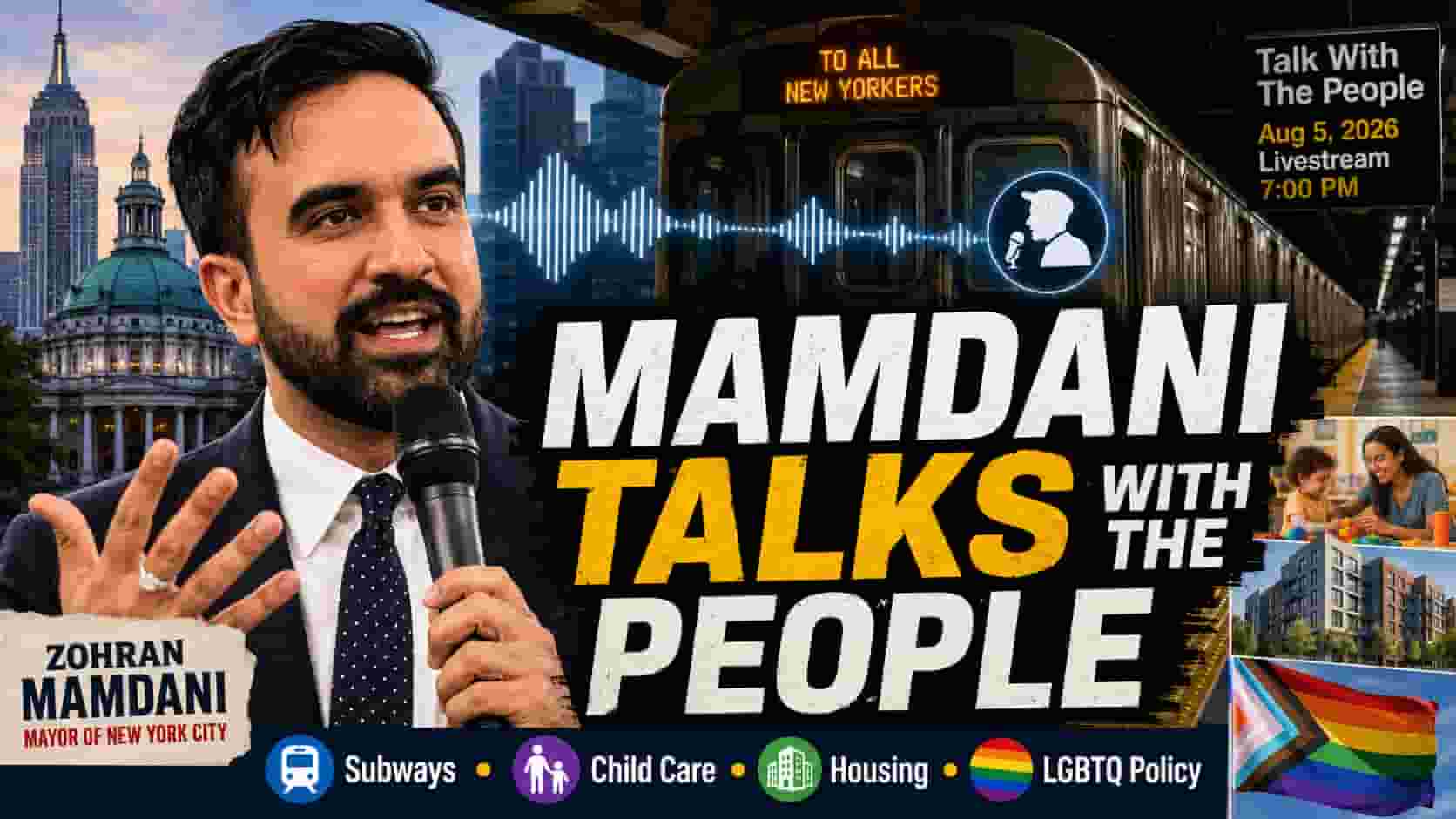
NEW YORK — August 5, 2026 — What began as a conversation with one of New York City’s most recognizable voices quickly turned into a wide-ranging discussion of Mayor Zohran Kwame Mamdani’s policy agenda — from free child care and affordable housing to homelessness and a $15 million city investment in gender-affirming care.
Mayor Mamdani hosted transit broadcaster and voice actor Bernie Wagenblast, whose recorded announcements have been heard by millions of subway riders, during the latest edition of the mayor’s online series “Talk With The People.”
The program, launched by City Hall in May, is a recurring interactive stream distributed across Twitch, YouTube, TikTok, Instagram, Facebook, X and Bluesky. The Mayor’s Office has described it as a modern version of Mayor Fiorello La Guardia’s radio program “Talk to the People,” designed to let New Yorkers question the mayor directly online.
The Person Behind the Subway Voice
Mamdani opened the conversation by asking viewers to imagine waiting for a subway in 2011 — before widespread underground cell service and before train-arrival information became commonplace — and suddenly hearing an announcement telling them when the next train would arrive.
He introduced Wagenblast’s voice as something millions associate with New York itself.
Wagenblast explained that the career began in radio and that practicing started by reading newspapers aloud in a basement as a child. Work with the MTA began in 2009.
The familiar subway announcements were not necessarily recorded as complete sentences. Wagenblast described recording individual fragments — including words such as “uptown,” “downtown” and “Bronx-bound” — that could later be assembled by computer depending on the train, station, direction and service pattern.
Wagenblast estimated recording more than 1,000 words and phrases for the system.
There was also a personal connection between host and guest: Wagenblast served as an announcer at Mamdani’s mayoral inauguration.
But roughly halfway through the stream, the conversation moved well beyond subway nostalgia.
Mamdani Defends $15 Million for Gender-Affirming Care
A viewer asked the mayor about the administration’s $15 million commitment to gender-affirming care for transgender New Yorkers.
Mamdani said his administration made the investment amid what he characterized as hostility toward transgender people from the federal government.
He also pointed to the creation of the Mayor’s Office of LGBTQIA+ Affairs and the city’s opposition to federal efforts to obtain private medical records involving transgender youth.
The $15 million initiative is not merely a proposal discussed on the stream. City Hall formally announced it on June 26.
According to the Mayor’s Office, the money is intended to support providers of youth gender-affirming care, establish a call and text line connecting New Yorkers with services and information, and fund research into health-care access and outcomes for transgender and gender-nonconforming New Yorkers.
The conversation then became personal.
Mamdani asked Wagenblast about coming out as a transgender woman. Wagenblast described the uncertainty surrounding the transition, which became public in 2023, and said the story unexpectedly generated national and international media attention.
5,700 Applicants — but About 2,000 Free 2-K Seats
One of the most significant policy disclosures came when a viewer asked Mamdani what he hoped to accomplish over the next year.
The mayor returned to one of his administration’s signature initiatives: free child care for two-year-olds.
Mamdani said the city received approximately 5,700 applications for the initial program and is preparing to roll out about 2,000 free seats this fall.
He said the goal is to increase the program to approximately 12,000 seats next year.
That distinction is important.
While the administration has promoted the first 2,000 seats as a major expansion of free child care, the mayor’s own numbers show that applications for the initial program substantially exceeded the number of available seats.
City Hall previously announced that the first 2,000 seats would be distributed across selected communities in Manhattan, the Bronx, Brooklyn and Queens, before a planned expansion to approximately 12,000 children.
Mamdani argued that free child care could save families between roughly $20,000 and $40,000 annually, depending on what they otherwise would have paid for private care.
The administration has said its broader agreement with Gov. Kathy Hochul involves $1.2 billion and is intended eventually to put New York City on a path toward providing a seat for every two-year-old.
200,000 Affordable Homes — and an Admission About Government Delays
Housing was another major subject of the broadcast.
Mamdani repeated his administration’s pledge to build 200,000 affordable homes over 10 years.
He discussed a recent tour of city-owned properties where affordable housing had been planned but, in some cases, construction had failed to begin for years.
Some of the sites, Mamdani acknowledged, had been designated for affordable housing as long as eight years ago and still appeared essentially unchanged.
“There’s been delays,” Mamdani said, describing the inaction as the type of problem that has come to characterize local government.
He said his administration wants to reduce parts of the development process by as much as two years.
The mayor’s broader “Block by Block” housing plan calls for construction of 200,000 new affordable homes and preservation of another 200,000 over the coming decade.
The crucial test, however, will be execution.
New York City has announced large housing targets before. Even Mamdani’s own discussion during the stream highlighted the basic problem: publicly controlled sites can remain caught in the government development process for years before residents ever see an apartment.
Homelessness and Supportive Housing
Another viewer asked what the administration planned to do about homelessness.
Mamdani pointed toward supportive housing — apartments combined with services intended to help formerly homeless residents remain housed.
He argued that New York City has failed to build enough housing for decades and said the city must restore the kind of construction ambition that once allowed projects such as the Empire State Building to rise in little more than a year.
“If we don’t grow as a city, we die,” Mamdani said during the discussion.
The administration has already made supportive housing a component of several projects, including developments combining affordable apartments with units reserved for formerly homeless New Yorkers.
City Hall Meets the Livestream Era
The episode also illustrated something broader about the Mamdani administration.
“Talk With The People” is simultaneously an interactive question-and-answer program and a communications platform through which City Hall can present its policies directly to voters without relying on a traditional press conference or television interview.
There were unscripted moments.
When one viewer accused the program of being prerecorded, Mamdani read the comment aloud and responded in real time. Near the end of the show, he again cited the current time to demonstrate that the broadcast was live.
And Wagenblast proved an unusually fitting guest for that format.
The discussion connected two generations of New York communications: the recorded voice that became part of the daily subway experience and a mayor attempting to make livestreams and social media part of the daily relationship between City Hall and the public.
But beneath the casual conversation were consequential commitments involving billions of dollars, thousands of child-care seats, hundreds of thousands of proposed apartments and an increasingly ideological dispute between New York City and Washington over transgender health policy.
For New Yorkers, those numbers — and whether City Hall ultimately delivers on them — may matter considerably more than the livestream format itself.
Midtown Tribune | New York City
Ask Midtown Tribune about this story
Answers are grounded first in this article. Search all Midtown Tribune reporting from the main AI Search page.
AI-generated summary. Verify important details in the linked original articles.