
By Midtown Tribune Staff
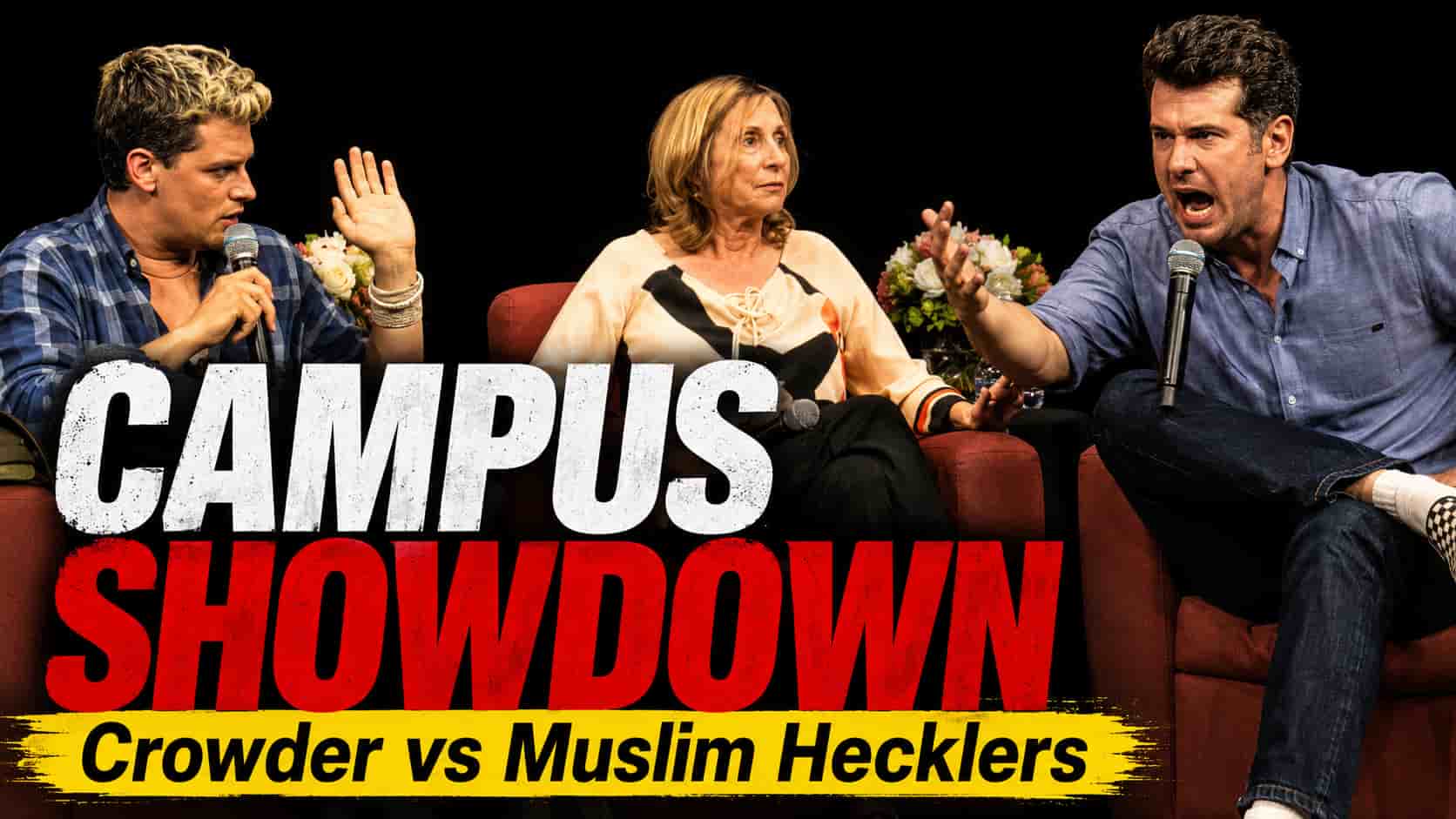
A video posted by JewishUncensored under the title “NOBODY On Earth Humiliates Muslim Hecklers Like Steven Crowder!!!” shows a heated campus-style panel discussion where Steven Crowder and Milo Yiannopoulos are confronted by audience members over Islam, “hate speech,” Donald Trump, feminism, gay rights, and political correctness.
The central question of the exchange is not only about Islam. It is about whether criticism of a religion — especially when that religion also claims legal and political authority — can still be spoken openly in America.
In the video, Crowder and Yiannopoulos repeatedly reject the idea that criticizing Islam as an ideology equals violence against Muslims as people. Crowder argues that people have the right to examine Islam the same way they examine any other set of ideas, saying that criticism of a religion, legal system, or political ideology should not be automatically labeled “hate speech.”
The confrontation becomes sharper when hecklers accuse the speakers of Islamophobia and suggest their rhetoric contributes to violence. Yiannopoulos responds by shifting the discussion toward antisemitism on campuses, terrorism in Europe and New York, and the treatment of women and gay people under Islamic law in many countries. His argument is blunt: Western activists often defend Islam from criticism while ignoring the treatment of minorities, women, and homosexuals in societies governed by Islamic law.
Crowder’s strongest point in the exchange is a direct challenge: name an Islamic country where Islam has achieved political power and produced Western-style freedom for women, gay people, religious minorities, and dissenters. He argues that his criticism is not aimed at every individual Muslim, but at Islam as a political and legal system when it becomes state power.
That distinction is the heart of the video. In America, citizens are not required to respect ideas. They are required to respect the rights of people. A Muslim person has the same constitutional rights as everyone else. But Islam, Christianity, socialism, nationalism, feminism, Marxism, atheism, and every other ideology must remain open to criticism, debate, satire, and rejection.
The video also exposes a deeper contradiction in modern campus culture. Many activists demand absolute freedom to attack America, capitalism, Christianity, Israel, police, borders, and traditional values — but when Islam is questioned, the word “hate speech” suddenly appears as a shield against debate.
Crowder and Yiannopoulos answer that shield with a First Amendment argument: offensive speech is still speech. The purpose of public debate is not to protect ideas from discomfort. It is to test ideas in the open.
For Midtown Tribune readers, the lesson is simple: America’s constitutional tradition does not guarantee that every belief system will be praised. It guarantees that every belief system may be questioned. That is not hate. That is liberty.
Video discussed: NOBODY On Earth Humiliates Muslim Hecklers Like Steven Crowder!!! — JewishUncensored
Topic: Steven Crowder, Milo Yiannopoulos, Islam, campus free speech, hate speech, First Amendment, political correctness.
Official Sources and Background Documents
The following official U.S. government and court sources provide legal and factual background for this article: First Amendment protections for controversial speech, the distinction between criticism of ideas and discrimination against people, and official human-rights reporting on religious law, blasphemy, apostasy, women’s rights, and LGBT rights in several Muslim-majority countries.
-
U.S. Constitution — First Amendment, Library of Congress / Constitution Annotated
Official text protecting freedom of speech, press, religion, assembly, and petition. -
Constitution Annotated — Historical Background on the Free Speech Clause
Congressional legal background on the Free Speech Clause of the First Amendment. -
Constitution Annotated — Religion Clauses: Establishment and Free Exercise
Official background on the First Amendment’s protection of religious liberty and limits on government establishment of religion. -
U.S. Supreme Court — Matal v. Tam, 582 U.S. ___ (2017)
Supreme Court opinion stating that speech may not be banned merely because it expresses offensive ideas. -
U.S. Supreme Court — Iancu v. Brunetti, 588 U.S. ___ (2019)
Supreme Court opinion reaffirming that the government may not discriminate against offensive viewpoints. -
U.S. Supreme Court — 303 Creative LLC v. Elenis, 600 U.S. ___ (2023)
Supreme Court opinion discussing the First Amendment right to speak one’s mind even when speech is considered misguided or offensive. -
U.S. Department of Justice — Combating Religious Discrimination
DOJ guidance explaining federal civil-rights protections against discrimination based on religion, including Islam. -
U.S. Department of Justice — Combating Post-9/11 Discriminatory Backlash
DOJ Civil Rights Division material on enforcement against bias crimes and discrimination targeting Muslims, Sikhs, Arabs, and South Asians. -
FBI — Hate Crime Statistics
Official FBI hate-crime data collection, including crimes motivated by religious bias. -
U.S. Department of Justice — Hate Crimes
DOJ official resources on hate crimes and federal enforcement. -
U.S. State Department — 2024 Country Reports on Human Rights Practices: Iran
Official U.S. human-rights reporting on Iran, including restrictions connected to the Islamic Republic’s legal and political system. -
U.S. State Department — 2023 Country Reports on Human Rights Practices: Qatar
Official reporting on legal restrictions, including criminalization of consensual same-sex conduct between men. -
U.S. State Department — 2023 Country Reports on Human Rights Practices: United Arab Emirates
Official reporting on restrictions involving same-sex conduct, women’s legal status, and civil liberties. -
U.S. State Department — 2023 Country Reports on Human Rights Practices: Saudi Arabia
Official reporting on legal and human-rights conditions in Saudi Arabia. -
U.S. Commission on International Religious Freedom — Saudi Arabia, 2026 Annual Report
Official USCIRF report noting Saudi Arabia’s religious-law framework, including apostasy and blasphemy as capital crimes. -
U.S. Commission on International Religious Freedom — Afghanistan, 2026 Annual Report
Official USCIRF report on Taliban enforcement of its interpretation of Shari’a, affecting women, girls, minorities, and religious freedom. -
USCIRF — Violating Rights: Enforcing the World’s Blasphemy Laws
Official USCIRF report on how blasphemy laws restrict freedom of expression and freedom of religion or belief. -
USCIRF — Updated Blasphemy Factsheet and Blasphemy Law Report
Official USCIRF release on countries with laws criminalizing expressions that insult or offend religious feelings, figures, or symbols.
Ask Midtown Tribune about this story
Answers are grounded first in this article. Search all Midtown Tribune reporting from the main AI Search page.
AI-generated summary. Verify important details in the linked original articles.