
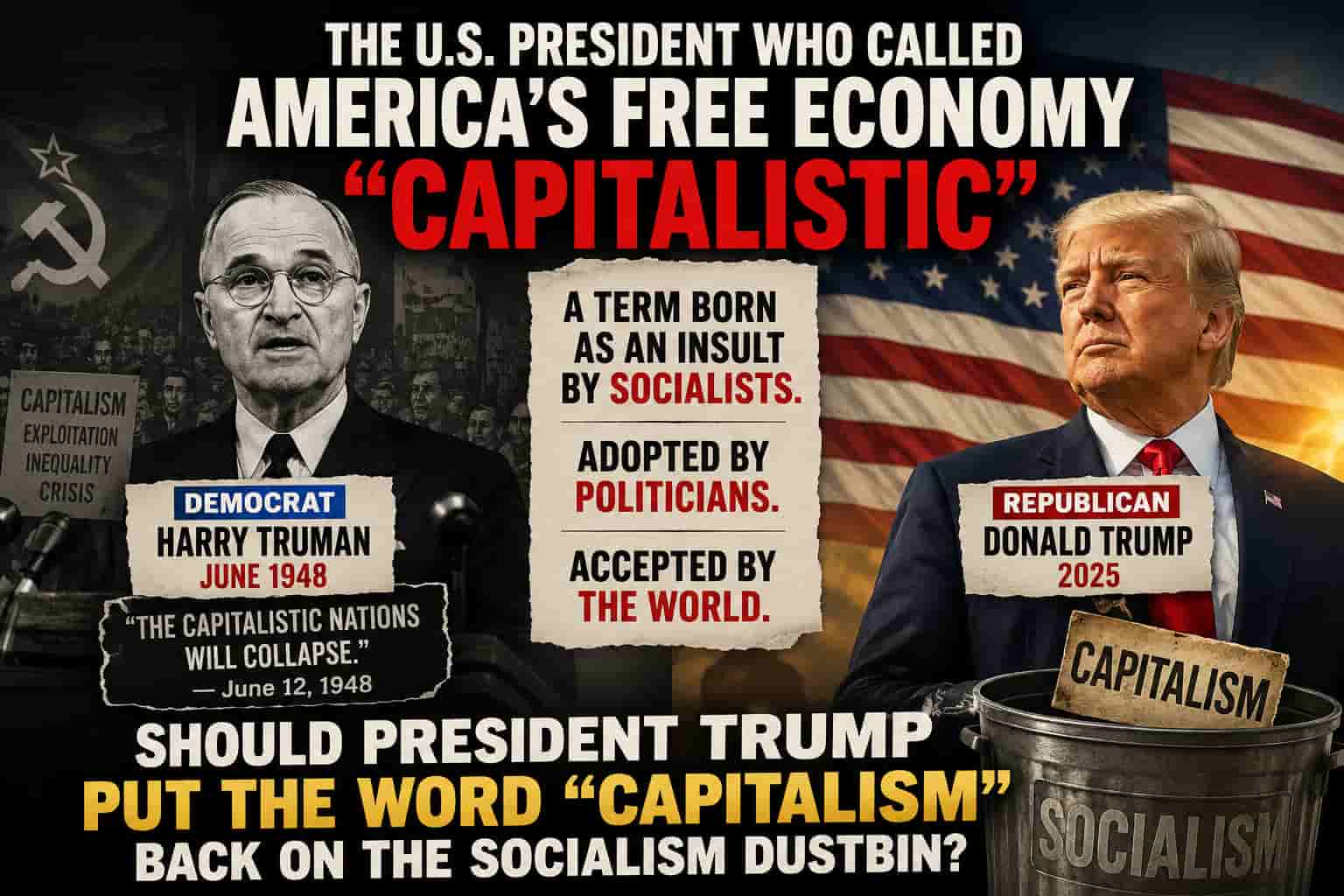
Democrat Harry Truman Placed America Among the “Capitalist Nations” in June 1948. Should Republican Donald Trump Send the Word “Capitalism” Back to Socialism’s Dustbin?
In June 1948, Democratic President Harry S. Truman publicly answered the Soviet claim that the “capitalistic nations” would eventually collapse. By October of that year, Truman had gone further. He spoke explicitly of “our capitalistic system.”
That wording marked an important change in American political language.
Adam Smith did not call his economic philosophy capitalism. George Washington, Thomas Jefferson, James Madison, Benjamin Franklin and Alexander Hamilton did not announce that they were creating a capitalist society. The Constitution does not establish capitalism as the official ideology of the United States. Smith and the American Founders spoke instead about natural liberty, private property, commerce, contracts, competition, individual initiative and government limited by law.
The word “capitalism” came later. It entered political debate not as a compliment to economic freedom, but largely as an accusation made by European socialists against a society they claimed was controlled by the owners of capital.
That creates a remarkable historical paradox:
A label created and popularized by critics of private property was eventually adopted by the political leaders of the countries those critics were attacking.
Should President Donald Trump reverse that linguistic surrender? Should the United States return to the language of the free market, free enterprise, economic liberty and individual opportunity—and send the word “capitalism” back to the ideological world that created it?
Before “Capitalism,” There Was Capital
The word capital existed long before the political term capitalism.
Capital referred to money, property, accumulated savings or productive resources that could be invested in commerce and industry. It was primarily a financial and accounting term.
The word capitalist also appeared before capitalism. A capitalist was originally a person who possessed capital or received income from investments.
That did not necessarily describe a political ideology. A capitalist was an owner of capital in much the same way that a landowner was an owner of land.
During the French Revolution, however, the word acquired a strongly hostile political meaning. Wealthy financiers, speculators and people living from investment income could be portrayed as members of a cold and unproductive class that placed money above morality and human relationships.
Before “capitalism” became the name of an entire system, the “capitalist” had already become a politically charged character: a wealthy owner who supposedly lived from property and interest rather than productive labor.
Louis Blanc: Capitalism as an Accusation
One of the earliest reliably documented writers to use the French word capitalisme as the name of a social and economic order was the French socialist and political leader Louis Blanc.
In the ninth edition of his book Organisation du travail—The Organization of Labor—published in 1850, Blanc accused the economist Frédéric Bastiat of confusing the usefulness of capital with a particular system of capital ownership.
Blanc defined capitalism as:
“the appropriation of capital by some to the exclusion of others.”
Blanc did not argue that capital itself was evil. Machinery, tools, savings and productive resources were necessary for society.
His objection concerned their exclusive ownership by a relatively small group.
Capital, in his argument, could benefit society. Capitalism was the system in which access to capital was supposedly monopolized by one class and denied to others.
This is crucial to understanding the history of the word.
“Capitalism” was not introduced as a neutral synonym for commerce, voluntary exchange or entrepreneurship. It contained an accusation: that society was structured to serve the owners of capital.
Historians cannot prove beyond all doubt that Blanc personally invented the word. It may have appeared in newspapers and political pamphlets during the revolutionary period surrounding 1848.
But Blanc remains one of the earliest reliably documented authors to use capitalisme systematically and in a meaning close to its later political use.
How “-ism” Turned Property Into a Political System
The difference between capital and capitalism was fundamental.
Capital is a resource.
A capitalist is an owner of that resource.
Capitalism is a theory about an entire social order allegedly structured around the ownership and power of capital.
The suffix “-ism” transformed a financial resource into an ideological system.
The word no longer referred merely to the freedom to buy, sell, invest, manufacture and establish businesses. It portrayed society itself as organized around the authority of capital owners.
That is why capitalism originally sounded very different from expressions such as free market or free enterprise.
A free market emphasizes freedom of exchange and competition.
Free enterprise emphasizes the right of individuals to create businesses, invest, enter contracts and compete.
Capitalism, in its original political usage, emphasized the owners of capital and their alleged control over society.
Adam Smith Was Not the “Father of Capitalism”
Adam Smith published An Inquiry into the Nature and Causes of the Wealth of Nations in 1776.
That was also the year in which the American colonies adopted the Declaration of Independence.
Smith is now routinely called the “father of capitalism.” Historically, however, that description is anachronistic.
Smith did not use the word capitalism.
The term had not yet become an established name for an economic system. Smith therefore did not describe Britain, America or any other country as capitalist.
He wrote about commercial society.
Smith examined the division of labor, voluntary exchange, competition, the accumulation of capital, the formation of prices and the desire of individuals to improve their economic condition.
His famous expression for a desirable economic order was the system of natural liberty.
Under such a system, after artificial privileges and unnecessary restrictions were removed, individuals would be free to pursue their own interests in their own way, provided they did not violate the laws of justice.
That is very different from saying that society should be governed by a capitalist class.
At the center of Smith’s system was not the political supremacy of capital owners. It was the free individual acting under general laws.
Smith Defended Markets, Not Monopoly Power
The modern portrayal of Adam Smith as an advocate of absolute government inaction is also misleading.
Smith opposed mercantilism—a political system in which governments granted commercial privileges, restricted trade and protected favored monopolies.
He believed producers, merchants and investors should compete rather than use political influence to eliminate competitors.
Smith was often suspicious of businessmen seeking special advantages from the state. He famously warned that members of the same trade could conspire against the public by fixing prices or restricting competition.
At the same time, Smith recognized legitimate public functions, including national defense, justice, infrastructure and education.
He did not defend an economy controlled by monopolies or corporations with privileged access to government power.
Smith defended commercial society against a state-created system of favoritism. He did not develop a doctrine called capitalism, and he did not advocate rule by capital.
The Founders Did Not Establish a “Capitalist State”
The American Founders also did not use capitalism to describe the new republic.
Their economic views were not identical.
Thomas Jefferson idealized a society of independent landowners. Alexander Hamilton supported a national bank, public credit, industrial development and government measures intended to strengthen American manufacturing.
Hamilton was not an advocate of a completely passive government. His 1791 Report on Manufactures proposed an active national role in developing American industry.
Despite their disagreements, the Founders shared a political vocabulary built around:
- liberty;
- private property;
- commerce;
- industry;
- credit;
- contracts;
- individual rights;
- government restrained by law.
James Madison wrote in Federalist No. 10 about the diversity of human faculties from which property rights arise.
Alexander Hamilton discussed commerce, national economic strength and the advantages of union in Federalist No. 11.
The Constitution gave Congress authority to regulate interstate and foreign commerce. It created a legal framework in which contracts, property, trade and investment could operate under federal and state law.
But the Constitution does not proclaim capitalism as America’s official ideology.
The United States was founded as a constitutional republic, not as a “capitalist republic.”
Its economic institutions developed inside that constitutional order.
How a European Accusation Became an Academic Category
After Louis Blanc, the word capitalism spread among European socialists, political critics and scholars of industrial society.
Pierre-Joseph Proudhon used the term to describe a system in which capital was generally separated from the workers who operated it.
Karl Marx did not invent the word.
The first volume of Das Kapital appeared in 1867—seventeen years after Blanc’s documented use of capitalisme.
Moreover, the noun Kapitalismus was not Marx’s principal analytical term in the first volume of Capital. He more frequently wrote about:
- the capitalist mode of production;
- capitalist production;
- capitalist society;
- the capitalist class;
- relations between capital and wage labor.
By the end of the nineteenth century, capitalism was gradually becoming more than a political insult. Scholars began using it as a historical and sociological category describing private ownership, wage labor, investment, profit and capital accumulation.
Nevertheless, the original accusatory structure remained.
Capitalism continued to suggest a social order created in the interests of capital owners.
Who Brought “Capitalism” Into American Politics?
The word appeared in American publications during the nineteenth century. But the first political forces to use capitalism systematically as the name of the American economic order were not mainstream Republicans or Democrats.
They were socialists, labor organizers and political movements influenced by European ideological traditions.
One of the most important figures was Eugene V. Debs, the leader of the Socialist Party of America and a five-time candidate for president.
Debs described both the Democratic and Republican parties as defenders of capitalism, private ownership of the means of production and the exploitation of workers.
The term was therefore present in American presidential politics before the Bolshevik Revolution of 1917 and before Joseph Stalin’s rise to supreme power.
In 1910, Victor Berger became the first Socialist Party representative elected to the United States House of Representatives.
European immigrants, German-speaking socialists, immigrants from the Russian Empire and labor activists helped carry the vocabulary of European class politics into American newspapers, unions and election campaigns.
But this process began before the establishment of the Soviet Union.
What the Bolsheviks, the Comintern and Stalin Changed
The Soviet government did not invent the word capitalism.
It did something different—and enormously consequential.
It transformed the opposition between capitalism and socialism into an official global map.
After 1917, Bolshevik ideology divided the world into categories such as:
- socialist states;
- capitalist states;
- colonial and dependent territories;
- revolutionary forces;
- counterrevolutionary forces.
The Communist International, established in 1919, spread this worldview through national communist parties, labor organizations, publications and international political campaigns.
Under Stalin, expressions such as capitalist countries, capitalist encirclement, monopoly capital and American capitalists became standard features of Soviet propaganda.
A 1947 United States State Department document reported that Soviet propaganda portrayed the American government, press and public life as being controlled by a small group of “monopoly capitalists.”
Historian Steven G. Marks therefore gave his study of the term an intentionally provocative title: The Word “Capitalism”: The Soviet Union’s Gift to America.
His argument was not that the Soviet Union invented the word.
It was that conflict with the Soviet Union helped persuade Americans to accept and redefine a label that had previously been used primarily by their ideological opponents.
There is no need to exaggerate this point by claiming, without archival evidence, that Stalin or Leon Trotsky spent a specific number of millions of dollars promoting the word itself.
The documented conclusion is already powerful:
The Soviet propaganda system devoted enormous state resources to spreading a worldview that divided the planet into socialist and capitalist camps.
Why American Politicians Resisted the Label
For an American politician of the nineteenth or early twentieth century, capitalism was an uncomfortable word.
It focused attention on capital rather than liberty, on owners rather than entrepreneurs, and on class structure rather than voluntary exchange.
American politicians generally preferred expressions such as:
- the American system;
- American individualism;
- private enterprise;
- free enterprise;
- individual initiative;
- economic liberty;
- equality of opportunity.
During the 1928 presidential campaign, Republican Herbert Hoover defended American individualism, not capitalism.
Hoover also explained that the American system did not mean a ruthless struggle in which every person was left completely alone. Nor did he describe it as pure laissez-faire.
He connected it to equality of opportunity, economic justice and resistance to control by any political or commercial group.
That language was much closer to Adam Smith and the Founders than the idea of a society organized around the power of capital.
The Great Depression Did Not Create the Word—but Brought It Into the White House
The Great Depression did not create the word capitalism.
By 1929, socialists, labor politicians and European theorists had already been using it for decades.
The economic collapse did, however, force American presidents to discuss more than individual banks, corporations or stock-market abuses. They had to address the survival of the entire economic order.
On January 3, 1938, Democratic President Franklin D. Roosevelt told Congress that capital was essential and that reasonable returns on capital were also essential.
But he warned that abuses could cause:
“the capitalistic system” to destroy itself.
This was one of the most prominent presidential uses of the expression.
Roosevelt did not present capitalism as a proud official name for America. He used the term in a warning about concentrated economic power, while arguing that regulation was necessary to preserve private enterprise.
Truman Placed America Among the “Capitalistic Nations”
The next important step was taken by Democratic President Harry S. Truman.
On June 12, 1948, speaking at the University of California, Truman rejected the Soviet expectation that “the capitalistic nations will collapse,” allowing communism to spread freely across the world.
The context placed the United States within the group of nations the Soviet Union called capitalist.
Truman was responding to communist terminology, but he was also repeating and normalizing that terminology in an official presidential address.
On October 15, 1948, in Indianapolis, Truman used an even more direct expression:
“The Communists … have been predicting that our capitalistic system would break down.”
The word our is historically important.
Roosevelt had spoken about “the capitalistic system” in a critical warning.
Truman explicitly spoke about “our capitalistic system.”
He had taken a term that socialists and communists used to condemn America and made it part of America’s own political self-description.
This does not prove that Truman was the first American president ever to use related language. Roosevelt’s 1938 statement clearly came earlier.
But the surviving documents establish that by 1948 Truman was accepting the division of the world into capitalist and communist systems—and directly identifying the American economy as “our capitalistic system.”
Did “Capitalism” Replace the Free Market?
Not literally.
Capitalism, free market and free enterprise do not mean exactly the same thing.
A free market describes a mechanism through which prices and production are largely determined by supply, demand and competition.
Free enterprise emphasizes the right of people to create businesses, enter contracts, invest, compete and pursue economic opportunities.
Capitalism generally describes a broader system involving private ownership, investment, profit, wage labor and the accumulation of capital.
A country described as capitalist may still have high taxes, state-owned companies, extensive regulation, subsidies, central banking and government-directed economic programs.
It does not necessarily possess a genuinely free market.
Capitalism did not erase the expressions free market and free enterprise. All three continued to be used.
But something more subtle happened.
A word created largely by critics of commercial society became the general name for the entire Western economic system.
The Semantic Victory of Socialist Language
The Soviet Union ultimately lost its economic and geopolitical confrontation with the West.
But in the struggle over terminology, socialism achieved a remarkable victory.
Today, even defenders of private property frequently call themselves capitalists.
Universities teach the history of capitalism. Politicians speak of democratic capitalism, market capitalism, regulated capitalism, stakeholder capitalism and capitalism for everyone.
The vocabulary of the system’s critics became the vocabulary of the system itself.
Adam Smith wrote about commercial society and natural liberty.
The American Founders spoke about property, trade, industry, contracts and government limited by law.
American politicians of the nineteenth and early twentieth centuries preferred free enterprise, private initiative and the American system.
Socialists called this order capitalism—a system allegedly based on the authority of capital owners.
After the Great Depression, and especially during the Cold War, American politicians gradually accepted that label and began defending not only free enterprise, but also “our capitalistic system.”
Should Trump Restore the Language of Free Enterprise?
That brings the debate to President Donald Trump.
Trump routinely presents himself as a defender of American workers, manufacturers, entrepreneurs and national economic independence.
But should his administration go further and challenge the vocabulary itself?
Should the president speak less about capitalism and more about:
- the free market;
- free enterprise;
- individual initiative;
- property rights;
- economic liberty;
- American industry;
- equality of opportunity;
- the right to build and own a business?
The word capitalism places capital at the center of the system.
The expression free enterprise places the free citizen at its center.
That is not a minor rhetorical distinction.
A socialist can easily attack capitalism as the rule of capital owners. It is much harder to attack the right of an ordinary person to open a store, create a company, own property, negotiate a contract, invent a product or compete without asking the government for permission.
If Trump wants to reclaim the economic language of the Founders, he could begin by refusing to define America using a term inherited from nineteenth-century European socialism and normalized by Soviet ideological warfare.
He could describe America not as a capitalist state, but as a constitutional republic with a free-enterprise economy.
Republic and Democracy: Another Terminological Debate
A similar debate exists over the words republic and democracy.
The Constitution guarantees every state a republican form of government. The Founders created a representative constitutional republic rather than a system of direct, unlimited majority rule.
At the same time, modern political science accurately describes the United States as both a constitutional republic and a representative democracy.
The terms are not mutually exclusive.
The essential constitutional principle is that majority power is limited by law, individual rights, separated institutions and judicial review.
The same care should be applied to economic language.
The United States is not defined merely by the ownership of capital. It is defined by individual rights, private initiative, legal equality and freedom restrained by justice.
Conclusion
The history of the word capitalism is not only a history of economics. It is a history of the political struggle to name an entire social order.
The term:
- emerged from European socialist criticism;
- originally described the alleged appropriation of capital by one group to the exclusion of others;
- spread through socialist parties and labor movements;
- entered mass American politics through socialists and immigrant political organizations;
- was turned by the Soviet Union into one side of a global ideological division;
- entered White House rhetoric during the Great Depression;
- became an explicit American self-description when Truman spoke of “our capitalistic system.”
It is therefore historically inaccurate to call Adam Smith the father of capitalism without qualification.
Smith was a major theorist of commercial society, competition and natural economic liberty.
The American Founders created a constitutional structure protecting rights, property, commerce and limited government.
Neither Smith nor the Founders argued that society should be organized around the political supremacy of capital.
The system’s opponents gave it the name capitalism.
America later accepted their word—and largely forgot that it had originally been an accusation.
The question for Donald Trump is therefore not only economic. It is linguistic and philosophical:
Can President Trump restore the words “FREE MARKET” to America’s political vocabulary—and send the language of “capitalism” and “oppressors” back to the ideological lexicon of European socialism and the Kremlin? Can he also restore the constitutional term “REPUBLIC” in place of “democracy,” a word now too often reduced to the idea of simple majority rule?
N. Сhief
Official Documents and Primary Sources
The following U.S. government archives and official presidential collections document the historical claims discussed in this article.
-
Harry Truman and the “Capitalistic Nations” — June 12, 1948
In this official commencement address, Democratic President Harry S. Truman rejected the Soviet belief that “the capitalistic nations will collapse,” placing the United States within the non-communist group described by Soviet ideology as capitalist.
Key quotation: “What is needed is the abandonment of the absurd idea that the capitalistic nations will collapse.”
Harry S. Truman Presidential Library — Commencement Address at the University of California, June 12, 1948 -
Truman Says “Our Capitalistic System” — October 15, 1948
Four months later, Truman used an unmistakable American self-description in a nationally broadcast address in Indianapolis.
Key quotation: “The Communists, as we all know, have been predicting that our capitalistic system would break down.”
Harry S. Truman Presidential Library — Address at the Indiana World War Memorial, October 15, 1948 -
Official Confirmation That Harry Truman Was a Democrat
The official Historian of the U.S. House of Representatives identifies Harry Truman as a Democrat who became president after Franklin D. Roosevelt’s death in April 1945.
U.S. House of Representatives — Party Government Since 1857 -
The Constitution Establishes a Republic, Not an Official Economic “-ism”
The Constitution establishes the institutions and powers of the federal government, protects a republican form of government and grants Congress authority over interstate and foreign commerce. It does not declare “capitalism” to be the official ideology of the United States.
National Archives — Transcript of the Constitution of the United States -
Congressional Analysis of the Constitution
This official Library of Congress resource provides the constitutional text together with legal analysis of commerce, property, federal powers, individual rights and the republican structure of government.
Congress.gov — Constitution Annotated -
Alexander Hamilton’s Report on Manufactures
Hamilton’s 1791 report shows that the Founders debated commerce, manufacturing, national development and government economic policy without describing their program as “capitalism.”
Founders Online, National Archives — Hamilton’s Final Version of the Report on Manufactures, December 5, 1791 -
Herbert Hoover and “American Individualism”
The Herbert Hoover Presidential Library records Hoover’s use of “American Individualism” as the preferred language for the American social and economic system before the Great Depression.
Herbert Hoover Presidential Library — Official Historical Timeline -
The First Socialist Elected to Congress
The official House history identifies Victor Berger as the first Socialist elected to the U.S. Congress. His election demonstrates that socialist political terminology was already present in American electoral politics before the Bolsheviks established Soviet power.
U.S. House of Representatives — Victor Berger, the First Socialist Member of Congress -
U.S. Government Analysis of Soviet “Failure of Capitalism” Propaganda
This 1947 State Department document discusses the Soviet prediction of an American economic crisis and the supposed “failure of capitalism.” It shows that the capitalism-versus-socialism framework was already a central instrument of Soviet propaganda before Truman’s 1948 speeches.
U.S. Department of State, Foreign Relations of the United States, 1947 — Document 392 -
Official Assessment of the Kremlin’s Goal of Defeating Capitalism
Another official diplomatic document described Soviet policy as seeking “the defeat of capitalism” through an international ideological and political campaign.
U.S. Department of State, Foreign Relations of the United States, 1947 — Evaluation of Kremlin International Policies -
U.S. Response to Soviet Anti-American Propaganda
This 1948 State Department policy paper recommended identifying major themes of Soviet and communist anti-American propaganda, correcting falsehoods and exposing ideological distortions.
U.S. Department of State, Foreign Relations of the United States, 1948 — U.S. Information Policy
Documented Conclusion
Democratic President Harry S. Truman referred to “the capitalistic nations” on June 12, 1948. On October 15, 1948, he used the more explicit phrase “our capitalistic system.”
The documents do not establish that Truman was the first American politician or the first president ever to use related terminology. Franklin D. Roosevelt had already referred to “the capitalistic system” in 1938. They do establish that Truman had accepted and repeated the capitalist-versus-communist classification no later than 1948.
Editor’s Note: On July 26, 2026, Midtown Tribune submitted this article and its central question to the White House through the official “Contact the President” form. The online confirmation verifies submission only; it does not establish that President Trump personally reviewed the article.
Ask Midtown Tribune about this story
Answers are grounded first in this article. Search all Midtown Tribune reporting from the main AI Search page.
AI-generated summary. Verify important details in the linked original articles.