
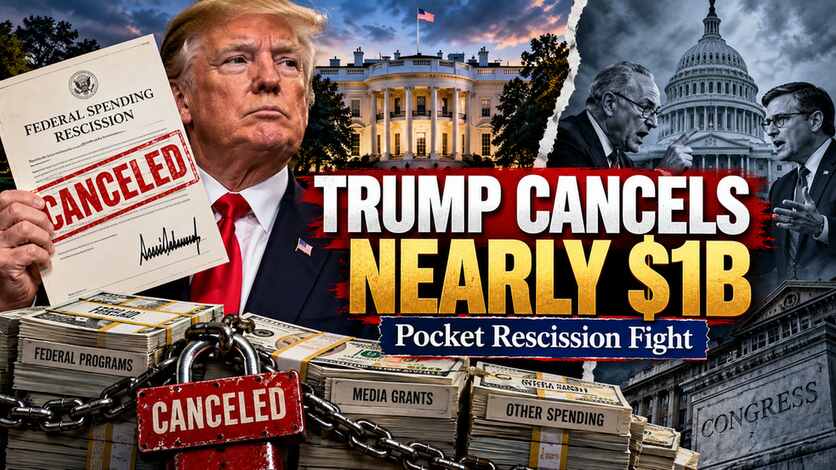
WASHINGTON — September 29, 2026. President Donald Trump has moved to cancel nearly $1 billion in previously appropriated federal spending through a controversial budget mechanism known as a pocket rescission, setting up another confrontation between the White House and Congress over who ultimately controls federal spending.
The White House announced the action on September 25, saying the administration was using the Impoundment Control Act to eliminate spending it considers wasteful or harmful. The administration described the package as “another nearly $1 billion” in rescissions. The White House
The largest category listed by the White House is $567 million in Health and Human Services funding for programs serving refugees, asylum seekers and other non-citizens. The administration also identified funds involving immigration legal services, migrant support programs, international education, housing counseling, minority-business programs and health research. The White House
What the White House says it canceled
According to the White House, the rescission package targets several categories of funding, including:
- $567 million in HHS services for refugees, asylees and other non-citizens;
- $15 million in DHS-related legal, mental-health and orientation services;
- $10 million in immigration-related grant programs;
- $25 million in education programs for migrant students;
- $15 million for the Justice Department’s Community Relations Service;
- $9 million in debt-relief programs tied to climate policies abroad;
- $10 million for Minority Business Development Agency programs;
- $70 million in international education programs;
- $28 million in HHS research funding;
- $56 million in HUD housing-counseling programs;
- additional race- and health-related grant programs. The White House
The White House’s descriptions of these programs are strongly political. Terms such as “open-borders NGO,” “woke,” “radical” and “wasteful” are the administration’s characterizations, not independent legal findings.
$810 million or nearly $1 billion?
One important distinction is that Senate Appropriations Committee Chair Susan Collins described the formal rescissions package sent to Congress as $810 million.
Collins, a Republican from Maine, said the administration had sent Congress an $810 million pocket-rescission package “without warning or consultation.” Senate Appropriations Committee
The White House, however, publicly described the broader action as involving “nearly $1 billion” in spending. The White House
So both numbers appear in official sources, but they refer to slightly different descriptions of the action.
Why Congress is objecting
The central legal dispute is not primarily about whether the individual programs are good or bad.
It is about whether a president can effectively prevent congressionally appropriated money from being spent by submitting a rescission request so close to the end of the fiscal year that the funds expire before Congress can act.
That is what critics call a pocket rescission.
The Government Accountability Office has taken a clear position: pocket rescissions are not permitted under the Impoundment Control Act. GAO says that if Congress does not affirmatively approve a rescission, the funds must remain available for prudent obligation before they expire. Government Accountability Office
Collins echoed that argument, saying OMB was attempting to undermine Congress’s constitutional power of the purse and calling the maneuver unlawful. Senate Appropriations Committee
The White House takes the opposite position
The Trump administration argues that it has authority under the Impoundment Control Act to use pocket rescissions and points to its use of the mechanism in 2025.
OMB’s official page lists the September 25, 2026 Proposed Rescissions of Budgetary Resources, confirming that the administration formally submitted a new rescission package. The White House
The White House says the purpose is to prevent taxpayer money from being spent on programs it believes do not benefit American citizens. The White House
That conflict creates a direct separation-of-powers question:
Congress appropriates money. The president executes the law. But how much discretion does the executive branch have to refuse to spend funds that Congress has already approved?
Video analysis
The video analyzed for this article is titled “Trump just CANCELLED almost $1 BILLION in Corrupt CASH!”
The video accurately reflects several core facts: the administration announced a large rescission package, $567 million of the targeted funding involves HHS programs serving refugees, asylees and other non-citizens, and Collins publicly attacked the action as unlawful. The transcript also accurately notes that the dispute centers on congressionally appropriated funds and the Impoundment Control Act. Pasted text
However, the video’s broader claims that members of Congress are “in on the grift,” that the money is “corrupt cash,” or that recipients were effectively laundering taxpayer money through NGOs are commentary by the host. The official documents reviewed for this article do not establish criminal corruption or money laundering by Congress, grant recipients or the named organizations. Pasted text
One audit claim needs context
The video also cites a 2025 audit involving the Minority Business Development Agency and says roughly $15.4 billion of $16 billion in reviewed transactions — about 96% — had problems. The White House repeats that figure, but its own description says the category included duplicate transactions, missing or inadequate documentation, and transactions that should not have been approved based on the underlying activity. That is broader than saying 96% of the money was stolen or fraudulent. The White House
That distinction is important.
Audit deficiencies can indicate serious management failures, but they do not automatically equal criminal fraud.
What happens next
The legal conflict is likely to continue because the executive and legislative branches are taking fundamentally different positions.
GAO says pocket rescissions are unlawful. Collins says the action violates Congress’s appropriations authority. The White House says the president is exercising lawful authority to stop spending it regards as wasteful. Senate Appropriations Committee
The underlying constitutional question may eventually require judicial resolution.
Official Sources
White House — President Trump Takes Historic Action to Eliminate Wasteful and Harmful Spending
OMB — Proposed Rescissions of Budgetary Resources, September 25, 2026
Senate Appropriations Committee — Susan Collins Calls Pocket Rescissions Package Unlawful
Government Accountability Office — What Is a Pocket Rescission and Is It Legal?
GAO — Impoundment Control Act resources
Ask Midtown Tribune about this story
Answers are grounded first in this article. Search all Midtown Tribune reporting from the main AI Search page.
AI-generated summary. Verify important details in the linked original articles.