
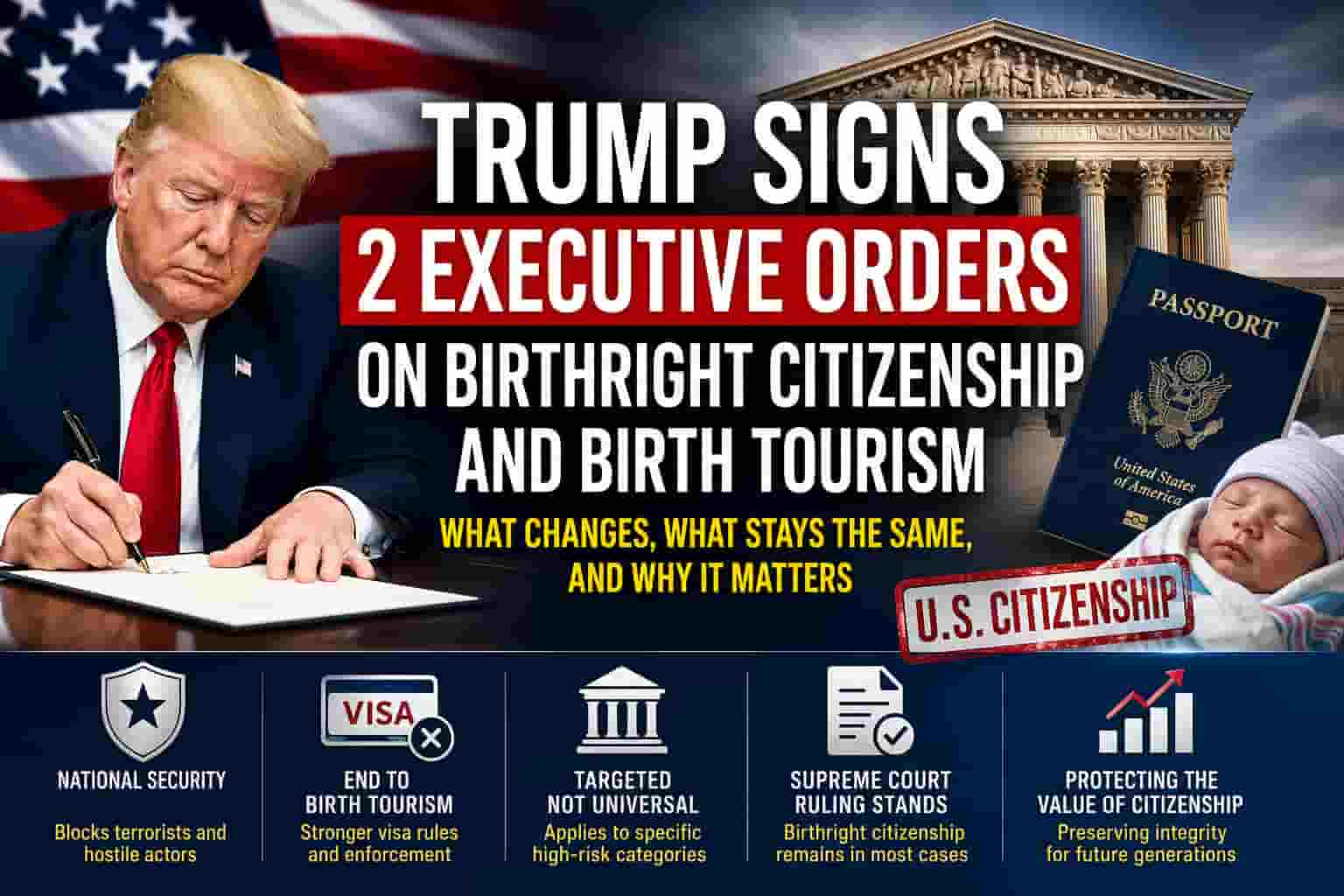
The August 6 actions target designated terrorists, foreign-government personnel, commercial birth arrangements and visa misuse—but they do not abolish birthright citizenship in the United States.
By Midtown Tribune Staff | August 6, 2026
President Donald Trump signed two executive orders on Thursday addressing birthright citizenship and so-called birth tourism.
The first order instructs federal agencies not to issue or recognize citizenship documents in several narrowly listed circumstances involving foreign terrorists, certain foreign-government personnel and commercial or fraudulent arrangements designed to obtain citizenship through a birth in the United States.
The second order gives the State Department and Department of Homeland Security additional authority to deny or revoke visas, block entry, pursue removal and take action against people or organizations involved in birth-tourism operations.
The actions are significant, but they do not eliminate the Citizenship Clause of the Fourteenth Amendment. A June 30 Supreme Court decision held that children born in the United States to parents who are unlawfully or temporarily present are generally subject to U.S. jurisdiction and are citizens at birth.
What the First Order Does
The first order is titled “Continuing to Protect the Meaning and Value of American Citizenship.”
It applies when neither parent is a U.S. citizen and at least one parent falls within a category identified by the administration.
Those categories include a parent who is:
- legally classified as an “alien enemy”;
- a member of a State Department-designated foreign terrorist organization;
- designated by the United States as a specially designated global terrorist;
- serving in the United States as an official employee of a foreign government;
- employed by a foreign embassy or consulate;
- working for an international organization while protected by diplomatic-style immunity; or
- participating in a commercial or fraudulent arrangement intended to secure U.S. citizenship for a child through birth in the country.
The order also covers certain paid arrangements designed to ensure that a pregnant woman is physically present in the United States when she gives birth. It separately mentions commercial surrogacy arrangements in which access to birthright citizenship is part of the transaction.
Federal agencies are directed to prepare public implementation guidance within 30 days.
What the Birth-Tourism Order Does
The second order, titled “Ending Birth Tourism,” defines birth tourism as entering the United States on a nonimmigrant visa for the purpose of giving birth or helping another person enter for that purpose.
Under the order, the State Department and DHS may, within their existing statutory authority:
- deny a visa or travel authorization;
- revoke a previously issued visa;
- refuse admission at the border;
- begin removal proceedings;
- impose a permanent bar on future entry where authorized by law; and
- take action against individuals, companies and organizations that facilitate birth-tourism operations inside or outside the United States.
The order allows humanitarian and national-interest exceptions. It does not state that every pregnant visitor must be denied entry. Enforcement is supposed to focus on the visitor’s actual purpose and on organized arrangements designed to obtain citizenship through a planned U.S. birth.
Birth Tourism Was Already Restricted
Birth tourism was not previously treated as an acceptable use of a visitor visa.
In January 2020, the State Department amended its visa regulations to permit consular officers to deny a B-category visitor visa when they had reason to believe that the applicant’s primary purpose was to give birth in the United States so that the child would obtain citizenship.
Current State Department guidance continues to state that birth tourism is not a permissible basis for a visitor visa.
The August 6 order goes beyond the earlier visa rule by emphasizing enforcement against organizers and commercial networks, as well as possible visa revocation, removal and future entry restrictions.
Why the Orders Affect U.S. Adversaries
The national-security portion of the first order directly identifies categories tied to hostile or sanctioned foreign activity.
It includes members of officially designated foreign terrorist organizations and individuals classified by the United States as global terrorists. Under the administration’s approach, such a person should not be able to create an automatic citizenship claim for a child merely by arranging for the birth to occur on American territory.
The order also reaches foreign-government personnel. This category is broader than terrorists or representatives of openly hostile governments: it may also include employees of governments friendly to the United States. Therefore, it would be inaccurate to describe every person covered by the order as an American adversary.
The more precise point is that the order attempts to prevent foreign governments, sanctioned individuals, terrorist organizations and organized commercial networks from using childbirth as a pathway to a U.S. citizenship document.
The second order targets the infrastructure supporting such arrangements. A commercial birth-tourism operation can include recruiters abroad, visa assistance, transportation, temporary housing, medical coordination and instructions on concealing the real purpose of the trip. The order authorizes enforcement not only against the prospective parent but also against people and organizations facilitating the scheme.
What the Supreme Court Has Already Decided
The constitutional limit on the administration’s actions is substantial.
In Trump v. Barbara, decided June 30, 2026, the Supreme Court concluded that children born in the United States to parents who are unlawfully present or temporarily visiting the country are generally within U.S. jurisdiction and are citizens at birth.
The Court described the recognized historical exceptions as narrow. They include children of foreign diplomats and births occurring in territory outside the sovereign control of the United States, such as territory under hostile occupation.
The ruling also states that foreign visitors remain subject to American law while they are in the country. As a result, their U.S.-born children ordinarily receive citizenship under the Fourteenth Amendment.
That means Trump did not end birthright citizenship for all children of undocumented migrants, tourists, students or temporary workers.
Several provisions of the new first order appear to extend beyond the traditional diplomatic exception discussed by the Court. Their ultimate legal durability is therefore uncertain and will likely depend on further litigation and how federal agencies implement them.
What the Birth Statistics Actually Show
Federal data do not provide an exact annual count of children born to foreign citizens who automatically become U.S. citizens.
The Centers for Disease Control and Prevention recorded 3,628,934 births to U.S. residents in 2024. The CDC’s natality files also recorded 9,502 births occurring in the 50 states and Washington, D.C., to mothers whose usual residence was outside the United States. An additional 74 births to foreign residents were recorded in U.S. territories.
The 9,502 figure should not be described as the number of birth-tourism cases.
It can include:
- American citizens who normally live abroad;
- foreign residents who entered for legitimate medical, family or business reasons;
- women who unexpectedly gave birth while traveling;
- and other circumstances unrelated to a planned citizenship arrangement.
At the same time, a woman participating in an organized birth-tourism operation could provide a temporary U.S. address and might not appear in the foreign-residence category.
Birth records identify information such as the mother’s birthplace and usual residence, but the standard federal birth data do not establish whether she is a U.S. citizen, permanent resident, temporary visa holder or undocumented migrant. They also do not establish her primary purpose for entering the country.
Consequently, there is no precise official federal number for all children born annually to foreign citizens or specifically through birth tourism.
What Happens Next
The immediate effect of the orders will depend on regulations and implementation guidance from the State Department, DHS, the Department of Justice, the Social Security Administration and other federal agencies.
The birth-tourism provisions largely rely on established federal authority over visas and admission to the country. The citizenship-document provisions face a more complicated constitutional question because the Supreme Court has already affirmed a broad application of the Fourteenth Amendment’s Citizenship Clause.
The most accurate description of Thursday’s action is therefore this:
Trump did not abolish birthright citizenship. He signed two orders seeking to restrict citizenship documentation in specific categories and to expand federal enforcement against birth tourism, designated terrorists, certain foreign-government personnel and organized visa-fraud networks.
Official Sources
- White House: Continuing to Protect the Meaning and Value of American Citizenship — full text of the August 6, 2026 executive order.
- White House: Ending Birth Tourism — full text of the second August 6 executive order.
- White House Fact Sheet on Birth Tourism and Citizenship — the administration’s official summary of the two actions.
- White House: January 20, 2025 Birthright-Citizenship Order — the administration’s earlier and broader executive action.
- U.S. Supreme Court: Trump v. Barbara — full June 30, 2026 opinion in PDF format.
- Constitution Annotated: Fourteenth Amendment — the official congressional publication of the Citizenship Clause.
- U.S. Department of State: Birth Tourism Visa Update — official explanation of the 2020 visitor-visa rule.
- U.S. Department of State: Visitor Visa Guidance — current official rules for temporary visitors.
- Federal Register: Visas for Temporary Visitors — official text of the federal birth-tourism visa regulation.
- CDC: Final U.S. Birth Data for 2024 — official National Vital Statistics System report.
- CDC: 2024 Natality Public-Use File User Guide — official methodology and counts for resident and foreign-resident births.
- CDC: Vital Statistics Online Data Portal — official access to federal birth-data files and documentation.
All links lead to official United States government sources. Accessed August 6, 2026.
Ask Midtown Tribune about this story
Answers are grounded first in this article. Search all Midtown Tribune reporting from the main AI Search page.
AI-generated summary. Verify important details in the linked original articles.