
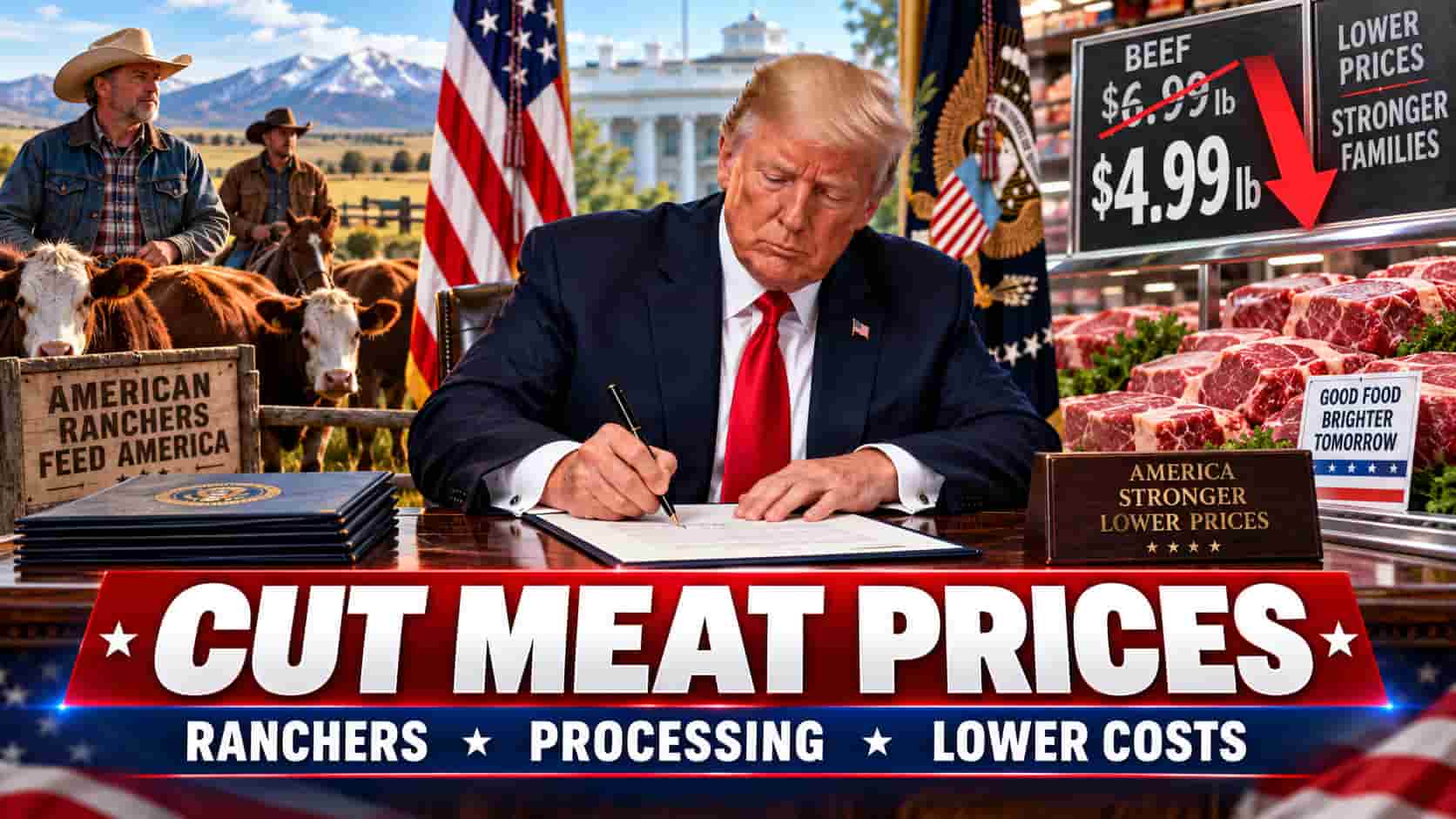
WASHINGTON — President Donald Trump signed two executive orders on September 4 aimed at strengthening America’s ranching industry, expanding opportunities for smaller meat processors, increasing competition in livestock markets and exploring a return to mandatory country-of-origin labeling for beef.
The orders also direct federal agencies to review protections for gray and Mexican wolves, strengthen enforcement against potentially unfair practices by large meat processors, modernize meat inspection rules and examine ways to allow more American-produced meat to move across state lines.
The White House says the broader objective is to strengthen domestic beef production while ultimately reducing costs for consumers.
Key Facts
- Trump signed two executive orders dealing with ranching, livestock markets and meat processing on September 4.
- Federal agencies have been ordered to review regulations affecting ranchers and recommend changes designed to improve financial viability and market access.
- The Interior Department must determine whether gray wolves and Mexican wolves qualify for delisting or downlisting under the Endangered Species Act.
- USDA must examine possible legislation and administrative action involving mandatory country-of-origin labeling for beef.
- A separate order calls for stronger enforcement of the Packers and Stockyards Act.
- The administration wants to expand opportunities for smaller producers to butcher, process, package and sell meat while maintaining federal food-safety requirements.
- Some of the most consequential changes are not immediate and will require agency rulemaking, further legal review or congressional action.
Trump Orders Government-Wide Review of Policies Affecting Ranchers
The first executive order, titled “Supporting America’s Ranchers,” launches a broad review of federal policies affecting livestock producers.
The White House says the national cattle herd is at a roughly 75-year low while consumer demand for beef has increased by nearly 10 percent over the past decade.
The order directs several federal agencies — including the Department of the Interior, U.S. Trade Representative, Food and Drug Administration and Small Business Administration — to examine regulations, guidance and other federal policies affecting ranchers.
The agencies are expected to recommend further actions intended to improve ranchers’ financial viability and access to markets.
Read the White House Executive Order: Supporting America’s Ranchers
Wolf Protections Could Be Reconsidered
One of the most significant environmental provisions concerns gray wolves and Mexican wolves.
The executive order directs the Secretary of the Interior to determine whether either species meets the legal criteria for delisting or downlisting under the Endangered Species Act.
If the statutory criteria are met, the Interior Department is instructed to begin the appropriate process.
The administration is also reviewing policies related to livestock losses caused by predators and protections available to ranchers.
Administration Opens Door to Mandatory Country-of-Origin Beef Labeling
The order also directs USDA to study the potential return of mandatory country-of-origin labeling for beef.
That could eventually make it easier for consumers to distinguish beef originating from cattle raised in the United States from imported products.
But Trump’s September 4 action does not itself immediately establish a new mandatory labeling system.
During questioning after the signing ceremony, Trump acknowledged that Congress may have a role in implementing such a policy.
Asked when consumers could expect country-of-origin labeling, Trump said the issue would be “a little bit involved with Congress” and said the administration was putting the matter before lawmakers.
Second Order Targets Competition in the Meatpacking Industry
Trump’s second executive order, “Promoting Fair Competition in Livestock Markets and Expanding Market Access for American Meat Producers,” focuses on meat processing and competition.
The administration says American ranchers should have greater ability to butcher, process, package and sell their products without becoming unnecessarily dependent on a small number of large processing companies.
The order directs USDA to prioritize investigations of potential violations of the Packers and Stockyards Act, increase resources devoted to those investigations and review existing policy to strengthen protections against unfair, deceptive or monopolistic practices.
Read the Executive Order on Livestock Competition and Meat Processing
Smaller Ranchers Could Process Meat Closer to Home
Another major goal is expanding regional and small-scale meat processing.
The White House says the policy is intended to reduce barriers that prevent ranchers from processing their own livestock and reaching consumers directly.
The administration is also directing USDA to modernize meat inspections, focus requirements more closely on core food-safety objectives and reduce regulations that it says add costs without producing corresponding safety benefits.
Trump emphasized the issue during the ceremony.
“Our ranchers are going to be able to do their own food processing.”
He said smaller producers would still face inspections and sanitation requirements but would not necessarily have to transport livestock hundreds of miles to major processing facilities.
Interstate Meat Sales Could Expand
The second order also calls for examining federal restrictions affecting the interstate sale of meat processed by smaller facilities.
The administration argues that appropriately inspected meat should have greater access to customers beyond the state where it was processed.
The White House describes the policy as a way to create more competition, provide alternatives to major processing companies and open new markets for independent ranchers and small processors.
Beef Imports Remain Part of Administration’s Price Strategy
Trump was also questioned about imported beef.
He said current imports were coming primarily from Argentina and Brazil, although other countries could eventually be included.
Trump characterized those imports as limited and said American ranchers are rebuilding cattle herds.
The administration had separately moved in August to temporarily increase the amount of certain lean beef trimmings that could enter the United States without an above-quota tariff.
The White House said that action was designed to increase the supply available for ground beef while domestic cattle inventories recover.
What Is Not Yet Final
The September 4 executive orders establish administration policy and give federal agencies specific assignments, but several headline provisions still require additional steps.
Mandatory country-of-origin labeling may require congressional involvement.
Changes to protections for wolves would have to proceed under the requirements of the Endangered Species Act.
Expanded interstate meat sales and inspection changes will depend on USDA implementation and existing federal law.
In other words, the executive orders begin regulatory and legislative processes; they do not instantly rewrite every existing rule governing American beef production.
Trump on Data Centers: Build Your Own Power Plants
After discussing agriculture, Trump took questions on a much broader range of subjects, including artificial intelligence and data centers.
Asked about communities that oppose data-center construction because of concerns over energy use and AI, Trump strongly defended the projects.
He said newly approved data centers are increasingly being allowed to construct their own electricity generation.
“They all create their own energy.”
Trump said the facilities can build their own power plants instead of relying entirely on the existing electrical grid and claimed excess electricity can be returned to the grid.
“The excess is going back into the grid.”
Trump argued that such projects could increase local tax revenue, attract investment and eventually help reduce electricity costs.
“Whoever Wins AI Wins”
Trump was then asked whether he worries about artificial intelligence getting out of control or launching cyberattacks.
He said the government is watching the technology closely but framed AI primarily as a strategic competition between the United States and China.
“Whoever wins AI wins.”
Trump called artificial intelligence a technological revolution and said he believes it could ultimately be more consequential than the internet.
He also pointed to potential medical discoveries as one area where AI could have enormous impact.
Trump Calls Iran Fighting a “Military Conflict”
Foreign policy also dominated part of the question-and-answer session.
Asked whether continuing U.S. military action against Iran should be described as a war, Trump called it a “military conflict” and described U.S. strikes as intermittent.
Trump said 18 American service members had been killed and argued that U.S. military action prevented Iran from obtaining a nuclear weapon.
Those were presidential statements during the press availability and were unrelated to the two agricultural executive orders signed earlier in the event.
Trump Says Putin Is “Not Looking to Attack NATO Territory”
A reporter also questioned Trump about Russia and NATO following reports involving an explosive drone found at a German airport.
Trump responded:
“Putin’s not looking to attack NATO territory.”
Trump said he knows Russian President Vladimir Putin well and does not believe Putin is seeking an attack on NATO territory.
The statement represented Trump’s assessment; it was not an independently established finding presented during the event.
Witkoff and Kushner Sent on Russia-Ukraine Peace Effort
Trump also confirmed that Steve Witkoff and Jared Kushner were being sent as negotiators in another attempt to reach an agreement involving Russia and Ukraine.
Asked whether they were carrying a new proposal, Trump said:
“They’re bringing with them a proposal to end the war.”
Trump later argued that intense personal hostility between Ukrainian President Volodymyr Zelenskyy and Russian President Vladimir Putin is making negotiations more difficult.
“They truly hate each other.”
Trump said he nevertheless believes there may be a chance to reach an agreement.
Xi Jinping Expected at White House on September 24
Near the end of the event, Trump said Chinese President Xi Jinping is expected to visit on September 24.
Trump said the administration plans to hold a state dinner and described his personal relationship with Xi as good despite the broader strategic and economic competition between the United States and China.
Why It Matters
The most consequential part of the September 4 event is the administration’s attempt to restructure parts of the American cattle and meat-processing market.
The policy combines several different approaches:
More domestic production. The White House wants to rebuild the U.S. cattle herd and improve the financial position of ranchers.
More processing competition. Smaller and regional processors could receive greater opportunities to compete with major meatpacking companies.
More direct market access. Ranchers could gain additional ways to process and sell meat closer to where livestock is raised.
More origin transparency. The administration is examining a return to mandatory country-of-origin labeling.
Consumer prices remain part of the equation. The White House is simultaneously using limited beef imports and domestic supply-side policies in an effort to increase supply and put downward pressure on beef prices.
The central question now is how quickly USDA, Interior and other agencies can convert Trump’s directives into enforceable rules — and which portions will ultimately require Congress.
Official Sources
White House — Supporting America’s Ranchers Executive Order
White House — Fact Sheet: President Donald J. Trump Supports America’s Ranchers
White House — Executive Order on Fair Competition in Livestock Markets and Meat Processing
White House — Fact Sheet on Livestock Competition and Meat Processing
White House — September 4 Executive Orders Video Library
Ask Midtown Tribune about this story
Answers are grounded first in this article. Search all Midtown Tribune reporting from the main AI Search page.
AI-generated summary. Verify important details in the linked original articles.