
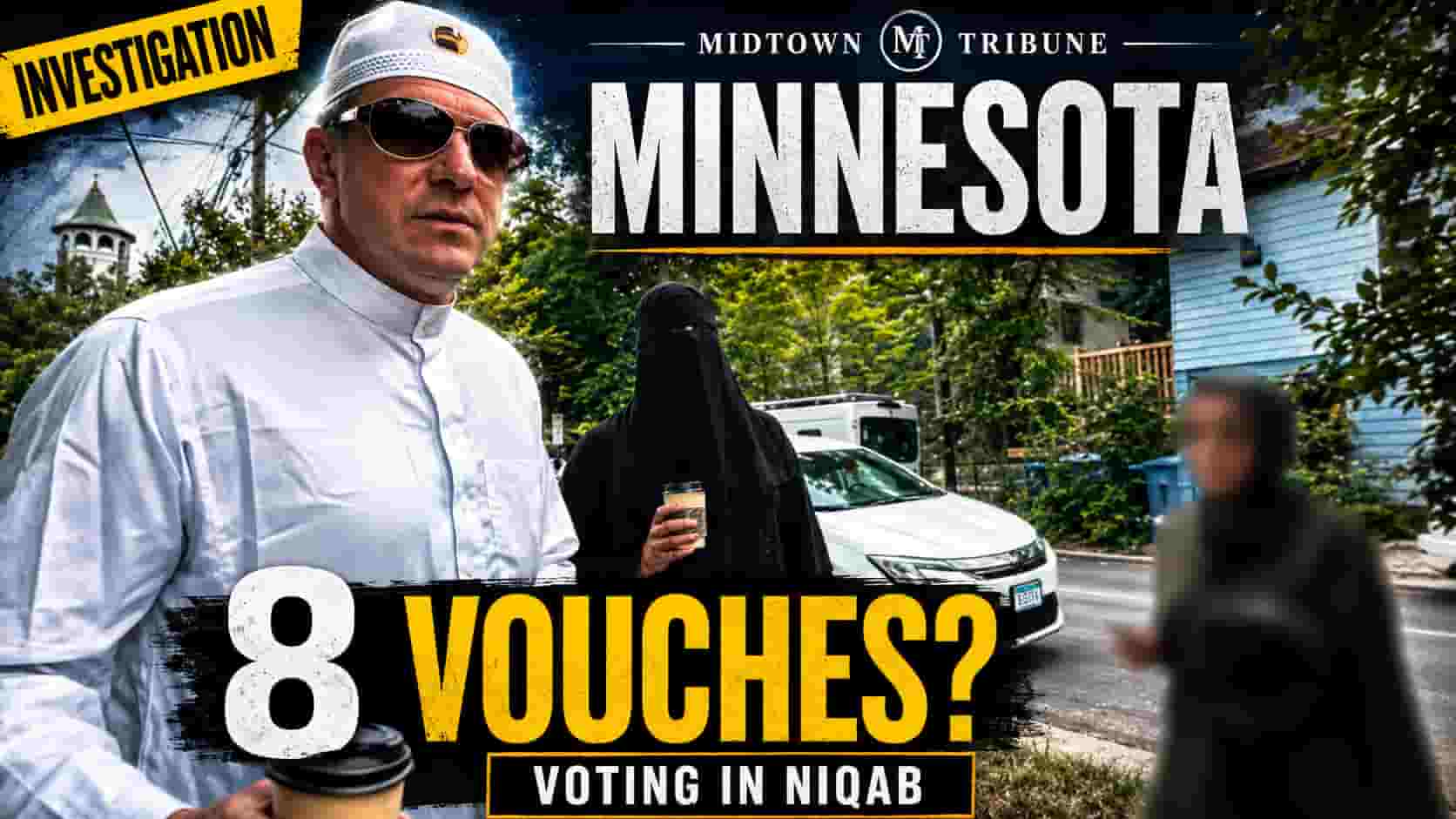
An undercover investigation at Minneapolis polling places tested Minnesota’s unusual Election Day voter-vouching system. State law confirms that one registered voter may vouch for up to eight Election Day registrants without those registrants using standard photo ID as proof of residence — and residential-facility staff can vouch for an unlimited number of eligible residents. Official state forms also allow an applicant to state that he or she has no Minnesota ID, driver’s license or Social Security number. The key question is what is verified before a ballot is issued, and what is checked only afterward.
On August 11, 2026 — Minnesota’s State Primary Election Day — journalist James O’Keefe, undercover reporters from O’Keefe Media Group (OMG) and members of the Justice League entered polling locations across Minneapolis to test Minnesota’s voter “vouching” rules.
OMG said O’Keefe and members of the team dressed in traditional Muslim attire. The organization described journalist Cam Higby’s face-covering garment as a burka. The operation deliberately presented polling workers with what OMG called an “extreme” scenario: multiple people who were not registered, did not present standard identification, and a registered voter willing to vouch for them.
The original O’Keefe Media Group investigation was published August 13.
The date and location of the operation are independently confirmed by official election records. The City of Minneapolis election calendar lists the 2026 Minnesota State Primary on August 11, 2026.
What O’Keefe’s Team Was Told Inside Minneapolis Polling Places
At the first location, according to the OMG investigation, O’Keefe told a polling worker that the people with him were not registered.
He asked whether he could vouch for them.
The worker told him that he could.
O’Keefe then asked whether he could leave and return with five additional people. The election worker explained that he could vouch for as many as eight.
At another Minneapolis polling location, the team received essentially the same explanation: if the individuals lived within the precinct and O’Keefe was registered there, he could vouch for them as proof of residence.
One poll worker summarized the voucher’s role with the striking statement:
“You’re the ID.”
At another location, an undercover reporter asked what happens after a voter is vouched for and whether the person’s eligibility is actually verified.
According to OMG’s recording, the worker answered:
“After the fact, yeah.”
The full context of those exchanges is available in the original OMG report and video.
Minnesota Law Really Does Allow One Voter to Vouch for Eight People
This part of the investigation is not merely an interpretation by O’Keefe.
It is written into Minnesota law.
Under Minnesota Statutes §201.061, subdivision 3, a person eligible to vote may register at the polling place on Election Day by completing a registration application, taking the required oath and proving residence.
One legal method of proving residence is for a voter already registered in that precinct to sign an oath before an election judge stating that the voucher personally knows the applicant is a resident of the precinct.
The statute expressly provides that:
a registered voter in the precinct may sign up to eight proof-of-residence oaths on an Election Day.
The Minnesota Secretary of State’s official Election Day registration instructions say the same thing: a registered voter from the precinct may accompany another voter and confirm that person’s address, and a registered voter may vouch for up to eight voters.
The state’s 2026 Election Judge Manual instructs polling officials to record the number of people for whom each voucher has vouched and states that ordinary voters cannot vouch for more than eight.
What Does the Voucher Actually Verify?
This distinction is critical.
A voucher does not certify that another person is a U.S. citizen.
A voucher certifies residence.
The official Election Day Voter Registration Application contains the voucher’s oath. The voucher swears that he or she personally knows that the named applicant “is a resident of this precinct.”
The applicant separately completes and signs the voter-registration application.
Minnesota law requires a voter to be a U.S. citizen. Under Minnesota Statutes §201.014, an eligible voter must, among other requirements, be at least 18 years old, be a citizen of the United States and have maintained residence in Minnesota for the required period.
Therefore, vouching does not legally authorize a noncitizen to vote.
The issue raised by the investigation is different: what documentary or database verification of the applicant’s identity and eligibility is completed before that Election Day registrant receives a ballot?
What If the Applicant Has No Minnesota ID or Social Security Number?
This is one of the most significant details in Minnesota’s official documents.
The state’s own Election Day Voter Registration Application allows an applicant to indicate that he or she has:
- no Minnesota-issued driver’s license;
- no Minnesota-issued identification card; and
- no Social Security number.
This is not an interpretation of the form. It is an actual option printed on the official Secretary of State application.
Minnesota Statutes §201.071 requires an applicant who has a Minnesota driver’s-license or state-ID number to provide it. If the person has no Minnesota license or ID, the applicant is instructed to provide the last four digits of the Social Security number if the person has been issued one.
The same statute expressly states that a voter-registration application from someone who does not have a Minnesota driver’s license, Minnesota identification number or Social Security number is not deficient merely because those numbers are absent.
That distinction matters.
A person using vouching is not necessarily required to present a physical driver’s license or other standard photo ID to the election judge as proof of residence. Instead, the voucher can serve as the legally recognized proof that the person resides in the precinct.
The applicant then signs the voter-registration application and certifies the required information under penalty of law.
The ID Number Is Used for Database Matching — But What Happens When There Is No Number?
The official registration form explains that election officials use a voter’s date of birth and identification number to confirm identity through the Minnesota Department of Public Safety or Social Security Administration.
But Minnesota’s rules also expressly contemplate applicants for whom no Minnesota driver’s-license number, Minnesota ID number or Social Security number can be used for that verification.
Under Minnesota Rule 8200.9310, voter-registration information normally is compared with Department of Public Safety records or, where applicable, Social Security Administration information.
The same rule, however, states that when an applicant has no Minnesota driver’s-license number, Minnesota identification number or Social Security number that can be verified, the unique voter-record number generated by Minnesota’s statewide voter-registration system is used as the verification number for that record.
That does not mean there are no safeguards. It does mean that possession of a Minnesota photo ID or Social Security number is not an absolute prerequisite for the creation of a Minnesota voter record.
Election Day Registrations Can Be Investigated After the Vote
Minnesota also has a post-registration verification process.
Minnesota Rule 8200.5500 provides that Election Day registrations are compared with information in Minnesota’s statewide voter-registration system and government databases.
If the information cannot be verified, the county auditor must investigate the discrepancy and send the Election Day registrant a notice requesting that the voter contact the registration office.
If the discrepancy cannot be resolved, the county auditor must challenge the voter’s record and may refer the matter to the county attorney.
If Department of Public Safety information affirmatively indicates that the voter was ineligible, the auditor must challenge the record and refer the matter to the county attorney.
This is an important safeguard.
It also raises an unavoidable timing question: if a discrepancy is discovered after the Election Day voter has already received and cast a ballot, what identity and eligibility checks had been completed before that ballot entered the election system?
That is the issue highlighted by the election worker’s recorded response to OMG that verification happens “after the fact.”
Already Registered Voters Generally Do Not Need to Show ID
The question becomes broader than Election Day registration.
The Minnesota Secretary of State states explicitly that if a voter’s registration is current and active, the voter does not need to bring identification to the polls.
The City of Minneapolis gives voters the same instruction: if a voter’s registration is current, identification does not have to be brought to the polling place.
That policy does not make voter impersonation legal. It raises a different election-security question: how is a polling worker expected to distinguish between the legitimate registered voter and another physical person claiming to be that voter when photo identification is not universally required?
The concern becomes particularly visible when a person’s face is covered, although the underlying issue is not religious clothing. The policy question exists whenever election officials are required to rely primarily on the voter record and the person’s sworn representation rather than universal photo-ID comparison.
Could One Person Simply Vote Eight Times?
Nothing in the O’Keefe investigation establishes that O’Keefe, Higby or anyone else actually registered eight fictitious voters and then cast eight ballots.
That distinction matters.
The video demonstrates that election workers repeatedly explained that one eligible voucher could vouch for as many as eight unregistered voters. It does not, based on the published OMG account, document eight completed fraudulent registrations followed by eight illegally cast ballots.
Minnesota law also explicitly criminalizes such conduct.
Minnesota Statutes §204C.14 prohibits a person from intentionally misrepresenting his or her identity when applying for a ballot and prohibits voting more than once at the same election.
A violation is a felony.
Therefore, the relevant public-policy question is not whether Minnesota law permits a person to impersonate eight voters. It plainly does not.
The question is:
What real-time mechanism detects an individual attempting to use multiple different voter records before the ballots are cast, particularly where no universal photo-ID requirement applies?
The answer cannot simply be that multiple voting is illegal. Criminal prohibition and real-time prevention are two different election-security issues.
The State Tracks the Eight-Person Voucher Limit
Minnesota does have a mechanism for keeping a normal voucher from repeatedly vouching for additional groups of eight under the same voter record.
Minnesota Rule 8200.9940 requires polling officials to track people who vouch for Election Day registrants.
The official form contains the voucher’s name and internal Voter ID number, and election judges are instructed to cross off a number each time the voucher vouches for another registrant.
For an ordinary registered voter, the maximum is eight.
That “Voter ID number” should not be confused with a physical voter-identification card. It is an internal voter-record identifier used by election officials.
The 2026 Minnesota Election Judge Manual similarly tells registration judges to verify and record the voucher’s voter ID number, when pre-registered, and keep track of how many people that record has vouched for.
There Is an Exception: Residential-Facility Staff Have No Eight-Person Limit
Minnesota law contains another remarkable provision.
The ordinary eight-person limit does not apply in the same way to qualifying employees of residential facilities who are vouching for residents of those facilities.
The official Minnesota Election Judge Manual states directly that ordinary voters may vouch for no more than eight people, while:
“Staff of residential facilities have no limit.”
Minnesota Rule 8200.9940 is even more explicit: employees of residential facilities may vouch for an unlimited number of facility residents who are registering to vote at the facility’s address.
The Minnesota Secretary of State’s residential-facility guidance explains that a staff member may vouch for all eligible voters who are residents of the facility, provided the employee proves his or her employment to election officials.
The Secretary of State lists qualifying facilities including assisted-living facilities, nursing homes, homeless shelters, battered-women’s shelters, adult foster-care programs, transitional housing, veterans’ homes, residential treatment programs and other qualifying residential settings.
This exception is legal and expressly established by Minnesota’s election rules. It is not evidence that fraudulent voting occurred at such facilities.
But it is another area in which Minnesota’s election system relies heavily upon legally binding attestations rather than requiring every Election Day registrant to present a conventional photo ID.
The Applicant Is Signing Under Penalty of Felony
Any analysis of the system also must acknowledge its legal safeguards.
A person registering and voting is not simply giving a name verbally and walking directly to a ballot box.
The 2026 Election Judge Manual instructs registration judges to verify that the voter is at the correct polling place, confirm that the voter has not already been identified as having voted, require completion of the registration application, confirm proof of residence and have the voter sign the Election Day Registration Roster before issuing a voter receipt.
The applicant certifies eligibility, including U.S. citizenship.
Minnesota Statutes §204C.14 makes intentional voter impersonation and voting more than once at the same election felonies.
Those safeguards are real.
The unresolved policy question is whether an oath, voter-record lookup and later database verification are sufficient substitutes for a mandatory real-time photo-ID check when the objective is to prevent — rather than merely investigate afterward — identity-based election fraud.
DOJ Had About 20 Federal Election Monitors in the Area
There is another notable fact surrounding the August 11 primary.
The U.S. Department of Justice announced that approximately 20 federal personnel from the Civil Rights Division’s Voting Section and the U.S. Attorney’s Office for Minnesota were monitoring polling places in Hennepin and Ramsey counties.
Minneapolis is in Hennepin County.
DOJ said the initiative was intended to promote transparency and communication between poll observers and election monitors and noted that the department had also monitored elections in Minnesota in 2020, 2022 and 2024.
The presence of DOJ monitors does not establish that federal authorities confirmed the allegations or concerns raised in the O’Keefe video.
As of this publication, the official DOJ announcement does not say that investigators established eight illegal votes, a mass voter-impersonation scheme or fraudulent registrations resulting from the incidents shown by OMG.
What the O’Keefe Investigation Proves — and What It Does Not
The facts supported by official documents are significant enough without overstating them.
Confirmed by Minnesota’s own rules:
A registered voter in a precinct can vouch for the residence of as many as eight Election Day registrants.
Vouching can substitute for conventional proof of residence.
An Election Day registration form expressly allows a person to state that he or she has no Minnesota driver’s license, no Minnesota ID and no Social Security number.
A voter-registration application is not automatically deficient merely because none of those numbers exists.
Minnesota rules contemplate the creation of an internal unique voter-record number where the usual identification numbers cannot be used for verification.
Election Day registrations that cannot be verified are subject to subsequent investigation and potential challenge.
A voter whose registration is already current and active generally does not have to show identification at the polling place.
Residential-facility employees can vouch for an unlimited number of eligible residents of their qualifying facility.
All of those points are supported by Minnesota government documents.
What has not been established by the published OMG material:
The investigation does not document O’Keefe successfully registering eight fictitious people and then casting eight ballots in their names.
It does not establish that a single individual actually voted repeatedly under eight identities.
And it does not, by itself, prove a statewide or mass fraud operation.
Those claims would require additional evidence.
Midtown Tribune Analysis: The Question Is Prevention, Not Merely Punishment
Minnesota officials can correctly point to multiple safeguards: sworn applications, felony penalties, voter-record tracking, statewide databases, post-election verification, challenge procedures and referrals to prosecutors.
Those protections should not be ignored.
But the O’Keefe investigation raises a narrower question that deserves a direct response from election officials:
When an Election Day registrant uses a voucher as proof of residence, has no Minnesota ID and no Social Security number, and does not present conventional photo identification, what mandatory procedure establishes — before the ballot is issued — that the individual standing before the election judge is actually the person whose name is being entered into the voter system?
And for already registered voters:
If photo ID is not required, what prevents one physical person from attempting to use multiple different voter records, particularly if normal visual recognition is difficult?
Minnesota law makes such conduct a felony. That answers whether it is legal.
It does not by itself answer the separate election-security question of how it is detected before a ballot is cast rather than after the election.
The distinction between those two questions — legality and real-time prevention — is where the O’Keefe investigation deserves serious scrutiny rather than either automatic dismissal or unsupported claims of proven mass fraud.
Primary Investigation Source
Official Sources
- Minnesota Legislature / Revisor of Statutes — §201.061: Election Day Registration and Vouching
- Minnesota Legislature / Revisor of Statutes — §201.014: Eligibility to Vote
- Minnesota Legislature / Revisor of Statutes — §201.071: Voter Registration Applications
- Minnesota Legislature / Revisor of Statutes — §204C.10: Polling Place Roster and Voter Oath
- Minnesota Legislature / Revisor of Statutes — §204C.14: Unlawful Voting, Impersonation and Multiple Voting
- Minnesota Rule 8200.5500 — Verification of Election Day Registrations
- Minnesota Rule 8200.9310 — Voter Registration Database Verification and Unique Voter Record Number
- Minnesota Rule 8200.9940 — Precinct List of Persons Vouching and Residential-Facility Exception
- Minnesota Secretary of State — Official Election Day Voter Registration Application
- Minnesota Secretary of State — Register on Election Day
- Minnesota Secretary of State — Do I Need to Bring ID?
- Minnesota Secretary of State — Voting and Registration in a Residential Facility
- Minnesota Secretary of State — 2026 Election Judge Manual
- City of Minneapolis Elections — 2026 Election Calendar
- City of Minneapolis Elections — Election Day Voting and Identification Requirements
- U.S. Department of Justice — Election Monitoring in Minnesota Primary Election, August 11, 2026
Ask Midtown Tribune about this story
Answers are grounded first in this article. Search all Midtown Tribune reporting from the main AI Search page.
AI-generated summary. Verify important details in the linked original articles.