The independent journalist described day-care centers without children, adult-care programs with impossible enrollment figures, billions in public money—and a political class that appears more alarmed by the camera than by the missing cash.
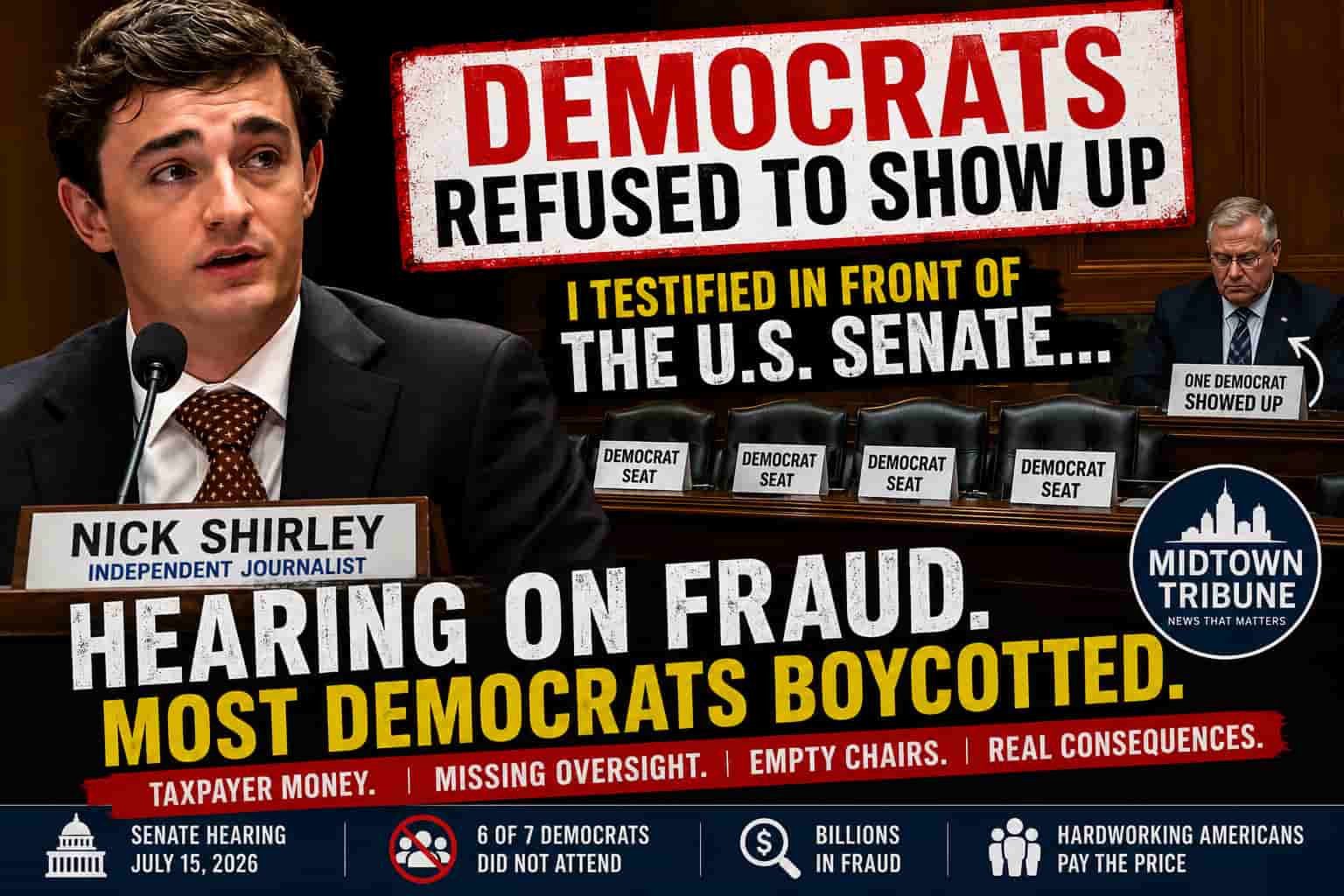
Nick Shirley’s latest video begins in Washington, D.C., where the independent journalist has just testified before the United States Senate about widespread fraud in government-funded programs.
The subject should have been comfortably bipartisan.
A stolen taxpayer dollar does not arrive wearing a MAGA hat or carrying a Democratic voter-registration card. It disappears equally from Republicans, Democrats and Americans who have stopped asking why every government program costs three times more than promised.
Yet according to Shirley, most Democratic members chose a remarkably efficient fraud-fighting strategy:
They did not come.
The committee’s ranking Democrat appeared briefly, criticized sensational social-media coverage and left without asking Shirley a question, the journalist says. The remaining Democratic seats were largely empty during the hearing shown in the video.
Washington had therefore achieved its traditional balance:
Republicans asked where the money went.
Democrats provided the furniture.
Quality Leaning Center: the typo that became a national symbol
At the center of Shirley’s Minnesota investigation was an establishment with an unforgettable sign:
Quality Leaning Center.
Not Quality Learning Center.
Leaning.
The people operating a publicly funded child-care facility, Shirley says, could not correctly spell the word learning on the building.
Apparently, spelling was optional.
Government reimbursement was not.
Shirley’s footage made the misspelled sign famous because it seemed to summarize the entire scandal. A facility reportedly received millions in taxpayer-funded child-care payments, yet when he arrived with a camera, there were no visible crowds of children and no obvious activity matching the scale of the public funding.
The sign promised neither learning nor proofreading.
It simply leaned confidently toward the Treasury.
During the Senate hearing, one senator said Shirley’s visit to the Quality Leaning Center showed how easy it appeared to be to receive government money without providing the expected services. The senator stated that roughly $10 million in taxpayer funds had gone to the center, while Shirley’s footage showed no children present during his visit.
Minnesota officials, the hearing was told, had previously insisted that the centers were operating as expected.
Perhaps expectations were simply very low.
Maybe the official checklist looked like this:
- Building exists: yes.
- Sign attached: yes.
- Word “learning” spelled correctly: not required.
- Millions transferred: completed.
Shirley’s revolutionary method: he went to the address
Senators asked Shirley how he identifies suspicious operations.
His method was disturbingly simple.
He searches public databases.
He identifies organizations receiving unusually large government payments.
He looks for numerical anomalies.
Then he commits the radical act that apparently separates independent journalism from modern government oversight:
He physically goes there.
Shirley described examining a New York City adult day-care facility that reportedly had 7,899 enrolled patients and had received $22.9 million. When he visited, he found a one-floor location that, in his view, could not possibly accommodate the reported number of clients.
The federal government has auditors, inspectors, analysts, investigators, databases, software contractors and conference rooms filled with people discussing interagency transparency frameworks.
Shirley has a camera and asks:
“How could nearly eight thousand patients fit in here?”
Washington may now need a new federal initiative called the National Program for Visiting the Address Printed on the Application.
Estimated initial cost: $14 billion.
Launch date: after a three-year feasibility study.
“No dollar is Republican or Democrat”
In his testimony, Shirley argued that fraud should not be a partisan issue.
When a fraudster steals from a government program, he said, the money is taken from every hardworking American taxpayer. The dollar does not ask which party its owner supports before disappearing.
But Shirley says the political response to his work has been intensely partisan.
He accused Democratic officials of attacking the investigator instead of addressing what he documented.
According to Shirley, Minnesota Gov. Tim Walz portrayed his reporting as white supremacy and dismissed him as a far-right conspiracy theorist. Shirley also said California Gov. Gavin Newsom’s office mocked him after his investigations into hospice and health-care programs.
This is a familiar political emergency procedure:
- A journalist finds a suspicious payment.
- A politician finds a suspicious adjective.
- Everyone debates the adjective.
- The payment continues enjoying its privacy.
Shirley’s complaint is not merely that Democratic politicians disagree with him.
It is that, in his view, they appear more eager to discredit the person holding the camera than to inspect the organization receiving the money.
Minnesota’s politically protected fraud machine
Shirley told senators that Minnesota residents had warned him about suspicious child-care centers and Medicaid-funded operations before he began investigating.
He said he spent months studying the available information, then visited the locations and attempted to enroll a child.
At multiple facilities, he said, enrollment appeared impossible. He saw no children and found little evidence of operations matching the payments recorded in public data.
One senator contrasted Shirley’s work with the state officials who claimed the fraud had been difficult or impossible to detect.
The difference appeared almost embarrassingly small:
The officials had years, investigators and government authority.
Shirley had public records, a camera and the willingness to knock on the door.
The hearing also focused on allegations involving Minnesota Attorney General Keith Ellison, campaign contributions and previous warnings about fraud. Senators argued that state officials had received referrals about questionable programs years before Shirley’s investigation attracted national attention.
Shirley’s broader conclusion was blunt: the fraud became enormous because too many people either failed to look, were afraid to look or benefited politically from not looking.
The governing philosophy seems to have been:
In fraud we trust. All others must submit additional documentation.
The Somali community and the politics of fear
A major portion of Shirley’s testimony concerned schemes involving members of Minnesota’s Somali community.
Shirley argued that politicians use immigrant communities as political cover while allowing fraudsters inside those communities to exploit public programs.
He said officials and investigators may fear being called racist or Islamophobic if they scrutinize questionable businesses connected to a minority population. He also criticized Rep. Ilhan Omar, saying she should be ashamed of what political leaders had allowed to happen to the Somali population.
His argument was not that an entire ethnic population is criminal.
His argument was that political leaders protect themselves by transforming ordinary financial oversight into a debate about identity.
That creates a wonderfully convenient accounting system:
Ask where the money went, and someone asks why you dislike immigrants.
Ask whether the children exist, and someone asks whether you understand cultural sensitivity.
Ask why a one-floor building reports thousands of patients, and you are invited to attend a diversity seminar.
Meanwhile, the electronic transfer clears normally.
California: mock the investigator, then regulate the camera
After Minnesota, Shirley says he investigated alleged fraud involving California day-care operations, hospice providers and Medicaid-funded services.
He told senators that the scale of hospice enrollment in Los Angeles appeared statistically impossible. According to Shirley, Newsom’s office initially mocked his reporting with an artificial-intelligence-generated image.
Then, he said, California officials attempted to claim credit for fighting the same fraud he had exposed.
This is the political equivalent of laughing at the fire alarm, then holding a press conference beside the fire truck.
Shirley also discussed California Assembly Bill 2624, which he calls the “Stop Nick Shirley Act.”
In his description, the bill could be used to restrict filming and publication around organizations that provide services to immigrants. He warned that publicly funded organizations might demand that journalists remove material recorded outside their facilities.
One senator suggested a different title:
The Protect Medicaid Fraudsters Act.
California, of course, would probably prefer something more official, such as:
The Community-Based Visual Accountability Prevention and Emotional Safety Act.
New York: Medicaid-funded ping-pong
Shirley also brought his investigation to New York City.
He described government-funded adult day-care programs serving elderly Korean and Chinese clients, where participants reportedly play ping-pong, practice tai chi and receive incentives for attending or recruiting friends.
Playing ping-pong is not fraud.
Tai chi is not fraud.
Even being unusually enthusiastic about government-funded recreation is not necessarily fraud.
The problem, Shirley says, is the number of registered patients, the scale of payments and allegations that some participants receive kickbacks.
He told senators that more than $2 billion had gone to questionable adult-care operations at taxpayer expense.
In the example involving 7,899 patients and $22.9 million, the physical location appeared far too small to serve the reported enrollment.
Perhaps the program was highly efficient.
Every client received four seconds of tai chi, one return serve and a complimentary Medicaid claim.
One journalist versus billions in oversight spending
Senators noted that federal inspectors general collectively operate with billions of dollars, while the Government Accountability Office has hundreds of millions available for oversight.
They asked Shirley whether he has anything resembling those resources.
He said no.
Instead, he told the committee that he now spends tens of thousands of dollars on personal security because of threats and public attacks following his investigations.
The contrast was central to the hearing:
Government agencies have armies of professionals.
Shirley has a small team and public tips.
Yet the young journalist says he can travel from state to state and repeatedly find suspicious operations by reviewing government payment records and visiting the recipients.
This does not suggest that Shirley possesses mystical investigative powers.
It suggests that some of the alleged fraud may be visible to anyone willing to get out of the office.
Why Shirley says Democrats need the fraud
The strongest accusation in Shirley’s testimony was directed at Democratic politicians.
He argued that they do not merely ignore fraud.
In his view, their political systems depend on the networks, organizations and public-money pipelines through which the fraud operates.
Shirley said no Democratic politician had ever congratulated him, thanked him for exposing wrongdoing or invited him to investigate suspicious programs in a Democratic-run state.
Instead, he said, they attack him—or fail to appear.
He described them as politically complicit because fraud-tainted money can help sustain the organizations and political infrastructure that support Democratic agendas.
That is a serious accusation.
And Democrats had an obvious opportunity to challenge it.
They could have attended.
They could have questioned his numbers.
They could have demanded evidence.
They could have defended the oversight systems under their leadership.
They could have confronted him directly and demonstrated why he was wrong.
Instead, the video showed empty seats.
An empty chair is rarely persuasive in a debate.
It is even less persuasive when the debate is about whether government employees are doing the jobs taxpayers fund.
Young Americans receive the bill
One senator asked Shirley what it feels like to know that his generation will inherit the national debt and the financial consequences of government waste.
Shirley said Americans his age struggle to buy homes, save for down payments and imagine a secure retirement.
At the same time, they watch organizations receive millions of dollars through programs that may be poorly supervised or systematically abused.
The message to young Americans is:
Work.
Pay taxes.
Save responsibly.
Accept that home ownership may remain out of reach.
And please do not ask why the Quality Leaning Center received millions before anyone checked whether it contained children—or a spell-checker.
The most important witness was the empty seat
The most memorable symbol in Nick Shirley’s video was not even the misspelled Quality Leaning Center sign.
It was the row of mostly empty Democratic chairs.
A spelling error can be corrected.
A sign can be replaced.
A fraudulent claim can theoretically be prosecuted.
But it is much harder to explain why elected senators would avoid a hearing about massive taxpayer losses while continuing to receive salaries funded by those same taxpayers.
Shirley compared failing to attend the hearing with failing to show up for an ordinary job.
Most Americans understand what happens when they repeatedly miss work.
They stop getting paid.
In Congress, the chair apparently reports for duty on your behalf.
The bottom line
In his latest video, Nick Shirley presents a country where:
Government-funded facilities receive millions while displaying little visible activity.
Public records contain numbers that appear physically impossible.
Independent journalists arrive before professional auditors.
Politicians attack the investigator rather than explain the payments.
Identity politics becomes a shield against financial scrutiny.
And most Democratic members avoid a Senate hearing devoted to fraud.
Shirley’s message is straightforward:
America does not lack the information needed to find fraud.
It lacks enough people willing to look.
And the Quality Leaning Center remains the perfect monument to the system—a publicly funded institution that could not properly spell what it supposedly provided.
The spelling leaned.
The oversight collapsed.
The money, however, traveled perfectly straight.
Official Sources and Documents
- U.S. Senate: “Exposing Fraud in America” Hearing — the official page for the July 15, 2026 hearing of the Senate Committee on Homeland Security and Governmental Affairs. It includes the hearing information, witness list, member statements, written testimony and video.
- Nick Shirley’s Written Testimony Before the U.S. Senate — Shirley’s official submitted statement containing his claims about alleged fraud in Minnesota, California and New York. Statements made by a witness should be distinguished from facts established by investigators or a court.
- Opening Statement by Ranking Member Gary Peters — the official statement delivered by the committee’s ranking Democrat. Peters called for stronger independent government watchdogs and criticized what he described as sensationalized social-media coverage.
- Testimony of Dylan Hedtler-Gaudette — the official testimony of the Project On Government Oversight representative, presenting a different perspective on federal fraud prevention, inspectors general, whistleblowers and government oversight.
- Official Membership of the Senate Committee — the official list of Republican and Democratic members of the Senate Committee on Homeland Security and Governmental Affairs.
- U.S. Government Accountability Office: Federal Fraud-Loss Estimate — GAO estimated that direct annual financial losses to the federal government from fraud ranged from approximately $233 billion to $521 billion, based on fiscal-year 2018–2022 data.
- U.S. Department of Justice: Minnesota Fraud Takedown — the official DOJ announcement of criminal charges against 15 defendants in alleged schemes involving more than $90 million in intended losses, including child-care-center owners and Medicaid service providers.
- Justice Department: Minnesota Case Summaries — official descriptions of the Minnesota cases, including the charges against Fahima Mahamud connected to Future Leaders Early Learning Center. The page reports criminal charges, not a conviction.
- Justice Department: Feeding Our Future Fraud Case — the official announcement of the original charges against 47 defendants in the alleged $250 million fraud scheme involving a federally funded child-nutrition program.
- California Legislature: Assembly Bill 2624 — the official bill page containing the text, legislative history, amendments and current status of AB 2624. The proposal concerns address confidentiality and personal information involving workers and volunteers at immigration-support organizations.
- Minnesota Governor’s Office: Tim Walz Will Not Seek Reelection — Governor Walz’s official January 5, 2026 statement announcing that he would not seek a third term as governor of Minnesota.
Legal note: Criminal charges are allegations, not proof of guilt. Every defendant is presumed innocent unless and until proven guilty in court. Statements by senators, witnesses, journalists and political officials should be distinguished from court findings, convictions and independently verified government records.
Ask Midtown Tribune about this story
Answers are grounded first in this article. Search all Midtown Tribune reporting from the main AI Search page.
AI-generated summary. Verify important details in the linked original articles.