
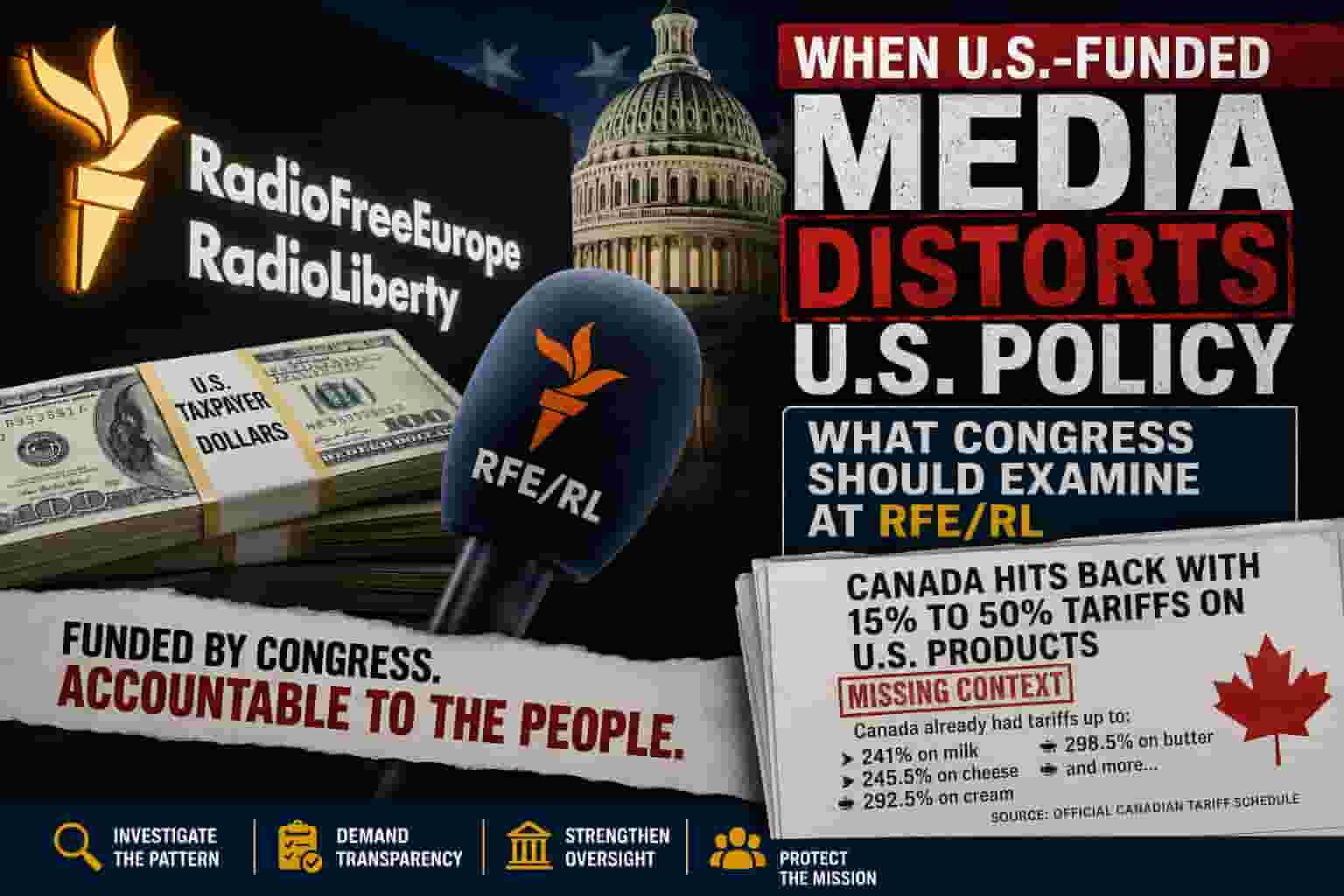
Radio Free Europe/Radio Liberty is funded by American taxpayers and protected from political interference. But that independence comes with another statutory obligation: its journalism is supposed to be accurate, objective, and comprehensive. A recent Russian-language report on the U.S.–Canada tariff dispute raises a legitimate question for Congress: Who checks whether those standards are actually being followed?
Radio Free Europe/Radio Liberty is not an ordinary private media company.
RFE/RL itself states that it is a private nonprofit corporation funded by the U.S. Congress through a federal grant from the U.S. Agency for Global Media, or USAGM. Congress appropriated $112.5 million for RFE/RL in fiscal year 2026.
That does not make RFE/RL a mouthpiece for whichever administration happens to occupy the White House. Nor should it.
Federal law protects the professional independence of RFE/RL journalists from government interference.
But the same legal framework establishes standards that U.S. international broadcasting is expected to meet.
Under 22 U.S.C. §6202, U.S. international broadcasting is supposed to provide news that is:
“consistently reliable and authoritative, accurate, objective, and comprehensive.”
It must also operate according to the “highest professional standards of broadcast journalism.”
Those requirements create an important distinction.
Congress should not ask whether RFE/RL agrees with President Donald Trump.
Congress should ask whether taxpayers are funding reporting that gives foreign-language audiences a sufficiently accurate and comprehensive explanation of American policy.
A Case Study: Canada’s Tariffs
A recent post by the Russian-language Radio Svoboda service provides a useful example.
On August 25, Radio Svoboda reported that Canada was imposing retaliatory tariffs of between 15% and 50% on American products.
The basic event was real.
Canada did announce counter-tariffs.
But the framing presented the dispute largely as a simple sequence:
The United States imposed tariffs on Canada after trade negotiations failed → Canada retaliated.
What was largely missing was an important part of the American government’s stated rationale for taking action in the first place.
The Trump administration had been objecting to Canadian trade restrictions and tariff barriers in several protected sectors.
That context matters.
Canada Already Had Tariffs Approaching 300% in Some Protected Markets
This is not simply a Trump talking point.
Canada’s own customs tariff schedules document extraordinarily high over-quota tariffs on certain agricultural products.
Among the rates listed in the Canadian tariff schedule were:
- 241% on certain milk imports above quota;
- 243% on certain powdered milk;
- 245.5% on many types of cheese above quota;
- 292.5% on certain cream products;
- 298.5% on butter above quota;
- and as much as 313.5% on certain other milk-derived fats and oils.
There is an important qualification: these rates did not apply to every U.S. shipment or to all Canadian imports from America.
Canada operates tariff-rate quotas. Imports within negotiated quota levels can receive much lower rates — and many qualifying U.S. products receive duty-free treatment under the U.S.–Mexico–Canada Agreement.
But once imports exceed those protected quota levels, the tariffs can become enormous.
That distinction is precisely why the Canadian system became one of Washington’s complaints.
The White House specifically stated in an August 2026 presidential proclamation that Canada was discriminating against U.S. commerce through its tariff-rate quota allocation measures affecting American cheeses.
Whether one agrees with Trump’s remedy is a separate question.
But readers cannot fairly evaluate the American policy without knowing what Washington says prompted it.
The Difference Between Criticism and Missing Context
There would be nothing improper about Radio Svoboda criticizing Trump’s tariff policy.
RFE/RL journalists are not required to support the President.
They can interview Canadian officials, economists who oppose tariffs, American critics of Trump, businesses harmed by tariffs, or anyone else relevant to the story.
That is journalism.
The more serious issue arises when a report describes an American action while omitting material facts necessary to understand why the U.S. government says it acted.
A reader who hears only:
“Trump imposed tariffs and Canada retaliated”
receives a substantially different picture from a reader who is told:
Canada maintained highly protective tariff barriers in particular sectors; Washington accused Canada of discriminatory treatment; Trump imposed additional tariffs; Canada rejected the American justification and retaliated.
The second version does not endorse Trump.
It simply gives the audience enough information to understand both sides.
That is particularly important because RFE/RL’s statutory standard does not merely require technically accurate sentences.
It explicitly uses the word “comprehensive.”
Why This Matters More Than One Canada Story
One incomplete report would normally be an editorial issue, not a matter for Congress.
The larger question is whether there is a repeated pattern in particular RFE/RL language services in which facts unfavorable to U.S. government policy are emphasized while important official American arguments, documents, statistics, or context are minimized or omitted.
That question cannot responsibly be answered from one Facebook post.
It can, however, be investigated.
And because RFE/RL operates with congressionally appropriated funds, Congress has both a legitimate interest and tools for determining whether statutory standards are being met.
What Congress Should Examine
1. Conduct a Sample-Based Review of RFE/RL Language Services
Congress should request an independent review of a statistically meaningful sample of reporting from individual language services — particularly coverage involving major U.S. foreign, economic, national-security and domestic policies.
The review should not judge whether journalists were favorable or unfavorable toward an administration.
It should ask measurable questions:
Were significant facts omitted?
Was the U.S. government’s stated position accurately described?
Were competing factual claims identified?
Were original government documents consulted?
Were corrections issued when important claims proved inaccurate?
Such a review could distinguish political disagreement from genuine failures of journalistic completeness.
2. Examine the Russian-Language Service Separately
RFE/RL announced in 2026 that Radio Svoboda, Current Time, Radio Azatliq and its North Caucasus service would be consolidated into a new Russia-focused multimedia unit.
That makes this an appropriate moment for Congress and USAGM to examine the editorial performance of Russian-language programming separately rather than relying only on organization-wide metrics.
Millions of Russian-speaking people receive information about the United States through these services.
How America is presented to those audiences matters.
3. Require Greater Transparency About Corrections
Taxpayer-funded international broadcasters should maintain an easily searchable public corrections database.
When a story materially misstates or omits facts and is later corrected, readers should be able to see:
what was changed, why it was changed, and when it was changed.
This is not government censorship.
It is basic accountability.
4. Ask GAO or an Inspector General to Review Compliance
Congress could request an independent examination of whether USAGM’s grant oversight mechanisms adequately measure compliance with the statutory standards of accuracy, objectivity and comprehensiveness.
The key question should be institutional:
What mechanisms currently detect repeated failures of accuracy or material omissions inside an individual language service?
If the answer is effectively “none,” Congress has identified an oversight problem regardless of political ideology.
5. Tie Accountability to Process — Not Political Viewpoint
Congress must be careful here.
The statutory firewall protecting RFE/RL’s professional independence is important.
Politicians should not be able to call an editor and demand favorable coverage of a President, Republican or Democrat.
Any reform should therefore focus on process and professional standards, not ideology.
Congress can legitimately demand:
fact-checking procedures,
transparent corrections,
documented sourcing,
independent quality reviews,
financial accountability,
and compliance with federal law.
It should not dictate editorial conclusions.
The Firewall Cannot Become a Shield Against Accountability
RFE/RL correctly emphasizes that U.S. law protects its editorial independence.
USAGM likewise states that government officials must respect the professional independence and integrity of RFE/RL and other international broadcasters.
That protection is essential.
But independence and accountability are not opposites.
The firewall was created to prevent political officials from manipulating journalism.
It was not created to exempt a federally funded media organization from scrutiny over whether it follows the journalistic standards Congress placed into law.
RFE/RL itself says that, as a recipient of U.S. taxpayer dollars, it holds itself to high standards of accountability and transparency.
Congress should take that commitment seriously.
The Question for American Taxpayers
This is ultimately bigger than Donald Trump, Canada, or one Radio Svoboda post.
American taxpayers finance RFE/RL because Congress concluded that truthful, credible journalism abroad serves the interests of the United States and of people living in information environments dominated by censorship and propaganda.
That mission only works if audiences trust the product.
If federally funded media repeatedly presents American policies stripped of essential context, taxpayers have a legitimate reason to ask whether the organization is fulfilling the mission they are paying for.
The proper response is not government censorship.
It is evidence, transparency, independent review and congressional oversight.
Before Congress approves another large appropriation, lawmakers should know whether every RFE/RL language service is meeting the standard already written into U.S. law:
reliable, authoritative, accurate, objective and comprehensive journalism.
Key Facts
RFE/RL funding: RFE/RL confirms that it is funded by Congress through a USAGM federal grant. Congress appropriated $112.5 million for FY2026.
Legal standard: 22 U.S.C. §6202 requires U.S. international broadcasting to follow the highest professional standards of journalism and provide news that is accurate, objective and comprehensive.
Editorial independence: Federal law and USAGM’s firewall protect RFE/RL from political interference in editorial decisions.
RFE/RL’s mission: RFE/RL says its mission is to provide accurate, uncensored news and open debate in countries where press freedom is threatened.
Canadian tariffs: Canada’s official tariff schedule confirms over-quota rates including 241% for certain milk, 292.5% for certain cream, 298.5% for butter, and 245.5% for many cheeses. These are tariff-rate quota measures and should not be described as tariffs imposed on all U.S. exports.
White House position: The August 2026 proclamation specifically accused Canada of discriminatory treatment involving alcoholic beverages, dairy products and motor vehicles, including tariff-rate quota allocation measures affecting U.S. cheese.
Official Sources
U.S. House Office of the Law Revision Counsel — 22 U.S.C. §6202, Standards and Principles.
U.S. Agency for Global Media — Broadcasting Standards & Principles.
U.S. Agency for Global Media — Editorial Independence / Firewall.
Radio Free Europe/Radio Liberty — How RFE/RL Is Funded and Managed.
Radio Free Europe/Radio Liberty — 2026 Strategic Reforms and FY2026 Funding.
Canada Border Services Agency — Canadian Customs Tariff, Dairy Products.
The White House — August 18, 2026 proclamation concerning Canadian trade measures.
Ask Midtown Tribune about this story
Answers are grounded first in this article. Search all Midtown Tribune reporting from the main AI Search page.
AI-generated summary. Verify important details in the linked original articles.