
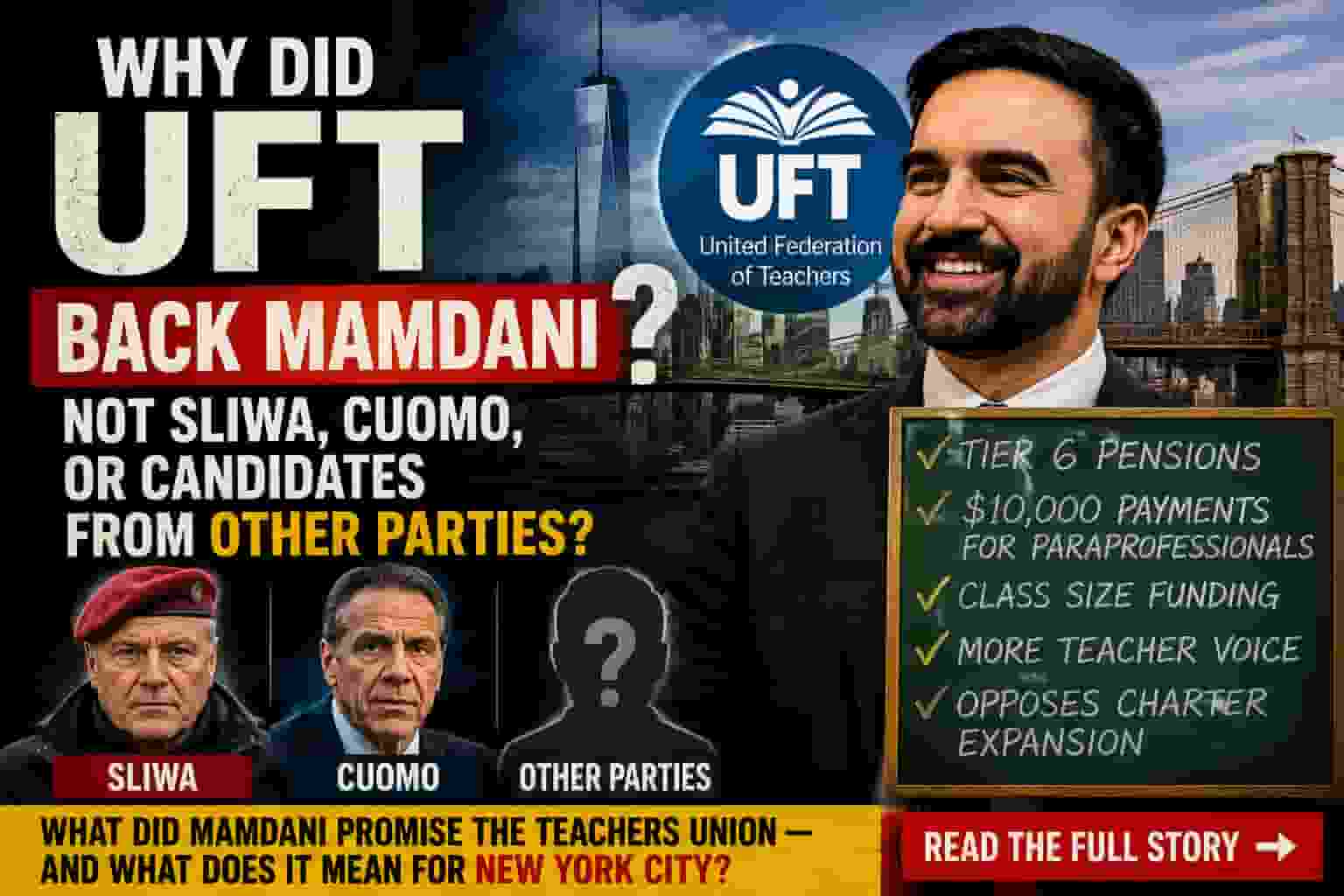
The United Federation of Teachers did more than endorse Zohran Mamdani in New York City’s 2025 mayoral election. The union mobilized members and retirees to help elect him after Mamdani pledged support for major UFT priorities — including Tier 6 pension reform, a roughly $10,000 annual payment for paraprofessionals, class-size funding and a larger role for educators in school policy. But other candidates also promised improvements for teachers and public schools. So why did one of New York City’s most powerful public-sector unions choose a democratic socialist — and what responsibility does that political choice carry now?
New York City voters had several choices for mayor on November 4, 2025.
The certified Board of Elections results list Zohran Mamdani on the Democratic and Working Families lines; Curtis Sliwa on the Republican and Protect Animals lines; Andrew Cuomo on the Fight and Deliver line; Irene Estrada on the Conservative line; Joseph Hernandez on the Quality of Life line; and Jim Walden on the Integrity line.
The United Federation of Teachers chose Mamdani.
And it did not simply issue a symbolic endorsement.
The UFT’s Delegate Assembly — the union’s highest decision-making body — formally endorsed Mamdani for the general election. UFT President Michael Mulgrew said the union wanted a mayor who would protect public education and public employees, improve pay and benefits, and work with the union. He described Mamdani as someone who could become that partner in City Hall.
The endorsement was approved by 64% of UFT delegates. That distinction matters: it was a vote by the union’s representative Delegate Assembly, not a direct vote of every New York City teacher or every UFT member.
What Did Mamdani Promise the UFT?
The union’s own publications provide a remarkably specific answer.
Mamdani pledged to work with the UFT to fully fund New York City public schools and ensure that education funding obtained in City Hall or Albany reached classrooms.
He supported the proposed RESPECT check, an annual payment of approximately $10,000 for paraprofessionals, arguing that low compensation was contributing to staffing shortages.
He also promised to make reforming Tier 6 pensions a key part of the city’s legislative agenda in Albany. Tier 6 had long been one of the UFT’s most important political campaigns.
Mamdani backed implementation of the state class-size law, called for thousands of additional teachers and said vacant positions at the School Construction Authority should be filled so the city could create additional classroom capacity.
He also told educators that teachers, parents and students should be partners in setting education policy — precisely the kind of access to City Hall that public-sector unions seek from an administration.
The UFT itself later summarized the arrangement even more simply: Mamdani had promised to work with the union on school funding, the RESPECT check, Tier 6 and other priorities.
Then the Union Went to Work for Mamdani
The endorsement was followed by organized political activity.
In September 2025, the UFT published schedules and instructions for members interested in helping turn out votes for Mamdani in the November general election.
By late October, the union said it was making a final push to elect Mamdani and linked that effort directly to shared priorities including school funding, the RESPECT check and Tier 6 pension reform.
The UFT later reported that its Member Action Committee, other members and retirees participated in campaigning and phone banking for Mamdani.
So this was not merely an editorial endorsement.
A public-sector union used its political organization to help elect a candidate who had publicly committed himself to advancing several of that union’s major policy priorities.
That activity is lawful political advocacy. But it also makes the union’s choice a legitimate subject of public scrutiny.
But Sliwa Also Promised Higher Teacher Pay
One fact complicates any simple explanation that the UFT chose Mamdani merely because he “supported teachers.”
Curtis Sliwa’s official education platform explicitly proposed increasing teacher pay to attract and retain top talent.
He also proposed cutting administrative bureaucracy at the Department of Education and redirecting money into classrooms for supplies, technology and direct student support.
So why wasn’t that enough for the UFT?
One major answer can be found elsewhere in Sliwa’s same education program.
Sliwa proposed ending the charter-school cap, expanding high-performing charter schools and allowing charter schools to co-locate in underused public-school buildings.
That placed him in direct conflict with a major UFT institutional position.
The UFT argues that charter schools consume space needed by district schools and has opposed policies that facilitate charter expansion. Its current legislative priorities continue to criticize charter-school expansion and the use of public-school space by charters.
This is an important distinction.
Sliwa could promise teachers more money while simultaneously supporting structural changes to the school system that the union leadership strongly opposed.
Mamdani offered something broader: not merely higher compensation for workers, but substantial alignment with the UFT’s institutional agenda.
What About Andrew Cuomo?
Andrew Cuomo also presented a substantial education platform.
His campaign proposed reducing class sizes, securing state funding for implementation of the class-size law and expanding 3-K and after-school programs.
But Cuomo took a very different position from the UFT and Mamdani on one fundamental question: who should control New York City schools?
Cuomo called mayoral control an “imperative” for accountability and later campaigned on using mayoral control to drive school reform.
Mamdani instead emphasized bringing teachers, parents and students directly into education policymaking. The UFT explicitly welcomed that approach.
Again, the distinction was larger than teacher salaries.
It concerned institutional power.
And There Were Candidates From Other Political Lines
The 2025 election was not legally limited to Mamdani, Sliwa and Cuomo.
The Board of Elections certified votes for Conservative candidate Irene Estrada, Quality of Life candidate Joseph Hernandez and Integrity candidate Jim Walden in addition to the three major contenders.
Yet the UFT’s published explanation for its endorsement centered on what Mamdani could do as a partner for the union — better compensation and benefits, public-school funding and cooperation on the UFT’s policy agenda.
There is no evidence in the UFT materials reviewed for this article that the union conducted a publicly documented, issue-by-issue comparison of Mamdani with every candidate and every independent ballot line before asking members to help elect him.
That does not make the endorsement improper.
But it is worth recognizing what kind of decision it was.
It was a political and institutional choice by an organized interest group.
The Socialist Question
There is also no ambiguity about Mamdani’s political affiliation with the democratic-socialist movement.
The New York City Democratic Socialists of America describes him as a “Democratic Socialist and DSA member” and says his mayoral campaign ran on an explicitly socialist platform. After his victory, NYC-DSA celebrated the result under the headline “Socialism Wins.”
That makes the UFT decision politically significant beyond education policy.
A major union representing workers in New York City’s taxpayer-funded school system made an organizational decision to help elect a DSA member running on a democratic-socialist program.
Individual teachers were, of course, free to vote however they wished.
It would therefore be inaccurate to say that “New York City teachers” collectively chose socialism.
But it is entirely accurate to say that their union’s political apparatus endorsed Mamdani and actively worked to elect him.
That distinction is essential.
What Has the UFT Received Since the Election?
This is where the story becomes especially relevant in 2026.
Tier 6 reform — one of the issues Mamdani specifically promised to advance — has already produced a major victory for the union.
The UFT reports that qualifying Tier 6 educators with 30 years of service can now receive full retirement benefits at 58 rather than 63.
The RESPECT check has also advanced substantially. On July 16, 2026, the City Council passed legislation providing an additional $10,000 for paraprofessionals, according to the UFT.
And on class sizes, the UFT reached a 2026 agreement with the Mamdani administration setting a revised path toward full compliance with state requirements. Mulgrew explicitly referred to the new City Hall as a prospective partner committed to building the necessary seats.
None of those facts proves a secret bargain.
There is no evidence reviewed by Midtown Tribune of a quid-pro-quo agreement in which UFT promised votes in exchange for specific government benefits.
What the documents demonstrate instead is an open political alignment:
Mamdani promised to advance major UFT priorities.
UFT endorsed Mamdani.
UFT mobilized members to help elect him.
Several of those union priorities subsequently advanced.
That sequence is documented.
Political Influence Also Means Political Responsibility
Public-sector unions occupy an unusual position in city politics.
They negotiate with government over the compensation and benefits of their members — but they can also use political resources to help determine who will sit on the other side of the negotiating table.
That is why the UFT endorsement deserves scrutiny beyond the question of whether its members received better pensions or compensation.
When an organization uses its political influence to help elect a mayor, it cannot reasonably claim that the consequences of that mayor’s broader agenda are entirely unrelated to its political choice.
Mamdani was not hiding his politics. NYC-DSA openly described his campaign as socialist.
Sliwa was not hiding his support for charter schools and school choice.
Cuomo was not hiding his support for mayoral control.
And the UFT was not hiding what it wanted from the next mayor.
The union made a choice.
The question for New Yorkers now is not whether every teacher should be blamed for that decision — they should not.
The more precise question is:
When a powerful public-sector union helps elect a mayor because his program advances its institutional interests, how much responsibility should that union’s leadership bear for the broader consequences of the administration it helped put into City Hall?
That is a question not only about Zohran Mamdani.
It is a question about political power, organized labor and who ultimately pays for the choices made at City Hall.
Sources: Government Records, UFT Documents & Official Campaign Platforms
Midtown Tribune reviewed government election records, official union publications, candidate campaign platforms and primary-source materials from political organizations referenced in this article.
Government Sources
-
NYC Board of Elections — Certified 2025 General Election Results for Mayor
Official citywide results and ballot lines for the November 4, 2025 mayoral election, including Zohran Mamdani, Curtis Sliwa, Andrew Cuomo and candidates on other lines.
View NYC Board of Elections Record → -
New York State Governor — FY2027 Tier 6 Pension Reform
Official state announcement confirming that qualifying teachers with 30 years of service can receive full retirement benefits at age 58 instead of 63.
View New York State Announcement → -
New York City Council — $10,000 Paraprofessional Stabilization Payment
Official Council announcement on Introduction 692-A, providing eligible school paraprofessionals with workforce stabilization payments totaling up to $10,000 for the 2026-27 school year.
View NYC Council Record → -
NYC Council Legislative Record — Introduction 692-A
Official legislative record for the paraprofessional workforce stabilization payment.
View Legislative Record →
Official United Federation of Teachers Sources
-
UFT Delegate Assembly Endorses Zohran Mamdani for NYC Mayor
The union’s official endorsement for the general election.
Read UFT Endorsement → -
UFT — “Union Backs Mamdani for Mayor”
UFT’s detailed account of Mamdani’s commitments on public-school funding, Tier 6 pensions, the RESPECT check, class sizes and educator participation in school policy. The article also reports that 64% of delegates voted for the endorsement.
Read UFT Account → -
UFT — General Election Mobilization for Mamdani
UFT’s September 2025 Chapter Leader Update lists canvassing and phone-banking activities to help elect Mamdani in the November general election.
View UFT Campaign Schedule → -
UFT — “Members Answer Call for Mamdani”
The union’s own report describing hundreds of members campaigning, canvassing and working phone banks for Mamdani.
Read UFT Campaign Report → -
UFT — Fix Tier Six
Official UFT campaign page documenting the pension reform and the reduction of the retirement age from 63 to 58 for qualifying Tier 6 educators with 30 years of service.
View UFT Tier 6 Campaign → -
UFT — 2026 Class Size Agreement
Official union statement on the agreement with the city establishing a revised timeline toward full compliance with New York’s class-size law.
View Class Size Agreement → -
UFT — City Legislative Priorities
Current UFT positions on class sizes, school construction and its relationship with the Mamdani administration.
View UFT City Priorities →
Official Candidate Campaign Platforms
-
Curtis Sliwa — Education Plan
Sliwa’s official campaign platform proposed higher teacher pay, redirecting DOE spending into classrooms, ending the charter-school cap and expanding high-performing charter schools.
View Curtis Sliwa Education Plan → -
Andrew Cuomo — Education & Childcare Platform
Cuomo’s campaign proposed smaller classes, expanded 3-K and after-school programs, measures addressing teacher attrition and continued mayoral control of NYC schools.
View Andrew Cuomo Platform →
Political Organization Primary Source
-
New York City Democratic Socialists of America — Zohran Mamdani
NYC-DSA identifies Mamdani as a “Democratic Socialist and DSA member” and describes its continuing political campaign in support of his agenda.
View NYC-DSA Source → -
NYC-DSA — “Socialism Wins” Statement After the 2025 Election
The organization’s official post-election statement celebrating Mamdani’s mayoral victory as a democratic-socialist political victory.
View NYC-DSA Election Statement →
Source note: Government records are separated from union, campaign and political-organization materials. UFT publications document the union’s own endorsement, political activity and policy positions. Candidate campaign websites document the candidates’ stated proposals. NYC-DSA materials are used as a primary source for the organization’s description of Mamdani and its own political program; they are not government records or independent reporting.
Ask Midtown Tribune about this story
Answers are grounded first in this article. Search all Midtown Tribune reporting from the main AI Search page.
AI-generated summary. Verify important details in the linked original articles.