
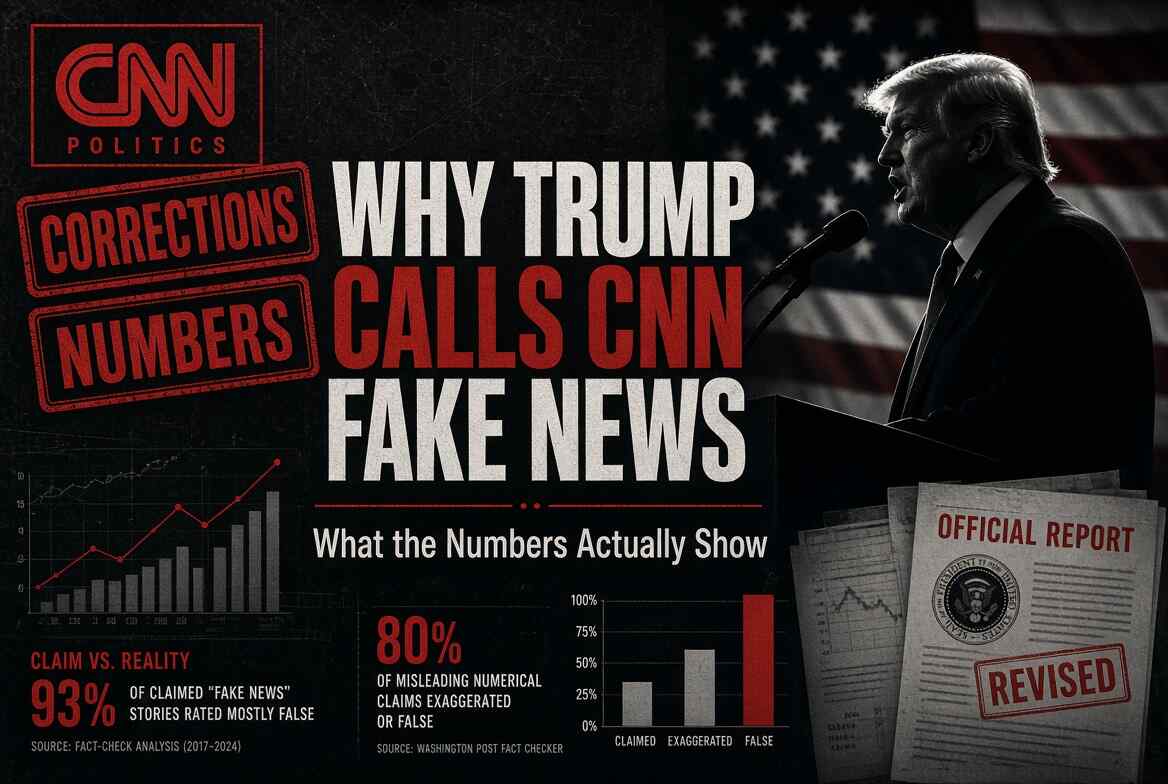
For years, President Donald Trump has called CNN “Fake News CNN.”
The phrase is usually treated as political rhetoric — part of the long-running confrontation between Trump and the national press.
But there is a question that can be examined without simply taking Trump’s word for it:
Is there measurable and documented evidence behind his complaint about CNN?
There is substantial evidence of specific problems.
CNN has retracted Trump-related reporting, corrected consequential factual errors, revised fact-checks, acknowledged missing context, and aired interpretations that its own journalists later qualified.
And there is something else that cannot be dismissed as a single newsroom mistake:
independent quantitative research found an extraordinary imbalance in CNN’s coverage of Trump.
The evidence does not establish that every CNN report is false.
It establishes something more specific:
Trump’s complaint that CNN has repeatedly presented him through an overwhelmingly negative editorial lens, while at times publishing materially incorrect or misleading reporting about him, has a documented factual basis.
The Number CNN Cannot Explain Away: 13-to-1
The most important evidence does not come from Trump.
It comes from Harvard.
The Shorenstein Center on Media, Politics and Public Policy at Harvard Kennedy School analyzed coverage of Trump’s first 100 days as president across major American and European news organizations.
Its finding about CNN was striking:
negative stories about Trump outnumbered positive stories by approximately 13 to 1 on CNN and NBC.
The researchers wrote:
“CNN and NBC’s coverage was the most unrelenting — negative stories about Trump outpaced positive ones by 13-to-1.”
The imbalance was not confined to one issue.
The Harvard study found no major topic where Trump’s coverage, on balance, was more positive than negative.
An important methodological point should be stated clearly:
Harvard’s positive-versus-negative calculations do not mean every CNN story was classified as one or the other. Neutral reporting existed as well.
So the finding does not mean that 93 percent of everything CNN said was negative.
It means that among coverage carrying a clear evaluative direction, the negative-to-positive imbalance was extraordinary.
That alone does not establish dishonesty.
Presidents can generate genuinely negative news.
But once such an imbalance is considered alongside corrections, retractions and examples of lost context, another question becomes unavoidable:
Was CNN merely covering negative events — or was its editorial process repeatedly selecting the most damaging interpretation of Trump?
1. CNN Retracted an Entire Russia Story About a Trump Associate
In June 2017, CNN published a story connecting Trump transition official Anthony Scaramucci to an investigation involving the Russian Direct Investment Fund.
Then CNN removed the story.
Not edited.
Not quietly updated.
Retracted.
CNN stated:
“That story did not meet CNN’s editorial standards and has been retracted.”
The network apologized to Scaramucci.
Three CNN journalists involved in the report subsequently resigned.
The Washington Post documented the retraction, apology and internal editorial failure, including CNN’s reliance on a single anonymous source.
Why it matters
This happened during one of the most politically explosive periods of the Trump-Russia controversy.
A story connecting a Trump associate with a Russian financial entity carried enormous political implications.
CNN itself eventually concluded that the report did not meet its editorial standards.
This is not Trump’s characterization of the story.
It is CNN’s own retraction.
2. CNN’s WikiLeaks Error Changed the Meaning of the Story
On December 8, 2017, CNN reported that Donald Trump Jr. and others associated with the Trump campaign had received an email on September 4, 2016 containing information about WikiLeaks documents.
The date was central to the story.
September 4 would have meant that people associated with the Trump campaign received information before relevant WikiLeaks material became publicly available.
Then the actual email surfaced.
It was dated:
September 14.
By that point, the relevant information was already publicly available.
CNN acknowledged that its original date was wrong and corrected the story.
Why it matters
This was not an insignificant typographical error.
The incorrect date created the most politically damaging implication of the original report.
September 4 suggested advance access.
September 14 did not.
The correction materially changed the story.
3. CNN Predicted Comey Would Contradict Trump — Then Comey Confirmed a Key Part of Trump’s Account
Before former FBI Director James Comey testified publicly in June 2017, reporting suggested Comey would dispute Trump’s assertion that Comey had repeatedly told him he was not personally under investigation.
Comey’s testimony established something different on that specific question.
CNN’s own June 8, 2017 transcript subsequently acknowledged that Comey corroborated Trump’s assertion that he had been told he was not personally under investigation.
That did not resolve every dispute between Trump and Comey.
Comey made other serious allegations concerning his interactions with Trump.
But on this specific point, the testimony supported what Trump had been saying.
Why it matters
The distinction is particularly important because the original story appeared during the intense Russia-investigation news cycle.
An expectation that Comey would contradict Trump became a very different story once Comey’s own testimony was available.
4. CNN’s Own Program Acknowledged the Missing MS-13 Context Behind Trump’s “Animals” Remark
One of Trump’s most notorious quotations was:
“These aren’t people. These are animals.”
Presented alone, that sentence can sound like a description of immigrants generally.
But the exchange immediately preceding Trump’s statement involved members of the violent MS-13 gang.
CNN later examined the controversy on Reliable Sources.
CNN’s own May 20, 2018 transcript records the discussion that some news outlets might have taken Trump out of context by showing his response without the preceding MS-13 question.
Jake Tapper separately said that, in context, he understood Trump’s remarks as referring to MS-13.
Why it matters
A person can still object strongly to describing gang members as “animals.”
That is a separate judgment.
But:
“Trump called immigrants animals”
and
“Trump called MS-13 gang members animals”
are materially different descriptions of what happened.
Context determines the object of the statement.
5. “Very Fine People”: CNN’s Own Jake Tapper Later Clarified the Distinction
Trump’s Charlottesville statement —
“very fine people on both sides”
— became one of the defining quotations of his first presidency.
But the complete remarks also contained an explicit exclusion.
Trump said he was not talking about neo-Nazis and white nationalists, whom he said should be condemned.
In a later CNN discussion, Jake Tapper explicitly acknowledged that Trump was not saying neo-Nazis and white supremacists were “very fine people”.
The political argument then became whether anyone participating alongside extremist organizations at the rally could legitimately be described as a “very fine person.”
That is a legitimate argument.
But it is different from claiming that Trump literally described neo-Nazis themselves as “very fine people.”
Why it matters
A complete account requires both portions of the statement.
Removing the exclusion changes the proposition that viewers believe Trump made.
6. “Bloodbath”: The Immediate Subject Was the Auto Industry
At a March 2024 rally in Ohio, Trump was discussing Chinese companies manufacturing automobiles in Mexico, tariffs and the future of American auto manufacturing.
He said:
“We’re going to put a 100 percent tariff on every single car…”
Then he said:
“If I don’t get elected, it’s going to be a bloodbath…”
CNN did include the automobile context in some coverage.
But the network also foregrounded bloodbath as a warning about what would happen to the country if Trump lost the election and discussed it within a broader frame involving political violence and January 6.
Why it matters
Nobody needed to fabricate Trump’s quotation.
The words were real.
The editorial power lay in deciding what those words meant and what viewers should associate them with.
That is framing.
7. Steele Dossier: The Funding Source Mattered
The Steele dossier became central to years of Trump-Russia reporting.
The financing chain is now documented.
The Democratic National Committee and Hillary Clinton’s presidential campaign paid Perkins Coie, which retained Fusion GPS, which hired former British intelligence officer Christopher Steele.
This does not mean Hillary Clinton “ordered a dossier from Russia.”
That would oversimplify the documented chain.
But it does mean that a politically explosive dossier concerning Trump originated as opposition research financed by his political opponents.
That is relevant when readers assess the provenance, incentives and reliability of the material.
Later investigations substantially challenged important portions of the dossier.
Why it matters
Source provenance is not a minor footnote in opposition research.
It is part of the story.
Viewers evaluating explosive allegations should know who financed the research used to generate them.
8. The Russia Story Also Produced the “17 Intelligence Agencies” Problem
CNN repeatedly used versions of the assertion that all 17 U.S. intelligence agencies agreed on conclusions concerning Russian interference in the 2016 election.
But the January 2017 Intelligence Community Assessment was produced through a narrower process involving the CIA, FBI, NSA and the Office of the Director of National Intelligence.
CNN later acknowledged this distinction in its own coverage.
Why it matters
This does not invalidate the conclusion that Russia interfered in the 2016 election.
It addresses another issue:
how strongly institutional consensus was represented to the public.
Saying the U.S. intelligence community contains 17 components is different from saying every one of those 17 agencies independently participated in producing the assessment.
9. CNN’s Reliability Problem Is Not Limited to Trump
Questions about CNN’s editorial reliability extend beyond Donald Trump.
In January 2025, a Florida jury found CNN liable for defaming U.S. Navy veteran Zachary Young over a report concerning private evacuation services during the withdrawal from Afghanistan.
The jury awarded $5 million in compensatory damages.
CNN and Young then reached a settlement before the jury determined punitive damages.
Reuters reported the verdict and subsequent settlement.
Why it matters
This case did not concern Trump.
That is precisely why it matters to the larger question of editorial reliability.
Criticism of CNN cannot automatically be dismissed as nothing more than a partisan invention created by Donald Trump.
A jury independently found CNN liable for defamation in another high-profile report.
10. Then There Is the Numbers Problem
Individual mistakes occur in every newsroom.
One correction does not establish systematic bias.
One retraction does not establish systematic bias.
One quotation dispute does not establish systematic bias.
But Harvard’s approximately 13-to-1 negative-to-positive ratio changes the context in which the individual cases are evaluated.
The question becomes:
When an outlet already produces overwhelmingly negative evaluative coverage of a political figure, what happens when factual errors and missing context also repeatedly move in the same negative direction?
That is a legitimate media-accountability question.
Harvard did not conclude that CNN was lying.
The 13-to-1 finding does not demonstrate that every negative story was unfair.
But it does demonstrate that viewers received an overwhelmingly negative evaluative picture of Trump during the period studied.
Did CNN Ever Say Anything Positive About Trump?
Yes.
That fact should not be hidden.
CNN has reported positively on particular accomplishments or developments.
Examples have included aspects of Operation Warp Speed, strong employment numbers, the Abraham Accords and particular foreign-policy developments.
That matters.
It demonstrates that CNN was capable of reporting developments favorable to Trump.
The relevant question is therefore not:
“Did CNN literally never report anything positive?”
It did.
The more serious question is:
Why was the overall evaluative balance so extraordinarily negative?
A roughly 13-to-1 ratio is not a subtle difference.
Is Negative Coverage Automatically Evidence of Bias?
No.
If a president experiences scandals, policy failures or serious political conflict, negative coverage can accurately reflect those events.
The Harvard researchers themselves cautioned against automatically equating negative tone with unfair reporting.
That caveat is important.
But tone is only one part of the evidence examined here.
Now place beside it:
- a complete CNN retraction involving a Trump associate;
- an incorrect WikiLeaks date that materially changed a major story;
- corrected or revised reporting;
- quotation-context disputes;
- CNN’s own acknowledgment of the MS-13 context;
- repeated disagreements over editorial framing;
- and an independently measured 13-to-1 negative-positive imbalance.
At that point, it becomes difficult to dismiss Trump’s criticism as though it arose without documented evidence.
Why Corrections Do Not Erase the Original Damage
CNN deserves credit when it corrects an error.
Corrections are a necessary part of serious journalism.
But the original story and the correction rarely receive identical exposure.
A dramatic headline can travel across television, social media, news aggregators and political commentary within minutes.
A correction may arrive hours later.
Many people who saw the original claim will never encounter the correction.
Consider the WikiLeaks example.
The original impression:
The Trump campaign may have received advance access to WikiLeaks material.
After the date was corrected:
The email arrived after the relevant material was already publicly available.
The correction changes the record.
It cannot guarantee that it changes the memory of every person who encountered the first version.
That is why accuracy before publication is particularly important in politically explosive reporting.
A News Company Is Selling Trust
A smartphone manufacturer cannot remain competitive indefinitely if its phones repeatedly fail.
A bank would face a crisis if customer balances were routinely incorrect.
The essential product of a news organization is not the studio.
It is not the anchor.
It is not access to politicians.
Its essential product is:
credibility.
A defective physical product is usually obvious to its owner.
A misleading political report can be much harder to detect.
A viewer who never watches the complete speech may never realize that important context was missing.
A reader who never returns to an article may never see its correction.
That makes quality control in journalism especially important.
So Is Trump Right When He Calls CNN “Fake News”?
There are two different propositions.
If “CNN is fake news” is interpreted to mean that every sentence CNN publishes is fabricated, the evidence presented here does not establish that proposition.
But that is not necessary to establish the more relevant finding.
If Trump’s complaint is that CNN has repeatedly published materially inaccurate information about him, omitted significant context, corrected consequential reporting, retracted politically explosive stories and subjected his presidency to an overwhelmingly negative editorial environment, then substantial documentary evidence supports that complaint.
The quantitative finding does not come from Trump.
The Scaramucci retraction is not something Trump invented.
The WikiLeaks date correction is not something Trump invented.
The MS-13 context is not something Trump invented.
CNN’s own journalists acknowledged the importance of that context.
Those are facts readers can examine themselves.
That does not require supporting Donald Trump politically.
It requires applying the same skepticism to a news organization that the news organization asks viewers to apply to politicians.
Watch the original video.
Read the complete transcript.
Read the paragraph before the quotation.
Read the paragraph after it.
Open the original government document.
Compare it with the headline.
And always check whether something appeared later:
CORRECTION.
One mistake can simply be a mistake.
A second can also be a mistake.
But when errors, retractions, missing context and overwhelmingly negative editorial selection repeatedly move in the same direction, readers have reason to scrutinize the reliability of the product they are being asked to trust.
The documented record shows that Trump’s criticism of CNN did not arise without evidence.
Readers can decide for themselves what label they believe should be attached to CNN.
But that decision should be made after looking at the numbers, the corrections and the original documents — not merely after being told that the President’s criticism is “baseless.”
Read the evidence. Compare the originals. Then make your own conclusion — including whether it is worth spending your time on “news” where the original meaning can emerge looking very different after passing through the editorial process.
Sources
Harvard Kennedy School — Shorenstein Center
News Coverage of Donald Trump’s First 100 Days
The Washington Post — CNN Scaramucci retraction
CNN’s retraction and the danger of relying on one anonymous source
The Washington Post — WikiLeaks email correction
CNN’s incorrect September 4 date and subsequent correction
CNN — Comey testimony
CNN transcript, June 8, 2017
CNN — MS-13 / “animals” context
CNN Reliable Sources transcript, May 20, 2018
CNN — “Very Fine People” clarification
CNN transcript, April 26, 2019
CNN — “Bloodbath” coverage
CNN transcript, March 18, 2024
Federal Election Commission
FEC enforcement actions involving DNC and Hillary for America reporting
Reuters — Zachary Young v. CNN
CNN found liable for defaming U.S. Navy veteran
The White House — “Fake News CNN,” October 2, 2026
Official White House video
Midtown Tribune Independent USA news from New York
Ask Midtown Tribune about this story
Answers are grounded first in this article. Search all Midtown Tribune reporting from the main AI Search page.
AI-generated summary. Verify important details in the linked original articles.