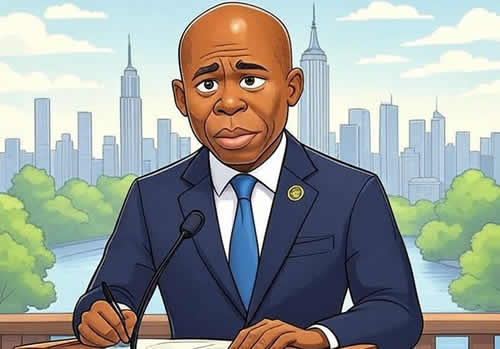
New York City Mayor Eric Adams has announced his formal support for Ryder’s Law, urging the City Council to pass legislation that would phase out horse-drawn carriages in favor of electric alternatives. To facilitate this transition, Mayor Adams signed Executive Order 56, which enhances regulatory oversight, initiates planning for the industry’s phase-out, and directs city agencies to support affected workers with job placement and voluntary license return programs. The move comes amid growing safety and animal welfare concerns following multiple high-profile incidents. By taking this step, the Adams administration is aligning city policy with modern urban standards while seeking to preserve tourism experiences through cleaner, safer alternatives.
Mayor Adams Calls on City Council to Ban Horse-Drawn Carriages, Signs Executive Order Strengthening Oversight and Enforcement of Industry and Ensuring City Agencies Are Preparing for Eventual City Council Ban
– New York City Mayor Eric Adams today announced his support to end the use of horse-drawn carriages in Central Park. First, Mayor Adams called on the New York City Council to pass Ryder’s Law, legislation to phase out horse-drawn carriages and replace them with electric alternatives, which has languished in the Council for over a year. Additionally, Mayor Adams signed Executive Order 56 to prepare for the end of the horse carriage industry in New York, strengthen oversight and enforcement over the industry until the Council passes the bill, create a process for voluntary return of licenses, and identify new employment opportunities for those in this industry. Finally, Mayor Adams sent a letter of necessity to the City Council, which grants the Council the authority to expedite the passage of this legislation by waiving the aging period, and urges them to promptly pass comprehensive reform given safety concerns for everyday New Yorkers.
“New York City is a place where history and progress live side by side, but as long as I am mayor, we will always put public safety first. While horse-drawn carriages have long been an iconic fixture of Central Park, they are increasingly incompatible with the conditions of a modern, heavily-used urban green space. A series of incidents over the last few years have raised concerns about the welfare of the horses, as well as the safety of pedestrians, cyclists, drivers, and carriage operators themselves. To understand all points of view on this complex issue, our administration convened all stakeholders, from driver representatives to community advocates, and it has become abundantly clear that these horse-drawn carriages no longer work for our city. While many talk about change, our administration has always been about real, meaningful action — and this issue is no different. That’s why today, I’m calling on the City Council to do what they should have done long ago: end the horse carriage industry in New York City and help keep all New Yorkers — including our animals — safe,” said Mayor Adams. “I’m also signing an executive order to ensure city agencies are doing everything in their power to prepare for a City Council ban on the horse carriage industry and to strengthen oversight and enforcement in the meantime. To be clear, we will not abandon the drivers themselves, who are honest, hard-working New Yorkers. Through today’s executive order, I have directed our agencies to identify new employment opportunities for those in this industry and create a process for voluntary return of licenses. We are also open to exploring a new program for electric carriages so New Yorkers and visitors can continue to enjoy the majesty of Central Park. Despite the changes we’re announcing today, we understand that this executive order can only go so far, as real, long-term change requires legislation. We need the Council to do their job, step up, and work with us on comprehensive reform. This is not about eliminating this tradition — it’s about honoring our traditions in a way that aligns with who we are today. New Yorkers care deeply about animals, about fairness, and about doing what’s right. The Adams administration hears those concerns loud and clear, and we’re taking action, but we need the Council to meet us at the table. We can preserve what makes New York unique while also ensuring we’re not leaving anyone — human or animal — behind.”
In the past few years, a number of troubling incidents have raised the alarm on this critical issue, including:
In August 2022, a carriage horse named Ryder fell and collapsed at the intersection of West 45th Street and 9th Avenue. The New York City Police Department intervened to help Ryder get back on his feet, and Ryder later died that October.
Just last month, another carriage horse named Lady collapsed and died at West 51st Street and 11th Avenue, bringing proposals for reform or closure of the carriage industry back into the spotlight.
This month also marked the third time this year alone where a carriage horse took off running in Central Park when a horse named Bambi ran out with no person at the reins, frightening visitors and causing three horse carriage passengers to jump out of the speeding buggy. Earlier this year, in May, a similar incident occurred when a pair of runaway carriage horses broke a driver’s wrist and injured others in Central Park after they bolted.
On a lively appearance on Jonesy in the Morning on 94.7 The Block, Mayor Eric Adams addressed a range of hot-button issues affecting New Yorkers. He pledged to investigate complaints about congestion pricing near the 59th Street Bridge, clarified that congestion toll policies fall under state control, and highlighted ongoing efforts to fight deed theft in Brooklyn, emphasizing education and new legislation to prevent fraud. Adams also responded to concerns about back pay for workers fired over COVID vaccine mandates, stating that while jobs were reinstated, back pay would not be issued due to the precedent it could set. He also shared updates on tech initiatives for underserved students, including distributing 350,000 Chromebooks with internet access.
Transcript: Mayor Adams Calls In for Interview on 94.7 the Block’s “Jonesy in the Morning”
Tarsha Jones: Good morning, Mayor Eric Adams.
Mayor Eric Adams: Hey, how are you doing?
Jones: Can I have the key to the city, seriously?
Mayor Adams: You have already unlocked the hearts of everyone.
Wayne Mayo: Good answer.
Jones: Yes, this is why. We’ll get back to that. How are you? I have people that have been calling about the same congestion pricing surrounding the 59th Street Bridge. How [can] you avoid a toll simply trying to get from– Wayne, was it from Brooklyn to Manhattan? Or what is it?
Mayo: Yeah, it’s like a double fare. It’s a little confusing, but yeah, you end up getting charged when maybe you shouldn’t be, but there’s some type of loophole. We recorded the listener last time he called in. Here’s what he had to say.
Question: We have to go all the way to Brooklyn to take the Williamsburg Bridge to come back to Queens and Long Island. If you get off at 62nd Street, you have to pay for congestion pricing, and you’re not going into Manhattan. And it’s a serious thing.
Mayor Adams: Let me look into that. The congestion pricing is controlled by the state lawmakers, the governor and the MTA. But if there’s a problem that’s impacting, you know, everyday New Yorkers, I’ll look into it. I’m going to look into it today. I’m going to have my deputy mayor of Operations take a look at what’s going on there.
Jones: Okay, thank you for that. I also would like to know, since we’re talking about the state lawmakers, Governor Hochul just endorsed Mamdani. Any feelings on that?
Mayor Adams: No, not at all. Endorsements come and go and change. [Inaudible] endorsements were made during the primary. And it comes down to the 8.5 million New Yorkers. She’s one vote. The goal is to really get the endorsement from everyday New Yorkers. That’s the focus. During these elections, you will see all sorts of distractions and ups and downs and rumors. And if you allow yourself to be distracted, you won’t stay focused on your mission. I am completely focused on the mission.
Jones: I can imagine, though, that makes it awkward for you and her to come together on the issues that are intertwined, no?
Mayor Adams: We work well together. We’ve done some great stuff together. You have to really have a level of maturity in politics to really understand that one has nothing to do with the other. You know, there are those who endorse me or endorse other candidates, and you still have to come together to solve the problems the city is facing. That’s just how this game of politics operates.
For example, Zohran did not endorse V.P. Harris when she ran for president. And, you know, a lot of people are understanding that and saying, you know, it’s almost hypocritical that he’s asking for the endorsement of other Democrats when, in fact, he did not endorse the first African-American woman to have a real viable shot to be president.
Jones: That was a nice little jab. I appreciate that. Because the people of New York may not have known that. Black women unite. You heard what he said?
Mayo: Mr. Mayor definitely has a way of saying things.
Jones: Speaking of Brooklyn, I saw a post somewhere about the deed theft. And that there are a group of developers that are paying money for people to go into homes that have outstanding bills. It could be as little as a thousand dollars and as high as a hundred thousand dollars.
But what they’re doing is they’re going in, they’re orchestrating this, they’re sending the notices of overdue payment to the wrong addresses deliberately. So the homeowners lose their homes because they never get notice and by the time they find out the house has already been stolen and this is happening a lot over and over in Brooklyn.
Mayor Adams: The deed theft is real and it’s a real problem on both the Attorney General Tish James and DA Eric Gonzalez have been both addressing this issue and we have been really educating our voters and homeowners, I should say, on what to look out for, how to protect yourself from it, because it is a problem, and we need to make sure that homeowners in Brooklyn and throughout the city are not duped into losing their home, because that’s what Black and brown wealth is, it’s in your home and when you lose that you’re losing your entire wealth and really a generational wealth because these homes are handed down to family members.
Jones: They need to go to jail like these are like serious organizations like they are– their purpose is to set out to fraud homeowners and once the homes are gone they’re gone like you can’t uno reverse that. We need action. What can you do now, please?
Mayor Adams: And that’s what I was saying, that both the attorney general and the DA– if they are found carrying out this action, they are arrested and they do go to jail. So it’s not about just looking the other way. And in those cases, those homes are reversed. They’re given back to the homeowners. So there is real action being taken when you identify someone that’s found guilty of doing this. Now the most important thing we can do is to educate people so they don’t go through this. That’s my job as the mayor. It’s the prosecutor’s job to prosecute, but my job as the mayor is to make sure that people are knowledgeable so they don’t lose their home.
Jones: All right, because this breaks my heart. These are a lot of our seniors that have given their lives to, you know, buying these homes and keeping these homes. And gentrification is real, but it doesn’t have to be fraudulent. We’re talking to Mayor Eric Adams, everybody, and we’ll be
back with more of him when we return.
[Commercial Break.]
Jones: We’re back with Mayor Eric Adams.
Mayor Adams: I want to just also go back to the deed theft question because there was a bill that was passed in the City Council by Nantasha Williams and it goes to homeowners with deed or mortgage filings to prevent property fraud. And the title changes. So what often happens, someone either files a change to the deed or the title, and homeowners are not notified of it. But if you’re notified, you can go and check right away. And there’s a bill that Nantasha Williams, Councilwoman Williams, she passed, or she introduced, which is very important, because notification and education is the best prevention to deed theft.
Jones: So tell us what good stuff you’ve been out there doing, because this race is heating up.
Mayor Adams: You know, so one of the exciting things we’re doing is around technology. You know, we handed out thousands of [Chromebooks] to our young people, particularly in underserved communities or communities that are dealing with real economic issues. This is so important because it’s coming. These Chromebooks are coming with internet access. It’s going to allow them to get online, to do their research, their studies, because this is an important tool that’s needed now in education. And so we’re gonna give out 350,000 of these Chromebooks. It’s so important to make sure that our young people have access.
Jones: Wow, that’s a lot of [Chromebooks]. Mayor, we had a candidate for councilwoman, Athena Clarke, on the show earlier this week, And she spoke about how she was terminated for not– she and several others, she was an educator and was terminated for not taking the COVID vaccine, but has not been refunded all the salary and all the money. And she pointed towards you. Can you explain why?
Mayor Adams: Yeah, and that’s interesting that she would point towards me. I think that she fully understands the decision on COVID vaccines happened before I became mayor. This was a policy that was put in place by the previous administration. It wasn’t put in place by me. And what we are looking at is, what can we do for those who were terminated? We’re having discussions with that right now. That is something we can talk to our Law Department to see if there’s something we can do.
But the termination of employees, that rule was put in place under the previous administration who didn’t take the vaccine.
Now, with that said, during COVID, that was a horrific period, a level of uncertainty. And we were being overrun in our hospitals, we were being overrun in the malls. There were so many deaths. The city was locked down. The previous mayor had to take some important action to prevent the city from really going to the state of chaos. And they put in place, both on the state level and on the city level, of the vaccine mandate. And the courts ruled.
There were some lawsuits around this. The courts ruled that the city has the power or the authority to actually put in mandates. And she knows that. These lawsuits were fought in court, the court ruled on behalf of the city, and that was the law of the land and everyone had to comply with it with the full understanding. If you did not, you risk being terminated and that’s what had happened so you know as mommy used to say there’s two sides to every story–
Jones: She said they were all offered their jobs back but they didn’t get their payback. That’s how it came up, and so we’re wondering now what can you do to push forward all those employees that were punished and penalized for them to get that back pay?
Mayor Adams: They’re not going to get back pay. You know, the mere fact they can get their job back is a huge step forward. So there’s not going to be any back pay. Think about this for a moment–
Jones: That’s not fair. That’s not fair. No, that’s not fair.
Mayor Adams: Okay, let’s think about this for a moment, okay? There were many city employees who did not want to take the vaccine, many. But if you put in place a policy that states that here are the repercussions for your actions. And then you turn against that policy later. Then later, when you’re dealing with an emergency like that, no one is going to take you seriously. When you put a policy in place, you have to ensure that you enforce it.
Or in the future emergencies, people are going to say, why am I listening because you’re not going to enforce it at all. What is not fair is for those other city employees who didn’t want to take the vaccine for many reasons and took it anyway because they knew the risk to the city and they knew the risk to their employment if they didn’t. You know, decisions have consequences. And as adults, we have to make decisions with a full understanding. Other administrations did not give them an opportunity to come back. We’re trying to find a win-win situation, and it’s not gonna come with back pay.
Jones: I tried, Athena. Well, there you have it. Mayor Eric Adams, it’s always a pleasure. We don’t always agree, but I appreciate you coming around.
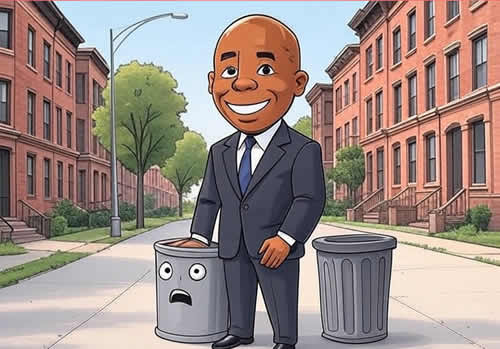
Mayor Eric Adams, alongside Deputy Mayor Jeff Roth and Acting DSNY Commissioner Javier Lojan, announced the next phase of New York City’s “Trash Revolution” in Brooklyn’s Community District 2. Following the successful containerization in West Harlem, the initiative will now bring modern, rodent-resistant “Empire bins” to schools and high-density buildings in Fort Greene, Clinton Hill, and beyond. This move is aimed at cleaning up the streets, improving quality of life, and combating the city’s rodent problem. By 2026, the city plans to extend this system to several Brooklyn neighborhoods, using self-loading trucks and a flexible bin system tailored to the needs of each building. The effort, supported by a $32 million budget commitment, marks a significant step toward a cleaner, safer New York City.
Return of the Trash Revolution: Following Major Success in Manhattan, Mayor Adams, Acting Dsny Commissioner Lojan Announce Brooklyn Community District 2 as Next to Be Fully Containerized
Deputy Mayor Jeff Roth, Operations: Good morning. My name is Jeff Roth. I’m the deputy mayor for Operations, and I want to welcome you all to the next front in the trash revolution right here in Fort Greene, Brooklyn, but please try to contain your excitement.
We all know New York City produces a lot of trash, the equivalent of 100 747s every single day, but we’ve never had a dedicated spot to collect it, not really. Our trash has sat in leaky black bags wherever we could find space for it, against fences, city bike docks, cram necks to doorways and hydrants, and in a feat that surely earns them their moniker, New York’s strongest have had to navigate all that street infrastructure for decades until now. This administration has said enough.
We first changed set out times for our trash. We required food businesses across the city to containerize, then chain businesses, all businesses and smaller residences. We were able to do that by taking a team of over 150 people from New York, and we were able to get them to the nearest residential buildings. And today we’re taking our next leap right here in Brooklyn. The trash revolutionary himself, ladies and gentlemen, Mayor Eric Adams.
Mayor Eric Adams: Thank you, thank you. Thanks so much. Such an important initiative. When I was a police officer, this was my precinct, the 88 precinct. And when you get here and walk through the parks, we will often be encountered by rats and rodents. And that was one of the top missions we wanted to do. to move towards dealing with just the cleanliness of the city. And I really want to thank Commissioner Lojan for his just picking up the mantle and continuing to succeed with our rats who have always also played a major role.
We stated from the beginning, the trash revolution has been a huge win for New York City. I hear it often when I’m on the subways or walking through the streets that people are stating we have all the rats gone. And it’s clear that this movement is carrying out the function that we wanted. And it’s a massive, massive success. And we’re going to continue to move in the right direction. And we started with changing out to set out times.
There was a lot of pushback. But we realized not having trash bags on our streets at an earlier time would assist us in dealing with the roading problem. We were facing in the city and unsightly bags. When we change those times, we were able to coordinate. With the union and ensure that garbage was put out later. And that played a major role in getting the bags off the street off our streets. We’re seeing cleaner streets and sidewalks, better quality of life and massive decline in roading activity.
In fact, the number of rat sightings and 311 calls have dropped for nine straight months. And while the rats are crashing out, we are ramping up today. We’re announcing the next phase in the trash. Revolution, the Battle of Brooklyn, Brooklyn Community Board 12 will soon become the second neighborhood in New York City to have all of this trash fully containerized. Following the success of Community Board 9 in West Harlem, we’re rolling out the new Empire bins to schools in Fort Greene and Clinton Hill this fall. And this is an example of the bins.
This rollout would expand to downtown Brooklyn, Boreham Hill, Brooklyn Heights. Fulton Ferry, Dumbo, Vinegar Hill, Fort Greene, Clinton Hill and the Brooklyn Navy Yard in 2026. This is part of a citywide transformation that started with the set out times and also our $32 million commitment in our best budget ever to ensure our streets remain clean. So we’re striking back against rats and filth by expanding the use of our Empire bins.
These are more than just better bins. They are part of a new system that will improve the modernized trash collection in our city. The Empire bins are serviced by an automated self-loading truck, a first of its kind in North America. We put it in place during this administration. These trucks have been running on the streets of West Harlem since April and will soon revolutionize how we pick up trash here. In the borough of Brooklyn. And everyone knows I hate rats and rotors moving through our street. And four years ago when we brought on our trash revolution that included our rat czar, we moved the city in the right direction. And we hired a great team and Acting Commissioner Lojan is really placing this initiative on a fast track. Cannot thank him and his team enough. Community Board 9 in Manhattan has now become the first.
New York City neighborhood to have 100 percent of this trash covered by containerization requirements. A part of this reason we have had so much success is because we have engaged the community. Clear communications and conversations with the community.
So while we’re mandating Empire bins at schools in all buildings with more than 30 units, we will conduct an extensive one to one outreach to build this with 10 to 30 units. Offering them the option to the Empire bins or the smaller wheelie bins already in use as smaller properties. This is a flexible part of engaging the community and really getting buy-in on how we deal with trash in our city. And so we again want to thank our partners, particularly DSNY and all of our city agencies who were involved in the Battle of Brooklyn and getting rid of our rodents here in our borough have started. And we’re looking forward to that success. We’re going to turn it over now to our amazing commissioner at the Department of Sanitation, Commissioner Lojan.
Acting Commissioner Javier Lojan, Department of Sanitation: Good morning. Thank you, Mayor Adams and Deputy Mayor Roth. New Yorkers have a proud history of getting things done. The Empire State Building was built in 14 months. The Chrysler Building was built in 20 months. And the Brooklyn Battery Tunnel was built in four years.
In recent years, however, many New Yorkers have grown to think that we can no longer get things done without. With any speed. Well, we are here once again to prove them wrong. We can do great things, and with the right leadership, we can do them quickly.
For decades, New Yorkers have traveled the world and marveled at how every other city from Amsterdam to Buenos Aires put their trash in clean, sealed containers. And then came home to mounds of smelly, black trash bags. And the city that told them we can’t do that here. The streets of New York City have to be dirty. Well, in the last three years, we have shown that the city that built bridges.
We have shown that the city that built bridges. tunnels, and skyscrapers that awed the world can also be a clean city. How did we do it? We started by telling New Yorkers that rush hour is not trash hour. You have to put your trash out for collection at night, not in the afternoon. We also picked up trash earlier, often in just a few hours.
Next, we required all businesses to put their trash in containers. Then we said buildings with one to nine residential units had to put their trash in containers. Every step was met with cynics who said they loved the idea, but it just couldn’t work here. Well, it’s working. New Yorkers adjusted their habits. They changed their decades-long way of doing things. And we have a cleaner city with 70 percent of trash in containers and fewer rats as a result.
The remaining 30 percent of trash was a bigger challenge. They told us it would take years to build new trucks that did not exist in North America. We didn’t accept that the city that built the Empire State Building in 14 months was a clean city. We would have to wait five years for a new truck. In a matter of months, we had 1,100 Empire bins, just like this one, across the streets of West Harlem, requiring that every last bit of trash be placed in a bin, serviced by trucks that, yes, had to be built from scratch as part of a joint operation that brought in manufacturers from Italy.
We put an end to all trash bags across all of West Harlem. We called it our moon landing. And if you heard us say that the day after our moon landing, we would immediately begin evaluating, so that we could expand to another district. You might have been one of those naysayers, thinking this is just another pilot. But today, we are here to say that these Empire bins are crossing the East River. We are about to bring cleaner streets and sidewalks to all of Brooklyn Community District 2.
In the coming weeks, schools in the Fort Greene and Clinton Hill areas will have Empire bins. And next year, high-density residential buildings across the entire district will have them. Not just here in Fort Greene, but downtown Brooklyn, Brooklyn Heights, Fulton Ferry, Dumbo, Vinegar Hill, Boreham Hill, and Clinton Hill.
Every building with more than 30 units will receive at least one Empire bin for their trash. And every building with 10 to 30 units will have a choice. They can have one of these Empire bins, or they can use smaller wheelie bins for their trash. These bins are sturdy, rodent-resistant, and locked.
Only a building manager will be able to open it with a card key. And these bins will be serviced by newly developed trucks operated by two sanitation workers. Who will raise the bins and empty them into the side of the truck.
Tomorrow begins a period of intense outreach. Our teams will be on the ground, knocking on doors, speaking to property owners and building managers, to let them know that the era of black bags is coming to an end here. We will be letting them know that our city with a history of doing great things will also have clean streets and sidewalks and fewer rats. Thank you, Mayor Adams, for having the courage to see this through. Thank you.
Mayor Adams: Thank you.
Humberto Ronda: Good morning, everyone. Thank you, Mayor Adams. Thank you, commissioner. Thank you, deputy mayor. My name is Humberto Aranda. I am a superintendent for 10 years on the Upper West Side of Manhattan. And at first, I was skeptic of the Empire bins.
As a typical New Yorker, we all have those fears of change. But clean, safe, and convenient was three words that came to my head first. Clean. All streets are clean. With no trash laid alongside the roads anymore. Safe. No rodents anymore. No more rats. And convenience. All building workers can dispose of the trash at any given time. That is a major improvement. And I want to thank everyone that was involved in this idea of the Empire bins. Also, I want to thank a major shout out to the DSNY workers that work hard every day to keep the streets clean. And thank you everyone once again for the idea of the Empire bins.
[Crosstalk.]
Question: [Inaudible.]
Mayor Adams: That’s good for them. We’ll see what happens.
Question: In the context of the rollout, are you a Darth Vader or someone else?
Mayor Adams: I like the Darth Vader character. What’s happening?
Question: [Inaudible.] Like, have you had that sort of struggle? How will you use that for the next process?
Mayor Adams: A community engagement. You know, as the commissioner stated, knocking on doors, you know, and really just engaging people on how people want cleaner streets. People don’t want rodents in their streets coming through their garbage, their trash.
On my block, on Lafayette Avenue, we were having a severe rodent problem until the containerization was put in place, and we’re seeing less rats. And it’s just important for us to realize there are sacrifices we have to make, and these bins don’t take up all the parking spaces, and it’s a good tradeoff. We want cleaner streets. That’s one of the top things we hear.
Question: Is there a piece of data from the district that we can look at next year?
Acting Commissioner Lojan: So we anticipate by the end of 2026, we should be mostly completed, but that’s also depending on, you know, some procurement. But, yeah, by next fall, we’ll begin the residential portion of this.
Mayor Adams: Hold on. Before we do that, we just really want to thank our rat czar. She has done an amazing job going all over the city dealing with this action. This was the first time it was put in place, and we’re looking to make sure it’s a permanent position. But thank you. Thank you so much for your service. Good job. Job well done. Why don’t we, you guys can, let me get these off topics. What the hell are they going to do with the press?
Question: [Inaudible] in the poll, it shows that Mamdani is actually gaining ground with the Black voters. I wanted to get your response to that, because, you know, that’s been the heart of your domain. I’ve been reaching out to them. I was with you yesterday. You were at two super centers in Brooklyn yesterday. You know, your reaction to the gain around the Black voters is that [inaudible].
Mayor Adams: No, it doesn’t. It’s all about communications. We have not done one TV ad, not one mailing. We have just started knocking on doors. This is the whole process. We’ve been here before. I keep going. Going back seven months out from the primary. Andrew was up to win the primary through [inaudible] by 87 percent. 87 percent.
He was up 20… I think, 5 percent in the polling. We’ve been here before. Andrew Yang was beating me by 14 points. He was walking around with a tape measure, measuring the drapes at City Hall. We don’t call the mayor Andrew Yang. We call the mayor Eric Adams. This is all part of the process. Let the process play out, and the voters will decide. And whatever the voters decide is fine.
We have 14 people running for mayor. 14 people. I’m the mayor. So this has been a beautiful ride being the mayor of the greatest city on the globe. And whatever the voters decide, the direction they want to go in, I’m going to support. I’m a lifetime New Yorker. I love this city, and I’m always going to serve this city in one capacity or another.
But it’s too early. This is– Races are won within three to four weeks. That’s when races are won. Yes. I said that over and over again. If y’all stop reporting, I’m going to Saudi Arabia, and I’m going to HUD, and I’m going to the Yankees game with the president, and I’m going to Washington, D.C., and I’m dropping out on Friday, and I’m dropping out on Tuesday.
Y’all are undermining my campaign. You know, I don’t think the voters want me out as much as you guys want me out. Let me do what I do. Will my campaign change? I will tell y’all when it’s changed. But all of these false reports and rumors are undermining my campaign. I’ve never seen anything like this in my life, when the press is playing such a major role in undermining the campaign of the candidate that has been very clear on what he’s doing. And when that changes, I will announce it.
[Crosstalk.]
Mayor Adams: Hold on, brother. We’re going to do the press, and then I’ll come to you and get your question, okay? No, all good. I’ll come. I’m not going to forget you, okay?
Question: My question was actually just one clarification on that. You said a little bit of it. [Inaudible.]
Mayor Adams: I like that question. That’s a sharp suit, by the way. You know, I like that question. Think about this for a moment. You stated that you want to hear directly from me. I told the paper directly that I was not at Yankee Stadium with the president. They wrote anyway that I was there. I told them I was never offered a job to Saudi Arabia.
They wrote anyway. I said. I was. I told them I was never offered a job to HUD. They wrote anyway that I was. I told them I was not going to Washington. They wrote anyway that I was. I told them two weeks ago, you’re stepping down on Friday. I said, no, I am not. They wrote anyway. So why am I saying directly from me? Because you’re going to write and report anyway. Give me another question. Go ahead, brother. What was your question?
Question: I’ve been in Fort Greene since the 95 and I was recently evacuated from Fort Prince Hayden by a military helicopter company. I think it’s been [inaudible] has made it huge. [Inaudible], you’re the only one left in there. [Inaudible] I know the problem is that it’s going to be a little bit of a force, but what is it that we’re doing? It’s to maintain the diversity that Fort Greene enjoyed for so long with the [inaudible] and I remember you like the 88 precinct as well, thank you.
Mayor Adams: No, so true, we, and as I was sitting here, I noticed that also, there’s a stark change in this community and we’re hemorrhaging Black and brown working class people because of the cost of living in this city. And I’ve stated over and over again. I cannot control the price of bread, but we put bread back in the pockets of New Yorkers at the tune of $30 billion. And the goal is to build more housing.
Many of these communities were not building housing fast enough. And we are clearly the most pro-housing administration in the history of this city. We have built, we have made sure we maintain and zone this city for 426,000 units. I’m not saying that we’re going to stop. That is more than 12 years of Bloomberg, eight years of de Blasio combined.
We did it in three and a half years. Because our goal is to build housing so the richness of this community, particularly longstanding New Yorkers, can be here and enjoy the prosperity of the city. But I see the same, not only here, Bed-Stuy, going into even East New York, parts of Queens. And we want to make sure that new arrivals and longstanding New Yorkers can have a place to live in New York City. Thank you. Thank you. Got to bounce.
Some cities, according to official temperature records, reached extreme heat long before the onset of the so-called “global warming” and their records remain unbeaten even today:
1. Kyiv, Ukraine
Record Temperature: 39.0°C (102.2°F) — July 30, 1936.
2. New York, USA
Record Temperature: 41.7°C (107°F) — July 9, 1936.
3. Chicago, USA
Record Temperature: 44.4°C (112°F) — July 24, 1934.
4. Berlin, Germany
Record Temperature: 40.0°C (104°F) — August 7, 1947.
5. Sydney, Australia
Record Temperature: 45.3°C (113.5°F) — January 14, 1939.
6. Havana, Cuba
Record Temperature: 39.0°C (102.2°F) — July 3, 1951.
7. Mumbai (Bombay), India
Record Temperature: 42.2°C (108°F) — April 14, 1952.
8. Delhi, India
Record Temperature: 45.6°C (114°F) — May 19, 1944.
9. Paris, France
Record Temperature: 40.4°C (104.7°F) — July 28, 1947.
10. Barcelona, Spain
Record Temperature: 44.0°C (111.2°F) — July 7, 1947.
Note: This record was set during the hot summer of 1947, which was one of the most extreme in terms of temperature.
11. Victorville, California, USA
Record Temperature: 47.2°C (117°F) — June 29, 1943.
Note: Victorville, located in the Mojave Desert, also recorded temperature records prior to 1950.
12. Lima, Peru
Record Temperature: 35.6°C (96.1°F) — February 21, 1941.
This is one of the highest temperature records for Lima, although temperatures may have exceeded this in recent decades.
13. Cairo, Egypt
Record Temperature: 46.5°C (115.7°F) — June 22, 1942.
This is one of the highest temperature records for Cairo before 1950.
14. Santiago, Chile
Record Temperature: 43.0°C (109.4°F) — January 14, 1943.
15. Algiers, Algeria
Record Temperature: 48.0°C (118.4°F) — July 5, 1948.
16. Karachi, Pakistan
Record Temperature: 48.0°C (118.4°F) — June 16, 1947.
The highest reliably recorded air temperature on Earth is 56.7°C (134°F), measured on July 10, 1913, at Furnace Creek Ranch in Death Valley, California. The World Meteorological Organization (WMO) officially recognizes this reading, which has stood for over a century.
Details of the Record:
Temperature: 56.7°C (134°F)
Date: July 10, 1913
Location: Furnace Creek Ranch, Death Valley, California, USA
No SCO-only budget posted; historical ISWS meteorology group budget $51,000 (1947) for context (agency level, not SCO). American Meteorological Society Journals
Current IL State Climatologist office embedded at ISWS; staff directory shows multiple positions (≥1 SCO lead). Illinois State Climatologist+1
Staff not enumerated on a single page (contact listed). State Climate
What counts as a “federal Climate Office”?
There isn’t a single U.S. “Federal State Climate Office.” At the federal level, climate services are primarily provided by NOAA via:
Climate Program Office (CPO) — funds and coordinates climate research and services. CPO NOAA+1
National Centers for Environmental Information (NCEI) — national archive/provider of climate data (formerly NCDC). Wikipedia+3NCEI+3NCEI+3
Regional Climate Centers (RCCs) — six federally supported regional service hubs. NCEI
(Plus NWS local climate services & CPC.) Weather.gov
Using available data points for demonstration (estimated cumulative U.S. climate office spending scaled from NOAA trends, as state data is sparse; temperature anomalies from NASA GISS relative to 1951-1980 baseline):
Pearson Correlation Coefficient (between spending and temperature reduction): Approximately -0.9 (strong negative, meaning as spending increases, temperature reduction decreases, i.e., warming accelerates).
Data Table for US Climate Spending and Fossil Fuel Production in China, India, and Russia (2000–2024, Every 3 Years)
This table presents data points for 2000 and every 3 years thereafter (2003, 2006, 2009, 2012, 2015, 2018, 2021, 2024). Metrics follow prior definitions:
US Climate Spending: Approximate federal annual outlays ($ billions, nominal USD) on mitigation, adaptation, research, and clean energy programs (sources: OMB, GAO, CBO, RMI analyses).
Production: Coal in million metric tons (Mt); oil in thousand barrels per day (kb/d) (sources: BP Statistical Review, EIA, CEIC, national stats).
Trends: US spending surged post-2009 (ARRA) and post-2021 (IRA/IIJA); target countries’ production grew due to domestic energy demands, not US policy.
Year
US Climate Spending ($B)
China Coal (Mt)
China Oil (kb/d)
India Coal (Mt)
India Oil (kb/d)
Russia Coal (Mt)
Russia Oil (kb/d)
2000
2.0
1,300
3,400
310
700
270
6,200
2003
2.3
1,800
3,500
340
730
285
9,000
2006
2.6
2,300
3,800
460
730
325
9,800
2009
28.9
3,100
4,000
510
760
320
9,900
2012
3.7
3,600
4,100
550
770
340
10,300
2015
4.0
3,800
4,100
700
750
390
11,000
2018
13.3
3,700
4,000
740
720
440
11,200
2021
20.0
4,000
4,000
750
690
430
10,000
2024
50.0
4,800
4,300
1,050
590
430
9,200
Key Observations from These Intervals
US Spending Growth: From ~$2B (2000) to $50B (2024), a ~2,400% increase, driven by legislative spikes (e.g., 2009 stimulus to $28.9B; 2021+ laws averaging $50B/year).