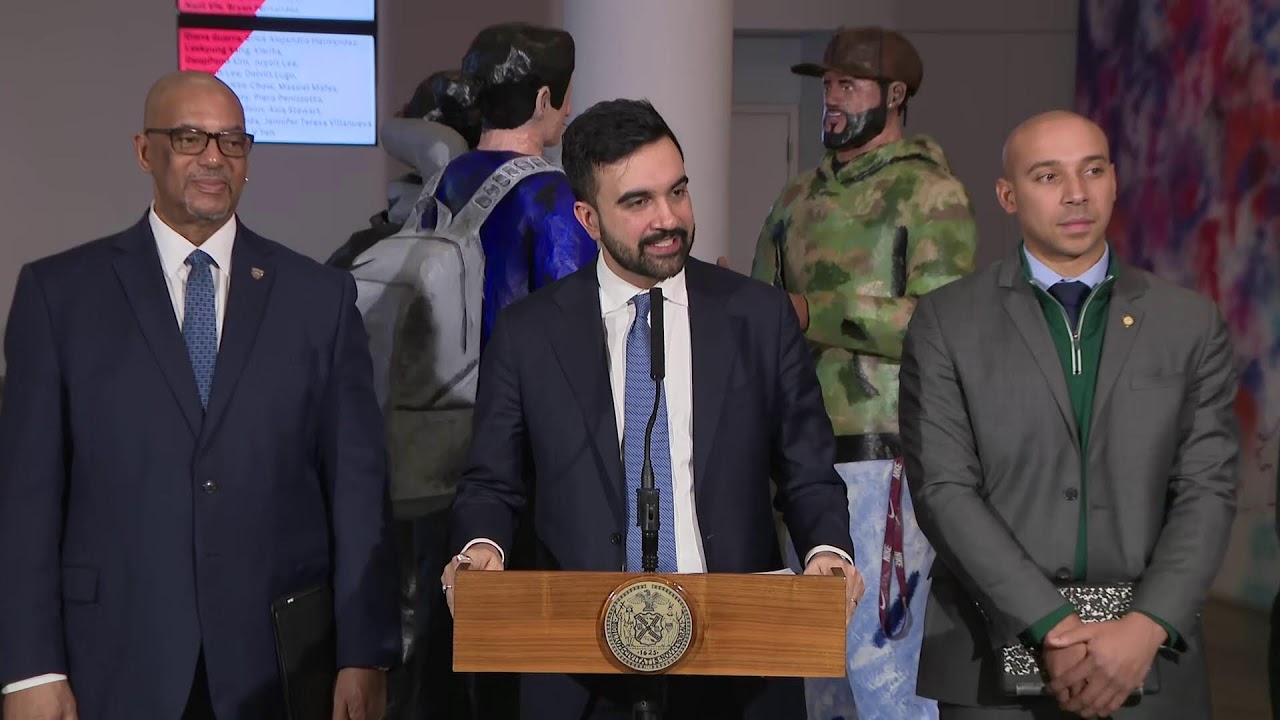
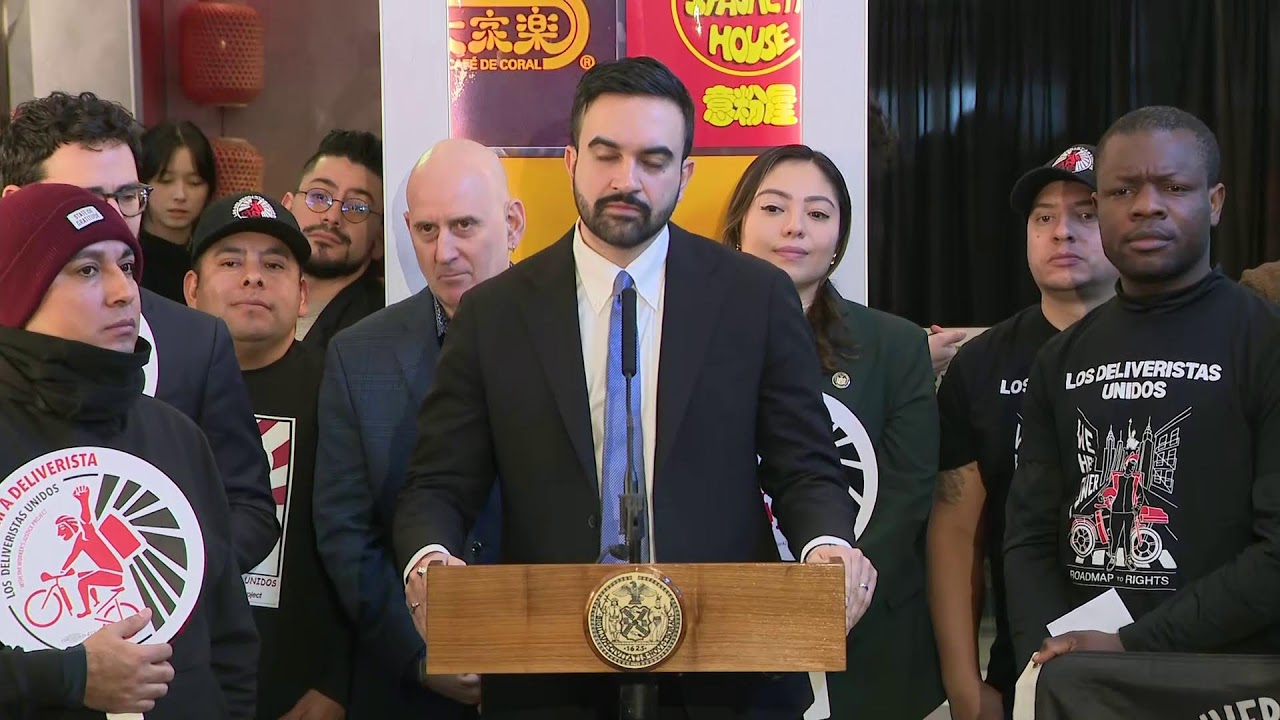
At a press conference at the
Bronx Museum of the Arts
,
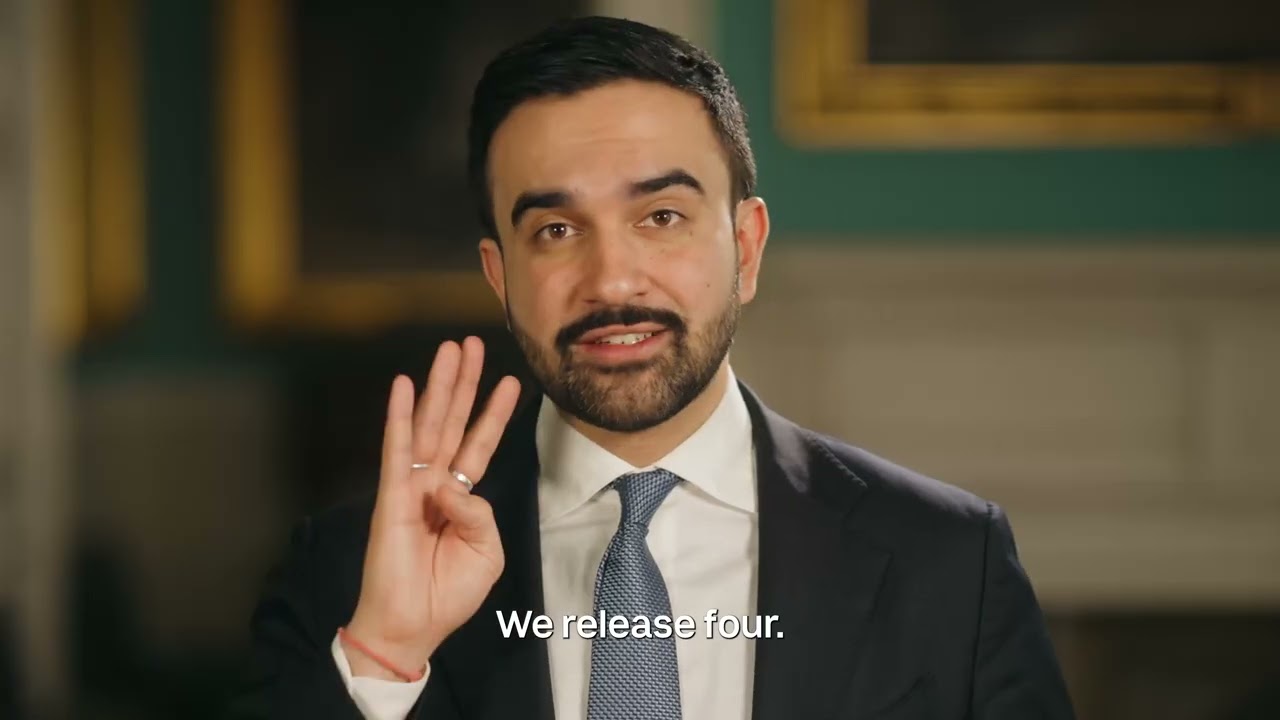
Mayor Zohran Mamdani announced five major appointments spanning justice reform, public health,
youth development, veteran services, and the city’s administrative court system. Before the introductions, he also
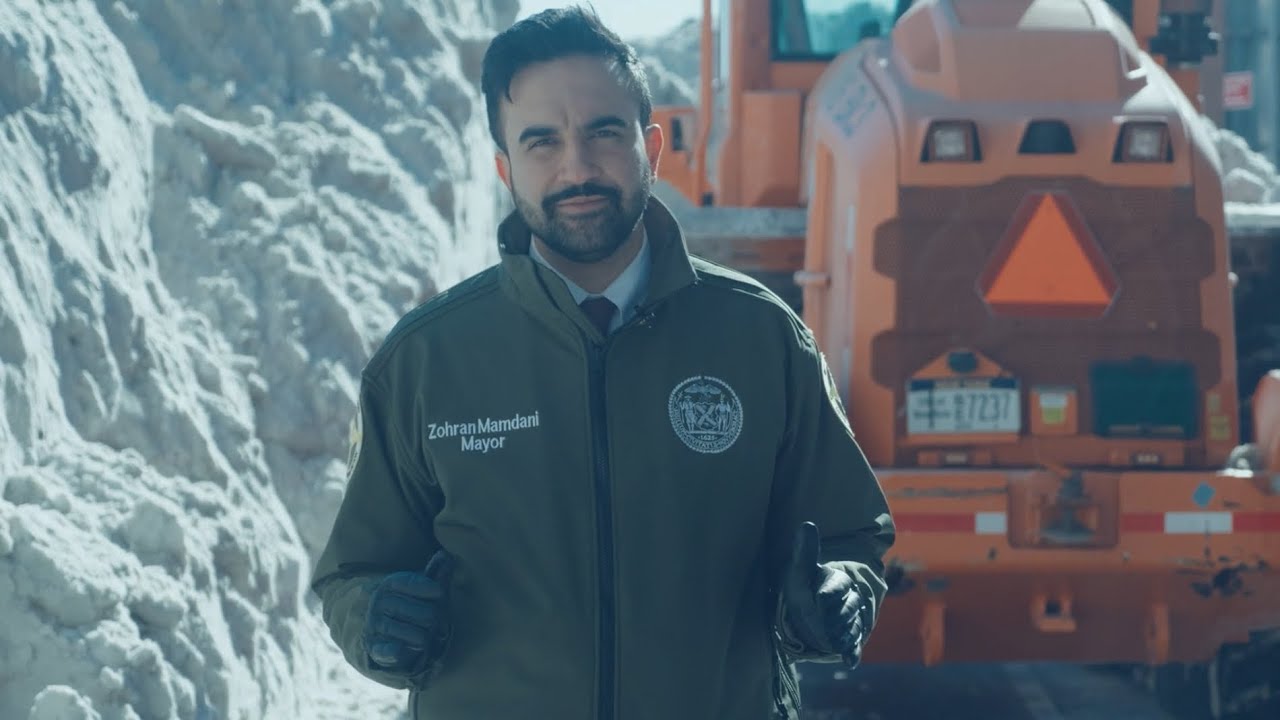
delivered a winter operations update: “code blue” remains in effect, shelter outreach is intensified,
and New Yorkers were urged to check on vulnerable neighbors.
Winter Weather Update — the “snow math”
67 million lbs of snow melted
188 million lbs of salt spread citywide
2,500 sanitation workers on 12-hour shifts (plus additional staffing for the weekend)
Code Blue: intensified outreach; shelters should not turn people away
The Five Appointments
1) Stanley Richards — NYC Department of Correction
Richards was named Commissioner of the NYC Department of Correction. The announcement emphasized a justice-reform
approach focused on safety, dignity, and re-entry, and noted he is described as the first formerly incarcerated
person to lead the department.
2) Dr. Alistair Martin — Department of Health and Mental Hygiene
An emergency-room physician with public health and government experience, Dr. Martin will oversee the city’s
public health apparatus and framed the mission as ensuring high-quality healthcare is not a privilege.
3) Sandra Escamia Davies — Youth & Community Development
Davies was appointed Commissioner of NYC’s youth and community development agency, emphasizing youth as “assets”
and calling for access regardless of ZIP code, with programs connected to credentials, pay, and jobs.
4) Yenya Mata — Department of Veterans’ Services
Mata was named Commissioner of the Department of Veterans’ Services, pledging support for the city’s veterans and
military families across housing, healthcare, and benefits navigation.
5) Vilda Vera Mayuga — OATH (Administrative Trials and Hearings)
Mayuga was appointed Commissioner of OATH, the city’s administrative law court, with a modernization agenda aimed
at making the process simpler and more straightforward than traditional court proceedings.
Q&A Highlights
Jail conditions: the administration said it is coordinating with the remediation manager to improve conditions.
Power outages: the mayor said the city will exhaust options to keep residents warm, including hotel placements if needed.
Cold-front fatalities: he announced the total reached 14 outdoor deaths since the cold front began; outreach and shelter placements were expanded.
World Cup planning: “World Cup Czar” Maya Honda was tasked with turning the event into a citywide celebration involving small businesses.
A conservative advocacy group criticized LinkedIn after the social media platform temporarily removed a post supporting a Trump-era immigration enforcement policy. LinkedIn later restored the post, saying the removal was an error.
What Happened
According to Fox News, a LinkedIn spokesperson confirmed:
“This was removed in error, and we quickly corrected it.” (Fox News)
The post had been flagged as “hateful speech” by LinkedIn’s moderation system. After review and public backlash, the platform reinstated the post.
Public Reaction
The removal prompted criticism from the conservative advocacy group and some social media users, who called for boycotts of LinkedIn. Inquisitr News reported that many users saw the removal as censorship, even though LinkedIn attributed it to a mistake. (Inquisitr)
Confirmation from Other Outlets
Several other news organizations confirmed the incident:
The Federalist reported LinkedIn quickly corrected the error. (The Federalist)
AOL News noted the post was restored and emphasized that the removal was unintentional. (AOL)
While LinkedIn’s removal of the post drew criticism, the platform confirmed it was a mistake and quickly restored the content. This incident highlights the challenges social media companies face in balancing content moderation with free speech concerns.
Social Media Platforms That Have Removed Posts Supporting Trump’s Policies
Based on official statements and reports from government archives, oversight bodies, and congressional documents, several major social media platforms have removed or restricted content that supported or promoted policies associated with former (and current) President Donald Trump. These actions often involved claims related to election integrity, immigration, or public health policies during his administration, but were frequently justified by platforms under rules against misinformation, incitement to violence, or hate speech. Note that platforms’ official policies emphasize neutral enforcement, though critics, including Trump administration officials, have argued these removals disproportionately targeted conservative viewpoints. Below are key examples from authoritative sources, focusing on platforms beyond LinkedIn (as mentioned in your query snippet).
Twitter (now X): Twitter removed multiple tweets from Trump’s account that supported his policies on election security and postal voting, labeling them as disputed or misleading. For instance, during the 2020 election, tweets falsely suggesting electoral fraud (tied to Trump’s policy stance on voter integrity) were removed or hidden. The platform also permanently suspended Trump’s account on January 8, 2021, citing risks of further violence after the January 6 Capitol events, where posts echoed his policy narratives on election results. Official Twitter statements (via archived government briefings) described these as editorial decisions to prevent harm, not political bias.
Facebook: Facebook removed posts from Trump praising the January 6 events, which supporters framed as backing his immigration and law-and-order policies amid election disputes. These were deleted under the platform’s Community Standards on Dangerous Individuals and Organizations, leading to an indefinite suspension of his account (later set to two years, lifted in 2023). The Oversight Board, an independent body reviewing Facebook decisions, upheld the initial suspension but criticized the indefinite nature as inconsistent with rules. Similar removals affected content supporting Trump’s COVID-19 or election policies deemed misinformation.
Instagram (Meta-owned): As part of the same ecosystem as Facebook, Instagram applied identical restrictions, removing Trump’s posts that glorified the January 6 events (seen by some as supporting his border security and anti-fraud policies). The suspension was extended indefinitely in January 2021 for at least two weeks, later formalized to two years.
YouTube (Google-owned): YouTube suspended Trump’s channel in January 2021 for “content violating policies on incitement, including videos supporting his election-related policies that allegedly risked violence”. The suspension was lifted in March 2023. Google has general policies against incitement to hatred, which have led to removals of content aligned with conservative policy advocacy.
Other platforms like Snapchat, Twitch, and Pinterest have banned Trump-related accounts or content supporting his policies (e.g., on immigration or election fraud), but these are less documented in official government sites and more in oversight reports. Platforms maintain these actions are content-neutral, aimed at curbing harm, but analyses from sources like the White House and Congress suggest asymmetries, with conservative content flagged more often due to higher rates of associated misinformation.
Approaches to Stopping Such Removals
Official sources, including White House executive orders, congressional proposals, and think tank analyses, outline several strategies to address perceived censorship of conservative or Trump-supporting content. These range from legal reforms to promoting transparency, though viewpoints differ: Some conservatives advocate aggressive regulation to limit platform power, while others (including free speech advocates) warn that government intervention could worsen censorship. The U.S. Supreme Court has ruled that platforms have First Amendment rights to moderate content, but government pressure on them can be unconstitutional. Here’s a high-level overview of proposed solutions from balanced sources:
Approach
Description
Key Proponents/Sources
Potential Challenges
Reform Section 230
Amend the Communications Decency Act to strip liability protections from platforms that engage in “editorial” moderation (e.g., removing political content). This would make platforms liable for user content unless they act neutrally, potentially discouraging removals. Bills like the Stop Shielding Culpable Platforms Act aim to clarify this.
Could lead to over-removal of all content to avoid lawsuits, harming free speech overall. brookings.edu
Executive Orders and Federal Accountability
Prohibit federal agencies from pressuring platforms to censor speech. The 2025 White House order requires agencies to report and correct past misconduct, ensuring no taxpayer funds support censorship. It accuses prior administrations of coercing platforms.
Trump Administration (2020 and 2025 orders) whitehouse.gov
Enforcement relies on administration priorities; critics say it risks politicizing speech. npr.org/
Transparency and Due Process Requirements
Mandate platforms to disclose moderation policies, provide appeals for removals, and report annually on actions (e.g., how many conservative posts were removed). Legislation could require public reports on government-platform communications.
Platforms resist full disclosure; may not stop removals but increases accountability.
Promote Competition and Alternatives
Encourage new platforms (e.g., Truth Social, Parler) via antitrust actions or reduced barriers, allowing users to migrate to less-moderated spaces. Avoid nondiscrimination mandates that force platforms to host all content.
New platforms struggle with scale and app store restrictions. washingtonpost.com
Multistakeholder Guidelines
Create international forums (e.g., proposed International Forum on Content Moderation) for voluntary standards on handling political speech, including definitions of harmful content and appeals processes.
On January 30, 2026, President Donald J. Trump nominated Kevin Warsh, a former Federal Reserve Governor who navigated the 2008 financial crisis, to serve as the next Chairman of the Federal Reserve, succeeding Jerome Powell. Warsh brings extensive credentials, including degrees from Stanford and Harvard Law School, experience as a Morgan Stanley executive, and advisory roles in the Bush administration. The nomination has garnered widespread acclaim across political and financial spheres, with Republican senators such as Tim Scott, Lindsey Graham, and Bill Hagerty praising his deep monetary policy expertise, steady leadership, and potential to refocus the Fed on its core mandate of price stability and maximum employment while enhancing credibility and accountability. Business leaders including JPMorgan Chase CEO Jamie Dimon, U.S. Chamber of Commerce President Suzanne Clark, and financial organizations like the Mortgage Bankers Association and American Bankers Association highlighted his prudent approach, crisis management skills, and commitment to economic growth, stability, and innovation in a complex environment.
Wide Acclaim for President Trump’s Nomination of Kevin Warsh as Fed Chair
Today, President Donald J. Trump announced his nomination of Kevin Warsh to serve as Chairman of the Board of Governors of the Federal Reserve System. Mr. Warsh is exceptionally well-prepared to lead the world’s most influential central bank, with a distinguished background including degrees from Stanford University and Harvard Law School, prior roles as a Morgan Stanley executive and top economic advisor to the Bush Administration, and service as the youngest-ever Federal Reserve Governor — where he helped steer the institution through the 2008 financial crisis.
The nomination has drawn widespread praise from lawmakers, business leaders, financial experts, and industry voices across the spectrum:
Senate Committee on Banking, Housing, and Urban Affairs Chairman Tim Scott: “The Federal Reserve’s decisions touch every American household, from mortgage rates to retirement savings, and President Trump has been clear that bringing accountability and credibility to the Federal Reserve is a priority, and his nomination of Kevin Warsh reflects that focus. As a former Federal Reserve Governor, Kevin has deep knowledge of markets and monetary policy that will be essential in this role. Federal Reserve independence remains paramount, and I am confident Kevin will work to instill confidence and credibility in the Fed’s monetary policy. As Chairman of the Senate Banking Committee, I look forward to leading a thoughtful, timely confirmation process that carefully examines his vision for focusing the Federal Reserve on its core mission.”
Sen. Jim Banks: “Kevin Warsh is a brilliant pick by President Trump for Fed Chair. Clear from what he wrote in 2021 he understands scale of China’s ambitions. As member of Banking Committee I look forward to working with him to maintain American financial supremacy.”
Sen. Marsha Blackburn: “Kevin Warsh is exceptionally qualified to lead the Federal Reserve as Chairman. I look forward to supporting this nomination in the Senate, and I am confident Kevin will help foster economic growth and create more opportunity for hardworking Americans.”
Sen. Katie Britt: “Congratulations to Kevin Warsh on his nomination to serve as the next Chair of the Federal Reserve. Kevin brings a deep expertise and proven track record in monetary policy, including years at the Federal Reserve where he helped our nation navigate some of its most economically turbulent times. He is an exceptionally qualified candidate, and I look forward to supporting his nomination.”
Sen. Shelley Moore Capito: “@potus’ pick of Kevin Warsh to serve as @federalreserve Chairman is an excellent choice. I’ve had the [opportunity] to get to know Kevin over the years and know firsthand that he brings experience, steady leadership, and a clear understanding of the challenges facing our economy. I’m looking forward to working together.”
Sen. John Cornyn: “With decades of experience in finance & economics spanning government and the private sector, Kevin Warsh is eminently qualified to serve as Chairman of the @federalreserve. I trust with him at the helm, the Federal Reserve will help guide our nation on a path of historic prosperity & opportunity just as @POTUS has. I look forward to supporting Kevin in the Senate.”
Sen. Tom Cotton: “I commend President Trump nominating Kevin Warsh to become the next Chairman of the Federal Reserve. I look forward to working with him and President Trump to make life more affordable for Arkansans.”
Sen. Lindsey Graham: “Great pick, Mr. President. Kevin Warsh has the experience and judgment this important role demands, along with a strong combination of academic and real-world knowledge. I have every confidence that he is the right choice at the right time, and I will enthusiastically support his nomination.”
Sen. Bill Hagerty: “Congratulations to my friend Kevin Warsh on his nomination to be Chairman of the Federal Reserve. I have known Kevin for years and his exemplary record speaks for itself. No one is better suited to steer the Fed and refocus our central bank on its core statutory mandate. I look forward to voting for his confirmation in short order, and watching him succeed. An outstanding choice by @realDonaldTrump!”
Sen. Cynthia Lummis: “Now more than ever, we need a Federal Reserve that embraces digital assets and financial innovation, not one that shuns advancement. I applaud President Trump’s decision and look forward to hearing Kevin Warsh’s plans to undertake needed reforms to make the Fed more transparent and accountable to Congress.”
Sen. Roger Marshall: “Kevin Warsh is an outstanding choice by President @realDonaldTrump to serve as the next Fed chair. His experience and expertise are exactly what our country needs right now. Time to unleash the full strength of the American economy.”
Sen. Dave McCormick: “I applaud President Trump’s nomination of Kevin Warsh to be Chairman of the Federal Reserve. Kevin has been a friend and colleague to Dina and me for almost 30 years. He is exactly who we need to fulfill the Fed’s mandate of monetary policy that keeps inflation in check while unlocking growth, new jobs, and opportunity. Pennsylvanians can be confident that this choice will bring common sense and steady leadership to the Federal Reserve.”
Sen. Bernie Moreno: “Phenomenal choice by President Trump! Kevin Warsh is a brilliant mind who will restore independence to the Federal Reserve. Unlike Powell, Kevin will make decisions based on logic and not based on politics. I look forward to voting to confirm him as the next Chairman!”
Sen. Pete Ricketts: “Congrats to Kevin Warsh on his nomination to be the next chairman of the Federal Reserve. I look forward to speaking with him about his vision of the Fed on @BankingGOP in the near future.”
Sen. Rick Scott: “Kevin Warsh is a great pick from @POTUS as the next @FederalReserve Chair, and I’m excited to vote for his confirmation ASAP. The Fed has lost its way. I believe Kevin understands the need to reduce the balance sheet and rein in out-of-control spending at the Fed to help get our country back on track.”
Sen. Tommy Tuberville: “Congratulations to Kevin Warsh who will do a great job as the next Chairman of the Federal Reserve. The President made an excellent choice. Time to cut rates.”
Canadian Prime Minister Mark Carney: “Kevin Warsh is a fantastic choice to lead the world’s most important central bank at this crucial time.”
The Wall Street Journal Editorial Board: “Does Kevin Warsh know what he’s getting into as President Trump’s nominee to be the next Chairman of the Federal Reserve? Yes, he does, which is only one of the reasons he is the right choice for a central bank that needs reform after a generation of exceeding its proper monetary remit… This is President Trump’s best second-term appointment.”
Mortgage Bankers Association President and CEO Bob Broeksmit: “MBA congratulates Kevin Warsh on his nomination to serve as Chairman of the Federal Reserve. His prior service on the Federal Reserve Board, where he developed a reputation as a prudent, thoughtful voice on monetary policy, paired with his private sector experience, will be invaluable as he leads the Federal Reserve in what has become an increasingly challenging and complicated mission.”
U.S. Chamber of Commerce President and CEO Suzanne P. Clark: “Kevin is well known to the business community. We appreciate his years of focus on how we grow the American economy and maintain stable prices for America’s families, and look forward to his confirmation process.”
JPMorgan Chase CEO Jamie Dimon: “Kevin Warsh is a highly respected and experienced leader — across government, business and education — who I have seen act with integrity and a dedication to making our country better.”
Rene M. Kern Practice Professor at the Wharton School of the University of Pennsylvania Mohamed A. El-Erian: “Congratulations to Kevin Warsh on being nominated by President Donald Trump as the next Chair of the Federal Reserve, the world’s most powerful central bank. Having observed and interacted with Kevin during his prior tenure as Fed Governor, in academia, and as a fellow member of the Group of Thirty (G-30), I believe he brings a strong mix of deep expertise, broad experience, and sharp communication skills. His commitment to reforming and modernizing the Fed bodes well for enhancing policy effectiveness and protecting the institution’s political independence.”
Financial Services Forum President and CEO Amanda Eversole: “The Federal Reserve is critical to ensuring the economic success of our nation—Kevin Warsh is the right man for the job of chair. Warsh brings an unmatched wealth of experience and has a proven track record of guiding our nation’s economy through financial crisis and recovery. President Trump understands the need for strong leadership at the Federal Reserve to fulfill its dual mandate while modernizing the institution. The Forum applauds President Trump’s nomination and looks forward to working with Warsh to ensure our nation’s economic strength for the benefit of all Americans.”
National Economic Council Director Kevin Hassett: “President Trump made a great choice… I really have high regard for Kevin and we’re going to put every effort that we have into getting him confirmed as soon as possible so that we can get the Fed moving in the right direction.”
Consumer Bankers Association President and CEO Lindsey Johnson: “On behalf of America’s leading Main Street banks, we congratulate Kevin Warsh on his nomination to serve as Chair of the Federal Reserve. Mr. Warsh’s depth of expertise and understanding of the Federal Reserve’s dual mandate will be critical as the central bank navigates a complex economic environment and works to maintain stability, confidence, and long-term growth. We look forward to working with Mr. Warsh and policymakers to advance sound, predictable policies that support a strong economy, a resilient financial system, and broad access to credit for consumers and small businesses nationwide.”
American Bankers Association President and CEO Rob Nichols: “Congratulations to Kevin Warsh on his nomination to serve as the next chair of the Federal Reserve Board. In selecting Warsh, President Trump has chosen an experienced and tested policymaker who previously served at the Fed during one of its most challenging moments. Having worked alongside him in the Bush administration, I know he has a deep understanding of monetary policy, markets and the important role the nation’s banks play in the economy. We look forward to learning more about his current policy views during the confirmation process, and ultimately seeing a smooth transition in Fed leadership.”
Job Creators Network CEO Alfredo Ortiz: “Kevin Warsh is the perfect choice to lead the Federal Reserve. He has repeatedly demonstrated understanding of the true driver of inflation: excessive government money printing, not economic growth. Under his leadership, the Fed can finally reach its target inflation rate, something Chairman Powell has continually failed to do, while also expanding access to credit for small businesses. By protecting the value of the dollar, supporting economic growth, and boosting capital access, a Warsh chairmanship can backstop a booming small business economy. The Senate should quickly confirm him.”
Investment Company Institute President and CEO Eric J. Pan: “ICI offers our warm congratulations to Kevin Warsh on his selection to lead the Federal Reserve. Warsh’s wealth of experience in monetary policy and financial regulation, along with his deep understanding of the Federal Reserve’s dual mandate, will serve him well in this position. His unique background as a former Federal Reserve Governor, twinned with his experience in global financial markets, means he has a firm foundation from which to step into this leadership role. We commend President Trump for this outstanding nomination and look forward to working with Warsh to support the millions of American investors we serve.”
CRE Finance Council President and CEO Lisa Pendergast: “CREFC congratulates Kevin Warsh on his nomination to lead the Federal Reserve. As a former Federal Reserve Governor with deep experience in financial markets, Mr. Warsh brings valuable perspective at a critical moment for the U.S. economy. Federal Reserve policy has a direct and significant impact on commercial real estate finance, influencing interest rates, liquidity, and the availability of capital across CRE lending and securitization markets. Strong, transparent leadership at the Fed is essential to maintaining market stability and supporting economic growth. We look forward to engaging with Mr. Warsh and policymakers throughout the confirmation process and beyond to advance policies that promote a healthy, resilient commercial real estate finance system.”
Independent Community Bankers of America President and CEO Rebeca Romero Rainey: “ICBA and the nation’s community banks congratulate Kevin Warsh on his nomination to serve as chairman of the Federal Reserve Board. As a previous member of the Fed board, Warsh has demonstrated a clear understanding of the important role of community banks in the nation’s economy and the need for tiered regulations to support access to banking services in local communities. ICBA encourages policymakers in Washington to continue ongoing efforts to address excessive regulatory burdens on community banks and ensure a level regulatory playing field between banks and nonbank entities to support a secure environment for consumers and the financial system. We look forward to continuing to work closely with Warsh, the Trump administration, and the 119th Congress on these issues.”
Former Secretary of State Condoleezza Rice: “Congratulations to my close friend and trusted colleague of many years at Hoover on being nominated as the next Fed Chair. Kevin is a dedicated public servant with the intellect, experience, and judgment to lead the Federal Reserve. He understands the central bank’s key role for the United States and our allies around the world. We will benefit from his steady, principled leadership.”
Apollo Global Management Chief Economist Torsten Slok: “He will be really a great Fed Chair because the issue is that he understands the institution. He understands that this is a committee; there are 12 voting members. He absolutely also understands the importance of guiding the committee and figuring out the consensus opinion.”
UPS CEO Carol B. Tomé: “Since joining the UPS Board more than 13 years ago, Kevin Warsh has served as a trusted advisor and colleague. His deep financial markets knowledge, global economic insight, crisis management expertise, and sound judgment have made him an invaluable member of our Board. On behalf of our more than 400,000 employees, we celebrate his nomination and his willingness to serve our country in this key role.”
Chevron CEO Mike Wirth: “The energy sector stands at an inflection point. Energy abundance is a national imperative, AI leadership requires unprecedented power, and geopolitics are reshaping the energy map. Having known Kevin Warsh for decades, he’s uniquely prepared — in judgment, experience, and temperament — to serve our country at this critical time.”
House Majority Leader Steve Scalise: “Kevin Warsh is an excellent pick to serve as the next Chair of the Federal Reserve. His extensive experience makes him well qualified for the role and with Kevin as Chairman, I’m hopeful the Fed can help America’s economy continue to get back on track and restore accountability and greater trust in the institution.”
House Majority Whip Tom Emmer: “Kevin Warsh is another outstanding pick by @POTUS. I hope to sit down with him soon to discuss the importance of maintaining America’s status as the crypto capital of the world and look forward to his swift confirmation in the Senate.”
House Republican Conference Chairwoman Lisa McClain: “President Trump has made a great choice in nominating Kevin Warsh to lead the Federal Reserve! As a former Fed governor, Mr. Warsh has the right experience and deep market expertise. I look forward to his confirmation.”
Rep. Jodey Arrington: “Kevin Warsh is the right man for the job. Kevin is a longtime friend and former White House colleague—one of the smartest and most talented people I have ever served with. Kevin is a conservative economist, financial markets expert, and respected authority on fiscal, monetary, and economic policy. Kevin is a strong leader with deep convictions for free people, free markets, and fiscal responsibility. He has questioned the Fed’s recent failures, criticized the Fed’s overreach of the past, and rightfully admonished the Fed’s complicity in the explosion of our national debt. He has dedicated his career to serving our great country and advancing the principles that made America the most powerful and prosperous nation in human history.”
Rep. Andy Barr: “President Trump has hit another grand slam home run with his nomination of @kev_warsh to serve as the next Chairman of the Federal Reserve Board. Over the years, Kevin has advised me and other members of the @FinancialCmte on monetary policy, interest rates, the economy and the proper role of the Fed. His advice has always been thoughtful, insightful and well-supported. Kevin and I have also connected over the years through our mutual love for the great sport of thoroughbred horseracing. Kevin’s powerful intellect, deep experience as a former Fed Board Governor, and strong background in finance and academia will serve him well in this very important position. He will do great things. Congratulations, Kevin!”
Rep. Vince Fong: “I’d like to congratulate Stanford’s Hoover Distinguished Visiting Fellow Kevin Warsh on his nomination to serve as Chairman of the @federalreserve. A former Fed Governor, Kevin brings steady leadership, deep monetary policy experience, and a strong commitment to reform. @POTUS made a great choice — Kevin understands the challenges facing hardworking Americans and how to keep our economy strong.”
Rep. French Hill: “With his service as member of the Federal Reserve Board of Governors, combined with his decades of academic and financial market experience, Kevin Warsh brings a clear understanding of the responsibilities of the Fed, and I congratulate him on his nomination. He has demonstrated a commitment to fighting inflation and to keeping prices in check for American families and am pleased that President Trump put forward such a qualified nominee.”
Rep. Ashley Hinson: “Excellent news, Mr. President. Congratulations to Kevin Warsh on receiving this nomination to become the next Chairman of the Federal Reserve. Iowans will greatly benefit from his expertise and strong leadership. I look forward to seeing him bring the Federal Reserve back to its core mission to help usher in economic prosperity for all Americans.”
Rep. Bill Huizenga: “I have known and interacted with Kevin Warsh for years. He played a pivotal role in navigating our country through one of the greatest financial crises in our lifetime. Kevin is incredibly qualified and immediately provides credibility as well as stability to this important role.”
Rep. Mike Lawler: “Congratulations to New York native Kevin Warsh on being appointed as Fed Chair! He will do a phenomenal job! Having served on the Federal Reserve under President Bush and at the height of the financial collapse in 2008, he is well prepared to handle these challenging times.”
Rep. Frank Lucas: “Kevin Warsh is the right pick for Fed Chair. Having previously served on the Federal Reserve’s Board of Governors, Mr. Warsh has seen firsthand how to build consensus during times of crisis, both at the Board and the FOMC. As an expert economist, Mr. Warsh will work well with Vice Chair Bowman on the work she’s already begun in right-sizing bank regulation and ensuring capital access across the country. Mr. Warsh’s work at the Fed, in the private sector, and in the executive branch, make him more than qualified to lead the Board as our banking industry undergoes tremendous innovation. As Chairman of the Task Force on Monetary Policy, Treasury Market Resilience, and Economic Prosperity, I look forward to working alongside him to bolster the American economy.”
Rep. Dan Meuser: “@POTUS made an excellent choice in Kevin Warsh to lead the @federalreserve, after months of vetting incredible candidates including Kevin Hassett, Chris Waller, and Rick Rieder. Warsh is a serious, credible choice who understands the magnitude of the job ahead — Fed policy directly affects mortgage rates, borrowing costs, and the price of everyday goods. President Trump has been clear about his priorities: lowering costs, fighting inflation, and restoring affordability, especially in the housing market. Kevin Warsh shares that focus and understands that you don’t fix the economy by crushing it. You restore stability with disciplined monetary policy that supports growth rather than working against it. With experience at the Fed, in the White House, and in the private sector, Kevin Warsh understands how monetary policy impacts real people, real businesses, and long-term economic strength. The Senate should move quickly to confirm him so the Fed can refocus on its core mission and focus on helping our economy grow to the benefit of all Americans.”
Rep. María Elvira Salazar: “Congratulations to my friend @kev_warsh on his appointment as Chairman of the Federal Reserve. Kevin is exceptionally qualified, experienced, and respected, and I am confident his leadership will strengthen our economy and restore trust in our financial system.”
Rep. Jason Smith: “I congratulate my friend, Kevin Warsh, being nominated to be the next Chairman of the Federal Reserve. Kevin has extensive experience with monetary policy, and I have no doubt that President Trump’s great selection will understand the struggles of hardworking Americans and implement policies to ensure our economy is working for them.”
Rep. Elise Stefanik: “This is a very smart nomination by President Trump of Kevin Warsh as Fed Chair. Kevin is a longtime friend and he is a fellow Upstate NY native. He is exactly the right leader at this time to right the ship at the Fed and get our economy back on track for the hardworking families and small businesses across America.”
Rep. Marlin Stutzman: “Kevin Warsh’s nomination as Fed Chair is a PIVOTAL step to unleashing the America First economy. He has decades of market experience, and has already demonstrated his commitment to FIGHTING inflation and keeping prices in check for American families. @POTUS has picked an extremely qualified nominee!”
Rep. Ann Wagner: “Kevin Warsh is fully qualified to serve as Chairman of the Federal Reserve, and his decades of experience will serve him well as he works to ensure American families have confidence in a stable economy. President Trump made an excellent decision to nominate Kevin, and I know he will be a thoughtful steward of his responsibilities as Chair as we all work to fight inflation and support strong economic growth for our nation.”
Rep. Roger Williams: “Congratulations to Kevin Warsh on his nomination to serve as Federal Reserve Chair. As a Member of the @FinancialCmte and Chairman of @HouseSmallBiz, I look forward to working together to advance policies that strengthen economic opportunity for every American.”
In a landmark verdict that underscores the high-stakes battle for AI dominance, a federal jury in San Francisco has convicted former Google software engineer Linwei Ding (aka Leon Ding) on 14 felony counts — seven of economic espionage and seven of trade secret theft — for secretly siphoning off thousands of pages of Google’s most advanced AI technology. Between 2022 and 2023, Ding allegedly exploited his privileged access to steal confidential details on custom Tensor Processing Units, GPU systems, and supercomputing infrastructure, uploading the data to his personal cloud account before downloading it to his own machine just days before quitting. Prosecutors revealed he was simultaneously building his own AI startup in China, boasting to investors that he could replicate and enhance Google’s cutting-edge supercomputers, all while applying for government-backed “talent plans” to boost Beijing’s tech ambitions — a brazen betrayal that prosecutors say threatened America’s lead in the global AI race and could land him decades behind bars.
Former Google Engineer Found Guilty of Economic Espionage and Theft of Confidential AI Technology
Yesterday, a federal jury in San Francisco convicted former Google software engineer Linwei Ding, also known as Leon Ding, 38, on seven counts of economic espionage and seven counts of theft of trade secrets for stealing thousands of pages of confidential information containing Google’s trade secrets related to artificial intelligence technology for the benefit of the People’s Republic of China (PRC). The jury’s verdict follows an 11-day trial before U.S. District Judge Vince Chhabria for the Northern District of California.
“This conviction exposes a calculated breach of trust involving some of the most advanced AI technology in the world at a critical moment in AI development,” said Assistant Attorney General for National Security John A. Eisenberg. “Ding abused his privileged access to steal AI trade secrets while pursuing PRC government-aligned ventures. His duplicity put U.S. technological leadership and competitiveness at risk. I commend the trial team and investigators whose exceptional work resulted in this conviction.”
“In today’s high-stakes race to dominate the field of artificial intelligence, Linwei Ding betrayed both the U.S. and his employer by stealing trade secrets about Google’s AI technology on behalf of China’s government,” said Assistant Director Roman Rozhavsky of the FBI’s Counterintelligence and Espionage Division. “Not only does this case mark the first-ever conviction on AI-related economic espionage charges, but it also demonstrates the FBI’s unwavering dedication to protecting American businesses from the increasingly severe threat China poses to our economic and national security. We remain committed to working closely with our partners across the private sector to protect our nation’s innovation, safeguard our trade secrets, and hold our foreign adversaries accountable.”
“Silicon Valley is at the forefront of artificial intelligence innovation, pioneering transformative work that drives economic growth and strengthens our national security. The jury delivered a clear message today that the theft of this valuable technology will not go unpunished. We will vigorously protect American intellectual capital from foreign interests that seek to gain an unfair competitive advantage while putting our national security at risk,” said U.S. Attorney Craig H. Missakian for the Northern District of California.
“This conviction reinforces the FBI’s steadfast commitment to protecting American innovation and national security. The theft and misuse of advanced artificial intelligence technology for the benefit of the People’s Republic of China threatens our technological edge and economic competitiveness,” said FBI Special Agent in Charge Sanjay Virmani for the San Francisco Field Office. “The FBI San Francisco division serves Silicon Valley and the companies who lead the world in innovation, and we are committed to safeguarding their work. This case demonstrates the strength of collaboration between the FBI and the private sector, including leading companies like Google, whose partnership is critical to protecting sensitive U.S. technology. Today’s verdict affirms that federal law will be enforced to protect our nation’s most valuable technologies and hold those who steal them accountable.”
Ding was originally indicted in March 2024. A superseding indictment returned in February 2025 described seven categories of trade secrets stolen by Ding and charged Ding with seven counts of economic espionage and seven counts of theft of trade secrets.
According to the evidence presented at trial, between approximately May 2022 and April 2023, while a Google employee, Ding stole more than two thousand pages of confidential information containing Google’s AI trade secrets from Google’s network and uploaded them to his personal Google Cloud account. Ding also secretly affiliated himself with two PRC-based technology companies while he was employed by Google: around June 2022, Ding was in discussions to be the Chief Technology Officer for an early-stage technology company based in the PRC; by early 2023, Ding was in the process of founding his own technology company in the PRC focused on AI and machine learning and was acting as the company’s CEO. In multiple statements to potential investors, Ding claimed that he could build an AI supercomputer by copying and modifying Google’s technology. In December 2023, less than two weeks before he resigned from Google, Ding downloaded the stolen Google trade secrets to his own personal computer.
The jury found that Ding stole trade secrets relating to the hardware infrastructure and software platforms that allow Google’s supercomputing data center to train and serve large AI models. The trade secrets contained detailed information about the architecture and functionality of Google’s custom Tensor Processing Unit chips and systems and Google’s Graphics Processing Unit systems, the software that allows the chips to communicate and execute tasks, and the software that orchestrates thousands of chips into a supercomputer capable of training and executing cutting-edge AI workloads. The trade secrets also pertained to Google’s custom-designed SmartNIC, a type of network interface card used to facilitate high speed communication within Google’s AI supercomputers and cloud networking products.
In presentations to investors, Ding called out the PRC’s national policies prioritizing AI development and innovation in the PRC, and in late 2023 Ding applied for a government sponsored “talent plan” in Shanghai, PRC. The jury heard evidence pertaining to the PRC government’s establishment of talent plans to encourage individuals to come to China to contribute to the PRC’s economic and technological growth. Ding’s application for this talent plan stated that he planned to “help China to have computing power infrastructure capabilities that are on par with the international level.” The evidence at trial also showed that Ding intended to benefit two entities controlled by the government of China by assisting with the development of an AI supercomputer and collaborating on the research and development of custom machine learning chips.
Ding is next scheduled to appear at a status conference on Feb. 3, 2026. Ding faces a maximum sentence of 10 years in prison for each count of theft of trade secrets in violation of 18 U.S.C. § 1832 and 15 years in prison for each count of economic espionage in violation of 18 U.S.C § 1831. Any sentence following conviction would be imposed by the Court only after consideration of the U.S. Sentencing Guidelines and the federal statute governing the imposition of a sentence, 18 U.S.C. § 3553.
Assistant U.S. Attorneys for the Northern District of California Casey Boome, Molly K. Priedeman, and Roland Chang are prosecuting this case, with assistance from Veronica Hernandez and Trial Attorney Yifei Zheng from the Counterintelligence and Export Control Section, National Security Division. The prosecution is the result of an investigation by the FBI.
Friday, January 30, 2026
For Immediate Release
Office of Public Affairs U.S. Department of Justice
Governor Kathy Hochul says the MTA hit an all-time record with $15.8 billion in capital commitments in 2025, the biggest single-year infrastructure investment in agency history—powered in part by over $5 billion tied to congestion pricing revenues—to push forward new subway and rail cars, modern signals, ADA accessibility, buses, and major expansion projects across the system. Highlights include Second Avenue Subway Phase 2 tunneling moving ahead on time and on budget, a key Interborough Express contract that shifts the Brooklyn–Queens line from planning to active development, and signal modernization on the Fulton & Liberty A/C lines using a new delivery model that’s 33% cheaper per mile than past upgrades. The MTA also points to measurable “delivery” wins—projects coming in below estimates, 41 elevator replacements, new accessible stations, and megaproject progress like the Park Avenue Viaduct replacement finished 21 months early and $93M under budget—framing the message as: congestion pricing money is being reinvested directly into a faster, more reliable, more accessible transit network for millions of riders.
Governor Hochul Announces MTA Sets Record With $15.8 Billion in Capital Commitments in 2025
Governor Kathy Hochul today announced that the Metropolitan Transportation Authority (MTA) made a record $15.8 billion in capital commitments in 2025, marking the largest single-year investment in transit infrastructure in the agency’s history. The commitments advance critical accessibility upgrades, state-of-good-repair work, and major megaprojects across the system, including more than $5 billion made possible through Congestion Relief funding. Projects advanced also included the first round of investments made possible by the MTA’s historic 2025-2029 Capital Plan, which was fully funded by Governor Hochul and the state legislature in the FY26 Enacted State Budget.
“New York is investing in transit like never before, with record levels of investment being made to upgrade our existing system and to bring better transit to more communities,” Governor Hochul said. “The historic year for capital investments at the MTA — including $5 billion in projects made possible by congestion pricing — will improve the commutes of millions of New Yorkers and will ensure that this lifeblood of the entire region is able to deliver for riders for years to come.”
MTA Chair and CEO Janno Lieber said, “This record year of commitments cements C&D’s status as a top-tier infrastructure developer. New Yorkers want to know where congestion relief revenues are going — the answer is right back into the transit system with new train cars, modern signals and more ADA elevators. Thank you, Governor Hochul!”
This historic year for capital awards includes investments across the transit system to improve reliability and accessibility, along with targeted investments in system expansion.
Signal improvements: $2 billion
Rolling Stock: $6.6 billion
Expansion: $2.7 billion
Accessibility: $500 million
Bus upgrades: $500 million
State-Of-Good-Repair & other program support: $3.4 billion
The MTA also awarded a significant $166 million contract for engineering and design of the Interborough Express last August, which advanced the project from planning to active phase. The MTA’s 2025-2029 Capital Plan includes $2.75 billion for this transformative transit expansion project between Brooklyn and Queens.
Thanks to funding from congestion pricing, major projects are advancing, including:
Second Avenue Subway Phase 2 Contract 2 for tunneling. This major expansion is advancing on time and on budget.
Signal Modernization on the Fulton & Liberty AC lines in Brooklyn and Queens. Thanks to a new delivery approach, this project is 33 percent cheaper on a per-mile basis than prior signal modernization projects.
Accessibility upgrades at 7 stations, including the Bryant Park Complex on the BDFM7 trains. These accessibility projects came in 6 percent below engineering estimates.
In addition, 2025 saw progress on the MTA’s new 2025-2029 Capital Plan. This includes new contracts for over 300 new train cars on the Long Island Rail Road and the exercise of an option to purchase 270 additional electric buses for the NYC Transit bus fleet.
The record-breaking year surpasses the previous mark set in 2022, when $11.4 billion in contracts were awarded.
MTA Construction & Development President Jamie Torres-Springer said, “This year’s record-setting numbers are the latest proof that the new MTA is delivering the capital program better, faster, and cheaper. From state of good repair and accessibility upgrades to signal modernization and major expansion projects, we are advancing projects all across the region that will improve the lives of New Yorkers for a generation.”
In addition to the record-setting commitments, the MTA completed $6.7 billion in projects in 2025, trailing only 2023’s $7.1 billion as the strongest year for capital project completions.
Customers saw major benefits throughout the system in 2025, with 41 elevator replacements and 10 new accessible stations across the subways and railroads. That record setting number of replacements saw the average project duration drop by more than 2 months.
Other major projects completed included circulation improvements at Grand Central as part of the 42 St Connection program, which saved $46.5M, the opening of New York City’s new Rail Car Acceptance Facility in Brooklyn, and the rehabilitation of the lower level main span deck of the Verazzano-Narrows Bridge. In addition, the MTA awarded a contract to Kawasaki last fall to construct 378 new R268 subway cars, which will ultimately replace nearly 50 year-old cars and improve reliability and performance.
Megaprojects also made major advances. The first phase of the full replacement of the Park Avenue Viaduct — the elevated steel structure that carries four Metro-North Railroad tracks and serves all Metro-North trains traveling into and out of Grand Central Terminal — saw bridge replacement completed 21 months ahead of schedule and $93 million under budget. Further south, additional savings were achieved during the rebuilding of the Grand Central Train Shed that holds up Park Avenue and the surrounding skyscrapers above Metro-North tracks near Grand Central, which came in $20 million under budget in its first phase and has secured $75 million in private funding for the second phase.
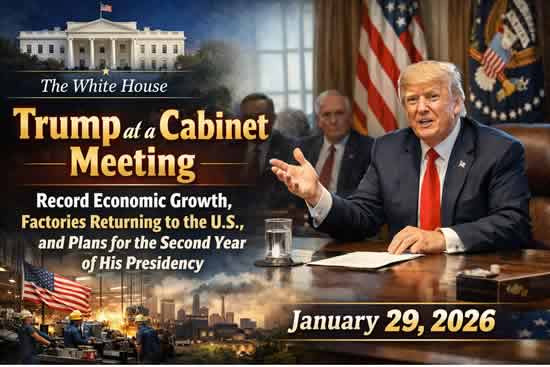
In this video, President Trump leads a Cabinet Meeting, highlighting his administration’s achievements and plans for the second year in office.
Key topics covered include:
Economic Growth : Trump emphasizes unprecedented economic growth, record-setting numbers, and a 5.4% GDP growth in the fourth quarter despite a “Democrat shutdown,” which he claims hindered a potential 7% growth. The S&P 500 hitting 7,000 for the first time and the Dow hitting record highs 52 times are cited as evidence of a booming stock market, adding $9 trillion to savings and retirement accounts.
Investments and Job Creation : The President states that $18 trillion in investments have flowed into the country in less than a year, leading to thousands of new businesses, plants, and equipment being built. He contrasts this with the Biden administration’s reported less than $1 trillion in investments over four years.
Inflation and Affordability : Trump discusses efforts to combat inflation, claiming that growth in real incomes is outpacing inflation by over $3,000 under his administration, contrasting it with a $34,000 cost to typical families under “Biden inflation.” He highlights falling gasoline prices (below $2 in many areas), decreasing grocery prices, airfares, hotels, car payments, and rent. He also claims his administration inherited the highest inflation in 48 years.
Tax Cuts : Millions of Americans are expected to receive record-setting tax refunds, with an average refund over $1,000 higher than ever before, thanks to the administration’s tax cuts. He contrasts this with the Democrats’ proposal for the “largest tax hike ever.” He also mentions no tax on overtime, tips, or social security, and a new interest deduction for car loans.
US Manufacturing and Tariffs : Trump attributes the return of car companies and manufacturing plants to the US from Mexico, Canada, Japan, and Germany to tariffs, which companies want to avoid paying. He highlights that for the first time in 26 years, the US produced more steel than Japan, directly linking this achievement to tariffs.
Drug Prices : The administration aims to bring down prescription drug prices by 80-90% through a “most favored nation” policy, where the US will pay the lowest price for drugs globally. This policy was achieved by threatening tariffs on other imported goods.
Foreign Policy and Hostage Release : The President discusses progress in the Middle East, including securing the release of the last hostage. He credits Hamas for assisting in the return of both living and deceased hostages. He also touches on efforts to demilitarize terrorists and establish an “all-Arab government.”
Russia-Ukraine Conflict : Steve Witkoff details progress made in peace talks between Russia and Ukraine since Geneva, including a largely finished security protocol and prosperity agreement. Trump personally requested President Putin to halt firing on Ukrainian cities for a week due to extreme cold, which Putin agreed to.
Trump Accounts and Future Economic Outlook : Scott Bessent highlights the success of “Trump Accounts,” with a million sign-ups in a week, and predicts 25 million eligible families. He anticipates a “Trump boom” in 2026, driven by supply-side policies, wage gains, and low prices. He also reiterates the positive impact of tariffs on US manufacturing and investments.
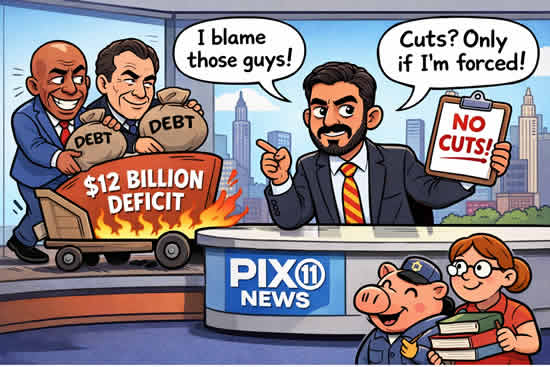
Appearing live in studio on PIX11 News on January 29, 2026, Mayor Mamdani addressed New York City’s reported $12 billion budget deficit, arguing it will take an “all-of-the-above” plan: pressuring Albany for a better revenue-share deal, seeking higher taxes on millionaires and highly profitable corporations, and launching a citywide hunt for operational efficiencies. In a made-for-TV moment, he signed an executive order on-air requiring every agency to appoint a Chief Savings Officer within five days and deliver a savings/efficiency review within 45 days, while insisting service cuts are a last resort unless state support and tax policy don’t change. He also condemned the car-ramming attack at 770, calling antisemitism a present-day threat, and said final interviews are underway for his Mayor’s Office antisemitism post.
New York. Mayor Mamdani Appears Live on PIX 11
Dan Mannarino: Mayor Zohran Mamdani has painted a grim picture for New York City’s budget, which now has a $12 billion budget deficit to fill. Mayor Mamdani pointed the finger at previous administrations, while saying that he will deliver an on-time, balanced budget on February 17th. So, the question is how? The mayor is joining me now live to talk about this and make an announcement. Mr. Mayor, great to see you.
Mayor Zohran Mamdani: Great to see you as well. Thank you for having me.
Mannarino: Of course, and great to have you here in studio. I think it’s your first as mayor so it’s great to have you here. Before we get to the announcement and the budget, I do want to talk about what we saw play out in Brooklyn last night at the synagogue there. Any indication as the investigation plays out that that individual is looking to commit a hate crime?
Mayor Mamdani: So, it’s currently being investigated. I have to say, I was there on the scene last night at 770 Chabad World Headquarters and it was a horrifying incident where a man repeatedly and intentionally crashed his car into the building and I am so thankful that no one was hurt and we know that this is a building that has immense meaning to so many Jewish New Yorkers and those across the world.
And yesterday’s attack also took place on the yahrzeit of Rabbi Schneerson and the leadership of Rabbi Menachem Mendel Schneerson, and this is just a day after the day when we remember the victims of the Holocaust, and we know that antisemitism is not simply something of the past to be learned about. It is a living, breathing thing that we have to combat every day.
Mannarino: Today, the City Council is expected to announce a task force to fight antisemitism and the question for you is: Have you found somebody to lead your own Office to Combat Antisemitism within the Mayor’s Office? When can we expect to see that up and running?
Mayor Mamdani: So, we are actually in our final interviews for that position. And that is going to be a key position that delivers on our commitment to root out antisemitism across the five boroughs, and make this a city where Jewish New Yorkers are not just safe, but frankly celebrated and cherished.
Mannarino: Sometime next week?
Mayor Mamdani: We’re working on the timeline but it is in the final stages.
Mannarino: Okay Mr. Mayor, and you are here today to talk about the big announcement, which is a $12 billion deficit. You said the city has not seen something like this since the Great Depression. You said you were given a poison chalice by previous administrations. So on behalf of so many New Yorkers who heard that noise and that news, what is the answer to bring So on behalf of so many New Yorkers who heard that noise and that news, what is the answer to budget down on time and on budget?
Mayor Mamdani: So, I think first, as you said, this is [a] $12 billion fiscal deficit. The last time New York saw a fiscal crisis anywhere close to this was the Great Recession. And yet, this actually eclipses that. This is a greater deficit than we saw at the time. It’s going to require an all-of-the-above approach. So, we said, this will require the city’s relationship with the state [to] change. What I mean by that is, today the city contributes 54.5 percent of the state’s revenue [and] receives 40.5 percent in return. The second is going to require a relationship change between the city and its wealthiest residents and most profitable corporations.
I’ve spoken a lot with you across New York City about how I think we should raise income taxes on those who make a million dollars or more by two percent, [and] how we should raise corporate taxes on the most profitable corporations. The third thing it’s also going to require is the city pursuing savings and efficiencies within its own operating budget. And so. that is something that I’m actually here to speak to you today about also, is the creation of savings officers within every single agency that will be tasked with assessing the efficacy of programs we have, the efficiencies that we currently have or are being denied, and what steps we need to take to make the kinds of changes to bring us back to a firm financial.
Mannarino: And you want that done yesterday. So, you have an executive order that you’re calling all city agencies to do right now in implementing and appointing these chief savings officers.
Mayor Mamdani: Yes, and that’s actually the executive order that I have with me right here. This is a directive that, within five days, every single agency head has to identify a chief savings officer. And then within 45 days, those officers have to come back to us with a full assessment of the savings that could be pursued, the efficiencies that we’re currently seeing, and the programs that frankly need to be sunsetted or are not effective.
Mannarino: Okay, so go ahead, put your John Hancock on that. And that will become officially an executive order as of this moment, right?
Mayor Mamdani: Yes, this is now an executive order, the first to be signed on PIX11.
Mannarino: There we go. So let me ask you what exactly that means. The previous administration, Eric Adams, cut from city agencies. For example, libraries were cut, right? Are you expecting agencies to look at some of these things and implement cuts? And how soon?
Mayor Mamdani: I think what we’re first talking about are efficiencies and savings. We’re talking about the things that we could be doing better.
Mannarino: Is that cuts?
Mayor Mamdani: No, I would say, cuts are a matter of last resort, right? We do not want to be cutting the services that New Yorkers are relying on. If the state does not change its relationship to the city, if it does not raise taxes on the wealthiest New Yorkers and the most profitable corporations, then all that leaves the city with, are the most painful tools. However, we want to do everything we can to ensure that those are not the tools we have to use.
Mannarino: But cuts could be on the table, as a last resort.
Mayor Mamdani: That is what we are left with if we are not able to change these relationships. That’s why we’re pursuing the relationship.
Mannarino: You talked a lot about Eric Adams and former Governor Andrew Cuomo, but the City Council was also involved in the budget-making process. Governor Kathy Hochul had four years to kind of implement some changes to Governor Cuomo’s budgets. Do you look at that as part of the reason we’re in this crisis, that there was failure on all levels?
Mayor Mamdani: I see the architects of this crisis being the prior mayor and the prior governor. I think that there have been steps taken in the past few years, especially under Governor Hochul’s leadership, to change some of that cost-sharing between the city and the state. It’s not been an exercise in cruelty towards the city coffers that we saw for about a decade. However, there’s more that needs to be done.
And what we have now, for the first time in a long time, is a directive from our own City Hall, from myself, to go to Albany and be honest and direct about what we need from Albany. That’s what we’re going to do.
Mannarino: What about President Trump? Does he play a role? Does he play a part in this crisis?
Mayor Mamdani: Well, I think President Trump has said himself in the Oval Office right after we had a meeting that the better New York City does, the happier he is. And what we’ve seen is that right now, New York City is in need of a change in its fiscal relationship with a number of the things I’ve listed, but also needs to be protected from some of the federal policies that are being put forward. And I’ve been honest about the fact that some of these proposals would devastate our city, and we’re going to fight them with everything that we have.
Mannarino: In the last couple days or weeks, have you had a conversation with President Trump about what he’s willing to send to New York or withhold from New York? As you go into the budget talks and negotiations now, knowing what you’re going to get from the federal government is huge. So, have you spoken to the president?
Mayor Mamdani: So, I keep those conversations between the president and myself private. What I will tell you, however—
Mannarino: When’s the last time you spoke to him?
Mayor Mamdani: Look, those are conversations that will always come back to New York City. And I think that that’s something that New Yorkers are expecting from me. And what they also know is that in a city of eight and a half million people, the wealthiest city in the wealthiest country in the world, we have one in four living in poverty. We have to find fiscal policy that lifts us all up.
Mannarino: What is your contingency? As you made that announcement, an hour later, Governor Hochul came out, and she said, “Newsflash, we’re not raising taxes in New York.” So, you had these conversations with the governor a number of times. You’re very complimentary to her, but she is adamant that they’re not raising taxes. So, if you don’t get that money, what is the contingency?
Mayor Mamdani: I think the first key thing is to make clear to New Yorkers why we need that money, how we got to this place. And some of [these] are the structural imbalances we’ve seen in our city’s fiscal health over many years. It would be all too easy to try and fix this budget. Only to get here next year. That’s why we’re looking for solutions that will last in the longer term, recurring ones, annualized ones. And so, we’re talking about these increased taxes on the wealthy.
Mannarino: She said no.
Mayor Mamdani: Look, I think politics is also an exercise in making the case and making clear what the stakes are. The tools that the city has, these are the most painful tools. We are talking about cuts. We are talking about property taxes, the things that I do not want to pursue. And yet, the scale of this fiscal crisis of $12 billion, this is not an ordinary crisis. This is not a mayor coming forward and saying, “It’s going to be a tough budget. “This is the likes of which we haven’t seen since the Great Recession. That requires an all of the above approach. That’s what we’re going to make clear.
Mannarino: So realistic[ally] [speaking], and you mentioned yesterday a number of times that you want to be really honest with New Yorkers and letting them know how we got to this point and what you’re planning to do about it. But there’s also a lot that you campaigned on, freezing the rent, fast and free buses. Could some of that take longer to implement, realistically talking, because of what we’re seeing?
Mayor Mamdani: I think this is a fiscal crisis that has to be [at the] front of mind for all of us. Now, I’m proud of the fact that we’ve already been able to advance our affordability agenda in the one month I’ve been in office. Day eight, we secured more than a billion dollars for universal child care. Freezing the rent is not something that requires a fiscal infusion. It’s a decision from the Rent Guidelines Board.
Making buses fast and free, the fast thing we’re already getting started on. And what I’ve said is that by the time I’m finished being mayor, they’re going to be free. What we have to deliver, however, in this very year, required by law, but also required just by being a good mayor, a balanced budget for this fiscal year [and for] the next fiscal year.
Mannarino: I’m up against the clock here, but yesterday you mentioned an AI chatbot that cost $500,000. It’s one of the things you thought was a waste of money. Can you name something else?
Mayor Mamdani: That’s exactly what this directive is about. What we want is to actually come to a number after looking at the budget. Because what we’re seeing, we’re talking about a budget of more than $115 billion. If I’m going to accuse the prior mayor of gross fiscal mismanagement in the budgeting process, we know that that likely extends to the expense side as well. And so we’re going to look through every agency to find every example, because when we are going to ask New Yorkers to commit themselves to a new era of politics we have to commit ourselves too. That’s what this is about.
Mannarino: If the governor comes up and says, “You know what, Mr. Mayor, I don’t want to raise the taxes, but I do want to find money. We made all this money from Wall Street, which she said, and we found some money for you to give to you.” Would that satisfy you?
Mayor Mamdani: I think that given the scale of this crisis, that’s not going to be a way to cover the entirety of it. Look, I’ll be direct with you. We’re encouraged by the results from Wall Street, by the news of bonuses. That would be something, if the deficit was smaller, I could say maybe this could cover it. But [for] $12 billion, there’s no news of bonuses or better forecasts that are going to get there. It’s going to require everything.
Mannarino: Mr. Mayor, I appreciate you coming here, talking straight with New Yorkers, signing the executive order. I think it’s the first that we’ve had here at PIX11 where legislation is signed right here on our air. Good to see you.
Mayor Mamdani: Good to see you as well.
Mannarino: Want to go do the weather?
Mayor Mamdani: Stay warm, stay inside, stay safe.
Mannarino: There you go. Mr. Mayor, thank you very much.