
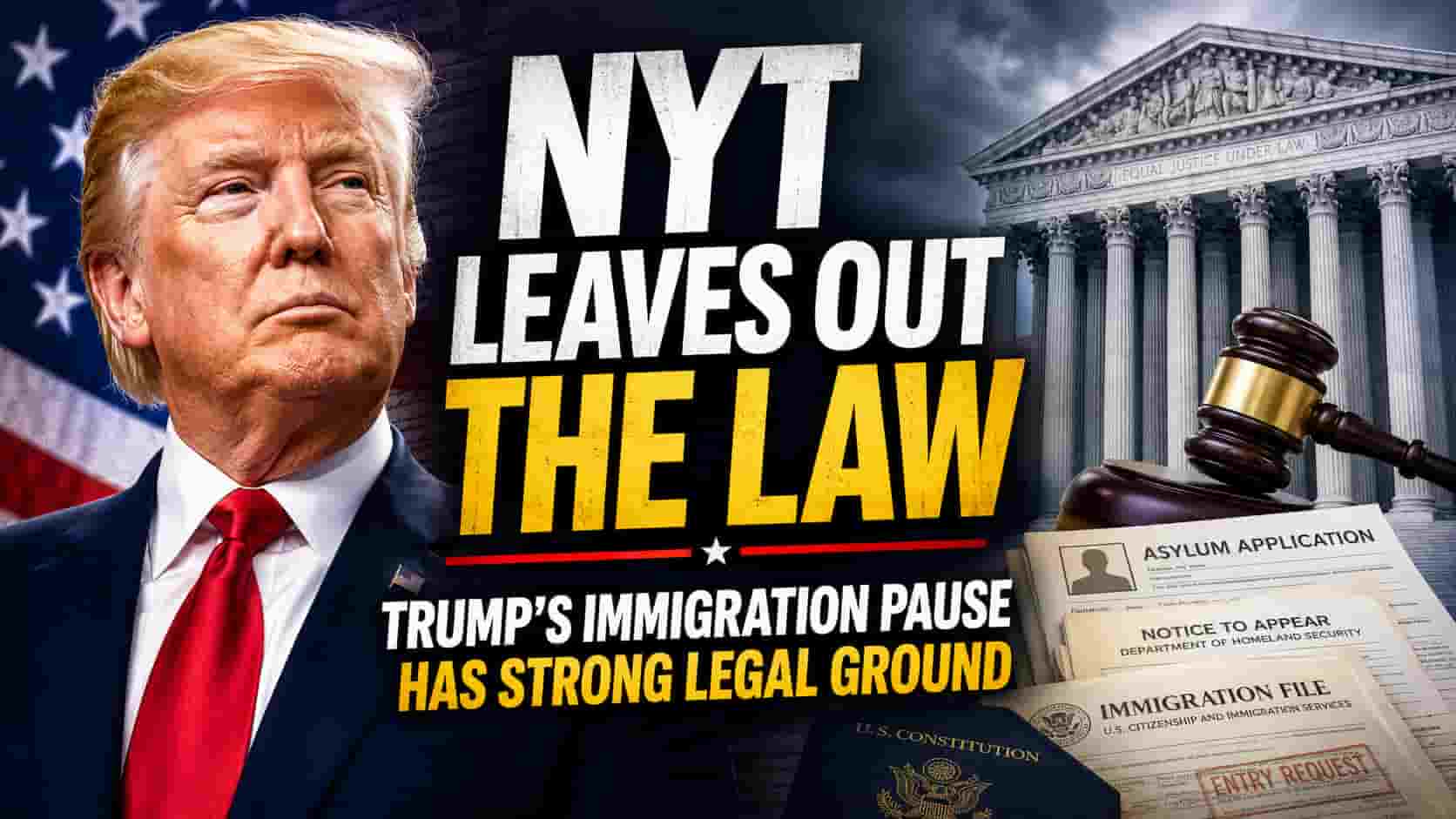
The New York Times reported the judge’s order against Trump immigration officials, but left readers without key legal context: federal law gives the President broad authority over entry restrictions, asylum is discretionary, and the Supreme Court has already upheld broad presidential power in Trump v. Hawaii.
By Midtown Tribune Staff
The New York Times once again presented its readers with an incomplete picture of a legal fight involving President Donald J. Trump, federal judges, and immigration policy.
In its June 5 report, “Judge Says Trump Officials Must Restart Asylum and Immigration Processing,” the Times focused on a federal judge’s ruling against Trump administration immigration policies. The article described the judge’s order, the affected applicants, and the criticism from immigration advocates.
But what the Times did not clearly explain is the legal foundation behind the administration’s position.
The real question is not whether immigration activists disagree with President Trump. The real question is whether the Executive Branch has legal authority to pause or restrict immigration processing when national-security vetting is incomplete.
Under federal law, the Trump administration has a strong argument that the answer is yes.
Congress gave the President broad power to suspend or restrict the entry of aliens when he finds their entry would be detrimental to the interests of the United States. The asylum statute also does not create an automatic right to approval. It gives the government discretion. And the Supreme Court has already upheld broad presidential authority in this area in Trump v. Hawaii.
That is the part of the story the Times largely leaves out.
This case should not be framed as a simple fight between “immigrants” and “Trump officials.” It is a fight over whether federal judges can force immigration agencies to continue processing benefits before the government completes security screening of applicants from countries with documented vetting, identity, terrorism, document-reliability, or information-sharing concerns.
The Trump administration’s argument is straightforward: America has the right to know who is receiving immigration benefits before the government grants asylum, work authorization, green cards, or citizenship.
That is not extremism. That is the basic duty of any sovereign government.
1. Federal Law Gives the President Power to Suspend Entry of Aliens
The strongest legal basis for the Trump administration is 8 U.S.C. § 1182(f), part of the Immigration and Nationality Act.
That law says that whenever the President finds that the entry of any aliens, or any class of aliens, would be detrimental to the interests of the United States, he may suspend their entry or impose restrictions for as long as he deems necessary.
Official law:
https://uscode.house.gov/view.xhtml?req=granuleid:USC-prelim-title8-section1182
This is broad language. Congress gave the President authority to decide:
- whose entry may be restricted;
- when restrictions are necessary;
- how long restrictions should last;
- what restrictions are appropriate.
That is exactly what the Trump administration argues it is doing: restricting or pausing immigration decisions tied to countries where vetting, identity verification, document reliability, terrorism concerns, visa overstays, or repatriation cooperation create national-security risks.
2. The Supreme Court Already Upheld Broad Presidential Power in Trump v. Hawaii
The Supreme Court confirmed this authority in Trump v. Hawaii, the 2018 case involving travel restrictions from countries with vetting and national-security concerns.
In that case, the Supreme Court held that the President lawfully exercised broad discretion under 8 U.S.C. § 1182(f) to suspend entry of aliens into the United States.
Official Supreme Court opinion:
https://www.supremecourt.gov/opinions/17pdf/17-965_h315.pdf
This matters because the current dispute involves a similar principle: the President and executive agencies must be allowed to act when foreign governments cannot provide reliable information or when national-security screening is insufficient.
Courts may review whether the government has a lawful basis. But courts are not supposed to replace the President’s national-security judgment with their own policy preference.
3. Asylum Is Discretionary — It Is Not an Automatic Right to Approval
The asylum statute, 8 U.S.C. § 1158, allows an alien to apply for asylum. But it does not say the government must grant asylum automatically.
The law says the Secretary of Homeland Security or the Attorney General may grant asylum if the applicant meets the legal requirements.
Official law:
https://uscode.house.gov/view.xhtml?req=granuleid:USC-prelim-title8-section1158
The word “may” is important. It means asylum is discretionary. An applicant may file a claim, but the government still must determine eligibility, credibility, security risk, criminal bars, terrorism-related concerns, and whether the applicant qualifies under the law.
That is why the Trump administration has a serious legal argument: pausing final decisions for enhanced review does not abolish asylum. It protects the integrity of the asylum system.
4. The Government Has a Legal Duty to Screen and Vet Applicants
The Trump administration’s policies are based on a basic principle: before giving immigration benefits, the government must know who the applicant is.
USCIS and DHS are responsible for screening immigration applicants for fraud, criminal history, terrorism concerns, national-security threats, and public-safety risks.
Official USCIS policy memoranda page:
https://www.uscis.gov/laws-and-policy/policy-memoranda
Official USCIS asylum information:
https://www.uscis.gov/humanitarian/refugees-and-asylum/asylum
The administration’s argument is simple: if the United States cannot verify identity, records, criminal background, or national-security risk, the government should not be forced by a court to continue granting benefits as usual.
That is not discrimination. That is security vetting.
5. The White House Proclamation Specifically Identified Vetting Problems
The Trump administration did not simply say “we dislike these countries.” The White House proclamation pointed to specific security concerns: poor information-sharing, weak identity-management systems, unreliable civil documents, high visa-overstay rates, terrorist activity, and refusal by some countries to accept back removable nationals.
Official White House proclamation, June 4, 2025:
https://www.whitehouse.gov/presidential-actions/2025/06/restricting-the-entry-of-foreign-nationals-to-protect-the-united-states-from-foreign-terrorists-and-other-national-security-and-public-safety-threats/
The proclamation states that screening and vetting are critical to preventing foreign nationals who may commit, aid, or support terrorism or other threats from entering the United States.
A later White House action again emphasized that some countries had deficient screening, vetting, document reliability, and information-sharing systems.
Official White House proclamation, December 16, 2025:
https://www.whitehouse.gov/presidential-actions/2025/12/restricting-and-limiting-the-entry-of-foreign-nationals-to-protect-the-security-of-the-united-states/
This is the core legal defense: the restrictions are not based on race or religion. They are based on whether the U.S. government can safely verify applicants from certain countries.
6. Country-Based Restrictions Are Not Automatically Illegal
Critics claim the policy is discriminatory because it affects nationals of specific countries. But U.S. immigration law has always treated nationality, foreign-government cooperation, document reliability, and country conditions as relevant factors.
The Supreme Court in Trump v. Hawaii rejected the argument that country-based entry restrictions automatically violate immigration law. The Court recognized that the President may act when the policy is connected to legitimate national-security and vetting concerns.
That is the key distinction.
Illegal discrimination would mean punishing people because of race, religion, or ethnicity.
Lawful national-security screening means treating applicants differently when their home governments cannot provide reliable identity records, criminal records, travel documents, or counterterrorism cooperation.
7. A Temporary Hold Is Not the Same as a Permanent Ban
The judge framed the administration’s policy as if it shut down legal immigration. But the better legal view is that the administration imposed a security hold while reviewing high-risk cases.
A pause is not a denial.
A hold is not a ban.
A review is not discrimination.
If USCIS believes it needs additional vetting before approving asylum, work authorization, permanent residence, or citizenship, that is a legitimate agency function.
The federal government should not be forced to issue final approvals before it can complete security checks.
8. The Administrative Procedure Act Should Not Be Used to Micromanage National Security
The judge reportedly found the policy arbitrary and capricious under administrative law. But national-security immigration decisions deserve substantial deference.
The President, DHS, USCIS, the State Department, the Attorney General, and intelligence agencies have access to information that courts do not manage on a daily basis.
A federal judge is not in a better position than national-security agencies to determine whether Afghanistan, Iran, Somalia, Yemen, Haiti, Venezuela, Libya, Sudan, or other countries provide reliable vetting information.
The legal question should not be whether the judge agrees with the policy. The question should be whether the Executive Branch had statutory authority and a rational national-security basis.
Under 8 U.S.C. § 1182(f), Trump v. Hawaii, and the asylum statute’s discretionary language, the administration has a strong legal foundation.
9. The Constitution Gives the Political Branches Primary Control Over Immigration
Immigration is not an ordinary domestic policy issue. It is connected to sovereignty, foreign affairs, border control, national security, and public safety.
Congress wrote broad immigration statutes. The President enforces them. DHS and USCIS administer them.
Courts have a role, but courts should not turn themselves into immigration super-agencies.
If the Executive Branch identifies serious vetting problems in specific countries, the lawful and responsible course is to pause, review, restrict, or condition immigration processing until the danger is addressed.
That is not lawlessness. That is the government doing its job.
Conclusion: National Security Comes Before Immigration Benefits
The Trump administration’s position is legally clear: immigration benefits should not be processed blindly when national-security screening is incomplete.
Federal law gives the President broad authority to restrict entry when he finds that certain classes of aliens may be detrimental to U.S. interests. The Supreme Court has upheld that authority. The asylum statute gives the government discretion, not a rubber-stamp obligation. USCIS has a duty to protect the integrity of the immigration system.
The judge’s ruling treats immigration processing as if it is more important than national security.
The Trump administration’s argument is the opposite: America has the right to know who is being admitted, who is receiving benefits, and whether the government has enough reliable information to make that decision safely.
That is not only common sense. It is supported by federal law.
Ask Midtown Tribune about this story
Answers are grounded first in this article. Search all Midtown Tribune reporting from the main AI Search page.
AI-generated summary. Verify important details in the linked original articles.