
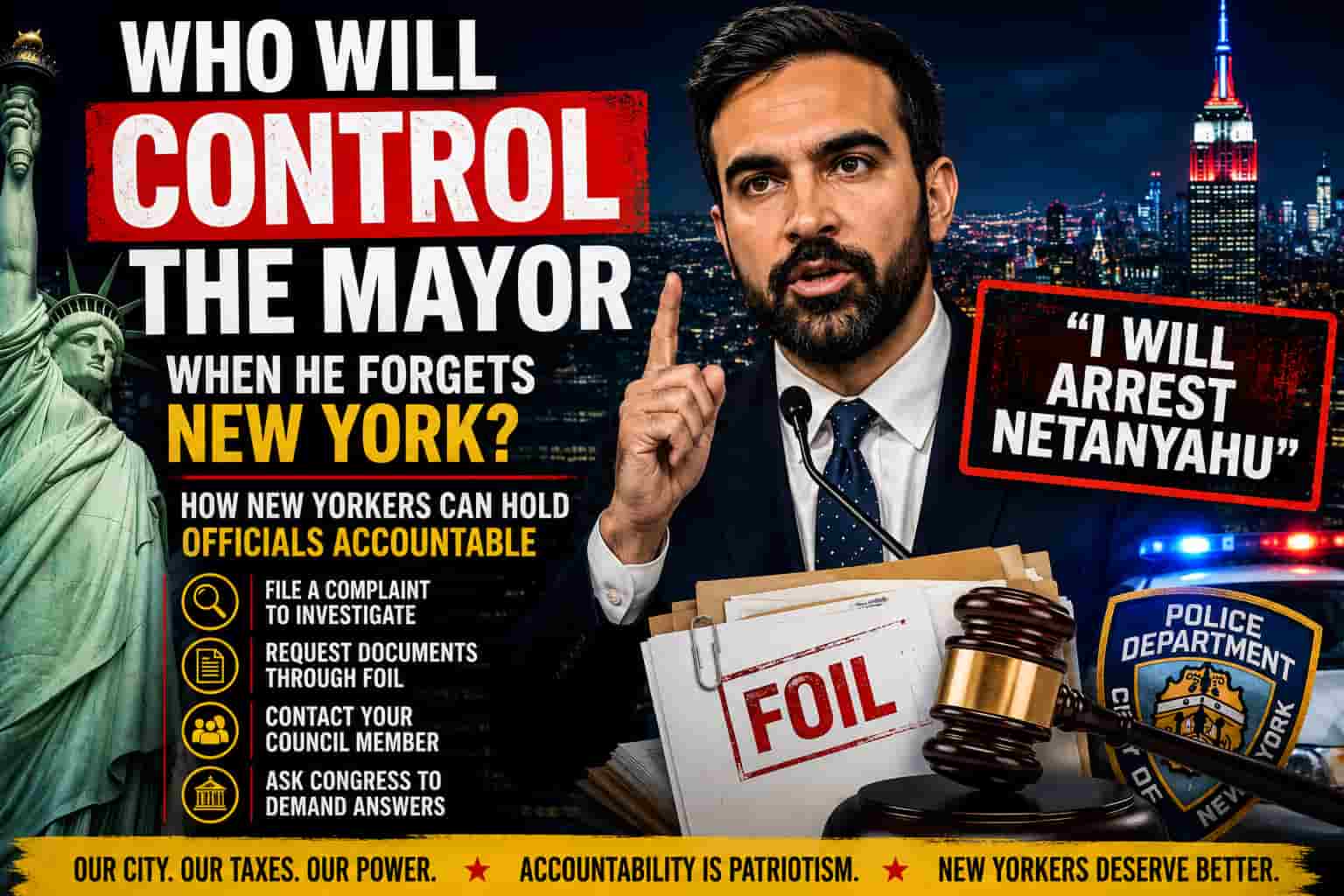
How New Yorkers can lawfully demand answers when a city official appears more focused on enforcing an international court’s agenda than serving the people who pay the city’s bills
Midtown Tribute — Civic Accountability
New Yorkers have no shortage of urgent problems.
They are paying some of the highest rents and taxes in the country. Small businesses are struggling with operating costs. Residents worry about public safety, sanitation, transportation, housing, schools, infrastructure and the basic quality of city services.
Those are the issues a mayor is elected to handle.
Yet Mayor Zohran Mamdani has publicly pledged to seek the arrest of Israeli Prime Minister Benjamin Netanyahu if Netanyahu comes to New York, citing the arrest warrant issued by the International Criminal Court. Mamdani has also said that city lawyers are examining what legal options may exist. Reuters reported that the administration is exploring possible legal avenues, while Mamdani continues to argue that Netanyahu should face proceedings in The Hague.
The political arguments surrounding Israel, Gaza and the ICC are intense. Americans are entitled to disagree about all of them.
But there is a separate question that every New Yorker should be able to ask, regardless of political affiliation:
May a city official use municipal employees, police resources, legal staff and taxpayer money to advance a personal foreign-policy objective?
That question is not about whether someone supports or opposes Netanyahu.
It is about the limits of municipal power.
A mayor is not merely a television commentator
Private citizens enjoy broad freedom to express political views.
A mayor does too. But a mayor is also a public official with authority over a vast city administration and substantial influence over the leadership and operations of the New York City Police Department.
That distinction matters.
When an ordinary person says that someone should be arrested, it is political speech. When a mayor says he will pursue an arrest, the statement may reasonably raise questions about whether city agencies, city lawyers or police personnel have been asked to help carry it out.
The statement alone does not prove that a crime has been committed.
It does, however, justify asking whether official action followed.
New Yorkers are entitled to know:
- whether instructions were given to the NYPD;
- whether city lawyers prepared legal memoranda;
- whether operational planning occurred;
- whether municipal employees spent working hours on the matter;
- whether taxpayer funds were used;
- whether the administration communicated with the ICC, federal agencies or foreign representatives;
- and whether lawyers warned the mayor that the city lacked lawful authority to act.
The public does not have to accept “trust us” as a substitute for oversight.
Demand an investigation, not a predetermined conviction
The weakest possible complaint says:
“The mayor is a criminal. Arrest him immediately.”
That is political rhetoric, not a useful evidentiary submission.
A stronger request says:
“Please conduct an independent review to determine whether the Mayor’s Office, the NYPD, the New York City Law Department or any other city agency used public employees, official authority or taxpayer-funded resources to prepare for the detention of a foreign head of government without a valid American warrant or clearly established legal authority.”
That wording does three important things.
First, it identifies a specific issue.
Second, it asks investigators to determine the facts rather than accept a conclusion.
Third, it focuses on public resources and official conduct—the matters oversight agencies are equipped to examine.
Anyone submitting a complaint should preserve:
- the complete video, not only an edited clip;
- the exact quotation;
- the date and setting of the statement;
- the time stamp in the recording;
- subsequent statements from City Hall;
- reports concerning consultations with city attorneys;
- and any evidence suggesting that NYPD or other agencies were involved.
A careful complaint distinguishes between what is known and what needs to be investigated.
File a complaint with the New York City Department of Investigation
The most direct city-level channel is the New York City Department of Investigation, commonly known as DOI.
DOI is the city government’s independent inspector general. Its jurisdiction may include any city agency, elected official, officer or employee. The agency accepts reports concerning fraud, waste, corruption, misconduct, gross mismanagement and abuse of authority.
Residents may ask DOI to determine:
- Whether the mayor directed any employee to prepare for Netanyahu’s detention.
- Whether NYPD officials received instructions, requests or informal guidance.
- Whether the Law Department prepared legal analysis or operational advice.
- Whether city time, personnel or funds were used.
- Whether the administration was advised that the city lacked jurisdiction.
- Whether planning continued after any such warning.
Reports may be submitted through DOI’s official complaint system, by telephone at 212-825-5959, or by mail to:
New York City Department of Investigation
180 Maiden Lane, 16th Floor
New York, NY 10038
The purpose of the complaint should not be to force DOI to adopt a political position on Israel.
It should be to establish whether New York City’s machinery of government was used for a purpose authorized by law.
Contact the New York State Attorney General
Residents may also submit information to the Office of the New York State Attorney General through its official public-corruption and wrongdoing complaint process.
The Attorney General’s Criminal Justice Division includes a Public Integrity Bureau, and its investigators assist with civil and criminal investigations involving potential abuses of public office.
A useful complaint might ask:
Did any city official use public authority, municipal staff or taxpayer resources to pursue an arrest unsupported by New York or federal law, and could such conduct constitute official misconduct, abuse of authority or another violation?
Citizens should not attempt to dictate the precise criminal charge.
That determination belongs to prosecutors after they review the evidence.
The citizen’s role is to provide facts, documents and a clear explanation of why official review is warranted.
Report concrete evidence to the FBI
If evidence emerges of specific operational orders, concealment of records, preparation for an unlawful detention or misuse of office implicating federal law, residents may submit a tip to the FBI.
But this channel should be used responsibly.
A controversial political statement is not automatically terrorism, kidnapping or federal corruption.
A serious FBI submission should contain:
- the exact statement;
- the complete source recording;
- known official correspondence or directives;
- evidence of instructions to law enforcement;
- names of offices or personnel involved;
- and an explanation of what federal issue may require examination.
The request should be framed this way:
Please determine whether any official action was taken that could have resulted in the unlawful detention of a protected foreign official or an improper use of municipal authority in an area governed by federal law.
Inflammatory labels weaken a complaint. Specific facts strengthen it.
Demand oversight hearings at the New York City Council
New Yorkers should ask their City Council members to hold public oversight hearings.
Representatives from the following offices could be called to testify:
- the Mayor’s Office;
- the NYPD;
- the New York City Law Department;
- the Department of Investigation;
- and the Mayor’s Office for International Affairs.
The questions should be simple and direct:
- What American law would authorize the proposed arrest?
- Is there a valid United States warrant?
- Were any NYPD personnel instructed to prepare?
- Were city lawyers assigned to the matter?
- How many employee hours were spent?
- Were taxpayer funds used?
- Was the federal government consulted?
- Did City Hall communicate with the ICC?
- What procedures prevent the NYPD from carrying out an unlawful political directive?
Political controversies often disappear after a few news cycles.
A hearing creates sworn testimony, official records and a public transcript.
That is why hearings matter.
Use FOIL to follow the paper trail
One of the most powerful accountability tools available to New Yorkers is the state Freedom of Information Law, commonly called FOIL.
The NYC OpenRecords portal allows members of the public to request records from every New York City agency.
Residents and journalists may request:
- emails from the Mayor’s Office;
- correspondence with the Law Department;
- internal legal memoranda;
- meeting calendars;
- NYPD communications;
- briefing documents;
- communications with the Department of Justice or Department of State;
- and records containing terms such as “Netanyahu,” “ICC,” “International Criminal Court,” “arrest” or “detention.”
A sample request could read:
Pursuant to the New York Freedom of Information Law, I request all emails, memoranda, legal opinions, calendar entries, meeting notes, presentations, directives and other records created or received by the Mayor’s Office, the New York City Law Department or the NYPD concerning the potential arrest or detention of Benjamin Netanyahu.
The request should specify a reasonable date range and clearly identify the agencies and records sought.
FOIL does not require an agency to create a new explanation. It requires the agency to search for existing records, subject to lawful exemptions.
Documents reveal where political rhetoric ends and official government action begins.
Ask members of Congress to obtain federal answers
New Yorkers may also contact their representatives in the House and Senate.
The request should be more specific than “condemn the mayor.”
Residents can ask federal lawmakers to send formal inquiries to:
- the Department of Justice;
- the Department of State;
- the FBI;
- and federal agencies responsible for diplomatic and protective matters.
A strong request would say:
Please obtain a written determination regarding whether the mayor of New York City or the NYPD has authority to detain a sitting foreign prime minister based solely on a warrant issued by the International Criminal Court.
A written federal response could provide legal clarity and create another public record.
That is more valuable than another round of cable-news outrage.
Accountability does not always mean prosecution
Not every misuse of judgment becomes a criminal case.
American democracy includes several forms of accountability:
- inspector-general investigations;
- prosecutorial review;
- public hearings;
- budget oversight;
- records requests;
- investigative journalism;
- peaceful public demonstrations;
- electoral opposition;
- demands for resignation;
- and voting.
A public official may avoid criminal liability and still lose the public’s trust.
New Yorkers are fully entitled to say:
We elected a mayor to manage New York City—not to act as an enforcement arm for an international prosecutor.
That is a political judgment voters have every right to make.
What residents must not do
Lawful civic pressure is not harassment.
Residents must not engage in:
- threats against the mayor, his family or city employees;
- calls for violence;
- publication of private home addresses;
- knowingly false crime reports;
- interference with government telephone systems;
- stalking or intimidation;
- or presenting allegations as proven facts.
Such behavior is wrong, potentially unlawful and strategically foolish.
It allows legitimate questions about public power to be dismissed as extremism.
The most effective citizen is not the person shouting the loudest.
It is the person who preserves evidence, files precise requests and demands written answers.
The central issue
The Netanyahu controversy is larger than any one foreign leader.
It raises a basic question of democratic government:
Can a municipal official use the authority, employees and money of New York City to pursue a personal international agenda?
If the answer is no, the public has a right to know whether city resources were used, who authorized their use and what legal advice was given.
Residents cannot convict a mayor themselves.
But they can do something City Hall often fears more than social-media outrage:
They can create an official paper trail.
A DOI complaint.
An Attorney General submission.
A carefully documented FBI tip.
A FOIL request.
A letter to a council member.
A demand for hearings.
A congressional inquiry.
And publication of every response.
That is how New Yorkers remind public officials whom the government is supposed to serve.
Official Sources and Action Links
The following links lead to official government websites where New Yorkers can submit complaints, request public records, contact elected representatives, or review the relevant oversight procedures.
-
NYC Department of Investigation — File a Complaint
Submit an online complaint to the New York City Department of Investigation
DOI accepts reports involving suspected fraud, waste, corruption, misconduct, gross mismanagement, or abuse of authority in city government. -
NYC Department of Investigation — Reporting Information
Review DOI reporting options and contact information
Telephone: 212-825-5959
Mailing address: NYC Department of Investigation, 180 Maiden Lane, 16th Floor, New York, NY 10038. -
Office of the Inspector General for the NYPD
Learn how to submit a complaint involving NYPD policies, operations, or practices
Complaints may be submitted anonymously, although contact information can help investigators request additional details. -
New York State Attorney General — Public Corruption or Wrongdoing
File a public-corruption or wrongdoing complaint
This is the official state channel for reporting suspected misuse of public office or other governmental wrongdoing. -
FBI — Submit a Tip
Submit information through the FBI’s official tip portal
Telephone: 1-800-CALL-FBI -
FBI — Public Corruption Program
Review the FBI’s official information about public-corruption investigations -
NYC OpenRecords — File a FOIL Request
Request records from New York City agencies
The portal accepts Freedom of Information Law requests involving the Mayor’s Office, NYPD, NYC Law Department, and other city agencies. -
NYC OpenRecords — Search Existing Requests
Search previously submitted FOIL requests and released documents -
New York City Council — Find Your Council Member
Find your district and contact your City Council representative
Residents may request oversight hearings, written inquiries, and public testimony from city agencies. -
U.S. House of Representatives — Find Your Representative
Locate your member of Congress by ZIP code -
United States Senate — New York Senators
View official contact information for New York’s U.S. senators -
Video Referenced in the Article
Watch the full video statement
Readers should review the complete recording and preserve the exact quotation, date, context, and time stamp when submitting a complaint.
Ask Midtown Tribune about this story
Answers are grounded first in this article. Search all Midtown Tribune reporting from the main AI Search page.
AI-generated summary. Verify important details in the linked original articles.